
Hydroponics has its own dictionary, and most guides assume you already own it. This glossary closes that gap. Every term you will meet in any Aqualogi hydroponic guide, defined plainly, with a link to the page that goes deeper.
Use it as a reference. Find the term, read the one or two sentences that explain it, and follow the cross-link to the Aqualogi page that owns the how-to, the comparison, or the buying decision behind it. If you are new to hydroponics altogether, start with the complete hydroponics guide, then come back here when a word stalls you.
Why Hydroponics Has Its Own Vocabulary (And Why It Matters)
Hydroponic growing replaces soil with a nutrient solution. Once you do that, every part of the system needs a name: how the water reaches the roots, what the chemistry looks like, what moves the water, and what goes right or wrong. That vocabulary exists because the science does. It is not jargon for the sake of jargon.
The most common reason beginners stall is not lack of effort. It is one unknown term that blocks the next sentence. DWC. NFT. Kratky. EC. PPM. Atomizer. Net pot. Each one has a definition, a use case, and a relationship to the others. Our full hydroponic systems guide walks through every system at depth; this page owns the vocabulary.
Two things change once you own the vocabulary. First, every system page in the cluster becomes readable instead of intimidating. Second, you stop cross-checking forum threads and start reading like someone who knows what they are looking at.
System Types: How the Water Reaches the Roots
The first thing a hydroponic vocabulary teaches you is that systems are organized by one question: how does the water reach the roots?
Deep water culture (DWC) is the simplest. Roots hang in a bucket of oxygenated nutrient solution, 24 hours a day. A small air pump drives an air stone that keeps dissolved oxygen high. DWC is forgiving, cheap to build, and a good first system. For the full walk-through, see deep water culture hydroponics.
Recirculating deep water culture (RDWC) is the same idea, scaled up. Multiple buckets share one reservoir and one pump, so the nutrient solution circulates between them. RDWC suits growers running several plants in parallel who want one reservoir to manage.
Nutrient film technique (NFT) sends a thin film of nutrient solution down a slightly tilted channel. Roots sit in the channel; the solution flows past them and back to the reservoir. NFT is the workhorse of commercial leafy-greens production and works well at home for lettuce, basil, and herbs. Our NFT guide covers channel slope, flow rate, and channel length trade-offs.
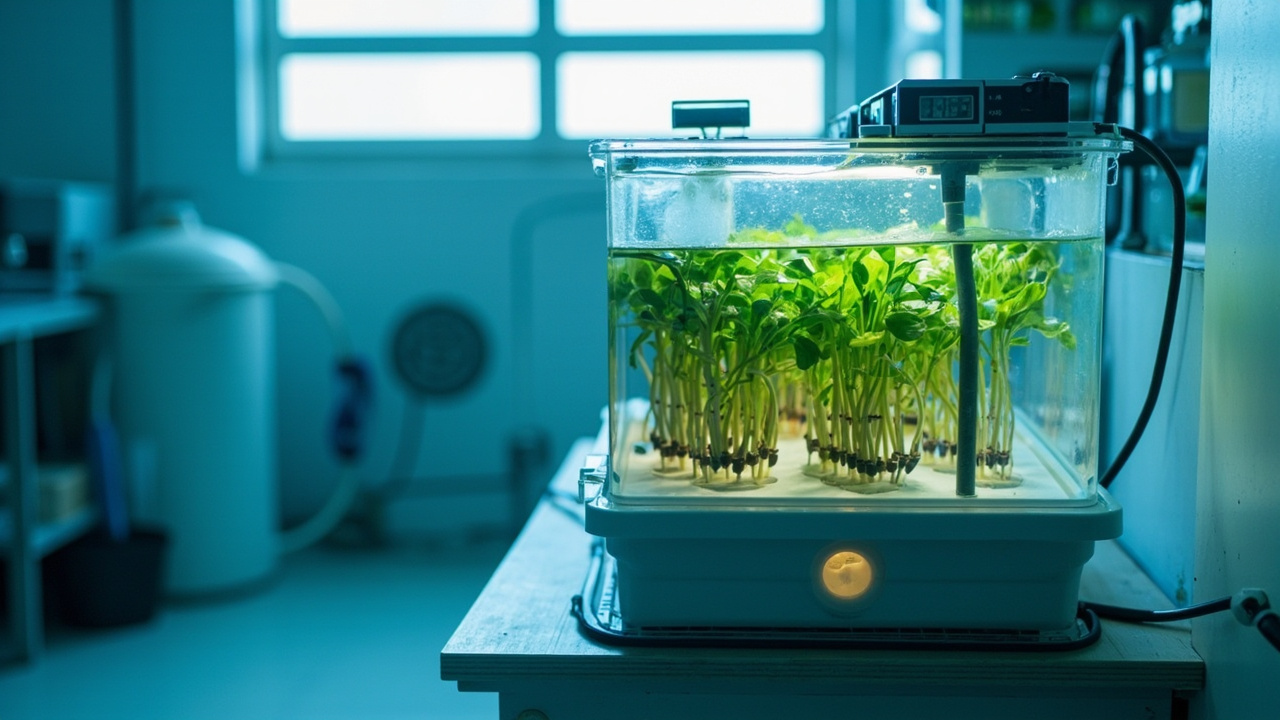
Kratky is the passive option. The plant sits in a net pot above a non-circulating reservoir. As the plant drinks, the water level drops and an air gap forms, giving roots access to oxygen without any pump at all. Kratky is genuinely low-maintenance for leafy greens and herbs, though it does not suit fruiting crops the way DWC or NFT do.
Ebb and flow (also called flood and drain) floods a tray of growing medium on a timer, then drains it back into the reservoir. Roots get wet cycles and dry cycles. Ebb and flow handles larger plants and heavier nutrient loads than Kratky but needs a reliable timer and a fail-safe drain.
Aeroponic systems mist bare roots with nutrient solution on a timer, usually every few minutes. No growing medium. No submerging. Just air and mist. Aeroponic systems grow fast but the equipment is more sensitive.
Drip system delivers nutrient solution through emitters, one drip per plant, on a timer. Run-to-waste drip drains the excess; recirculating drip returns it to the reservoir. Drip systems suit larger plants like hydroponic tomatoes.
Dutch bucket is a specific drip configuration: each plant grows in its own bucket of growing medium, fed by a drip line. Dutch buckets are common for vining crops like tomatoes and cucumbers.
Wick system is the simplest possible hydroponic setup. A wick draws nutrient solution from a reservoir into the growing medium by capillary action. No pumps. No electricity. Wick systems work for small, low-demand plants and are a useful introduction to the vocabulary without committing to equipment.

Nutrient Chemistry: NPK, pH, EC, and What Plants Actually Eat
Plants in hydroponic systems do not eat soil. They eat dissolved ions in water. The vocabulary around that is short, exact, and worth owning.
NPK stands for nitrogen (N), phosphorus (P), and potassium (K), the three macronutrients every plant needs in the largest amounts. The numbers on a fertilizer bottle (for example 5-5-5 or 3-1-2) are the percentage of each, always in N-P-K order. Our hydroponic fertilizer guide walks through which ratio fits leafy greens versus fruiting crops.
Nutrient solution is the water plus dissolved fertilizer that the system delivers to the roots. It is the entire feeding system in liquid form.
pH measures how acidic or alkaline the nutrient solution is, on a scale of 0 to 14. Most hydroponic crops want a pH between 5.5 and 6.5. Outside that band, the nutrients in the solution are still present but become harder for the plant to absorb. Our pH in hydroponics guide covers the full range and adjustment strategy.
pH up and pH down are the two adjusters you keep on hand. pH up raises the solution (typically potassium hydroxide or potassium carbonate); pH down lowers it (usually phosphoric or nitric acid). Always add adjusters to water, never water to adjusters, and add in small doses.
Nutrient lockout is what happens when pH drifts out of range. The nutrients are still in the water; the plant just cannot take them up. Lockout shows up as deficiency symptoms on healthy-looking plants, and the fix is to correct pH, not to add more fertilizer.
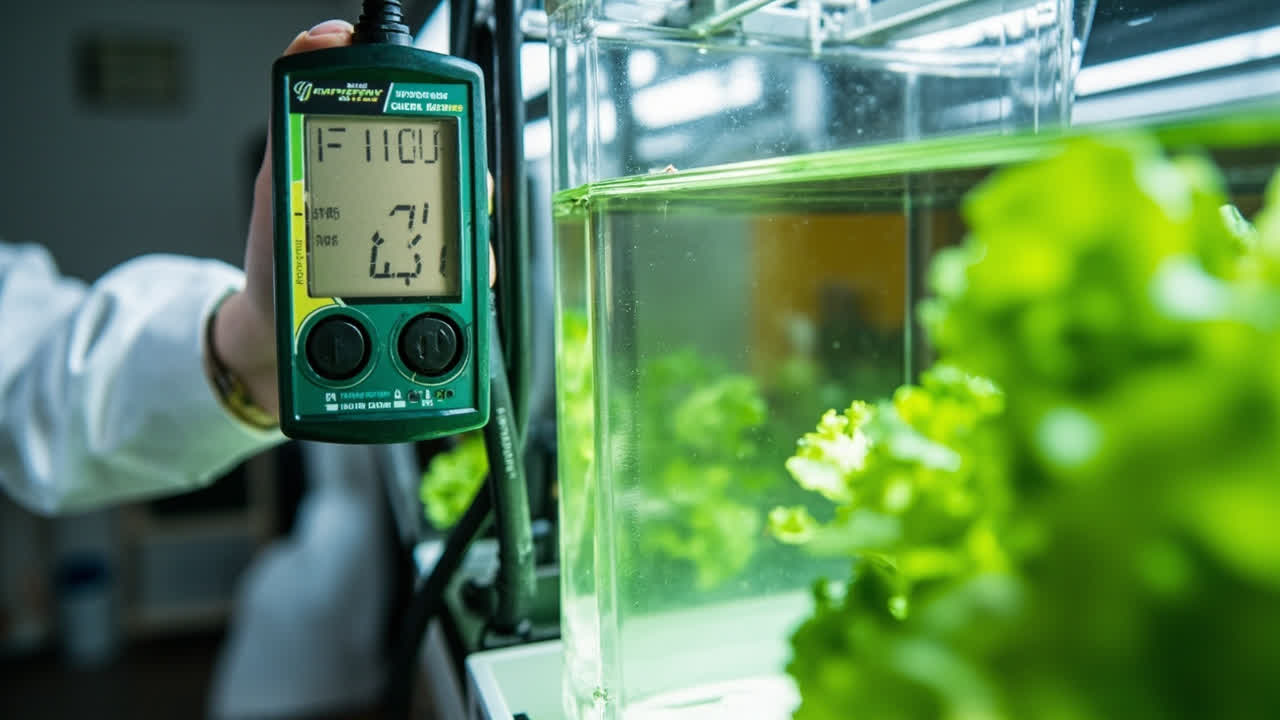
EC stands for electrical conductivity. It measures how well the nutrient solution conducts electricity, which is a proxy for how much dissolved salt (fertilizer) is in the water. Higher EC means a stronger solution. Most leafy greens grow happily between 1.0 and 1.6 mS/cm; fruiting crops like tomatoes often want 2.0 to 3.0. Our EC meter guide covers measurement, calibration, and the home-grower target band.
PPM stands for parts per million. It is a different unit for the same thing EC measures. Higher PPM means more dissolved fertilizer. Conversion depends on the scale your meter uses: the 500 scale, the 700 scale, or the 650 scale (also called TDS or sodium chloride scale). Our PPM for hydroponics guide covers conversion and target ranges.
TDS stands for total dissolved solids. PPM and TDS are often used interchangeably, but TDS meters actually estimate PPM from EC using one of the conversion scales above. The practical takeaway: when you read a PPM number, check which scale your meter is on before comparing to a guide online.
Cal-Mag is a calcium and magnesium supplement. Reverse-osmosis water and very soft tap water often lack both, and most base nutrient lines assume the water has them. Adding Cal-Mag prevents the blossom-end rot and tip burn that show up when calcium runs short.
Tap water, hard water, and chloramine matter because the water you start with shapes the nutrient solution you end with. Hard water already carries calcium and magnesium; chloramine (used to disinfect municipal water) can stress the biofilter in some systems.
Equipment: Pumps, Stones, Pots, and Reservoirs
Vocabulary shifts from chemistry to hardware. Most home systems share the same parts under different names.
Reservoir is the container that holds the nutrient solution. It is the heart of every recirculating system. Size, material, and light-blocking matter; an opaque reservoir keeps algae from starting. Top-up cadence depends on system size and plant load.
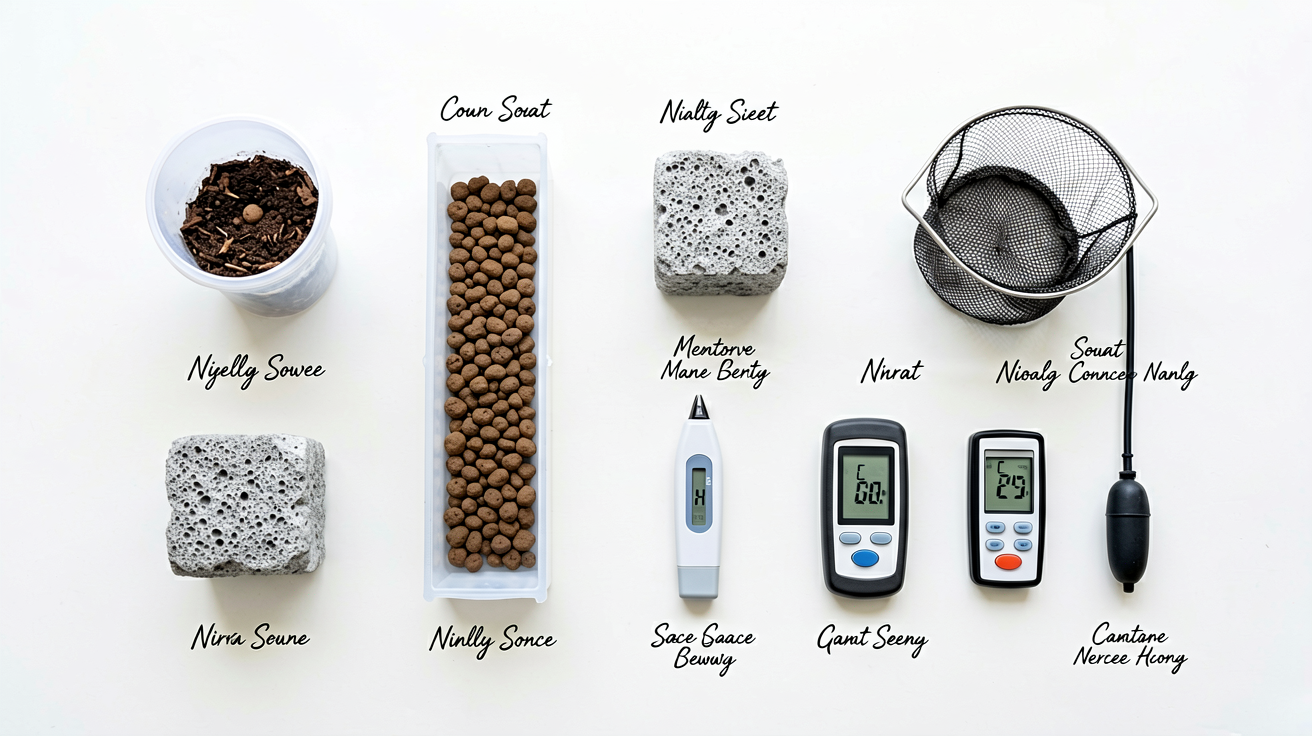
Air pump pushes air through a tube into an air stone, which breaks it into fine bubbles. The bubbles keep the solution moving and raise dissolved oxygen in the root zone, which is the single most important variable in a DWC.
Water pump moves nutrient solution. In NFT, drip, and aeroponic systems, the water pump is the engine that delivers solution to the plants on a timer or continuously.
Net pot is the plastic mesh cup that holds the plant and growing medium while letting roots grow out into the solution or channel below. Net pots come in 2-inch, 3-inch, and larger sizes; the plant and the system decide which fits.
Growing medium (also substrate) is what supports the plant physically. Hydroponic media do not feed the plant; they hold roots in place while the nutrient solution does the feeding. The main options:
Rockwool is a spun mineral fiber that holds water and air in roughly equal parts. It is the most common starter medium for seedlings and transplants. Prep it the right way (soak to pH, drain) and it transitions cleanly from propagation to main system.
Clay pebbles (also sold as hydroton or LECA) are baked clay balls. They drain freely, do not hold too much water, and are reusable. Clay pebbles suit ebb and flow, Dutch bucket, and drip systems.
Coco coir is a coconut-husk fiber that holds water well and rehydrates easily. It is a popular organic-leaning medium for drip and Dutch-bucket systems, though it does carry some natural salts that need to be rinsed out.
Perlite and vermiculite are heat-expanded minerals used as soil amendments and occasionally as hydroponic media. Perlite improves drainage; vermiculite holds water. Both show up more in seed-starting mixes than in main-system media.
Plant Biology in Hydroponics: Roots, Oxygen, and Disease
The biology terms are the ones that show up when something goes wrong.
Root rot is what happens when roots sit in low-oxygen or pathogen-loaded water. Roots turn brown and slimy; the plant wilts even though the reservoir is full. DWC and Kratky are most exposed. The fix is oxygenation, reservoir hygiene, and sometimes a beneficial bacteria inoculant. Recovery depends on catching it before the root mass collapses.
Algae grows wherever light hits nutrient solution. It competes with plants for nutrients, clogs pumps, and feeds the pathogens that cause root rot. The fix is opaque reservoirs, light-proof tubing, and clean surfaces.
Dissolved oxygen (DO) is the amount of oxygen held in the nutrient solution. DWC, Kratky, and aeroponic systems live or die by DO. Higher water temperature carries less DO; that is why reservoir water temperature matters more than most beginners expect.
Pump failure is the single most common cause of crop loss in recirculating systems. If the pump stops, roots run out of oxygen or water within hours. A redundant air pump and a daily visual check are the cheapest insurance.
Common Confusions: Terms Beginners Mix Up
The same handful of mix-ups shows up in every hydroponic forum. Naming them once keeps you from chasing the wrong fix.
EC vs PPM. They measure the same thing in two units. EC is in millisiemens per centimeter (mS/cm) or microsiemens (uS/cm); PPM is in parts per million. Convert with the scale your meter uses: PPM 500 equals EC times 500; PPM 700 equals EC times 700. A reading of 1.4 mS/cm is roughly 700 to 980 PPM depending on the meter. The two are not interchangeable without a scale. Our EC meter guide and PPM guide lay the conversion out cleanly.
PPM vs TDS. TDS meters estimate PPM from EC, so they are not independent readings. A “TDS meter” reading of 800 is just an EC meter reading of 1.6 mS/cm on the 500 scale, expressed in PPM. The number is the same; the label depends on the meter.
pH up vs pH down. pH up raises; pH down lowers. They are opposites, not two versions of the same thing. Adding the wrong one is the most common reason a beginner’s pH swings wildly between checks.
Hydroponics vs aquaponics vs aeroponics. Hydroponics feeds plants with a nutrient solution the grower mixes. Aeroponics feeds plants by misting bare roots with a nutrient solution. Aquaponics feeds plants with the waste water from fish, filtered by bacteria into a usable nutrient solution. All three are soilless; only aquaponics introduces livestock into the loop. The trade-off is control versus biological complexity.
Soilless vs soil-less. Both spellings are used; both mean the same thing. Soilless growing replaces soil with a growing medium plus a nutrient solution. The medium supports; the solution feeds.
Hydroponics vs general fertilizer use. Most soil fertilizers are calibrated for outdoor soil biology, not bare-root hydroponic uptake. They often leave residue, clog emitters, and feed the wrong ratios. Reach for a hydroponic-specific line first.
Quick-Reference: One-Page Hydroponic Vocabulary
Save this section. It is the short version of the glossary, organized the way a grower actually thinks: system first, chemistry second, hardware third, biology fourth.
Systems. DWC (roots in oxygenated solution), RDWC (multiple DWC buckets share a reservoir), NFT (thin film flows down a channel), Kratky (passive, no pump), ebb and flow (flood and drain on a timer), aeroponic (mist to bare roots), drip (emitters on a timer), Dutch bucket (per-plant drip in a medium), wick (passive capillary).
Chemistry. NPK (nitrogen, phosphorus, potassium), nutrient solution (water plus dissolved fertilizer), pH (acidity on a 0 to 14 scale, target 5.5 to 6.5), pH up / pH down (adjusters), EC (electrical conductivity, mS/cm), PPM (parts per million), TDS (total dissolved solids, same reading in a different unit), nutrient lockout (pH out of range, nutrients not absorbed), Cal-Mag (calcium and magnesium supplement).
Equipment. Reservoir (nutrient tank), air pump and air stone (oxygenation), water pump (delivery), net pot (mesh plant holder), growing medium (rockwool, clay pebbles, coco coir, perlite, vermiculite).
Biology. Root rot (low-oxygen roots), algae (light plus nutrient solution), dissolved oxygen (DO, the root-zone variable), pump failure (the recurring cause of crop loss).
When a term in another Aqualogi guide stops you cold, this is the page to come back to. When the definition here is not enough, the cross-link under each entry leads to the page that owns depth.
Turn That PDF Into a Spreadsheet in Minutes
You've seen how to do it manually — now let the tool handle the heavy lifting. Upload your bank statement and get Excel, CSV, or QBO in a few clicks.
Try It Free