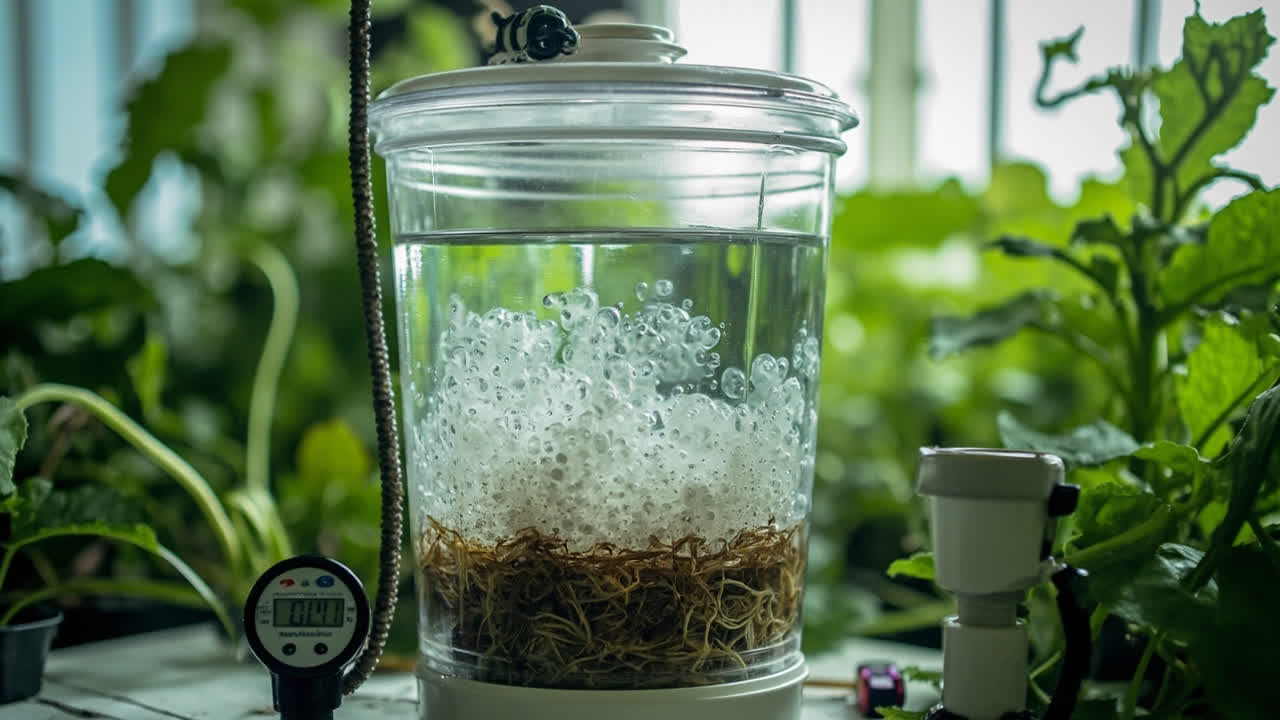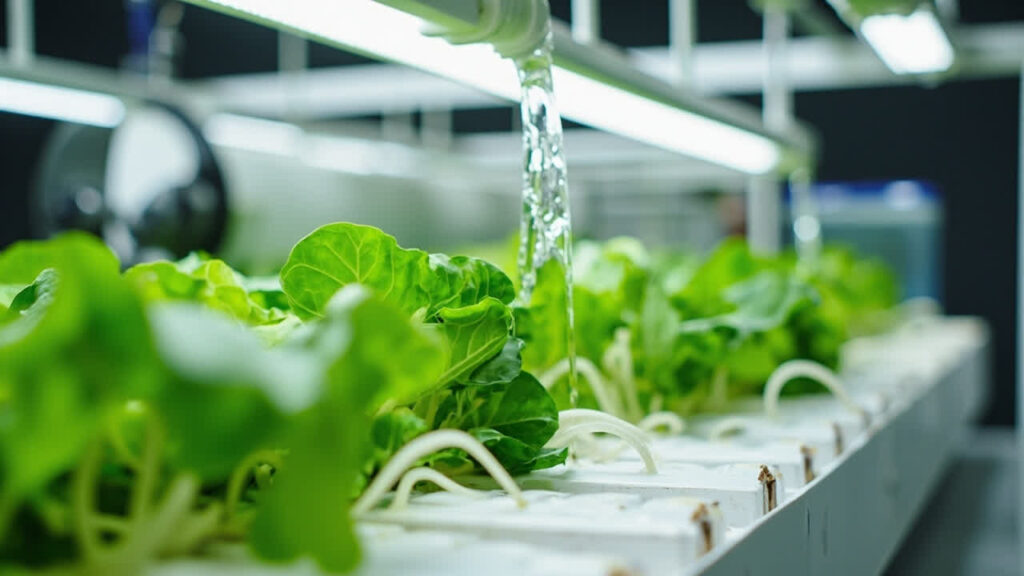

The Nutrient Film Technique is a hydroponic method where a thin, continuous stream of nutrient-rich water flows over the roots of plants suspended in a tilted growing channel. The channels are set at a slight angle so the solution drains from one end to the other, passing over the roots before returning to a reservoir or being discarded. The idea is that roots absorb what they need from the film as it passes, while the exposed upper portions get plenty of the oxygen they need from air.
Think of it as a very shallow, self-siphoning stream threading through a long, narrow gully. Plants sit innet holder cups or slits cut into the channel lid, with their roots dangling into the flow below. The whole system recirculates, or can be set up as a one-way drain-to-waste layout. Either way, the defining feature is the film – just a few millimetres of water in constant motion over the root zone.
If you are comparing this to deep water culture (DWC), the difference is fundamental. In DWC, roots sit submerged in a deep, still pool of nutrient solution. In NFT, roots are only partially immersed – the lower portion touches the flowing film while the upper section stays exposed to ambient air. That access to oxygen is one of the main arguments NFT growers make for the system.
How NFT Works: The Mechanics Behind the Film
A working NFT system has four core components working in a loop:
- Reservoir – A sealed, light-proof tank that holds the nutrient solution. Temperature and pH need to stay within range here.
- Submersible pump – Moves solution from the reservoir up to the highest point of the channel.
- Growing channels – Tilted tubes or flat trays where plants sit. The slight downward slope (typically 1-3% grade) lets gravity pull the film toward the drain end.
- Return drain – Pipes the solution back to the reservoir in a recirculating setup, or out of the system entirely in a drain-to-waste configuration.
For recirculating systems, a timer is not always required since the pump often runs continuously – but many growers use a simple interval timer to create cycles of flow and rest, which can reduce pump wear and allow roots to dry slightly between feeds. Drain-to-waste systems, common in commercial operations, supply a fresh flow of nutrient solution continuously, with runoff discharged rather than returned.
The film thickness matters. Too deep and you starve the upper root zone of oxygen. Too shallow and roots dry out fast if the pump hiccups. Most hobby systems aim for a film around 1-3 mm deep across the base of the channel.
What Grows Well in NFT – and What Does Not
NFT has a clear sweet spot, and it is not everything.
Best crops for NFT:
- Lettuce and salad greens
- Basil, mint, cilantro, and other culinary herbs
- Spinach and baby leafy greens
- Small brassicas like kale and bok choy
- Strawberries, under the right support conditions
These plants share traits that make them ideal for NFT: relatively modest root systems, fast growth cycles, and a tolerance for close spacing. A row of butterhead lettuce in a 3-metre channel can produce a serious harvest in six to eight weeks.
Plants that struggle or fail in NFT:
- Tomatoes, peppers, and other large fruiting vegetables
- Courgette, cucumber, and squash
- Root vegetables like carrots and radishes (unless the channel is very deep)
The reasons are structural and nutritional. Fruiting plants develop extensive root systems that quickly block the narrow channels used in most NFT setups. They also demand far higher nutrient concentrations than leafy greens, and those concentrations vary as the fruit develops – which is hard to manage when the film is thin and the margin for error is small. Add the weight issue: a mature tomato plant with fruit can exceed what a standard net cup and thin channel can physically support.
If you want to grow fruiting crops hydroponically, hydroponic systems for beginners typically point toward DWC, Dutch buckets, or media-based methods as more forgiving options for those plant types.
NFT vs Other Hydroponic Methods
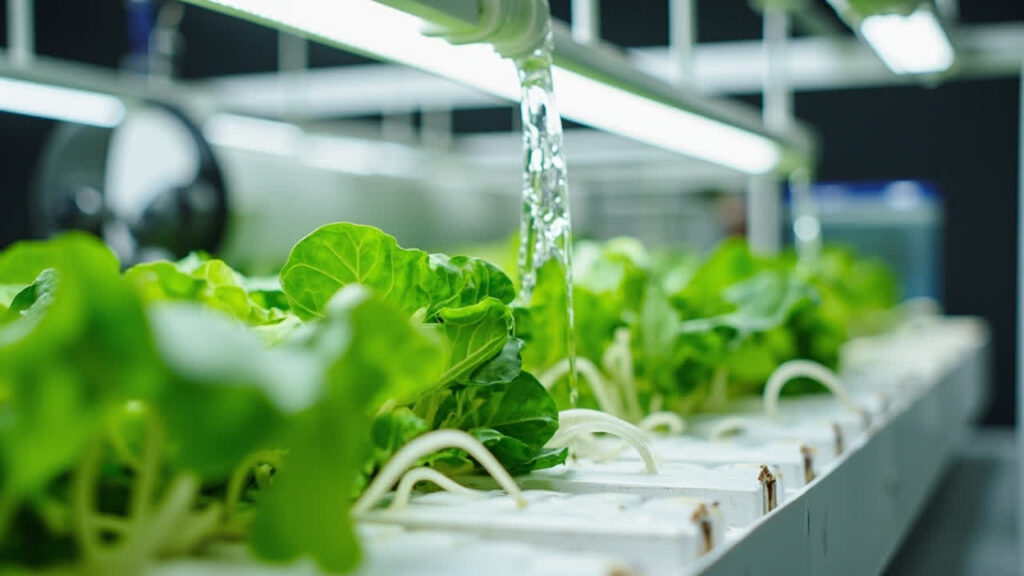
NFT sits alongside several other hydroponic techniques, and understanding the trade-offs helps you decide if it is the right fit for your situation.
NFT vs Deep Water Culture (DWC): DWC is simpler to build and more forgiving of pump failures – if the power goes out in DWC, roots still sit in a large volume of aerated solution. In NFT, a pump failure can cause wilting within hours because roots have access only to the thin film. That said, NFT typically produces faster growth rates in leafy greens due to superior oxygen access at the root zone.
NFT vs Aeroponics: In aeroponics, roots are suspended in air and misted with nutrient solution at intervals. This delivers even more oxygen to the root zone than NFT, but it is more complex, more expensive, and more sensitive to nozzle clogging. NFT is generally considered a more beginner-accessible step up from DWC, while aeroponics is a more advanced proposition.
NFT vs Ebb and Flow (Flood and Drain): Ebb and flow periodically floods a growing tray with nutrient solution and then drains it back. This gives roots a periodic soaking rather than a continuous film. It works with a broader range of plant sizes, but NFT’s constant flow suits high-density, fast-cycle production of leafy greens better.
Setting Up Your First NFT System
A basic NFT setup can be assembled from off-the-shelf parts for under $150, or you can spend significantly more on commercial modules. Here is what the minimum viable system looks like:
1. Reservoir (10-20 litres for a small setup)
Use a light-proof container to prevent algae growth. A black IBC container cut down works well. Place it below the growing channels so gravity assists the return flow.
2. Pump
A submersible aquarium or hydroponic pump rated at 400-1000 litres per hour depending on the total channel length. Match the pump capacity to the number and length of channels – longer systems with multiple branches need more flow to maintain an adequate film at the far end.
3. Channels
White or black PVC gutter sections, standard rainwater downpipes, or purpose-made NFT channels from a hydroponics supplier. Cut plant holes in the lid at intervals of 15-20 cm for leafy greens, 20-30 cm for herbs. The channel should be level across its width but sloped lengthwise at roughly 1:30 to 1:50 (roughly 2-4 cm drop per metre).
4. Nutrient solution
Use a quality hydroponic nutrient formula mixed according to the manufacturer’s guidelines. Check and adjust pH levels daily – NFT systems are sensitive to pH drift because the solution volume is small relative to the plant load. Aim for a pH range of 5.5-6.5 for most crops. EC or TDS readings will tell you whether the nutrient concentration is holding or needs topping up.
5. Timer (optional but recommended)
A simple plug-in timer to cycle the pump – 15 minutes on, 15 minutes off, or 30 minutes on/off depending on your setup and ambient temperature – gives roots a slight rest period and can help prevent root stress in warm conditions.
Common NFT Problems and How to Deal With Them
NFT is straightforward in principle, but it has a short list of failure modes that catch out beginners.
Pump failure = rapid wilt. This is the single biggest risk in NFT. Because roots only have access to a thin film, any interruption in flow causes immediate water stress. A root-bound channel or a clogged inlet can produce the same effect as a dead pump. The solution: install a high-water-level alarm or a float switch that cuts power if the reservoir runs dry, and inspect pump and lines weekly.
Channel clogging. If roots grow too dense or if algae and biofilm accumulate, flow slows and the film thins unevenly. This creates dry patches where roots desiccate. Clean channels regularly, trim roots if they are pushing into the flow path, and keep the reservoir covered to prevent light from encouraging organic growth.
Root mat buildup. In active NFT systems run for months, root mass can compact at the base of the channel, effectively raising the water level and reducing air exposure in the lower root zone. Thin or prune root mats during crop changeouts to restore proper flow depth.
Nutrientimbalance and pH drift. Because NFT uses a smaller solution volume than DWC, changes in pH and nutrient concentration happen faster. Check your reservoir every day in warm weather, every second day in cooler conditions. Top up with fresh nutrient solution rather than plain water when levels drop, to avoid diluting concentrations below what plants need.
Temperature. Nutrient solution above 24degC (75degF) holds less dissolved oxygen and encourages root pathogens. In hot climates or warm rooms, insulate the reservoir and consider a chiller or at least a shaded, ventilated location for the system.
DIY vs Commercial NFT Systems
You can build a perfectly functional NFT system from standard hardware store parts. A PVC gutter, a submersible pump, a reservoir, and some net cups will get you growing. Commercial systems add convenience, durability, and often better channel geometry – but they carry a price tag that only makes sense if you are growing at scale or want a setup that looks clean and runs with minimal intervention.
For a first-time grower focused on leafy greens and herbs, a DIY gutter-based system is entirely adequate and will teach you more about how the system works than a plug-and-play unit ever will. If you find yourself replacing clogged channels every few months or fighting persistent pH issues, then a commercial NFT setup with wider channels, better pump redundancy, and integrated monitoring may be worth the upgrade.
Commercial kits also make sense if you want to run a drain-to-waste configuration, which requires more precise nutrient delivery and is harder to improvise from scratch.
Is NFT the Right System for You?
NFT works best when you have:
- A focused interest in fast-growing leafy greens and culinary herbs
- Space for a horizontal channel system with some vertical headroom for the reservoir below
- A reliable power supply – the pump cannot be offline for long
- Time to check pH and nutrient levels daily, especially in warm conditions
NFT is less suitable if you want to grow tomatoes, peppers, or large fruiting crops; if you have an unreliable power situation; or if you want a system that can tolerate extended periods of neglect. For those situations, deep water culture (DWC) or a media-based flood-and-drain setup would serve you better.
Nutrient Film Technique (NFT)
One of the best things about getting started with NFT is that it connects directly to growing herbs hydroponically in a way that makes the whole system feel approachable.
You do not need a greenhouse or outdoor space – a spare corner with decent light or a modest grow lamp setup is enough to run a productive NFT channel.
Mix your hydroponic nutrients correctly, keep the film flowing, and watch your plants push out clean, fast growth that soil-based gardening struggles to match for speed.
The key to success with NFT is honesty about what the system is built for. It is not a universal hydroponic solution.
But within its sweet spot – dense, fast production of leafy greens – it is one of the most efficient methods available.
Build it tight, watch it closely, and it will deliver.
From Bank Statement to QuickBooks-Ready File
That manual cleanup you just read about? This tool skips it. Turn your PDF into QBO for QuickBooks without storing your data anywhere.
Start Converting