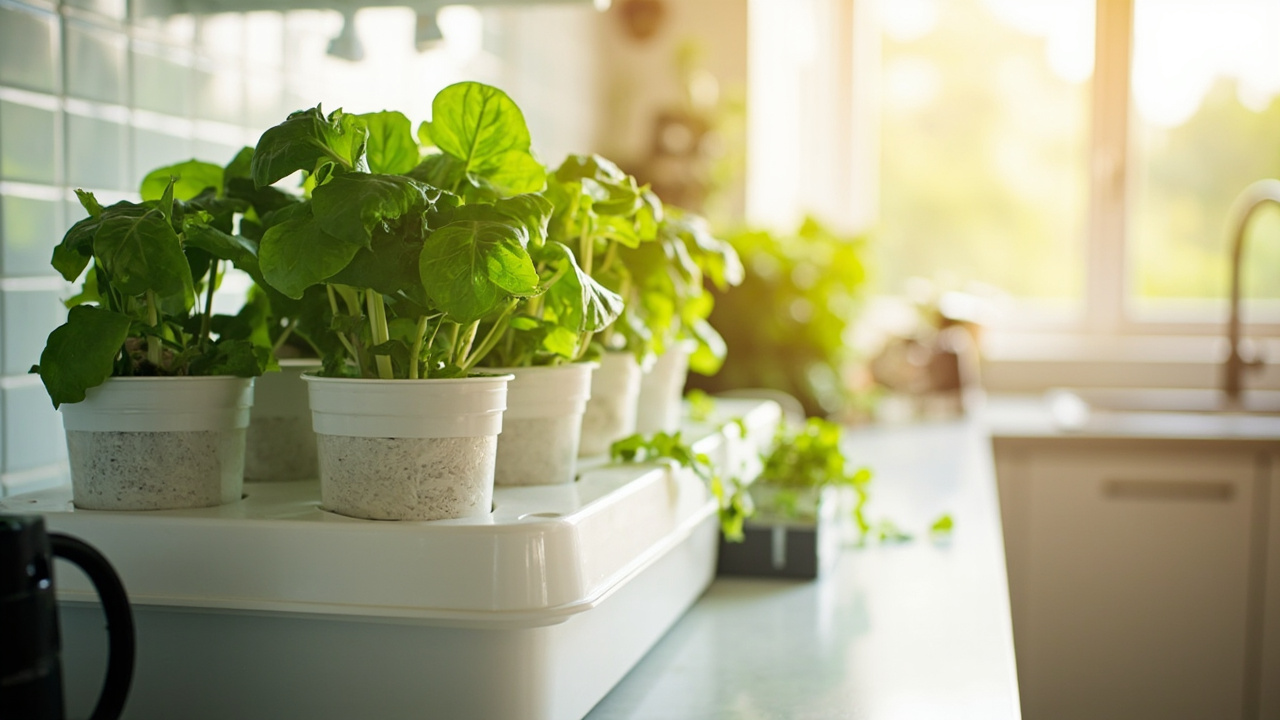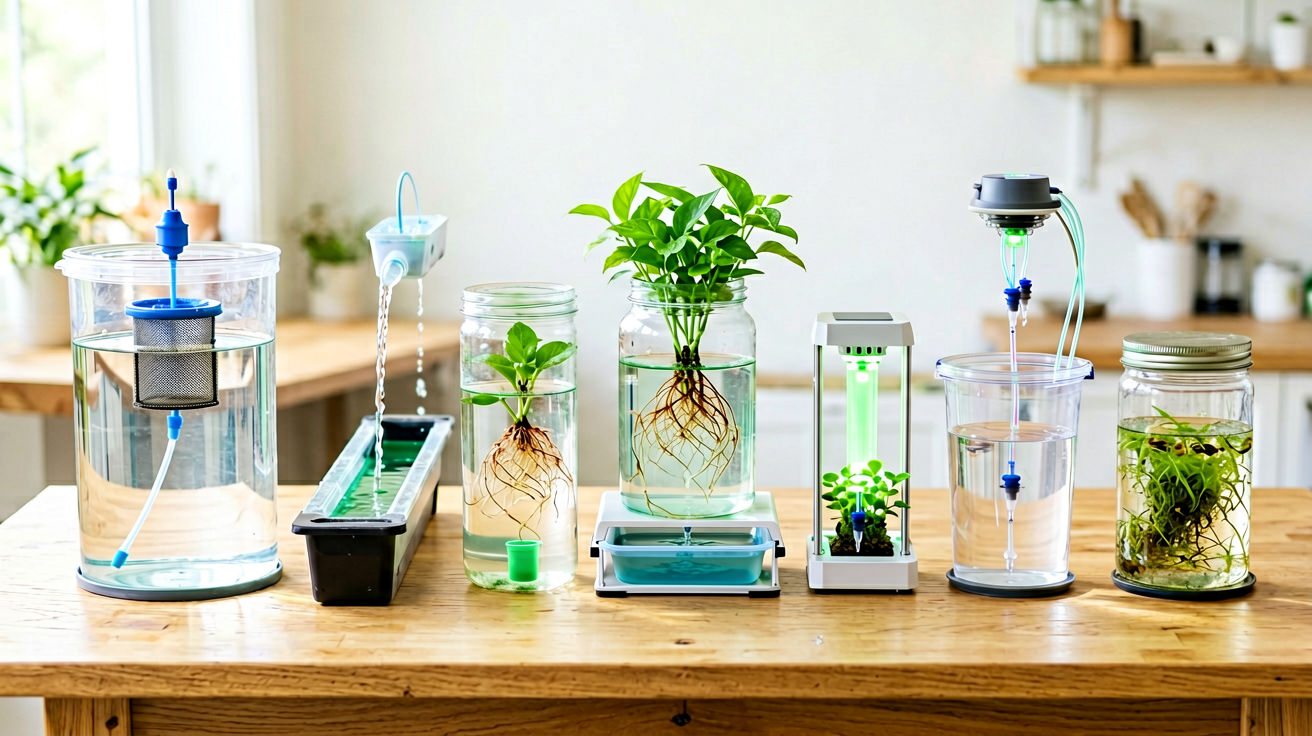

Seven hydroponic systems cover nearly every home grow, and the right one depends on your crop, budget, and how often you want to mess with it. This guide walks each system by mechanism, names the crops it actually fits, and routes you to the setup guide for the one that matches your grow.
If you have ever Googled hydroponic system and come back with a list of acronyms (DWC, NFT, RDWC, Kratky, Ebb & Flow) and ten vendor comparison pages, you already know the problem. Each system works. None of them works the same way. Picking the wrong one costs you a grow cycle; picking the right one costs about the same as a takeout dinner. That decision is what this page is built for. To understand the wider context before diving into each system, start with the umbrella hydroponics guide, then return here to pick your system.
The 7 Hydroponic Systems at a Glance
Every soilless system you will meet falls into one of these seven families. The names are the ones vendors, university extension offices, and growers actually use.
- Deep water culture (DWC) — roots dangle in an oxygenated nutrient reservoir.
- Nutrient film technique (NFT) — a thin film of nutrient solution flows through sloped channels past bare roots.
- Kratky method — a passive, non-circulating deep water culture with a static air gap the roots grow down into.
- Ebb and flow (flood and drain) — a tray floods with nutrient solution, then drains back to a reservoir on a timer.
- Aeroponic — roots hang in air inside a chamber and get misted with nutrient solution on a cycle.
- Drip system — a pump delivers nutrient solution to each plant through emitters, with runoff returning to the reservoir.
- Wick system and Dutch bucket — the most passive setups (capillary wicks) and a media-filled bucket variant tuned for larger fruiting crops.
The first four are the workhorses most home growers will consider. The last three fill specific niches (small passive setups, large-fruit crops, classroom demos). Pick one or compare two, and the deep guide behind it walks the setup.
How the Systems Differ
Before naming crops, it helps to see the systems on three axes. These axes decide almost every trade-off you will run into.
Passive versus active. Passive systems (Kratky, wick) have no pump and no moving parts. They are quiet, cheap, and almost impossible to electric-fail, but they give you less control over oxygen and nutrient delivery. Active systems (DWC with an air pump, NFT, Ebb & Flow, aeroponic, drip) use a pump or a timer to move or aerate the nutrient solution. They cost more and can fail if the pump dies, but they scale and they yield more per square foot.
Recirculating versus non-recirculating. Recirculating systems (NFT, Ebb & Flow, RDWC, drip) return the nutrient solution to a reservoir and reuse it. They are efficient, but pH and EC drift over time, so you have to monitor. Non-recirculating setups (a basic Kratky jar, a drain-to-waste drip system) discard the runoff. They are simpler to manage but use more solution.
Water contact versus mist. DWC, Kratky, NFT, and Ebb & Flow all keep roots in direct contact with liquid nutrient solution (or a thin film of it). Aeroponic systems spray a fine mist into a root chamber and never submerge the roots. Mist delivers oxygen more efficiently than submersed roots, but a clogged nozzle or a pump failure kills a crop fast.
Hold those three axes in your head as you read each system. The right one for you is the one whose trade-offs you can live with.
How growers actually pick. In commercial CEA (controlled environment agriculture), NFT dominates leafy greens because channels stack vertically and the recirculating reservoir makes nutrient management efficient at scale. DWC is the workhorse of research greenhouses and teaching labs because it is easy to instrument and easy to inspect. Ebb & Flow is the standard for mixed-crop operations. Kratky is rare in commercial settings because it does not scale, but it is everywhere in home growing and classroom demos because it has no moving parts.
What every system shares. No matter which family you choose, the inputs are the same: a balanced nutrient solution (calcium nitrate, potassium nitrate, magnesium sulfate, plus micronutrients), pH held between 5.5 and 6.5, electrical conductivity (EC) tuned to your crop, and a soilless growing medium if you are not using bare roots. The system is the delivery mechanism. The chemistry is the engine. Get the chemistry wrong and no system saves the grow.
The nutrient chemistry is the same in every system, but the way you monitor it differs. DWC and Kratky need a weekly pH and EC check because the reservoir is small and the plant drinks fast. NFT and Ebb & Flow need daily checks because the larger reservoir and the recirculating plumbing drift slower but can swing harder when something does fail. Aeroponic and drip need both: a daily check on the reservoir and a quick visual on nozzles and emitters. Whichever system you pick, plan to own a pH meter, an EC meter, and a calibration solution before you transplant the first seedling.
One last note on water source. Most municipal tap water is fine for hydroponic nutrient solutions after a 24-hour rest to off-gas chlorine, but hard water (above 150 ppm calcium carbonate) can push your pH up and lock out iron and manganese. If your tap water runs hard, blend it with rainwater or run it through a simple carbon filter before mixing nutrients. Soft water or rainwater cuts the other way and may need a calcium-magnesium supplement to keep the NPK ratios in balance. Either way, the system you build is only as good as the water you pour into it.
Deep Water Culture (DWC): The Beginner Default
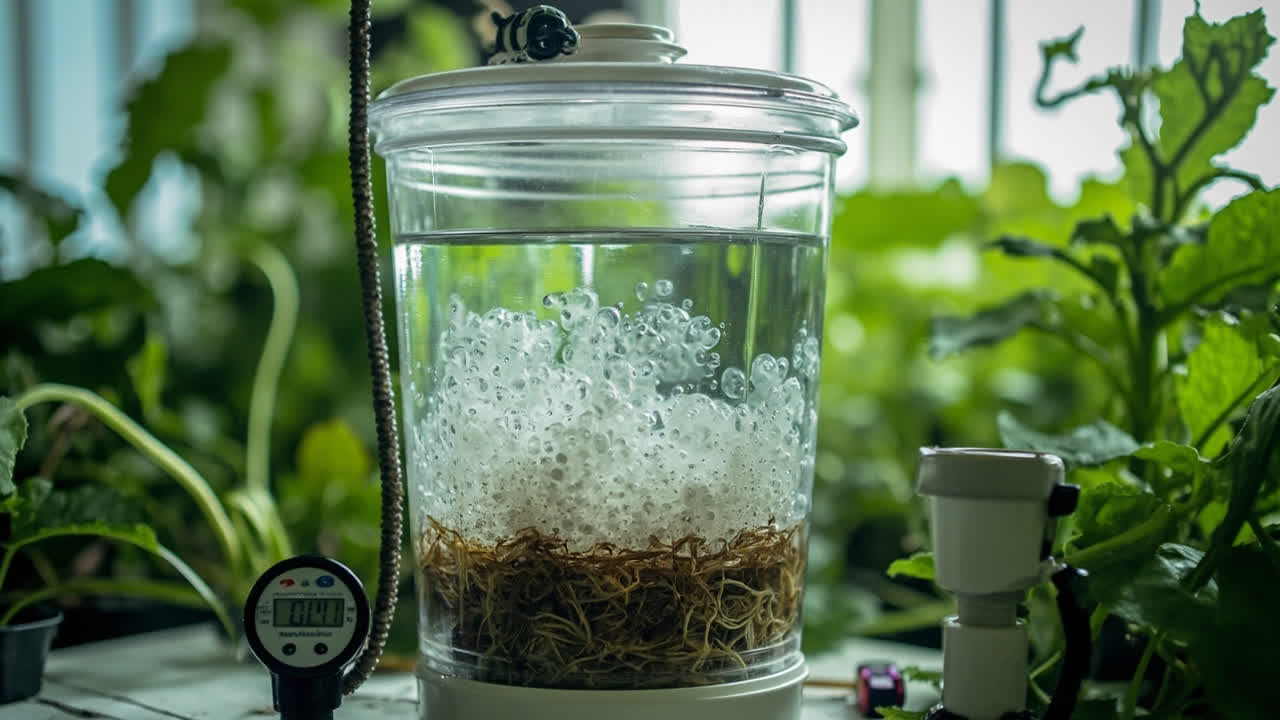
In a deep water culture setup, plants sit in net pots over a bucket or tote filled with nutrient solution, and an air pump drives an air stone at the bottom to bubble oxygen into the water. Roots dangle in the reservoir, drink what they need, and the bubbles keep them from drowning.
It is the simplest active system you can build at home. A 5-gallon bucket, a lid with a hole, a net pot, an inexpensive air pump, and an air stone will run a head of lettuce from seedling to harvest. Add a second bucket and you have a scalable setup. The parts cost less than a sit-down restaurant meal.
DWC fits leafy greens (lettuce, basil, spinach, kale) and herbs almost perfectly. A 5-gallon bucket with a single head of lettuce or basil will run from seedling to harvest on the same reservoir with a weekly top-off. With a larger reservoir (20 to 50 gallons), a heavier air pump, and the right nutrient mix, you can grow fruiting crops (compact tomatoes, peppers, strawberries), but they demand more oxygen and a steadier EC than a single bucket delivers. For your first indoor garden, DWC is the system you should default to.
Most home growers start DWC with a single 5-gallon bucket and a small air pump, then scale to a multi-bucket RDWC (recirculating deep water culture) once they understand the rhythm. RDWC connects several buckets to one shared reservoir, keeps pH and EC balanced across every plant, and lets you run a dozen heads of lettuce or basil from one pump and one reservoir. The same chemistry, more plumbing, more yield per square foot.
Trade-off. The air pump never sleeps. Power goes out, oxygen drops, and root rot arrives within hours. Buy a cheap backup air pump or a battery air pump if you grow in a closet. Also, reservoir temperature matters: above 70°F (21°C), dissolved oxygen drops fast and root pathogens multiply. Most home growers chill the reservoir in summer or move it to a basement room that holds below 68°F (20°C). A small aquarium heater covers the cold shoulder of winter if the reservoir sits under 60°F (15°C) and the lettuce stalls.

DWC also pairs well with common nutrient recipes built around calcium nitrate, potassium nitrate, magnesium sulfate, and a micronutrient mix. Most growers aim for an EC of 1.2 to 1.8 mS/cm for lettuce and basil, 2.0 to 2.5 for fruiting crops, with pH held between 5.5 and 6.5. The reservoir is the engine; the air stone is the lungs; the plant is the customer.
Nutrient Film Technique (NFT): The Channel Workhorse
Nutrient film technique uses a sloped channel or gutter. A reservoir pump pushes nutrient solution to the high end, a thin film flows past the bare roots of each plant sitting in a net cup, and the solution drains back to the reservoir. NFT is recirculating, modular, and the standard configuration for commercial leafy-green operations.
It is the right pick when you want to grow a lot of lettuce, basil, or herbs in a small footprint. Channels stack vertically, run down a greenhouse, and let you scale from one channel to dozens without redesigning the system. NFT also surfaces nutrient problems fast, because the reservoir is shared and the solution has to be balanced for every plant at once.
NFT is a poor fit for heavy or fruiting crops. A large tomato wants more root mass and a sturdier anchoring than a bare root sliding down a channel gets. Big root systems can also clog the channel and dam the flow, which is why most NFT growers stick to leafy greens and herbs. Strawberry production in NFT is possible but finicky, and tomatoes are usually moved to a drip or Dutch bucket setup once they outgrow the channel.
NFT channels are typically made of PVC or food-grade plastic, sloped at 1 to 3 percent so the solution flows under gravity back to the reservoir. The film is shallow on purpose (just a few millimeters) so the roots can breathe the air above it while the tips stay wet. Too much flow and the roots drown. Too little and the channel runs dry at the low end. The slope, the flow rate, and the channel length all have to be matched.
Trade-off. Pump failure means total crop loss in hours, because the roots dry out instead of drowning. A reservoir sensor, a guard against channel slope sag, and a spare pump are not optional at scale. Also, NFT runs cold: the same shallow film that oxygenates the roots also chills them. In a cool basement that is a feature; in a warm greenhouse, you may need a chiller to keep the reservoir below 68°F (20°C).
Kratky Method: The Zero-Electricity Passive
The Kratky method is a non-circulating, non-aerated deep water culture. You fill a jar or a tote with nutrient solution, suspend the plant’s roots in the water through a net pot lid, and let it sit. As the plant drinks, the water level drops and an air gap forms above the solution. Roots split into two zones: the submerged tips drink nutrient solution, the upper roots breathe the moist air in the gap.
There is no pump, no timer, and no electricity. You can put a Kratky jar on a sunny windowsill and walk away for weeks. It is the cheapest possible system, the easiest possible setup, and the lowest possible learning curve for a first grow.
Kratky works for leafy greens and herbs, exactly the crops a beginner wants. A mason jar with a net pot lid, a lettuce seedling, and a quart of nutrient solution on a sunny windowsill is a complete Kratky setup. It does not work well for long-cycle or fruiting crops because the nutrient balance drifts, the pH climbs as the plant drinks, and the air gap becomes too large for the roots to keep up. It is also sensitive to pH and EC swings, because nothing is circulating or buffering. By the time the solution is half gone, a leafy crop has usually finished its cycle anyway, which is why Kratky and lettuce are such a good match.
Trade-off. It is a one-shot system per container. Once the nutrient solution is depleted, you top it off or transplant. If you want a continuous harvest from the same container, look at DWC instead. Also, Kratky needs full sun or a strong grow light; in low light the plant drinks slowly, the air gap never forms correctly, and the roots rot. If you are growing on a dim windowsill, DWC with an air pump will outperform Kratky every time.
Ebb & Flow (Flood and Drain): The Versatile Mid-Tier
Ebb and flow, sometimes called flood and drain, sits a growing tray above a reservoir. A pump on a timer floods the tray with nutrient solution, holds it for a few minutes, then drains it back down. The roots get a drink and a breath of air on every cycle.
It is the most versatile mid-tier system. You can fill the tray with clay pebbles, rockwool cubes, coco coir, or a mix, and grow leafy greens, herbs, strawberries, peppers, and compact tomatoes. Ebb and flow also plays nicely with Dutch bucket variants, where each plant sits in its own media-filled bucket fed by the same flood cycle.
Ebb and flow demands more plumbing than DWC or NFT. You need a tray, a stand, a reservoir, a pump, a timer, and a drain that does not leak. Set it up wrong and you get a flood in your living room. Set it up right and it will run quietly for years.
Trade-off. Pump and timer failure is a hard stop. A stuck-open fill valve can overflow the tray. The good news is that the media reservoir gives roots more buffer than NFT, so a short outage does not kill the crop.
For a deeper walk through Ebb & Flow setup and a comparison with other systems, the hydroponics system guide covers it in more depth. The typical home Ebb & Flow runs a 4-cycle per day schedule (every 6 hours) with a 15-minute flood and drain. Some growers run continuous cycles in summer heat to keep the root zone cool; others back off to twice a day in winter to keep the media from drying out.
Aeroponic, Drip, Wick & Dutch Bucket: The Specialists
Three smaller families cover the niches the four workhorses leave open.
Aeroponic systems hang plant roots inside a sealed chamber and mist them with nutrient solution on a timer (typically a few seconds every few minutes). The roots never sit in water, which delivers oxygen more efficiently than any submersed system. Aeroponic setups grow lettuce, herbs, and some fruiting crops faster than DWC or NFT, but every nozzle and every pump cycle is on the critical path. If you want the fastest growth and you can keep the misters clean, aeroponic is the frontier pick.
Drip systems run a pump on a timer that delivers nutrient solution through a small emitter at each plant’s base. Run-to-waste drip discards the runoff; recirculating drip returns it to the reservoir. Drip is the standard for large-fruit crops (tomatoes, peppers, strawberries, cucumbers) because each plant can have its own emitter, its own stake, and its own nutrient schedule. The system is simple in principle but fiddly at scale (clogged emitters, uneven pressure across rows).
Wick systems are the most passive. A capillary wick draws nutrient solution from a reservoir up into a soilless growing medium (perlite, vermiculite, coco coir). No pump, no electricity, no timer. Wick setups are great for small herbs and classroom demos, but they deliver water too slowly for large or thirsty plants.
Dutch bucket systems are a media-filled variant of drip. Each plant grows in its own bucket of clay pebbles or perlite, fed by a single drip emitter and drained back to the reservoir. Dutch buckets are the standard for home growers who want to grow a tomato plant or a pepper plant without building a full Ebb & Flow tray. They scale from a single bucket on a patio to a row of buckets feeding a greenhouse crop of cucumbers.
Across all seven systems, two pieces of gear do the most work: a pH meter and an EC meter. The pH meter keeps the nutrient solution in the 5.5 to 6.5 band where every macro and micronutrient (nitrogen, phosphorus, potassium, calcium, magnesium, sulfur, iron, manganese, zinc, copper, boron, molybdenum) is available to the plant. The EC meter tells you how strong the solution is, so you can raise it for fruiting crops and lower it for leafy greens. PPM and TDS meters read the same strength in different units; pick one and stay with it. Together they are the difference between guessing and growing.
For a quick orientation on which specialty system fits a beginner setup, the hydroponic systems for beginners page walks the same ground with more starter-friendly framing.
How to Pick: The 5-Question Triage
The fastest way to land on the right hydroponic system is to answer five questions in order.
What are you growing? Leafy greens and herbs → DWC, NFT, or Kratky. Strawberries and compact fruiting crops → Ebb & Flow, drip, or Dutch bucket. Tomatoes, peppers, cucumbers → drip or Dutch bucket on a larger reservoir.
What is your budget? Under fifty dollars → Kratky or a single-bucket DWC. Fifty to two hundred dollars → multi-bucket DWC, a small NFT channel, or a desktop Ebb & Flow. Above that → RDWC, multi-channel NFT, or a multi-tray Ebb & Flow with proper sensors.
How much space do you have? Countertop or windowsill → Kratky jar, wick pot, or compact DWC. Spare closet or grow tent → DWC rack, NFT channels, or a small Ebb & Flow table. Greenhouse or basement → any of the above at scale.
How often do you want to check on it? Once a week or less → Kratky or a wick system. Daily five-minute check → DWC. Daily ten to twenty minutes with EC and pH monitoring → NFT or Ebb & Flow.
How much electricity can you afford to lose? Zero tolerance for outage → Kratky or wick. Some tolerance, with backup → DWC with a battery air pump. Tight tolerance → NFT, Ebb & Flow, or aeroponic with sensor alarms.
If you want a recommendation in plain English, the best hydroponic system for home guide compares the leading kits side by side and pairs each with the crops it actually grows well.
Pick one system. Click into its deep guide. Build it before you buy anything expensive. The system that fits your crop, your budget, and your patience will outgrow the system that looked best on a vendor page.
If you are picking the right system for your home, For the at-home version, two pages translate this taxonomy into room-by-room practical: the hydroponic farm basics guide and hydroponic farming at home, which match each system family to the room it actually fits.
Turn any PDF statement into a clean sheet
Skip the typos and the hours of copying. Our converter handles any bank statement format and outputs Excel, CSV, or QBO for QuickBooks. No file retention, free to try.