If there is one measurement that determines whether your hydroponic farming plants can actually absorb the nutrients you are giving them, it is hydroponics pH.
You can have the perfect nutrient formula, the cleanest system, and the healthiest-looking seedlings — and if your pH is off, your plants will still show deficiency symptoms and struggle to grow.
pH in hydroponics is the variable most hydroponic beginners overlook, and it is the one that most consistently determines whether a setup succeeds or fails within the first month.
What pH in Hydroponics Actually Is
pH is a measurement of hydrogen ion concentration in a solution — expressed on a scale from 0 to 14, where 7 is neutral. Below 7 is acidic. Above 7 is alkaline (basic). The scale is logarithmic — a solution with pH 5 is ten times more acidic than one with pH 6, and a hundred times more acidic than one with pH 7.
In hydroponics, what matters is not just the pH number itself but what the pH does to nutrient availability. Different nutrients become accessible to plant roots at different pH levels. In soil, the pH also affects the chemistry of the soil itself, but in hydroponics — where the root environment is a liquid solution — the relationship between pH and nutrient availability is more direct and more immediately impactful.
Most common hydroponic crops grow best in a pH range of 5.5 to 6.5. Within this range, the majority of essential nutrients are available for root absorption. Outside this range — whether too high or too low — certain nutrients become chemically locked out, meaning they are present in the solution but the plant physically cannot absorb them through the root membrane.
Why pH Matters More in Hydroponics Than in Soil
In soil growing, the soil itself acts as a buffer — a reserve of nutrients and a chemical environment that moderates pH changes. If you slightly over-acidify soil, the buffer slows the pH change and gives you time to correct it. If you slightly over-fertilise, the soil chemistry ties up some of the excess nutrients and releases them more slowly.
In hydroponics, there is no buffer. The nutrient solution is the entire environment — it is in direct contact with the root surface. A pH change in your nutrient reservoir is a pH change at the root zone within minutes. The plant experiences the change immediately, and there is no buffer of reserve nutrition to fall back on while you correct the problem.
This is why the pH measurement is not optional in any serious hydroponic operation. It needs to be checked daily and corrected whenever it moves outside the target range.
What Happens When Hydroponics pH Is Wrong
When pH is too low (below 5.5): The solution becomes increasingly acidic. At very low pH, aluminium and manganese become over-available — toxic at high concentrations even though they are essential nutrients in the right amounts. Meanwhile, calcium, magnesium, and phosphorus become less available. Plants in low-pH solution show signs of calcium deficiency — tip burn on new leaves, marginal leaf necrosis — even when calcium is present in the solution at adequate levels.
When pH is too high (above 6.5): The solution becomes increasingly alkaline. Iron, manganese, boron, and copper become less available — producing deficiency symptoms in plants even when these nutrients are in the solution. Plants in high-pH solution show interveinal chlorosis on new growth — the yellowing between leaf veins — which is the classic iron deficiency symptom, even if you have been adding iron to the nutrient solution.
The key insight: The deficiency symptoms caused by wrong pH look identical to the deficiency symptoms caused by actual nutrient absence. Most beginners see yellowing leaves, assume they need to add more fertiliser, add more nutrients, and make the problem worse because the issue was never a lack of nutrients — it was a pH-induced lockout preventing absorption of nutrients that were already present.
How to Measure and Adjust pH
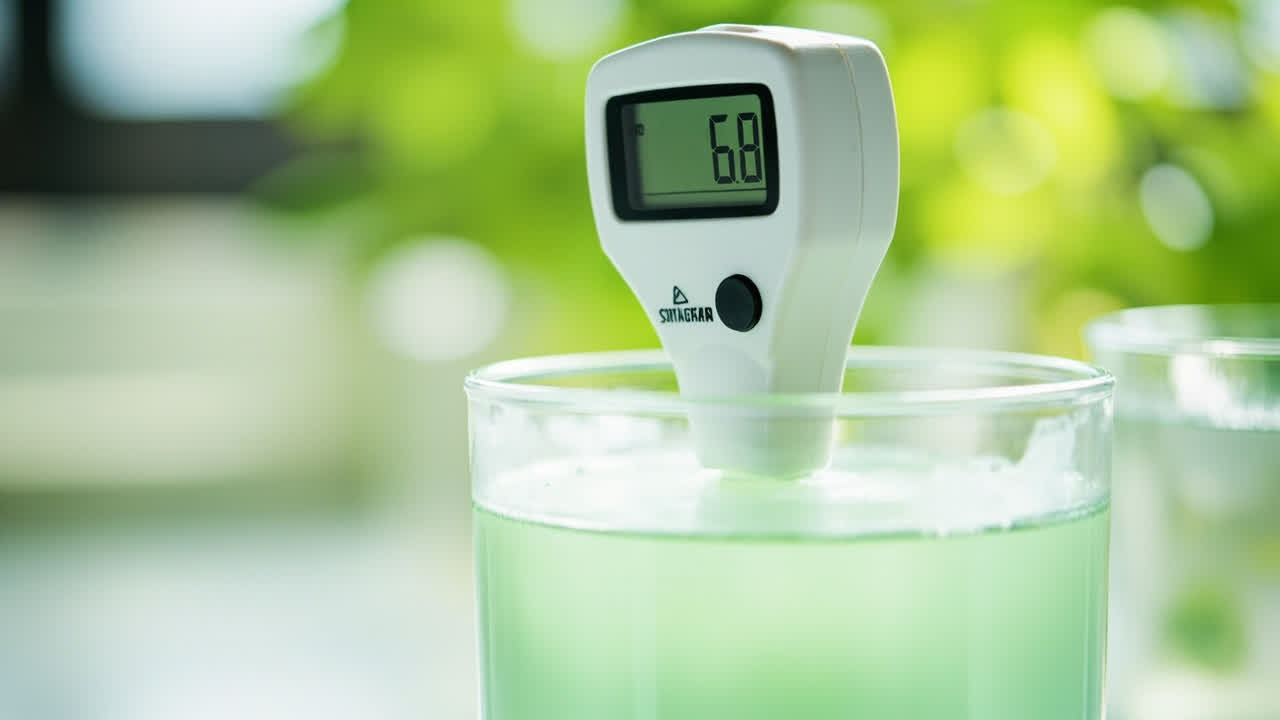
Measuring pH: Use a pH meter or pH test strips. Digital pH meters are more accurate and give consistent readings. Test strips are less accurate but useful for quick checks. Calibrate your meter regularly using pH calibration solutions at 4.0 and 7.0 to ensure accuracy.
Take your measurement from the reservoir itself — not from a small sample poured into a separate container, as the pH can shift slightly when the solution is exposed to air.
Lowering pH: Use pH down solution — typically phosphoric acid in a dilute form. Add a few drops at a time, stir, and re-test. The effect is immediate. Add slowly and re-test as you go — it is much easier to lower pH gradually than to deal with overshooting into an acidic range.
Raising pH: Use pH up solution — typically potassium hydroxide or potassium carbonate in dilute form. Same approach: add a small amount, stir, re-test, and repeat until you reach the target range.
Buffering: If your pH consistently drifts — especially if it keeps rising no matter what you do — the issue is often the water source itself. Tap water in some areas is naturally alkaline and has significant buffering capacity. Using filtered or RO water for your nutrient solution removes this variable and makes pH management significantly easier.
pH and EC Together : The Full Picture
pH tells you nutrient availability. EC tells you nutrient concentration. Both measurements together give you the complete picture of your nutrient solution’s health:
EC is correct + pH is correct: The solution has the right quantity of nutrients and they are chemically available for absorption. This is the target state.
EC is correct + pH is wrong: The nutrients are present but the plant cannot absorb them because pH is locking them out. Fix the pH first — the EC is not the problem.
EC is low + pH is correct: The nutrient concentration is too dilute. The plant has insufficient nutrition. Add nutrients.
EC is high + pH is correct: The nutrient concentration is too strong. The plant may experience osmotic stress and nutrient burn. Dilute with water.
Monitoring both together and responding appropriately to each reading is what separates a successful hydroponic grower from one who is constantly fighting mysterious plant problems that fertiliser cannot fix.
For the EC meter guide, see EC Meter Explained for Hydroponics. For the full nutrient management process, see the Hydroponics Fertilizer guide.
Turn That PDF Into a Spreadsheet in Minutes
You've seen how to do it manually — now let the tool handle the heavy lifting. Upload your bank statement and get Excel, CSV, or QBO in a few clicks.
Try It Free