PPM in Hydroponics Explained: What the Numbers Actually Mean
PPM stands for parts per million, and in hydroponics it is the unit of measurement that tells you exactly how concentrated your nutrient solution is. If you have ever wondered why your hydroponic plants look different from someone else’s even though you are both using the same bottle of nutrient concentrate, the almost certain answer is that your PPM readings are different. PPM is not a suggestion — it is a precise measurement of what your plants are actually eating, and getting it right is the difference between a productive hydroponic system and one that looks alive but never actually thrives.
Most hydroponic nutrient products give you a target PPM range alongside their dosage instructions. A typical formulation might say “use 800–1200 PPM for vegetative growth” or “EC 1.2–1.6 mS/cm for fruiting.” Those numbers are not arbitrary. They represent the actual ion concentration in your solution — the total dissolved salts that your plant roots can absorb. Running your system at 400 PPM when the target is 1,000 PPM means your plants are getting roughly 60% of the nutrition they need. They will not die immediately. They will grow slowly, look slightly off-color, and underperform compared to what they are genetically capable of.
What PPM Actually Measures
PPM is a ratio: one part of a substance per million parts of water. In hydroponics, it is measuring the total concentration of dissolved salts — the nutrient ions — in your solution. When you dissolve hydroponic nutrient powder or concentrate in water, you are adding specific ions: nitrogen (N), phosphorus (P), potassium (K), calcium (Ca), magnesium (Mg), sulfur (S), and trace amounts of iron (Fe), manganese (Mn), zinc (Zn), copper (Cu), boron (B), and molybdenum (Mo). Each of these ions contributes to the overall PPM reading.
A TDS (total dissolved solids) meter — which is what most hydroponic PPM meters actually are — works by measuring the electrical conductivity of the solution and converting that reading into PPM. This is important: a TDS meter does not identify individual nutrients. It gives you the total. Two solutions can have identical PPM readings but very different nutrient ratios. One might have the right balance of N-P-K for vegetative growth; the other might have so much potassium that nitrogen uptake is blocked, even though the total salt concentration is the same. PPM tells you how much is in the water. It does not tell you whether that balance is correct for your plants.
This is why most serious hydroponic growers use both a TDS/PPM meter and an EC (electrical conductivity) meter. EC measures conductivity directly in millisiemens per centimeter (mS/cm) and is generally more accurate across different nutrient formulations. Most nutrient brands provide conversion charts so you can translate their PPM targets to EC if your meter reads in EC. A reading of 1.2 mS/cm is roughly equivalent to 600 PPM on the 500 scale (the most common scale for hydroponics meters, which uses a 0.5 NaCl solution as reference).
The Three PPM Scales: Why Your Meter Might Read Differently
Not all PPM meters use the same conversion factor. There are three common scales: the 500 scale (which multiplies EC by 500), the 700 scale (which multiplies EC by 700), and the NaCl 442 scale (which uses a sodium chloride reference solution). If you are reading 800 PPM on your meter and someone else is reading 800 PPM on a different brand of meter, you might actually have different nutrient concentrations — because the conversion factors are different.
The practical implication: always calibrate your meter to the same scale as your nutrient manufacturer’s target values. If your nutrient bottle says “target 1000 PPM” and your meter is set to the 500 scale, you know what to aim for. If you switch nutrient brands and the new brand lists targets in mS/cm, you need to know your meter’s conversion factor to translate accurately. Mixing meters or switching between scales without translating the numbers is how nutrient imbalances happen.
Target PPM Ranges by Growth Stage
Different stages of plant growth have different nutritional requirements. Seedlings and cuttings need much lower nutrient concentration than mature plants — their root systems are small, their transpiration is minimal, and they are adapted to extract nutrients from very dilute sources. Giving seedlings full-strength nutrient solution burns roots and kills them. Here is the practical range framework most hydroponic growers use:
Growth Stage
Typical PPM Range
EC Equivalent (approx.)
Notes
Seedlings / cuttings
200–400 PPM
0.4–0.8 mS/cm
Start at the low end; increase as roots develop
Early vegetative
400–800 PPM
0.8–1.6 mS/cm
Roots established; plants can take more
Mature vegetative
800–1200 PPM
1.6–2.4 mS/cm
Heavy leaf growth; N demand is highest here
Pre-flowering / transition
600–900 PPM
1.2–1.8 mS/cm
Slight reduction as plant shifts from leaf to flower
Fruiting / flowering
1000–1600 PPM
2.0–3.2 mS/cm
P and K dominant; reduce N sharply
These ranges are guidelines from most major nutrient brands. Specific crops may vary — strawberries, lettuce, and herbs all have different optimal windows, and cultivars bred for hydroponic systems often tolerate higher concentrations than field varieties. Reading what your specific crop looks like — leaf color, stem thickness, new growth rate — will tell you whether your PPM is in the right ballpark long before a meter will.
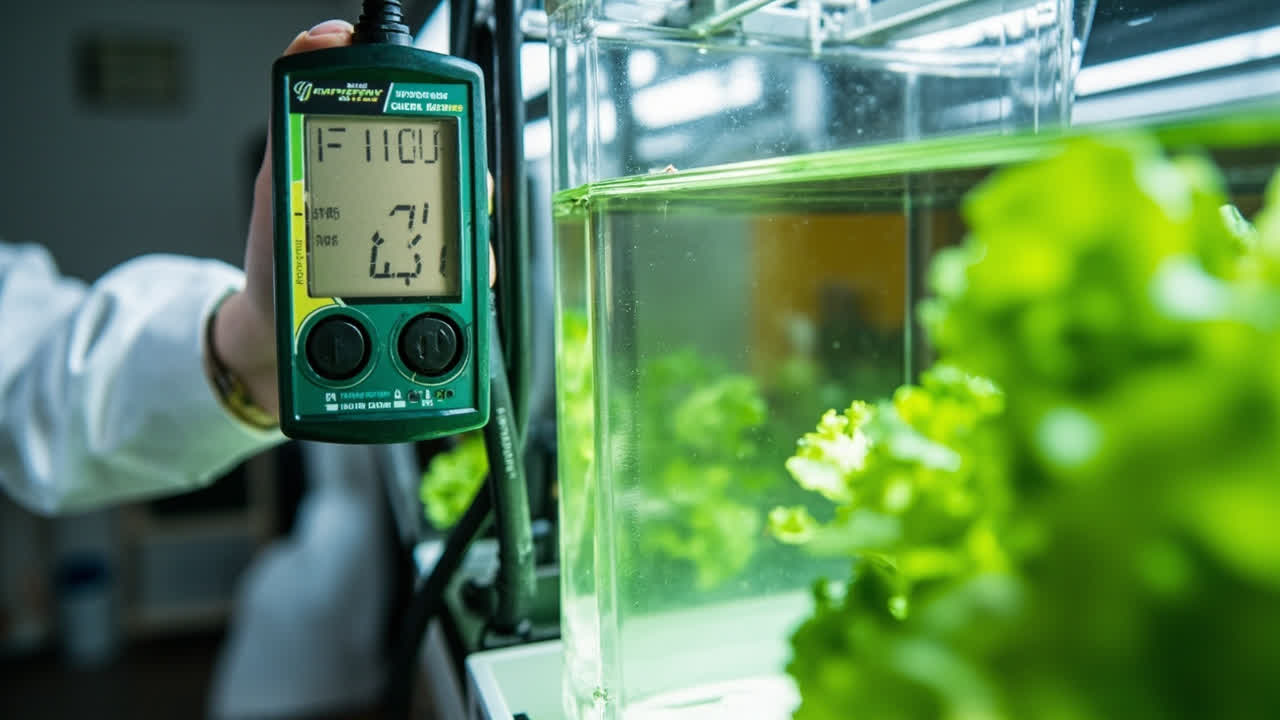
A TDS meter measuring the PPM of a hydroponic nutrient solution — the reading tells you exactly how concentrated the solution is before adjusting.
How to Measure and Adjust PPM Correctly
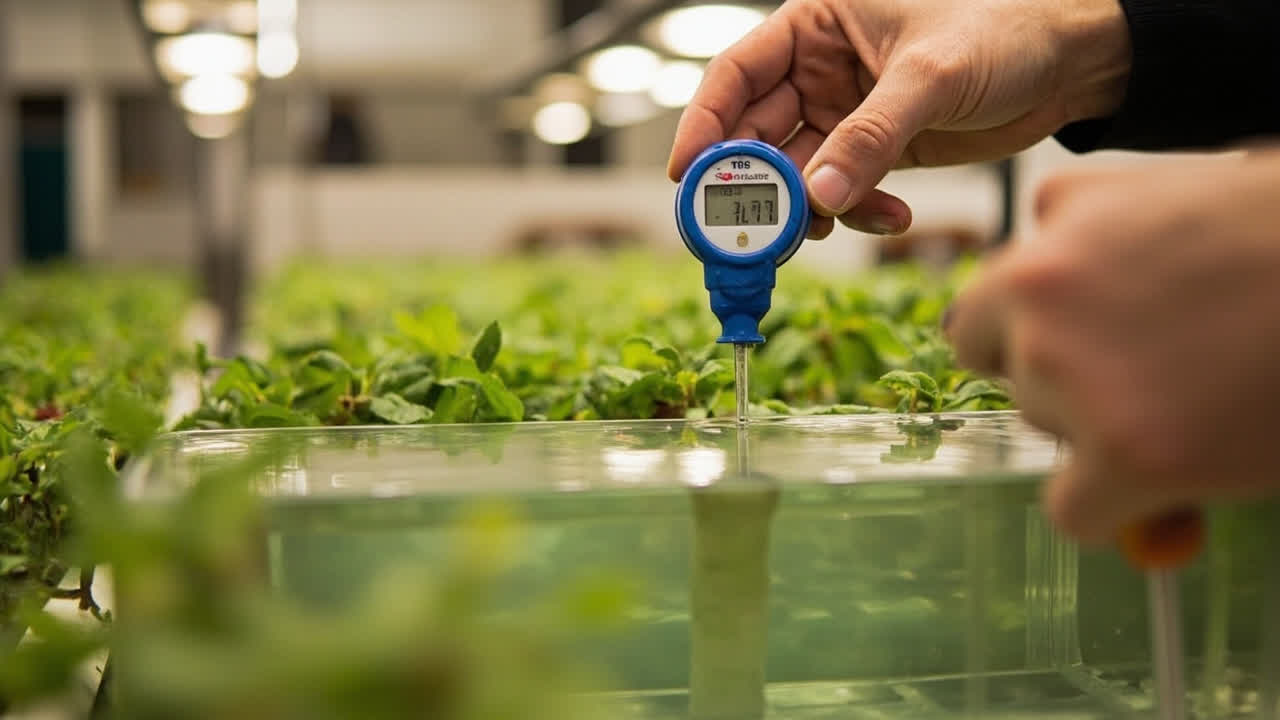
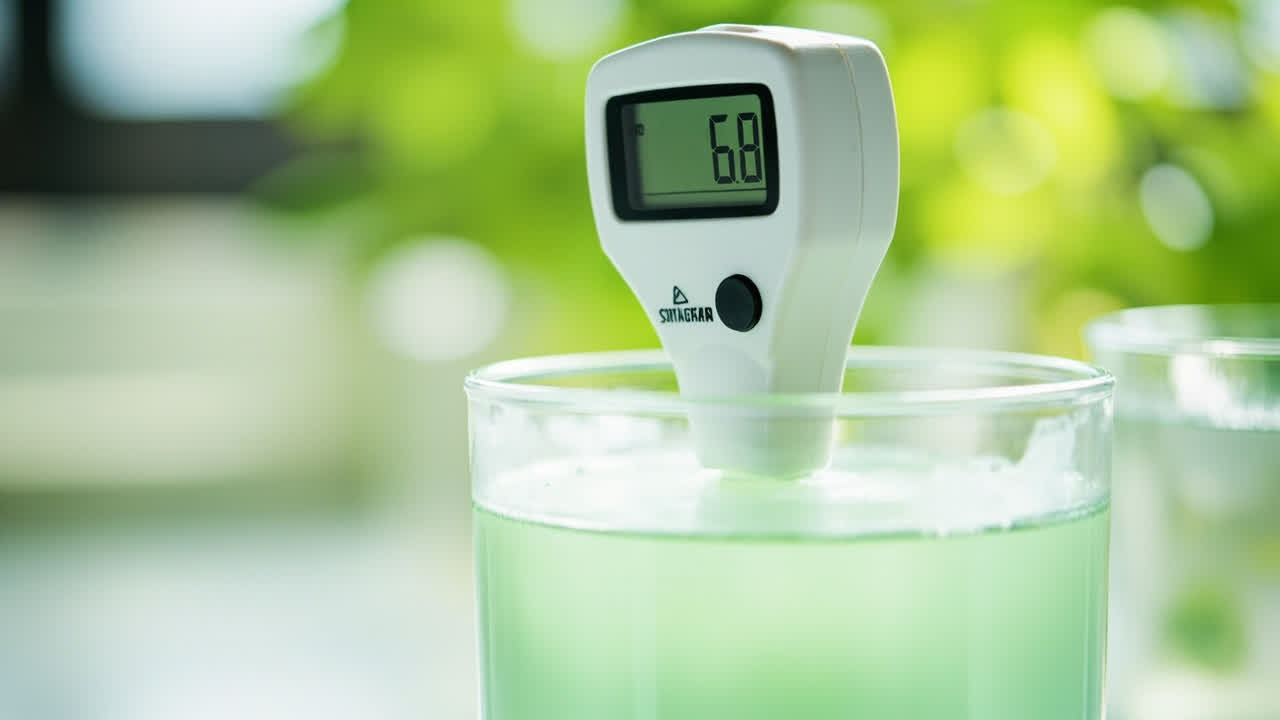
Measuring PPM is straightforward: calibrate your meter according to the manufacturer’s instructions using a 500 or 1000 PPM calibration solution, rinse the probe with clean water, and dip it into your nutrient reservoir. Wait ten to fifteen seconds for the reading to stabilize. Note the temperature — some meters auto-compensate, others require you to adjust the reading for temperature. Record the reading alongside your reservoir’s pH.
If your PPM is too low, add nutrient solution in small increments — roughly 100 PPM at a time — re-measuring after each addition. If your PPM is too high, add clean pH-balanced water in measured amounts. Never add nutrient concentrate directly to a running system without dilution — this can cause localized nutrient burn at the root zone.
PPM in a living system changes over time. Plants absorb nutrients from the solution, which lowers PPM. Water evaporation from the reservoir raises the concentration. Topping up with plain water when PPM drops slightly will bring concentration down further if you are not careful — you need to track both the PPM and the total reservoir volume. Many growers find that a weekly full reservoir change — emptying, cleaning, and remixing fresh solution from scratch — produces more consistent results than trying to maintain and adjust a single reservoir over two to three weeks.
PPM vs. EC: Which to Use and When
EC (electrical conductivity) is generally the more scientifically accurate measurement because it does not depend on a conversion factor. When a nutrient formulation gives you an EC target, it is giving you a direct reading that works regardless of which PPM scale your meter uses. If you are serious about hydroponics — if you are running multiple systems, growing different crops simultaneously, or troubleshooting chronic underperformance — an EC meter is a better investment than a basic TDS/PPM meter.
The relationship between EC and PPM is straightforward for most hydroponic nutrients: multiply the EC value in mS/cm by approximately 500 to get PPM on the most common scale. A solution at 2.0 mS/cm EC is roughly equivalent to 1000 PPM. This conversion varies slightly between nutrient brands because different ion combinations conduct electricity differently, but for most practical purposes, the 500x multiplier is close enough.
Common PPM Mistakes and How to Avoid Them
Starting too high with seedlings: This is the most common beginner error. Seedlings and rooted cuttings in rock wool or clay pebbles should start at 200–400 PPM, not the 800–1200 PPM the nutrient bottle might suggest for vegetative plants. Their root systems are not developed enough to process concentrated nutrients, and the resulting salt burn can kill them within days.
Not accounting for base water PPM: If your tap water reads 150 PPM on its own, and you target 1000 PPM total, you only need to add enough nutrient concentrate to reach 850 PPM of added dissolved solids. Adding concentrate to reach 1000 PPM on top of your 150 PPM base water gives you 1150 PPM total — roughly 15% over your target.
Ignoring pH after adjusting PPM: Adding nutrient concentrate or plain water to adjust PPM almost always shifts pH slightly. Always re-check pH after a PPM adjustment and correct if needed. A nutrient solution at the right PPM but wrong pH is as unusable by the plant as one at the wrong PPM entirely.
Using a meter past its calibration: TDS meters drift. The calibration solution that came with your meter has an expiry date. If you have not calibrated in two to four weeks of regular use, your PPM reading might be off by 10–20%, which is enough to push you outside the target window for sensitive crops.
What to Do Now
If you are not already measuring PPM in your hydroponic system, start today. A basic TDS meter costs $15–25 and is the single most useful tool for understanding what your plants are actually experiencing. Calibrate it against a known standard if you have not used it in more than two weeks.
Measure your current reservoir’s PPM, compare it to the target range for your crop and growth stage, and adjust accordingly. If you are within range, note that reading as your baseline. If you are outside the range, adjust in small increments and re-check after 30 minutes. Within a week of consistent monitoring, you will have a much clearer picture of what is actually happening in your system — and your plants will respond with noticeably better growth as a result.
Turn any PDF statement into a clean sheet
Skip the typos and the hours of copying. Our converter handles any bank statement format and outputs Excel, CSV, or QBO for QuickBooks. No file retention, free to try.
Meet Samuel, a passionate gardening enthusiast and lifelong learner.
With a deep love for all things green, Samuel spends his days exploring the latest gardening trends and technologies.
Whether it's trying out new techniques or discovering innovative tools, he is always eager to enhance her gardening skills.
Join Samuel on her journey as he shares experiences, tips, and the joy of nurturing nature!