Root rot in a deep water culture system does not announce itself with dramatic symptoms. The first signal is usually a quiet week of slower nutrient uptake — the reservoir level stops dropping at the rate it did the week before. By the time the roots turn brown and the reservoir smells sour, the damage is already measured in lost yield. Caught in the first 7 to 10 days, Pythium root rot is recoverable in most systems. Caught in week 3, it usually takes the crop with it.
The cause is not “too much water.” Roots rot in DWC because Pythium, a pathogenic oomycete, outcompetes the beneficial bacteria that normally coat the root surface. Three conditions have to align before that happens: dissolved oxygen below 5 ppm, reservoir temperature above 68°F (20°C), and a small amount of organic debris in the water. Each is controllable without special equipment, which is why Pythium in DWC is almost always a management failure rather than a pathogen problem.
This article walks through the symptom progression in order (signals 1 to 4 over 10 to 14 days), the six-step recovery that saves most crops when started in week 1 or 2, the four causes of recurrence, and the one temperature rule that prevents Pythium from coming back. If more than 60% of the root mass has turned brown and slimy by the time you reach the diagnostic step, replacement is faster than recovery — the article ends with the threshold for that decision.
What Actually Causes Root Rot in Hydroponics (It’s Not Just Water)
The common explanation is “too much water,” but in DWC the roots are always in water — that is the point of the system. Roots rot because Pythium, a water-mould organism, multiplies faster than the beneficial bacteria coating the root surface when three conditions align. Without all three, infection stays at a manageable level and the plant grows fine. The conditions are:
- Dissolved oxygen drops below 5 ppm. Roots in still water consume oxygen faster than it can be replaced. At 77°F (25°C), root respiration speeds up significantly, making low-oxygen conditions worse. Airstone output that’s adequate at 65°F (18°C) becomes inadequate at 75°F (24°C) because warmer water holds less gas.
- Reservoir temperature rises above 68°F (20°C). Warmer water holds less oxygen and sits inside Pythium‘s preferred growth range of 59 to 86°F (15 to 30°C). Below 65°F (18°C), Pythium activity slows dramatically; above 70°F (21°C), it doubles roughly every 48 hours.
- Organic debris accumulates in the reservoir. Sloughed root tips, algae film on the reservoir walls, and unconsumed nutrient solution provide the carbon source Pythium needs to bloom. A clean reservoir with a balanced root mass almost never breaks out.
The good news: every one of these is a measurement or a cleaning, not a piece of equipment. University of Florida IFAS Extension guidance, updated in 2024, confirms that holding reservoir temperature at 65 to 68°F (18 to 20°C) is the primary non-chemical control — even before beneficial bacteria and hydrogen peroxide treatments are added. If you can hold the water cool, you can avoid Pythium outbreaks in 90% of home DWC systems. For system setup and pump selection that supports this, see the deep water culture setup walkthrough.
Four Early Warning Signs Before the Smell
Roots do not go from white to brown overnight in DWC. There is a 7 to 14 day window where the problem is reversible, and the signals arrive in a predictable order. Watch for them in this order of reliability — the lower in the list, the further the infection has progressed.
Signal 1 : Growth Stalls When Conditions Are Unchanged
If your nutrient solution is at the correct pH and EC but the plant suddenly slows its uptake — the reservoir level stops dropping at its usual rate, or leaf expansion flattens for 4 to 5 days in a row — that is signal 1. It means the root surface area active in nutrient uptake has decreased. The cause is biofilm coating the root tips from early Pythium colonization, blocking nutrient exchange before the roots change colour. This signal is subtle enough that most growers miss it for a week.
Signal 2 : Roots Lose Their White Color
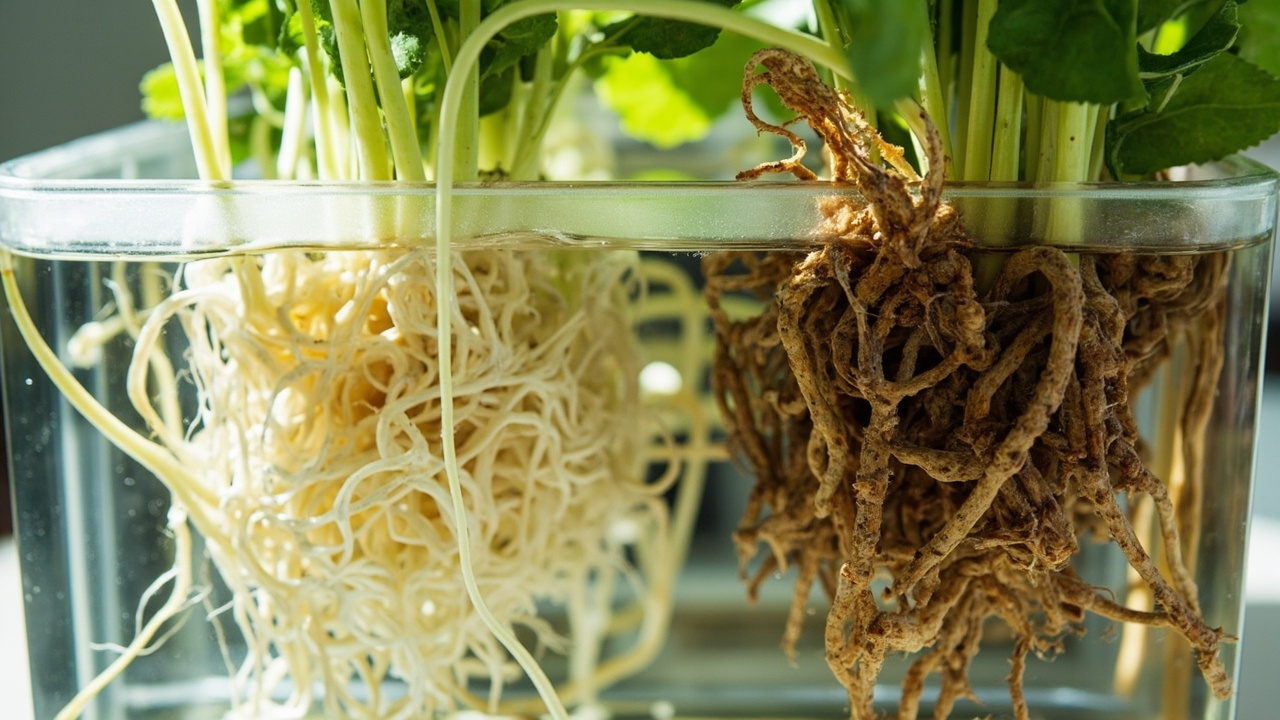
Healthy DWC roots are firm, white to cream-coloured, sometimes with a translucent quality when held under light. Early Pythium infection shows as a greyish or tan tint that is hard to photograph but obvious when you touch them — the roots feel slightly slimy rather than smooth. The slime is a biofilm the pathogen builds to anchor itself and resist your treatment later. Inspect roots weekly once plants are 3 weeks old; pull the lid briefly and look. By the time you notice a smell, you should have seen this signal 5 to 7 days earlier.
Signal 3 : Reservoir Temperature Climbs Above 70°F (21°C) for 3+ Days
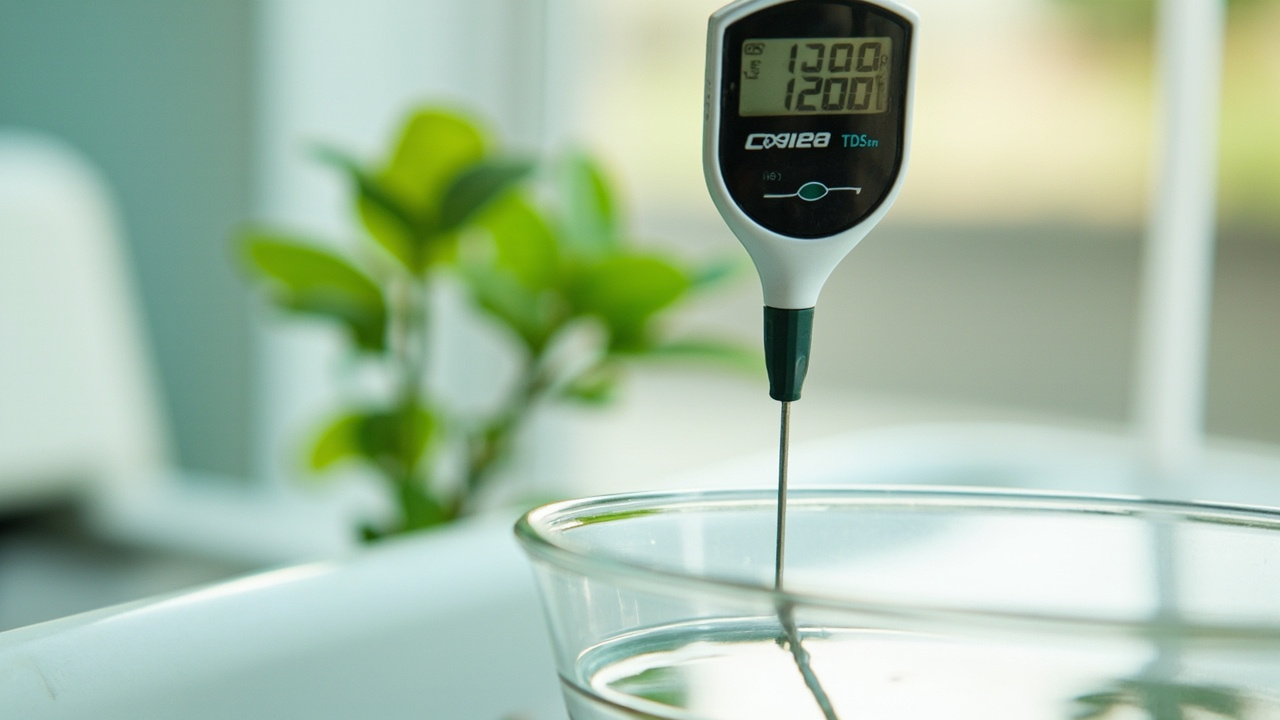
If you are not measuring water temperature, start now. A digital probe costs under $15 and takes 10 seconds to read. Pythium activity increases sharply above 68°F (20°C), and the effect compounds: warmer water holds less oxygen, which stresses roots, which makes them more susceptible. Holding reservoir water at 65 to 68°F (18 to 20°C) makes the environment far less hospitable without harming most vegetables. For an air-pump and reservoir setup that holds this range through summer, see the reservoir water temperature guide.
Signal 4 : The Smell, A Late Signal
Ammonia and a rotten-egg or sulfur odor from the reservoir means the root mass is already significantly damaged. This signal arrives last because the anaerobic bacteria producing the smell need dead root tissue to feed on — by the time they are producing noticeable odor, the Pythium bloom has been underway for 7 to 14 days. Cutting away affected roots and treating with hydrogen peroxide is still possible, but expect to lose some plants in the system. The decision threshold is below in the recovery section.
The Six-Step DWC Recovery That Actually Works
Once signals 1 or 2 have been present for 2 to 3 days, run all six steps in this order. Skipping steps or doing them out of order is the most common reason root rot recurs within 14 days. The full procedure takes 90 to 120 minutes for a single 5-gallon reservoir, longer for larger systems. Plan for half a morning.
Step 1: Remove the affected plant from the system immediately. Do not try to treat a plant while it remains connected. Pythium zoospores swim through water; leaving the plant in place gives the pathogen 24 to 48 hours to colonize healthy roots on neighbouring plants. Lift the net pot out, set the plant on a clean tray, and keep the root mass moist but not submerged while you work. If multiple plants are affected, treat them one at a time and sterilize your shears between plants.
Step 2: Rinse the root mass under cool running water. Work through the root bundle with your fingers and cut away any section that is brown, soft, or slimy. Leave only firm, light-coloured roots, even if it means removing 30 to 40% of the root mass. This is messy work; wear gloves and do it over a sink, not over the reservoir. Sterilize the shears with rubbing alcohol between cuts if you are unsure whether the disease has crossed into the cream-coloured roots.
Step 3: Treat the remaining healthy roots in a 3% hydrogen peroxide solution for 5 minutes. Mix 2 tablespoons of 3% H2O2 (the brown bottle from any drugstore) per gallon of cool water. Submerge only the root mass, not the crown or stem. Do not exceed this concentration — the 35% food-grade concentrate that some growers advocate burns fine root hairs within 30 seconds, and the plant loses the very tissue it needs to recover. After 5 minutes, lift and let drain on a clean tray. For a fuller explanation of ppm, EC, and what your reservoir should look like during this phase, see the ppm and dissolved oxygen guide.
Step 4: Clean the reservoir and all hydroponic tubing. Empty the nutrient solution completely. Scrub the reservoir with a 5% hydrogen peroxide solution (about 1 part 3% H2O2 to 1 part water), then rinse three times with clean water. Pay attention to the water level corners and the lid — algae film on these surfaces is a Pythium food source. If your system uses tubing, fill the tubing with the same 5% solution for 10 minutes, then flush with clean water three times. Replace net pots and any clay pebble or rockwool substrate that came in contact with infected roots; these cannot be fully sterilized at home.
Step 5: Refill with fresh nutrient solution at 65 to 68°F (18 to 20°C). Mix to your usual EC and pH (most leafy greens at 1.2 to 1.6 EC, fruiting crops at 2.0 to 2.4). Add a commercial beneficial-bacteria product such as Bacillus-based HydroGuard at the rate on the label — this recolonizes the root zone with competing organisms that suppress Pythium re-establishment. Beneficial bacteria alone will not cure an active infection; they prevent the next one. This step is non-negotiable if you want the recovery to last.
Step 6: Monitor water temperature every 24 hours for the next 14 days. A clean system with reservoir water at 70°F (21°C) is still a Pythium-friendly environment. Read the water temperature at the same time each day. If it creeps above 70°F (21°C), take action before the next reading: move the reservoir to a cooler room, add a frozen water bottle swap on the budget end, or install a reservoir chiller for systems larger than 10 gallons. The 14-day window matters because Pythium recolonizes from residual spores in 7 to 10 days when the environment stays warm.
Why Root Rot Comes Back After You Clean the System
The most common reason root rot recurs in the same system within 14 to 21 days is that one of the three trigger conditions was never addressed. The peroxide treatment knocks back the pathogen population, but it does not change the environment that allowed Pythium to win in the first place. Walk through these causes in order.
Recurrence Cause 1 : Reservoir Temperature Was Never Held Below 68°F (20°C)
If your reservoir was running at 72 to 75°F (22 to 24°C) when the original outbreak happened and you cleaned without changing temperature, Pythium will recolonize within 7 to 10 days. The clean water, the new beneficial bacteria, the trimmed roots — none of it matters if the environment is the same. This is the most common recurrence cause by a wide margin. There is a trade-off worth naming: cooler nutrient solution slows plant growth slightly in some crops, particularly warm-season vegetables like tomatoes and peppers, where a 5°F (3°C) drop in reservoir temperature can reduce growth rate by 10 to 15%. But a 15% growth reduction beats losing the entire crop to root rot. For ongoing reservoir care through the growing season, see the reservoir maintenance routine.
Recurrence Cause 2 : Organic Matter Remained in Net Pots or Substrate
If dead root material from the previous infection remains in clay pebbles, rockwool cubes, or net-pot mesh, it feeds the next Pythium bloom within 14 days. Hydrogen peroxide does not penetrate substrate the same way it does free water. Replace net pots and any substrate that contacted infected roots. Clay pebbles can be reused if you bake them at 200°F (93°C) for 30 minutes in a kitchen oven — this sterilizes them without melting or releasing chemicals. Rockwool cannot be sterilized at home economically; replace it.
Recurrence Cause 3 : Air Pump Output Dropped Without Notice
Airstones clog, diaphragms in air pumps fatigue, and tubing develops micro-leaks at connections — all without obvious symptoms. If you have a recurrence within 14 days and the water temperature is controlled and the system is clean, the air pump is the next suspect. Measure dissolved oxygen if your meter supports it; below 5 ppm despite a visibly bubbling airstone means the pump is no longer delivering. Most diaphragm pumps lose 30 to 40% of their output between month 6 and month 12, well before they fail outright.
Monitoring Protocol: Hold the System at 65 to 68°F (18 to 20°C)
Prevention is a daily, weekly, and monthly check — not equipment. The single most important lever is reservoir temperature; everything else follows from it. Adopt this protocol and the chance of a recurring outbreak drops to near zero in most home DWC systems.
- Daily (10 seconds). Read reservoir temperature at the same time each day, ideally when the air temperature is at its peak. A digital probe with a 1-meter cable costs under $15 and survives years of daily use. The target is 65 to 68°F (18 to 20°C); above 70°F (21°C) for 3 days in a row means action.
- Weekly (5 minutes). Check pH and EC. Roots under stress shift pH faster than healthy roots, and a pH drift outside your crop’s range is itself a stress multiplier. For most leafy greens, pH 5.8 to 6.2 and EC 1.2 to 1.6; for fruiting crops, pH 5.5 to 6.5 and EC 2.0 to 2.4. The interaction between pH and nutrient uptake is detailed in the pH in hydroponics guide.
- Monthly (15 minutes). Lift each plant briefly and inspect 4 to 6 roots for colour and firmness. White and firm is the target. Grey or tan and slightly slimy is signal 2 — start the six-step recovery within the week. Replace 25% of the reservoir water monthly even if everything looks healthy, and rinse the lid and reservoir walls to prevent algae film buildup.
If ambient air climbs above 80°F (27°C) for more than 3 days running — a heat wave, a heat-pump failure in summer — add a temporary chiller or move the system to a basement corner. The frozen-water-bottle swap works for systems under 10 gallons: freeze four 1-liter bottles, swap them in 4-hour rotations, and expect to lose some growth to the temperature swings. For larger systems, a 1/10 HP reservoir chiller runs $200 to $300 and pays for itself in one saved crop.
When to Give Up on the Plant and Start Over
Not every plant is worth a six-step recovery. The threshold below 30% firm white roots — measured by eye as you work through the root mass during step 2 of the recovery — is the line at which replacement is faster than revival. A plant past 60% root loss usually fails to recover, and worse, the time you spend monitoring it for three weeks infects the rest of the system.
- Less than 30% firm white roots. Replace the plant. Disinfect the net pot and the section of reservoir the plant occupied; the next plant benefits from a clean start.
- 30 to 60% firm white roots. Run the full six-step recovery. Expect 14 to 21 days of monitoring before new root growth is visible.
- More than 60% firm white roots. Recovery is near 100%. Run the six-step anyway as prevention — neighbouring plants are likely at signal 2 even if you have not seen symptoms.
Replanting a seedling is faster than reviving a mature plant past 60% loss, and the energy spent on a borderline case is energy not spent on the rest of the system. For the broader set of DWC problems beyond Pythium — algae, pH drift, deficiencies — see the hydroponic problems and solutions hub.
Turn That PDF Into a Spreadsheet in Minutes
You've seen how to do it manually — now let the tool handle the heavy lifting. Upload your bank statement and get Excel, CSV, or QBO in a few clicks.
Try It Free