
Rockwool is an inert growing medium made from molten basaltic rock and chalk, spun into dense fibers and pressed into cubes, slabs, or loose floss. It holds roughly 80% of its volume as water while retaining 20% air space — a balance that prevents root rot in hydroponic systems where roots sit in constant contact with moisture. Unlike perlite or clay pebbles, rockwool does not break down over time, so its physical properties remain stable across multiple growing cycles.
The critical property that makes rockwool work for hydroponics is capillary action. The dense fiber matrix draws water upward from a reservoir or nutrient solution, keeping the root zone evenly moist without waterlogging. In an ebb-and-flow system, a rockwool slab absorbs solution during the flood cycle and holds it for 2-4 hours during the drain phase, depending on ambient temperature and humidity. At 70°F (21°C) with 60% relative humidity, a saturated 4-inch cube releases roughly 60% of its water content within 3 hours — fast enough to prevent root suffocation, slow enough to avoid drought stress between flood cycles.
This guide covers how rockwool works physically, which hydroponic systems it suits best, how to prepare and handle it safely, and the limitations that make it wrong for some setups.

How Rockwool Works as a Hydroponic Medium
Rockwool’s fiber structure creates a matrix of interconnected pores. These pores hold water through capillary action — the same force that draws water up a paper towel — while excess water drains freely through larger channels. The result is a medium that stays moist at the root zone while allowing oxygen to reach the roots. This is the fundamental requirement for hydroponic root health: roots need both water and oxygen simultaneously, and most media fail at one or the other.
The physics matter because hydroponic roots behave differently from soil roots. In soil, roots grow toward water and oxygen gradients. In hydroponics, roots are suspended in a uniform medium — if the medium holds too much water, oxygen drops below the 5-6 mg/L minimum most crops need and roots begin to suffocate. Rockwool’s 20% air-filled porosity at field capacity keeps dissolved oxygen above this threshold, which is why it performs well in systems where roots are constantly wet.
Rockwool has no cation exchange capacity — it does not hold or buffer nutrients the way soil or coco coir does. This is an advantage because it means the nutrient solution you mix is exactly what the roots receive. No hidden reserves, no unexpected lockouts. But it also means there is no safety net: if your nutrient solution is wrong, the plant feels it immediately. This is why pH and EC monitoring matter more with rockwool than with buffered media like coco.
Which Hydroponic Systems Work Best with Rockwool
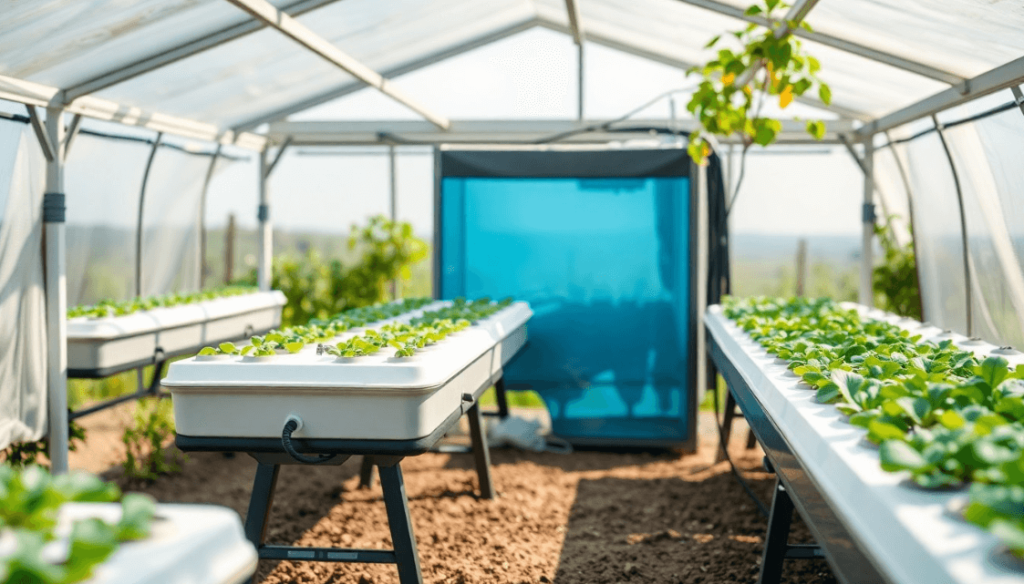
Rockwool performs best in ebb-and-flow and drip systems where the medium is periodically flooded and drained. The flood cycle saturates the rockwool; the drain cycle pulls fresh oxygen into the pore space. This wet-dry rhythm mimics the natural soil moisture cycle that roots evolved to expect. In deep water culture, rockwool cubes work as starter plugs for seedlings and cuttings, but slabs perform poorly because they stay saturated for too long without a drain phase.
In nutrient film technique (NFT), rockwool is generally a poor choice. NFT relies on a thin film of solution flowing past bare roots — adding rockwool restricts flow and can create stagnant zones where algae and biofilm accumulate. For NFT, net pots with clay pebbles or bare-root systems outperform rockwool consistently.
Aeroponics is incompatible with rockwool. The medium restricts root exposure to the misting chamber, and the fibers break down under high-pressure misting, clogging nozzles. If you are running aeroponics, use foam collars or bare-root systems instead.
Preparing Rockwool for Use
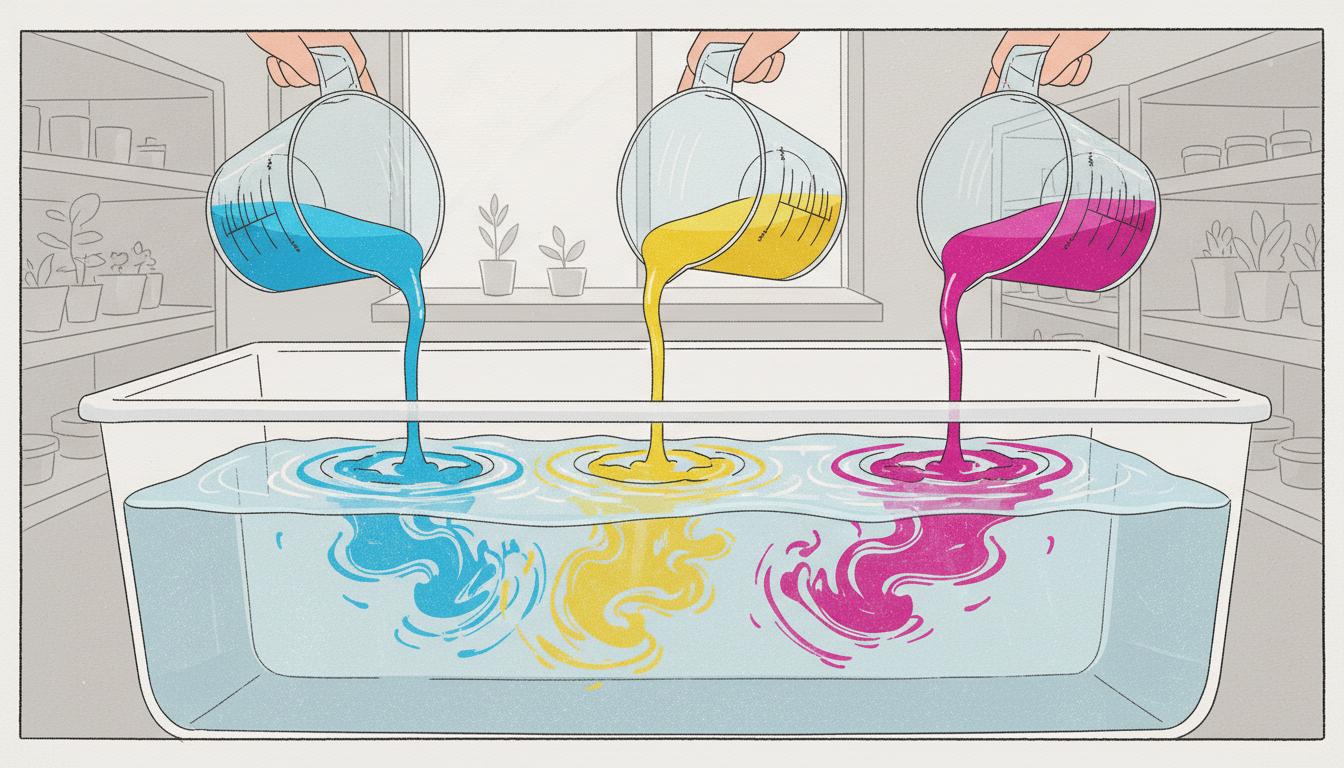
Fresh rockwool has a pH of 7.0-8.0 — too alkaline for most hydroponic crops, which prefer 5.5-6.5. Before planting, soak rockwool in pH-adjusted water (5.5-6.0) for 24 hours. This pre-soak brings the medium’s pH into the acceptable range and removes air pockets that can dry out root tips. After soaking, the rockwool should feel heavy but not dripping — squeeze gently to remove excess water before placing plants.
Seedlings and cuttings root directly into 1.5-inch rockwool cubes. The cube size matters: too small and the root ball dries out between waterings; too large and the center stays waterlogged. For lettuce, basil, and herbs, 1.5-inch cubes transplanted onto 4-inch slabs work well. For larger crops like tomatoes and cucumbers, start in 2-inch cubes and transplant to 6-inch slabs. The transplant timing matters — wait until roots emerge from the cube bottom before moving to the slab, typically 10-14 days after germination at 70-75°F (21-24°C).
Handling and Safety
Rockwool dust irritates skin, eyes, and lungs. Always wear gloves and a dust mask when cutting or breaking apart dry rockwool. The fibers are not carcinogenic like asbestos, but they are mechanical irritants — prolonged exposure causes dermatitis and respiratory discomfort. Pre-soaking eliminates airborne dust, so handle dry rockwool briefly and soak immediately.
Rockwool is not biodegradable. Used slabs do not compost and should not be added to garden soil — the fibers persist for decades. Some commercial operations shred and recycle rockwool into insulation, but home growers should dispose of it in general waste. This is a genuine environmental drawback: rockwool reduces water and pesticide use during operation but creates persistent waste at end of life.
Limitations and Trade-offs
Rockwool’s main limitation is its water holding capacity in cool conditions. Below 60°F (15°C), evaporation slows and rockwool stays wet for days longer than at 70°F (21°C). This creates root rot risk in winter or in air-conditioned spaces. If your growing environment regularly drops below 60°F, consider coco coir instead — it holds less water and drains faster in cool conditions.
Rockwool also has no buffering capacity against nutrient errors. If you mix a solution at the wrong pH or EC, the plant has no protection. Soil and coco coir both buffer minor mistakes; rockwool transmits them directly to the roots. This makes it less forgiving for beginners who are still learning to mix and monitor nutrient solutions.
Finally, rockwool is single-use for most home growers. While commercial operations sterilize and reuse slabs for 2-3 cycles, the sterilization process (steam at 212°F / 100°C for 30 minutes) is impractical at home. Budget for fresh rockwool each growing season — roughly $0.50 per 1.5-inch cube and $3-5 per 4-inch slab.
For a full comparison of hydroponic growing media, see our guide to choosing the right hydroponic medium and our hydroponics system guide.
From PDF to Excel in one click
Forget retyping line by line. Upload any bank statement, get a spreadsheet you can actually use. Your files are never stored, and you can test the converter with 3 free conversions.
Try it free