Haworthia and Aloe vera are frequently confused at the garden center because both form rosettes of fleshy succulent leaves and both are sold as beginner-friendly houseplants. The confusion matters because their care requirements diverge in three critical areas: light tolerance, watering frequency during dormancy, and cold sensitivity. Treating a Haworthia like a mini Aloe leads to sunburn and dehydration; treating an Aloe like a Haworthia leads to etiolated stretching and weak leaf structure. This comparison covers the five key differences that determine which plant fits your home and how to care for each one correctly once you know which you own.
Rosette Structure: Leaf Thickness and Window Patterns
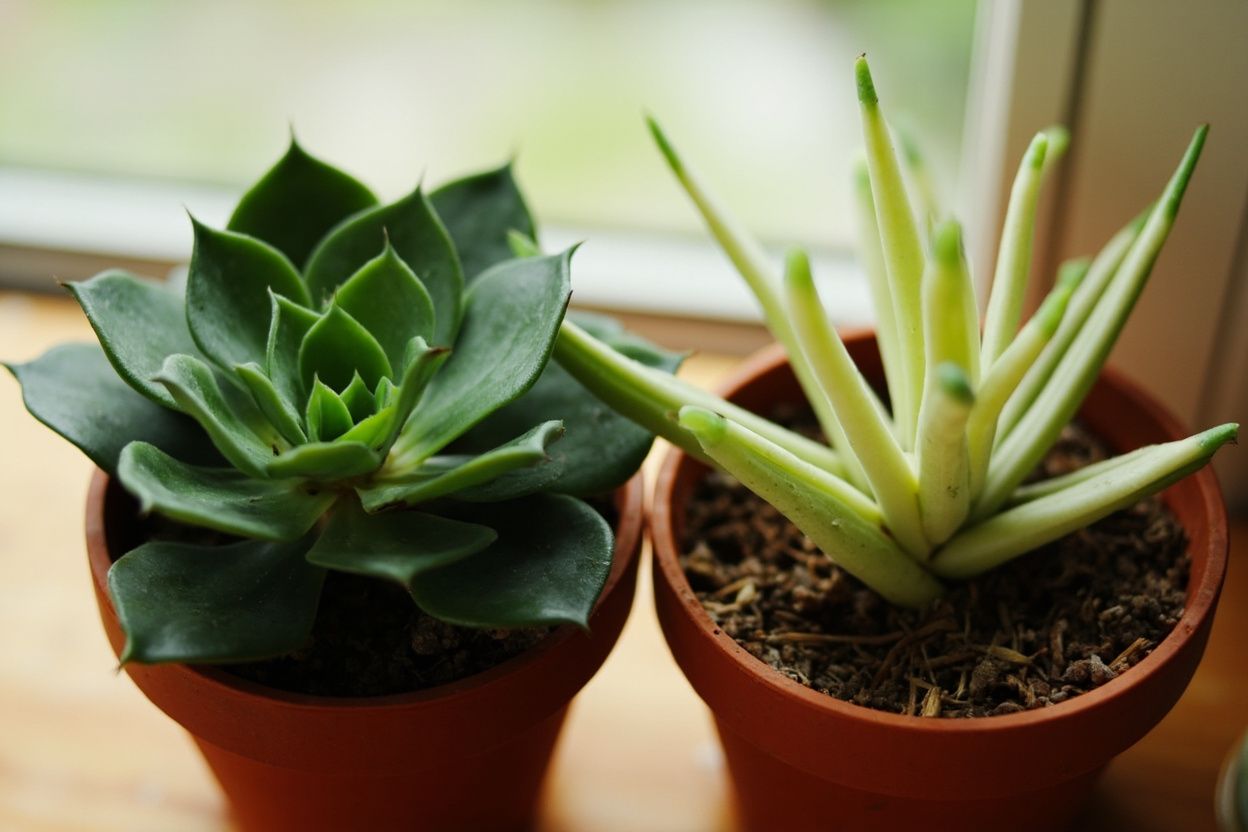
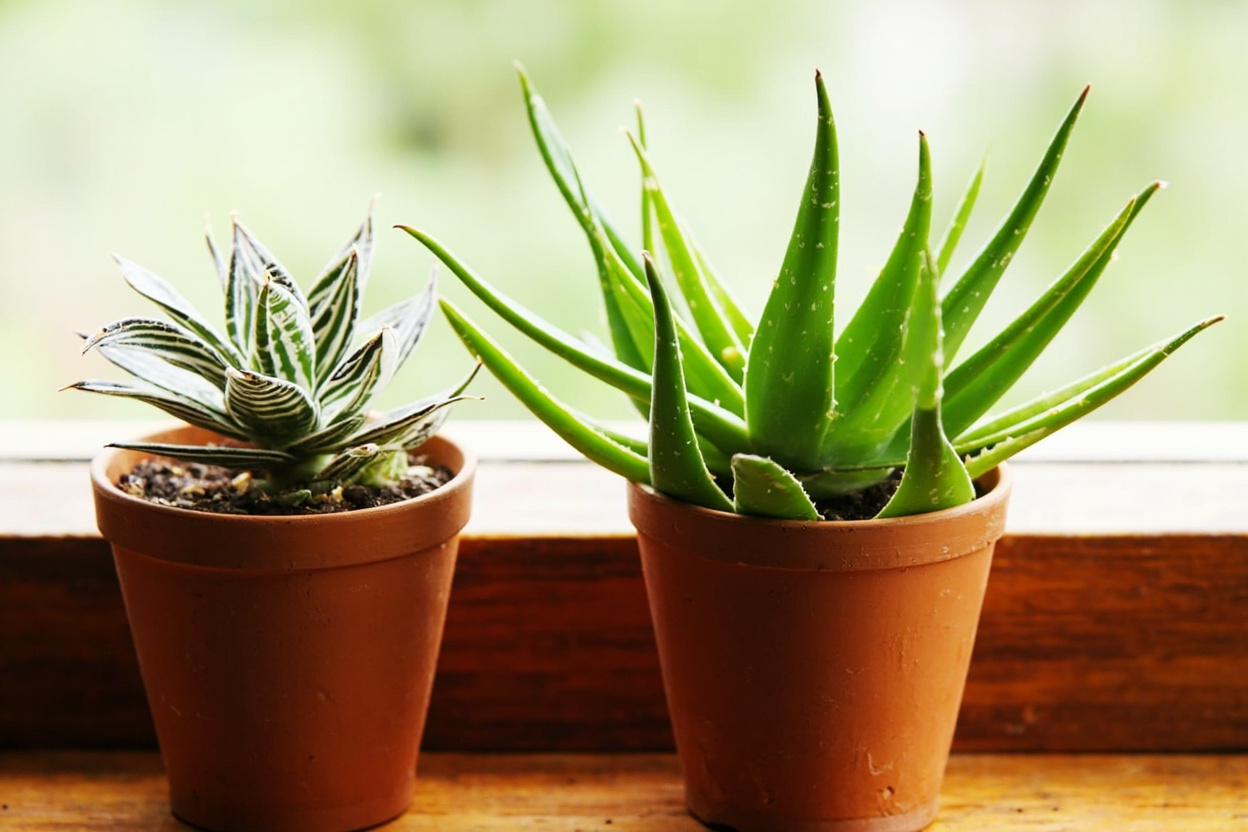
The quickest visual identifier is the leaf surface. Haworthia leaves have distinctive translucent tips or bands called windows — clear epidermal cells that allow light to penetrate deeper into the leaf for photosynthesis in low-light conditions. These windows appear as striped bands on Haworthia attenuata and fasciata (the zebra plant) or as clear tips on Haworthia cooperi and cymbiformis (the window plant). The leaves are firm, triangular or lance-shaped, and grow in a tight, compact spiral that rarely exceeds three to four inches in diameter for most common species.
Aloe vera leaves lack windows entirely. The leaf surface is uniformly green or gray-green, sometimes with pale spots on young plants that fade as the leaf matures. The margins of Aloe leaves bear small white teeth — distinct saw-tooth edges that Haworthia does not have. Aloe vera leaves are significantly thicker, longer, and wider than Haworthia leaves, growing upright rather than spreading horizontally. A mature Aloe vera rosette can reach twelve to eighteen inches in diameter, while a mature Haworthia rosette stays under six inches. If the leaf has teeth on the edges and no translucent patches, it is an Aloe. If the leaf has window patterns or banded white stripes on bumpy ridges, it is a Haworthia.
A less commonly known identifier is the tubercle arrangement. Haworthia leaves are surfaced with small, raised tubercles — white or pale bumps arranged in horizontal bands on zebra plant types or scattered irregularly on other species. These tubercles are tactile: running a finger along a Haworthia leaf feels rough or pebbled. Aloe vera leaves are smooth to the touch, with no tubercles at all, though some Aloe species have scattered white spots that fade as the leaf matures. The combination of rough texture and window patterns confirms Haworthia beyond any doubt.
Light Tolerance: Why Aloe Needs More Direct Sun
This is the most practical care difference between the two genera and the one most commonly mismanaged. Haworthia evolved on the shaded south-facing slopes of South Africa’s Cape mountains, where they grow under shrubs and rock overhangs that diffuse direct sunlight. Their natural habitat delivers bright indirect light — the equivalent of an east-facing windowsill two feet from the glass or a shaded south window. Direct afternoon sun burns Haworthia leaves within hours, turning the window patches white or brown as the thin leaf tissue overheats.
Aloe vera evolved in more open, arid terrain and tolerates — and prefers — several hours of direct morning sun. An Aloe placed in the same indirect spot as a Haworthia will stretch, droop, and develop thin, weak leaves that flop over the pot edge. The Haworthia light requirements guide provides foot-candle readings for Haworthia specifically; Aloe requires roughly double the daily light exposure, with at least three to four hours of direct sun during the growing season. A shared windowsill works only if the Haworthia is set back from the glass and the Aloe sits directly in the sunniest spot.
Watering Differences: Dormancy Cycles and Drought Response
Haworthia and Aloe both follow a soak-and-dry watering method, but their dormancy timing is opposite. Haworthia is a winter grower — it actively produces new leaves and roots during the cooler, shorter days of autumn and winter (October through February in the northern hemisphere) and enters a semi-dormant rest period during summer heat, when daytime temperatures consistently exceed 85 degrees Fahrenheit (30 degrees Celsius). During summer dormancy, Haworthia should be watered sparingly — about once every three to four weeks — to prevent root rot in warm, damp soil.
Aloe vera follows the reverse pattern: it grows actively in spring and summer and goes largely dormant in winter, when lower light and cooler temperatures slow its metabolism. Water Aloe vera every two to three weeks during the growing season and reduce to once a month or less during winter dormancy. The key difference is that Aloe can tolerate longer dry periods between waterings than Haworthia because its thicker leaves store more water. If you water both plants on the same schedule, the Haworthia will dry out faster and need more frequent watering during its active winter season, while the Aloe will rot if watered at the same frequency during its winter rest. The Haworthia watering guide has the seasonal schedule for active vs dormant months.
The potting mix preference also diverges. Haworthia requires a grittier, faster-draining mix than Aloe vera because its fine root system is more prone to rot in moisture-retaining organic soils. A standard Haworthia mix — one part potting soil, one part coarse sand or pumice, one part perlite — drains completely within seconds. Aloe vera tolerates a slightly higher organic content, up to fifty percent potting soil, because its thicker roots can handle brief moisture without rotting. Using an Aloe-appropriate mix for Haworthia retains too much moisture and invites root rot; using a Haworthia mix for Aloe vera requires more frequent watering because the mix dries out faster than the Aloe’s roots can absorb. The Haworthia soil mix guide has the specific ratio for the gritty mix that Haworthia requires.
Growth Habit: Offsets, Stems, and Mature Size
Both genera produce offsets — pups — around the mother plant, but they do so at different rates and with different spatial habits. Haworthia offsets grow tight against the base of the parent rosette, forming a dense clump that fills the pot evenly over several seasons. A three-year-old Haworthia cluster may have five to ten offsets packed into a four-inch pot, creating a mound of compact rosettes. Offsets can be separated and potted individually once they reach roughly one-third the size of the parent, typically after they have developed three to four roots of their own.
Aloe vera offsets emerge on short stolons — horizontal stems that extend one to three inches from the parent before the offset forms its own rosette. This gives Aloe pups a distinct stem connection that makes separation easier: you can cut the stolon cleanly without disturbing the parent’s root ball. Aloe vera also reaches a much larger mature size. While a mature Haworthia fills a four-inch pot, a mature Aloe vera requires an eight to ten-inch pot and may need repotting every twelve to eighteen months as the root system expands. The Haworthia propagation guide covers offset division timing for Haworthia specifically, including when to separate pups from compact clumps versus stolon-based offsets.
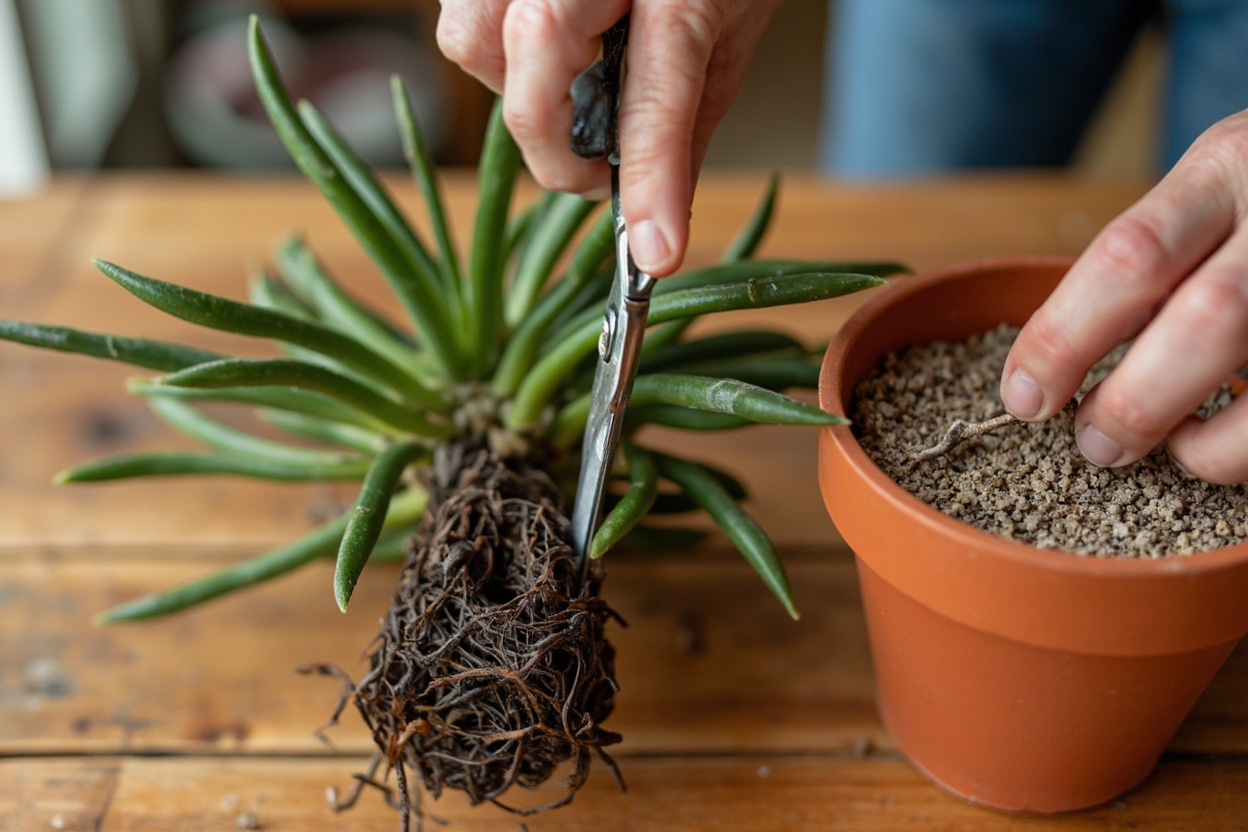
The root structure itself differs noticeably. Haworthia produces a network of thin, fibrous roots that spread horizontally just below the soil surface. These roots are fragile and break easily during repotting, which is why Haworthia recovers best from repotting in early autumn, just before its active growth season begins. Aloe vera produces thicker, fleshy roots that grow downward and outward more aggressively. An Aloe vera root ball that has filled a pot becomes a dense mass of pale, finger-thick roots that hold the potting mix together when lifted out of the container. The structural difference means Haworthia needs repotting only when offsets have physically overgrown the pot surface, while Aloe vera needs repotting as soon as roots appear at the drain holes, which happens more frequently due to the faster root expansion.
Common Care Mistakes: Applying Aloe Rules to Haworthia
The most frequent care error among owners who confuse the two genera is over-lighting the Haworthia and under-lighting the Aloe. A Haworthia placed in the same direct south window as an Aloe develops white or brown leaf tips within days and may lose its deeper green pigmentation entirely, leaving a pale, stressed rosette that looks bleached rather than healthy. Conversely, an Aloe kept in the same indirect east window as a Haworthia will develop leaves that are abnormally long, thin, and pale — the same etiolation pattern seen in stretched Haworthia but at a slower rate because Aloe can tolerate low light for longer before showing structural damage.
The second common mistake is repotting frequency. Haworthia thrives in tight pots and should be repotted only every two to three years, when the offsets have completely filled the pot surface. Aloe vera needs more frequent repotting because its root system expands faster and the larger leaves require a wider base for stability. A Haworthia in an oversized pot stays wet too long and rots; an Aloe in an undersized pot becomes top-heavy and tips over. The Haworthia repotting guide and the Aloe repotting guide have the specific pot sizing charts for each genus. If you own both, keep them in separate pot sizes and separate watering schedules from day one.
Which One Should You Grow: Space, Light, and Commitment
Choose Haworthia if your home has limited natural light — north or east-facing windows, shaded balconies, or rooms where direct sunlight never reaches the windowsill. Haworthia tolerates lower light levels than almost any other succulent and will maintain its compact rosette shape in conditions that cause other succulents to stretch. It is also the better choice for small spaces: a single Haworthia fits comfortably on a desk, bookshelf, or bathroom counter for years without outgrowing its pot. The plant’s slow growth and tight clumping habit mean you can leave it in the same container for two to three years without intervention, making it ideal for owners who prefer a low-maintenance plant that stays the same size.
Choose Aloe vera if you have a bright windowsill that receives at least three hours of direct morning sun and you want a larger, more sculptural plant that produces usable leaf gel. Aloe vera grows faster, offsets more aggressively, and reaches a more dramatic size within twelve to eighteen months. It is less forgiving of low light than Haworthia but more forgiving of missed waterings. For owners who want both, position the Aloe closest to the window and set the Haworthia back by twelve to eighteen inches, or place them in separate rooms with different light exposures. The Haworthia plant care guide has the full seasonal care calendar, and the Aloe vera care guide covers the reverse schedule for Aloe-dominant homes.
A practical note for mixed-collection owners: overwatering remains the single biggest threat to Haworthia when Aloe care habits bleed over, and underwatering is the parallel risk for Aloe kept in Haworthia-style indirect light. Check drainage holes monthly — a clogged hole in a terracotta pot creates waterlogged conditions that trigger leaf rot within days. In sun stress conditions (sudden heat waves or prolonged drought), Haworthia leaves may show scorch marks while Aloe leaves wilt — opposite symptoms that confuse owners who treat both genera identically. A simple grow light on a timer solves the humidity and light-balance problem for both plants in a shared indoor garden.
From Bank Statement to QuickBooks-Ready File
That manual cleanup you just read about? This tool skips it. Turn your PDF into QBO for QuickBooks without storing your data anywhere.
Start Converting