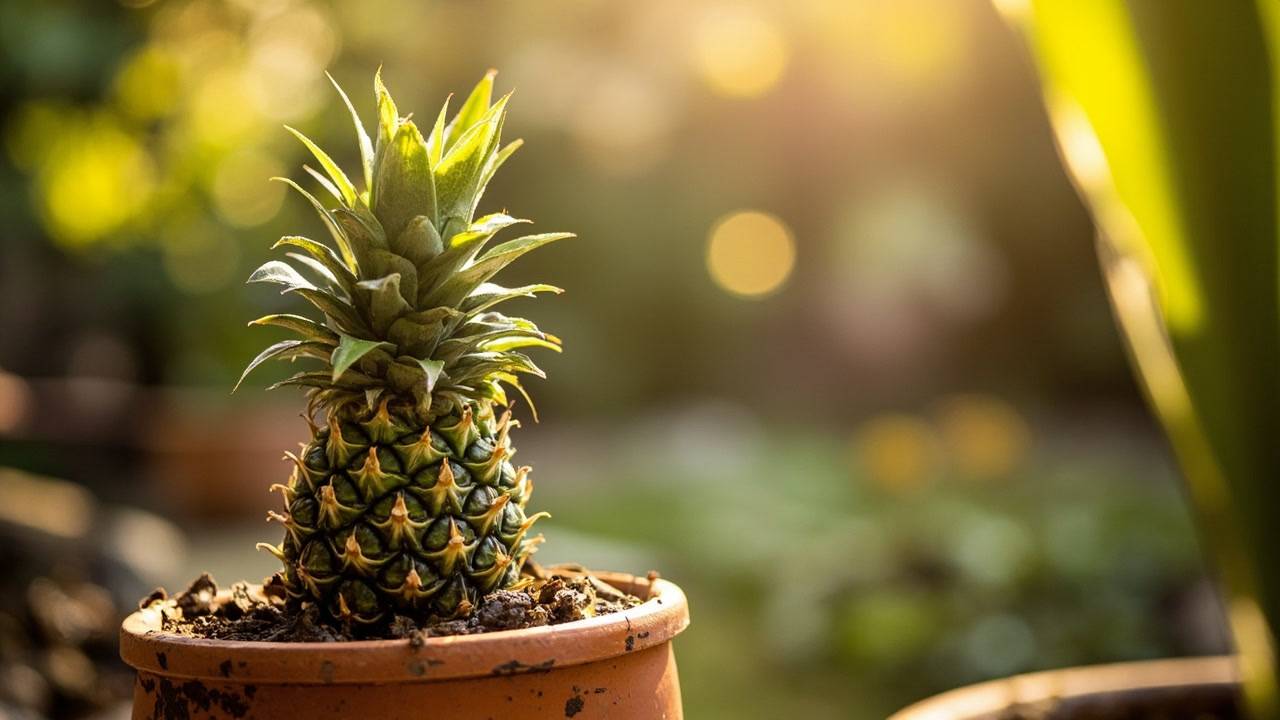
Here’s the thing about pineapple plants — pineapples didn’t evolve to live in dim corners. Ananas comosus grew up in open sunlight across tropical regions of South America, and that genetic expectation doesn’t disappear just because you’ve moved it to a windowsill in Brooklyn or a balcony in London.
Most people who struggle with pineapple plants indoors are not overwatering or underwatering. They’re underexposing.
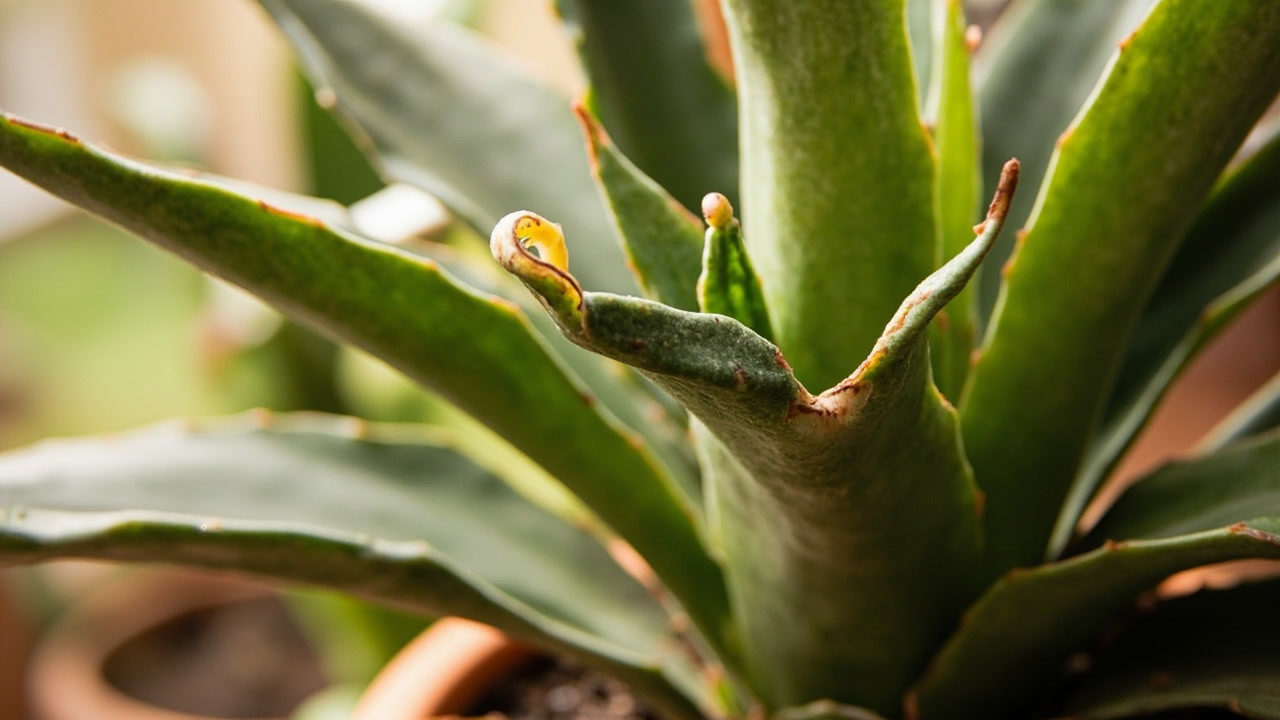
The plant tells you this in subtle ways at first — slower growth, leaves that look a little more grey than green, a center that refuses to push out new leaves. Then it gets obvious: the whole plant starts to look washed out, almost yellow-green, and you think it needs fertilizer when really it just needs more photons.
How Much Light Does a Pineapple Plant Actually Need?
The minimum is 6 hours of direct sunlight per day. That’s the line below which most pineapple plants will survive but not thrive. For vigorous growth — the kind that produces offsets and eventually a flower — aim for 8 to 10 hours.
Here’s the breakdown by light level:
- Full sun (8u201310 hours direct): Ideal. The plant will grow actively, produce glossy upright leaves, and have the energy to eventually flower and fruit.n
- 6u20138 hours direct: Acceptable for maintenance. The plant will survive and stay healthy but growth will be slow and fruiting may take years longer.n
- 4u20136 hours indirect or filtered: Marginal. The plant will gradually decline — slower leaf production, progressively paler foliage, no fruiting.n
- Less than 4 hours: Insufficient. The plant will stop growing altogether. Leaves will elongate unnaturally (etiolation) reaching for light, and the whole plant will look stretched and unhealthy.nn
One thing to understand: pineapple plants are not shade-tolerant. They can handle brief periods of lower light, but sustained underexposure causes a progressive decline that’s hard to reverse once the roots start weakening.
Indoor Light Guide: Where to Place Your Pineapple Plant
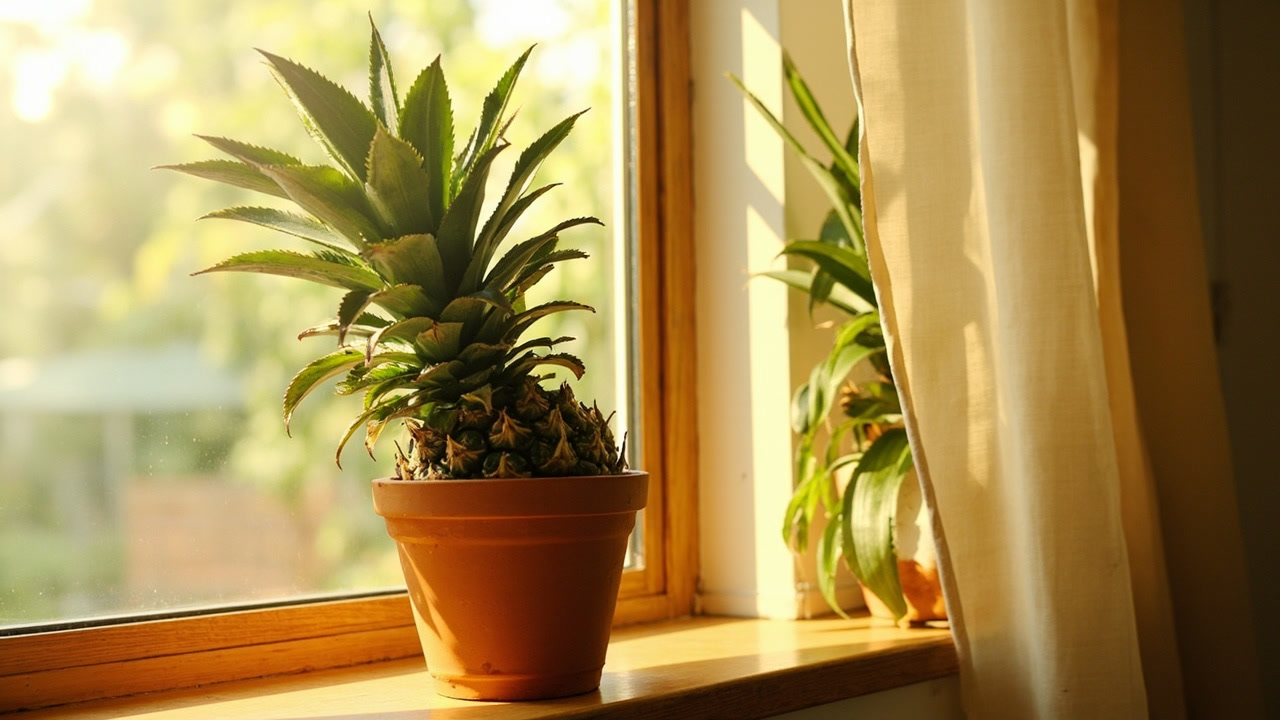
The best window for a pineapple plant indoors is south-facing in the Northern Hemisphere (north-facing in the Southern Hemisphere). This is non-negotiable if you want the plant to do more than just survive.
Window Direction Cheat Sheet
- South-facing window: Optimal. Maximum direct sun hours year-round in most latitudes.n
- West-facing window: Acceptable. Afternoon sun is strong, typically 4u20136 hours of direct. Works in spring, summer, and fall. Might need supplemental light in winter.n
- East-facing window: Marginal. Morning sun is gentler, often insufficient as the sole light source. The plant will likely need supplement.n
- North-facing window: Insufficient in most cases. Even in summer, direct light is limited to brief periods. Do not rely on this direction for pineapple.nn
If you only have east or north-facing windows, you will need to supplement with a grow light. Full spectrum LED grow lights placed 12u201318 inches above the plant for 10u201312 hours per day work well for pineapple plants. The initial investment is around $20u2013$50 for a decent bulb setup, and it’s genuinely the difference between a struggling plant and a thriving one.
How to Tell If Your Window Is Strong Enough
Use the shadow test: on a clear day at midday, hold your hand 6 inches above the plant. If you can see a sharp, defined shadow, the light is strong enough. If the shadow is fuzzy, diffuse, or barely visible, it’s marginal — the plant will survive but won’t flourish.
Watch also for the way the leaves lean. If the whole plant tilts toward the window, it’s reaching for more light. That leaning is a signal — not a charming growth pattern. Act on it by moving the plant closer to the light source or adding supplemental lighting.
Outdoor Light: When and How to Move Your Pineapple Outside
If you’re growing pineapple in a container and you have a patio, balcony, or garden, the plant will absolutely benefit from time outdoors — but transition it carefully.
Pineapple plants cannot go from indoor dim to full outdoor sun instantly. The leaves will burn (turning reddish-brown at the tips first, then broader patches) even though they’re technically full-sun plants. The indoor environment has conditioned the foliage for lower light, and sudden full exposure overwhelms it.
Hardening Off Schedule for Pineapple
- Week 1: Place the plant outdoors in shade for 1u20132 hours per day. Bring it back inside overnight.n
- Week 2: Move to filtered sun (under a shade cloth or beneath a tree canopy) for 3u20134 hours per day.n
- Week 3: Introduce to direct morning sun (before noon) for 3u20134 hours.n
- Week 4 onwards: Full sun exposure. The plant is now acclimated.nn
Once hardened off, a pineapple plant can stay in full sun outdoors year-round in frost-free climates (USDA zones 10u201311). In cooler climates, bring it back inside when temperatures drop below 50u00b0F / 10u00b0C — pineapple plants are not frost-hardy and even brief freezes will damage or kill them.
A south-facing window gives pineapple plants the direct sun they need to grow actively and build toward fruiting. Seasonal Light Variations: Adjusting Through the Year
Light intensity and duration change across seasons, and your pineapple plant will feel it. Here’s what to watch for and how to adjust:
Summer
Long days and high sun angles mean most south-facing windows deliver more than enough light. If the plant is in a very hot south window, watch for stress signals — leaves that look bleached or sunburned at the tips, especially the uppermost leaves. Move slightly back from the glass if this happens. The glass can amplify heat and light together, creating a burn zone even though the light itself isn’t too strong.
Winter
Daylight hours drop significantly in winter, and the sun angle shifts lower. A spot that was perfect in July may become marginal by December even in the same window. Watch for the plant slowing down or stopping new leaf production — this often happens in winter even when everything else is correct, and it’s usually the light dropping below the threshold. If growth slows significantly in winter and you’ve ruled out temperature and water issues, add supplemental lighting.
The practical fix: a timer on a grow light from November through February in temperate climates. Set it for 10 hours per day, timed to extend the natural daylight period (e.g., 7amu20135pm natural + 5pmu20139pm grow light). This keeps the plant actively growing through winter rather than going into slow-motion survival mode.
Signs Your Pineapple Plant Is Getting Too Much Light
Yes, there is a limit — though it’s less common than too little light. The warning signs of overexposure:
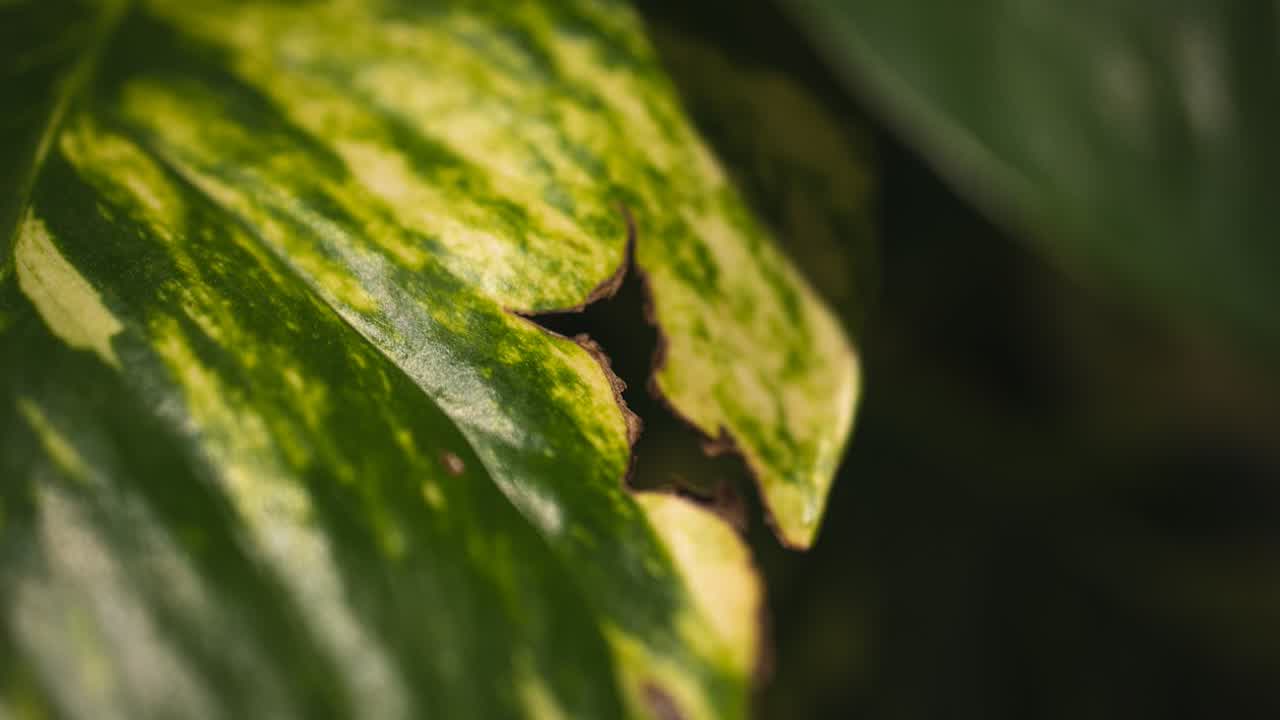
- Leaves turning reddish-brown at the tips, progressing inward. This is a burn pattern, not a natural coloration change.n
- Bleached or faded patches on leaves that were previously deep green. The chlorophyll is being destroyed by excessive light/heat.n
- Leaf surfaces feeling hot to the touch even when the room is otherwise comfortable.nn
Move the plant back from the window or add a sheer curtain filter if these signs appear. Unlike underexposure, which takes weeks to show, overexposure can cause visible damage within days in peak summer. Heat and light combine — the pineapple temperature tolerance guide explains how to manage both together.
Trade-offs: The Honest Limitations
Pineapple plants are not low-light tolerators. If you have a home with predominantly north-facing windows and no outdoor space, a pineapple plant will be a constant struggle. The honest recommendation: either invest $30u201360 in a quality grow light setup, or choose a different plant that handles low-light better (like a pothos or snake plant). A pineapple plant in persistent low light will never be the statement plant it could be — it will just slowly decline and you will keep wondering what you’re doing wrong.
The other trade-off: south-facing windows in summer can run very hot. In climates like Texas, Arizona, or Southern Spain, a south-facing window in July can create temperatures that stress the plant even though the light is technically correct. In these cases, east-facing or filtered west-facing light may actually be more balanced — enough light without the heat stress. Light is foundational, but it works alongside fast-draining soil, consistent watering, and regular feeding to produce a plant that actually progresses rather than just survives.
The Minimum Setup to Keep a Pineapple Plant Healthy Indoors
If you’re going to keep a pineapple plant indoors, you need:
- A south-facing window with unobstructed light for at least 6 hours per day, ORn
- A full-spectrum grow light running 10u201312 hours per day, positioned 12u201318 inches above the plant canopynn
That’s the non-negotiable foundation. Everything else — watering, soil, fertilizer — only matters after light is handled. Get the light right first. Then tune the rest. If growth is stalling despite good light, the why your pineapple is not growing guide covers what to check next.n”}
From PDF to Excel in one click
Forget retyping line by line. Upload any bank statement, get a spreadsheet you can actually use. Your files are never stored, and you can test the converter with 3 free conversions.
Try it free
- Bleached or faded patches on leaves that were previously deep green. The chlorophyll is being destroyed by excessive light/heat.n
- Week 2: Move to filtered sun (under a shade cloth or beneath a tree canopy) for 3u20134 hours per day.n
- West-facing window: Acceptable. Afternoon sun is strong, typically 4u20136 hours of direct. Works in spring, summer, and fall. Might need supplemental light in winter.n
- 6u20138 hours direct: Acceptable for maintenance. The plant will survive and stay healthy but growth will be slow and fruiting may take years longer.n