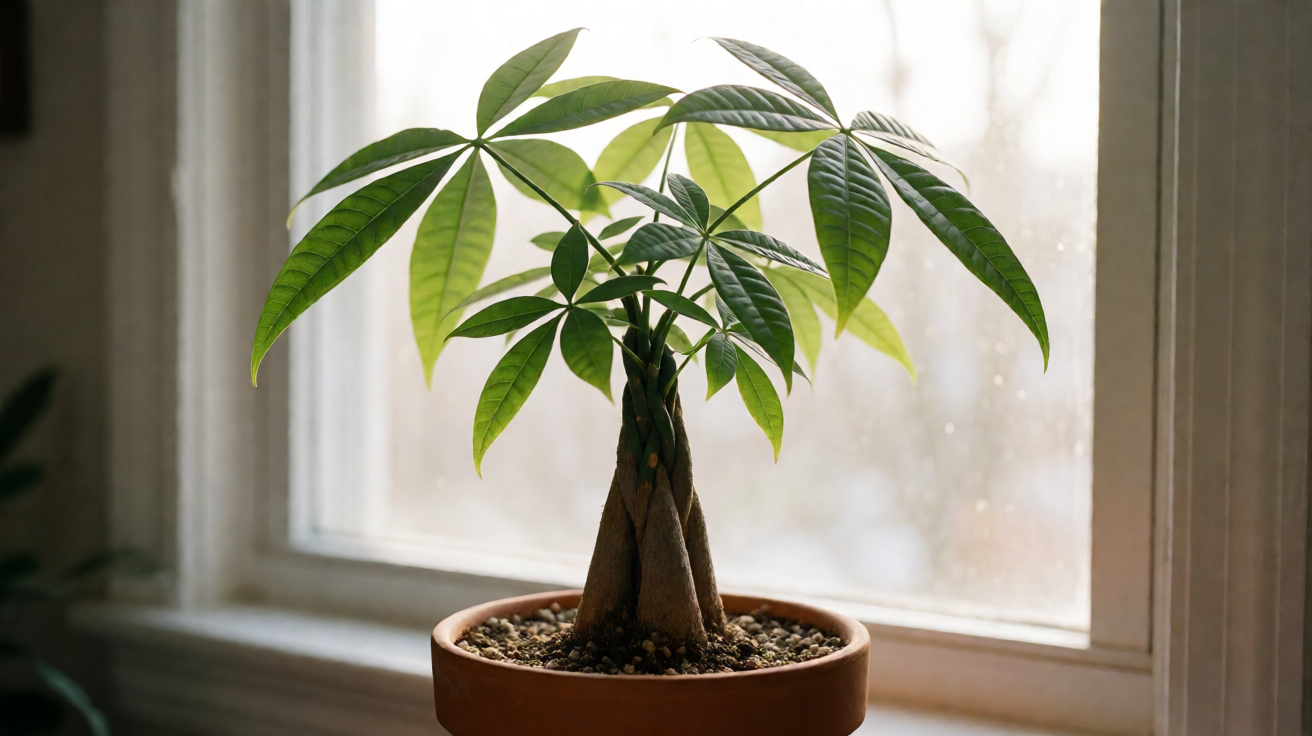

A money tree (Pachira aquatica) is a tropical houseplant from the Malvaceae family, and it dies most often from overwatering in a poorly draining pot or from being treated like a pothos with weekly calendar watering. The braided trunk is not a horticulture trick; it is a swollen caudex that stores water between rain events in its native Central American wetland habitat.
Indoors, that reservoir plus a heavy ornamental pot creates the perfect setup for crown rot within 72 hours of the soil staying wet. The plant evolved for periodic flooding followed by dry spells, so steady-wet soil suffocates the fine roots in days, not weeks.
This guide covers the five care requirements that decide whether a money tree survives its first year indoors: light, water, soil, temperature, and fertilizer. Each requirement is grounded in how Pachira aquatica actually grows in the wild, not in gift-shop folklore. Treat the cultural framing (Vastu placement, prosperity symbolism, feng shui corners) as marketing, not as care guidance. The plant does not read the brochure.
Two honest limits up front. First, a money tree shipped with crown rot already in progress cannot be saved by any care routine; it needs unpotting and surgery, which the Problem page covers. Second, money tree is not a low-light plant despite the marketing; bright indirect light is non-negotiable for year-round leaf retention. With those limits clear, the rest is straightforward.
What Kind of Plant a Money Tree Actually Is
Pachira aquatica is a small tropical tree native to the wetlands of Central and South America. It is in the Malvaceae family, the same family as cotton and hibiscus. That family placement matters indoors: Malvaceae prefers steady moisture without waterlogging, which is why the braided trunk stores water but the fine root system rots quickly when soil stays anaerobic.
The braided trunk is a young Pachira grown on for ornament. In the wild, the trunk stays a single soft-wood stem until it is two or three years old, at which point growers braid four to six stems together while the bark is still flexible. The braid locks the stems as they thicken, producing the decorative trunk you see in stores. It does not change the plant’s biology.
Money tree and money plant are not the same species. Money plant is Epipremnum aureum, an Araceae aroid vine sold in East and South Asian markets. The two share only the common name. Caring for one like the other is the fastest way to lose a Pachira, because Epipremnum tolerates weekly soaking and Pachira does not.
Money Tree Light: Bright Indirect, Not Low Light
A money tree needs bright indirect light for at least 6 hours a day. The sweet spot is 3 to 6 feet from an east-facing window, where morning sun is direct but the rest of the day is filtered. A south-facing window with a sheer curtain also works. A north-facing window does not, unless you supplement with a grow light through the darker months.
Low light causes slow decline rather than dramatic drop. A money tree in a dim corner produces smaller new leaves with longer stems between them, sheds older leaves from the bottom up, and pushes the trunk toward the brightest source it can find. Over months, this looks like under-watering symptoms but the cause is light, not water. Move the tree to a brighter spot before adjusting the water schedule.
Direct sun through a south- or west-facing window burns the leaves within hours. The damage shows as pale tan patches on the upper canopy where the sun hits first. If your tree is in front of an unshaded window, move it 4 to 6 feet back or hang a sheer curtain between the glass and the foliage. The tree wants the brightness, not the burn.
Rotate the pot a quarter turn every two weeks so the canopy stays symmetrical. Without rotation, the side facing the window fills out while the shaded side thins. The trunk will also lean toward the light over time, which is fixable by rotation but not by repotting.
Money Tree Watering: When the Top Inch Dries Out
Water a money tree when the top 1 inch of soil feels dry to a finger. In 65 to 75 degree Fahrenheit room conditions with bright indirect light, this usually means watering once every 7 to 10 days during the active growing season from March through September, and once every 14 to 21 days from October through February when the tree is semi-dormant.
Do not water on a calendar. Calendar watering is the most common cause of crown rot because it ignores temperature swings, humidity changes, and the size of the root ball. Stick a finger into the soil up to the first knuckle; if it comes up dry, water. If it comes up with damp soil clinging to it, wait three days and check again.
Water thoroughly until the excess drains from the bottom of the pot. The water should flow through the soil mass, not down the inside edge of the pot. Bottom-watering (setting the pot in a tray of tepid water for 30 minutes) works equally well for rehydrating soil that has pulled away from the edges.
Whichever method you use, drain the pot completely. A money tree never sits in standing water; even 30 minutes of saturated bottom can suffocate roots after the third or fourth repeat.
Overwatering symptoms arrive in two stages. Early: yellow leaves at the bottom of the canopy with soft soil. Late: soft trunk base, sour soil smell, leaf drop within 48 hours. By the time the trunk base compresses with light finger pressure, the crown rot is past the care-routine phase and needs the surgical protocol on the Problem page.
In winter, the tree uses less water because transpiration slows. If you keep watering on the summer schedule, the soil stays wet for 10 to 14 days between waterings, which is enough time for anaerobic conditions and root death. Dial back to every 14 to 21 days and only when the top inch is dry to the touch, not on a fixed day.
Money Tree Soil and the Pot That Drains
A money tree needs well-draining soil in a pot with drainage holes. The mix is 30 percent perlite, 40 percent orchid bark, and 30 percent coco coir by volume. This combination drains fast enough to prevent anaerobic conditions around the roots, while still holding enough moisture for the 7-to-10-day watering rhythm above. Standard potting soil on its own stays wet too long.
The pot must have at least two drainage holes. Decorative pots without drainage holes are the second most common cause of crown rot, because water collects at the base of the soil mass where the fine roots live.
If you want to keep a decorative pot for aesthetics, keep the tree in a plastic nursery pot with drainage holes and set that inside the decorative pot. Remove the nursery pot for every watering, let it drain, and put it back inside the decorative pot once dripping stops.
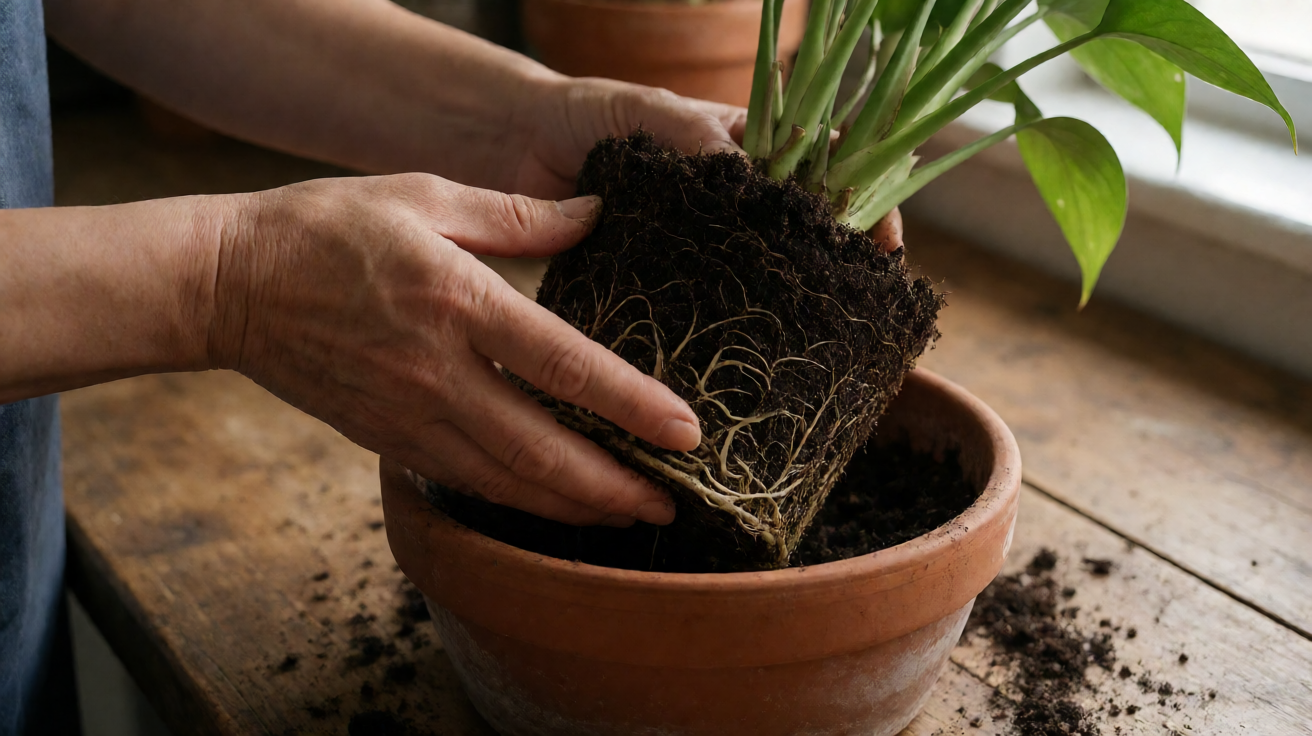
Repot every 2 to 3 years, or when the roots circle the bottom of the pot and push the tree up on a small soil mound. Spring through early summer is the best window because the active growing season supports quick root recovery. Refresh the soil mix at every repot; old mix compacts and loses drainage over time, even if the surface still looks loose.
After repotting, water once and then wait 14 days before the next watering. Fresh roots are tender and overwatering them causes the same crown rot you were repotting to escape. Keep the tree in the same light position after repotting; moving it to “recover” in a darker spot delays leaf production by another 2 to 3 weeks.
Money Tree Temperature, Humidity, and Fertilizer
A money tree grows best between 60 and 75 degrees Fahrenheit. It tolerates down to 50 degrees briefly, but a single night below 50 ruptures cells in the leaves and stems within hours. Damage shows as dark water-soaked patches on the leaves and sudden leaf drop the next morning. Move the tree away from air-conditioning vents, drafty single-pane windows, and exterior doors that open to cold air.
Humidity between 40 and 60 percent is ideal. Pachira aquatica tolerates average household humidity around 30 to 40 percent, but the leaf edges crisp at the lower end. A humidifier set 6 feet from the tree is the cleanest fix; misting the canopy raises humidity for an hour and then drops back, which does more for the owner’s mood than the plant’s.
Fertilize monthly from March through September with a balanced liquid fertilizer (10-10-10 or 20-20-20) at half strength. Half strength is the key detail; Pachira roots are sensitive to salt buildup, and full-strength feeding twice a month burns the fine roots within 6 weeks. Stop fertilizing entirely from October through February when the tree is semi-dormant and not pushing new growth.
Skip fertilizer for the first 30 days after repotting; fresh soil mix has enough nutrients for that window. If you bought the tree recently and it is still in its nursery pot and nursery soil, the first month of feeding is also optional because the nursery grower usually charges the soil with a slow-release fertilizer that lasts 60 to 90 days.
If older leaves yellow from the bottom up while new growth stays small, the most common cause is nitrogen depletion, not overwatering. Resume half-strength fertilizer for one feeding and watch the older leaves green up within 10 to 14 days. If the yellowing continues past two feedings, the cause is usually root damage from a past overwatering event, and the tree needs the Problem page protocol instead of more food.
When a Money Tree Needs Repotting or Propagation
Repot every 2 to 3 years, when the roots circle the bottom of the pot, or when the soil stays wet for more than 10 days between waterings (a sign of compaction). The best window is spring through early summer so the tree can push new roots into the fresh mix during the active growing season. Repot in the same light position the tree already occupies.
Move up only one pot size, from 6 inches to 8 inches or from 8 inches to 10 inches. A pot that is too large holds more soil volume than the roots can dry out, which recreates the anaerobic conditions that cause crown rot in the first place. Refresh the soil mix at every repot; old mix compacts and loses drainage over time.
Propagation by stem cutting is the cleanest way to start a second money tree from a healthy parent. Cut a 6-inch section of stem with at least two leaf nodes, root it in water or moist perlite, and transplant once the roots reach 2 inches. The propagation page covers the step-by-step protocol, including how to handle the latex sap that bleeds from fresh cuttings.
Stem cutting does not preserve the braided trunk. New growth from a single cutting forms a single straight trunk, which still grows into a healthy Pachira aquatica but does not have the ornamental braid. If the braid matters, buy a new braided starter from a nursery.
From Bank Statement to QuickBooks-Ready File
That manual cleanup you just read about? This tool skips it. Turn your PDF into QBO for QuickBooks without storing your data anywhere.
Start Converting