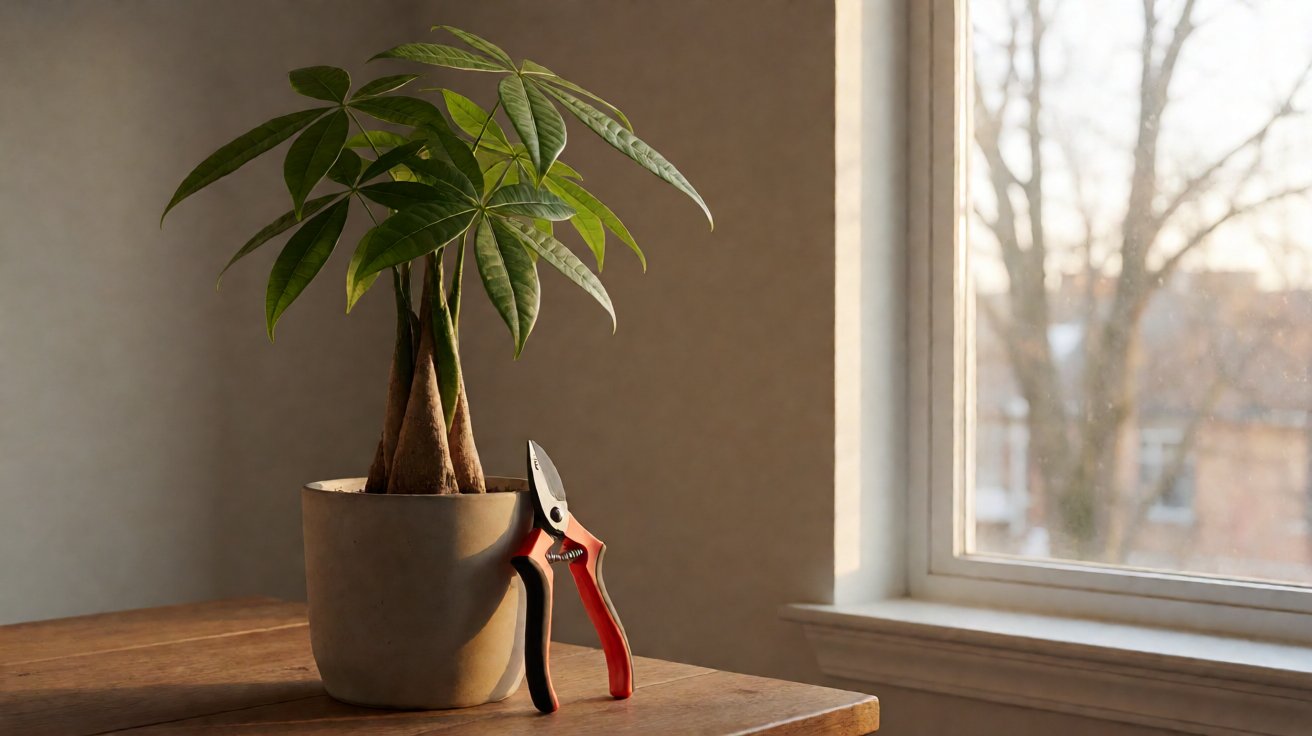

Pruning a money tree is not the routine cleanup the marketing copy makes it. Pachira aquatica evolved in seasonally flooded wetlands where wind and flood do the shaping work; the pruning response it offers back to a pair of shears is mild, not vigorous. Cut too aggressively and you trade one season of leggy growth for one season of bare branches while the canopy rebuilds. Most money trees sold in florist shops do not need pruning at all. They need brighter light.
The mechanism that controls whether pruning works sits on auxin transport at the apical meristem. The shoot tip produces auxin, the auxin moves down the stem in a one-way stream, and that stream suppresses the dormant axillary buds in every leaf axil below the tip. When you remove the shoot tip, the stream stops. The axillary bud directly below the cut receives less inhibition, and within two to four weeks you see it break and produce a new shoot. Cut too far above the node and the auxin stream from any remaining tissue re-inhibits the bud you wanted to release. Cut through the node and you damage the meristem you wanted to activate. Cut at the right distance (about one centimeter above the node) and the meristem is intact, the auxin source above the cut is gone, and the dormant bud releases.
Two failure modes follow. The first is the common one: the reader cuts mid-internode because the stem looks tidier that way, then waits six weeks for nothing to happen, then assumes the plant is broken. The plant is not broken. The cut site healed over with callus and the dormant bud below is still receiving auxin from the next live node down. The second is the rare one: the reader cuts a third or more of the foliage at once. Pachira aquatica loses more than a third of its leaf area and the canopy cannot photosynthesize enough to rebuild the lost branches. Recovery takes a full growing season or longer.
One honest limit up front: pruning does not fix a leggy plant. If the internode spacing on the new growth is longer than five centimeters, the plant is light-starved. Move it to a brighter window or grow light first. Pruning a chronically light-starved money tree produces a temporarily shorter chronically light-starved money tree. The new growth will lengthen its internodes again within two months because the underlying cause, too little daily light, has not changed.
When to Prune a Money Tree
The window is late winter to early spring, in the week or two before new growth begins. In most indoor conditions this means late February to mid-April in the northern hemisphere, or late August to mid-October in the southern hemisphere. Pachira aquatica does not have a strong winter dormancy like a temperate tree, but its growth slows measurably as the daylight integral drops below about 6 mol/m²/day. Cutting during the slow period means the plant can route its stored reserves to the healing cut sites and to the axillary buds below, instead of splitting energy between pushing new shoots and healing wounds.
Cutting in late spring or early summer is acceptable. The plant will heal faster because the vascular cambium is more active. The risk is that any new shoots pushed right after the cut may not harden off before the next autumn. Avoid pruning in deep winter if you can; the cambium response is slow and rot risk at the cut site rises. Remove yellow or damaged leaves any time of year; that kind of removal does not count against the one-third leaf-area budget because the leaf is no longer photosynthesizing anyway.
The Internode Test: Do Not Legit-Prune Before Reading
Before you reach for the shears, measure three of the most recent internodes on a branch that grew in the last two months. An internode is the section of stem between two leaves. Healthy new growth on a money tree in good light has internodes of two to four centimeters. Stressed new growth (light-starved or over-fertilized with nitrogen) has internodes of six to ten centimeters. If your plant’s recent growth has internodes longer than five centimeters, the plant needs more light, not pruning. Move it closer to a south-facing window or install a full-spectrum LED at 20 to 30 centimeters above the canopy, run it for 12 to 14 hours a day, and wait two months. New internodes shorter than four centimeters will tell you the underlying problem was light. After those two months, then prune to shape what you have.
Where to Cut: The One-Center, the Angle, and the Node
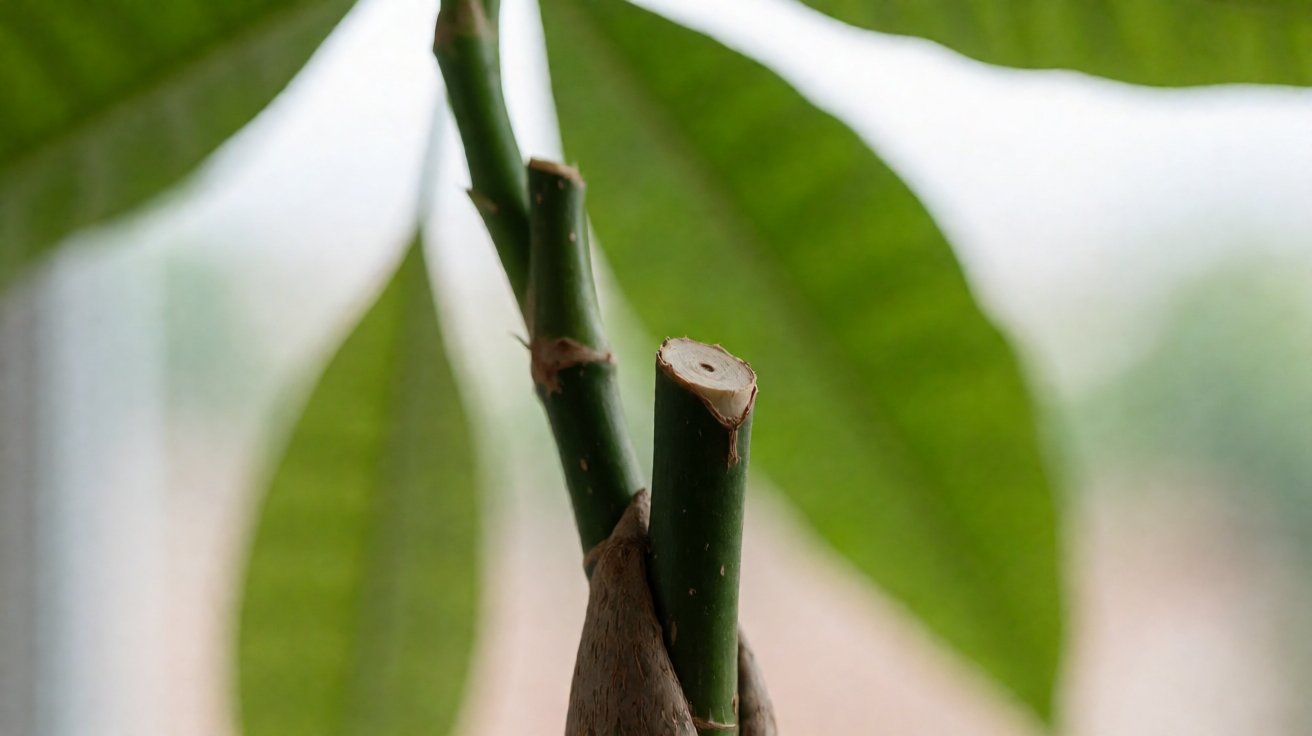
Cut about one centimeter above a leaf node, where the node is the V-shaped junction where a leaf or branch meets the main stem. The one-centimeter stub above the node is intentional: it gives the wound surface area to callus over cleanly without leaving a long bare stub that will eventually yellow and die back. The cut should be a slight angle, 30 to 45 degrees from horizontal, so water runs off the wound instead of sitting on it. Water pooling on a flat-cut cambium creates the conditions for fungal rot at the vascular tissue directly below.
Use a clean, sharp pair of bypass pruners or scissors. Wipe the blades with isopropyl alcohol before you start and again between plants if you are working on more than one. A torn cut from dull blades damages more cambium cells than a clean cut, and the larger the damaged area the longer the healing time and the higher the rot risk. Do not use anvil-type pruners on Pachira aquatica stems; they crush the vascular tissue on the side opposite the blade.
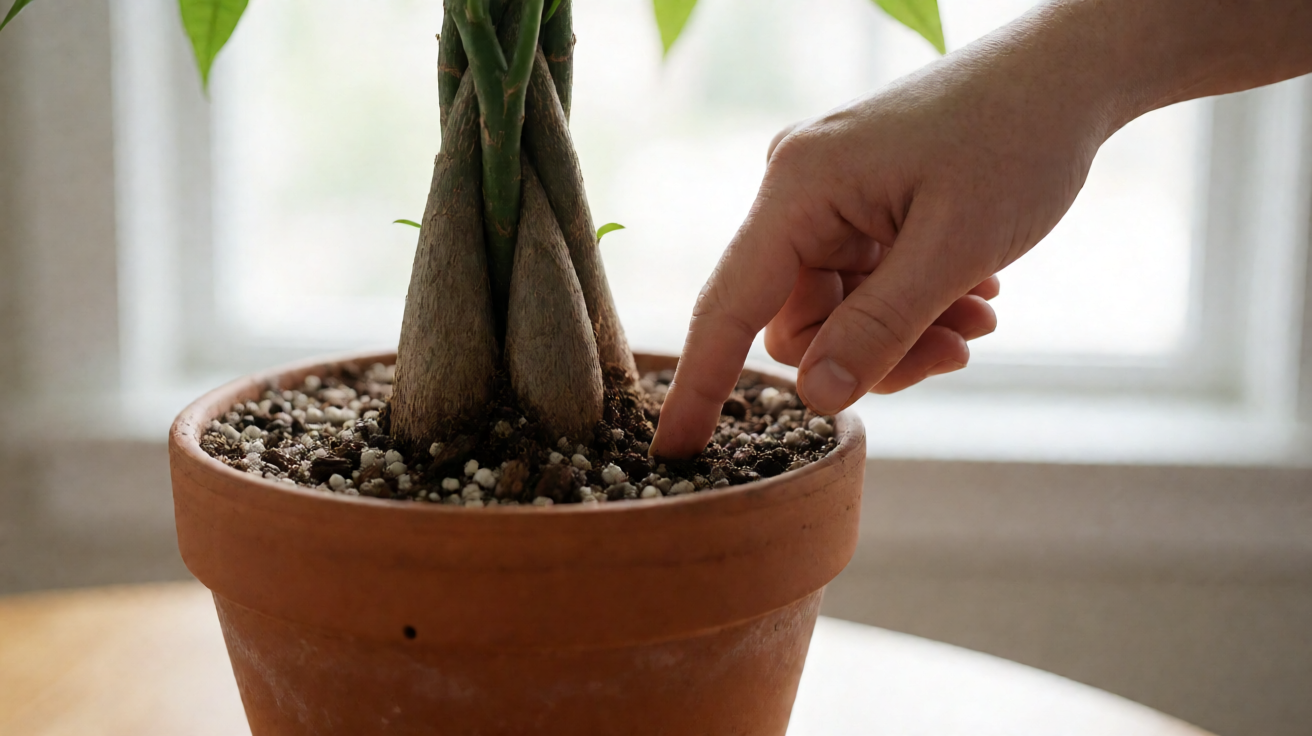
For braided-trunk nursery stock, prune the upper branches only. Cutting into the braided trunk removes the bud source for any new shoots at that point and the bare braid stays bare. The braided trunks are usually three to five individual Pachira aquatica seedlings twisted together at the nursery; each one has its own apical meristem and its own canopy. Treat each trunk’s canopy as a separate plant for pruning purposes.
How Much to Remove: The One-Third Leaf Area Floor
Remove no more than one-third of the total foliage in a single pruning. The one-third number is not a stylistic choice; it is a photosynthesis floor. Pachira aquatica in active growth uses roughly 60 percent of its daily photosynthate for maintenance respiration and only 40 percent is left for new growth and storage. Cut more than a third of the leaf area at once and you remove a third of the photosynthetic capacity while the plant still has the same maintenance cost to pay. The math stops working. The plant cannibalizes stored reserves, the cut sites heal slowly, and any axillary buds that do break produce weak shoots because the source-sink balance has tipped.
Count what you plan to remove before you cut. Pick out the leaves and stems you intend to remove, count them, divide by the total leaf count, and stop when you reach one-third. If you can only reach one-fifth without compromising the silhouette, stop at one-fifth. A money tree that needs more than a third removed needs more than one pruning: wait six months, do another one-third, and repeat. Three pruning sessions over eighteen months will reshape almost any specimen.
What You’ll See in the First Four Weeks After the Cut
The first ten days the cut site calluses. The exposed cambium produces a thin layer of wound tissue that hardens and protects the vascular tissue underneath. You will see the cut edge dry out and darken slightly; do not seal it with pruning paste, the plant does not need it and the paste traps moisture against the cambium. By week three a small bud swelling appears in the leaf axil directly below the cut. By week four the bud opens and a fresh leaf emerges, lighter in color than the mature foliage around it.
If you see no bud activity at four weeks, the cut was too far above the node and the auxin from the next live tissue down is still strong enough to suppress the bud you wanted to release. A second smaller cut, this time directly above the dormant bud, releases it. If you see new growth but it stretches quickly into long internodes, the plant is still light-starved. Return to the internode test and adjust the light before any further pruning.
The yellow leaf is the message. The next leaf is the answer.
Read also: the complete money tree care guide covers watering and substrate; money tree soil and pot covers the mix, the pot size, and the drainage hole that prevents cambium rot; money tree yellow leaves covers the diagnostic after pruning; money tree temperature tolerance covers the 65 to 80 °F window when cuts heal fastest; can you revive a dead money tree covers recovery when the canopy has already collapsed; and indoor plant light levels covers the four-tier framework that fixes a leggy tree before you ever cut.
Turn That PDF Into a Spreadsheet in Minutes
You've seen how to do it manually — now let the tool handle the heavy lifting. Upload your bank statement and get Excel, CSV, or QBO in a few clicks.
Try It Free