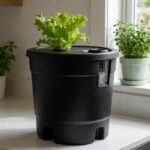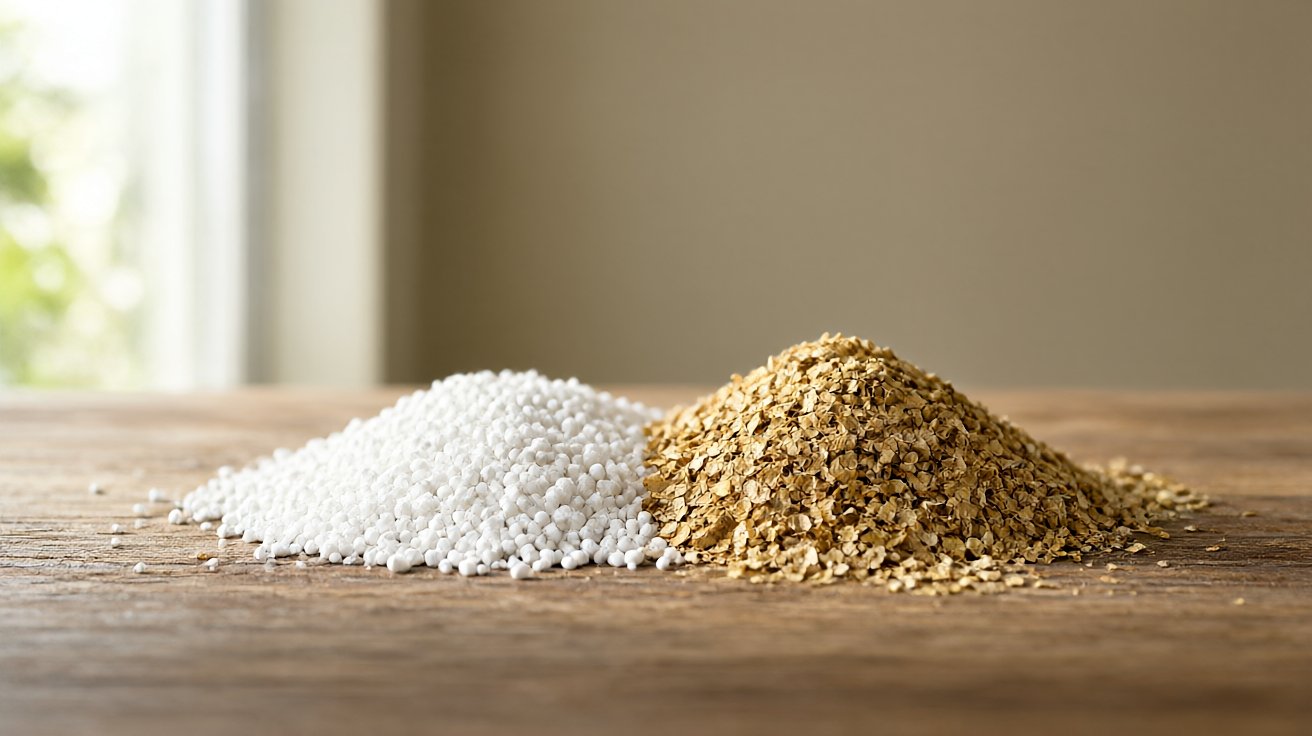

Perlite is the better choice when your hydroponic system needs maximum aeration and fast drainage, while vermiculite is the better choice when you need high water retention and steady moisture around the roots. Perlite, an expanded volcanic glass, holds roughly 3 to 4 times its weight in water but drains quickly and keeps air spaces open; vermiculite, an expanded mica, can hold up to 4 to 5 times its weight in water and releases it slowly, acting more like a moisture reservoir. In practice, most growers blend the two, or pair one of them with coco coir or rockwool, rather than using either one alone.
This guide is written in the Aqualogi voice, drawing on more than a decade of hands-on testing across deep water culture, nutrient film technique, drip systems, and hand-watered containers in our own research greenhouse. We cover what each material actually is, how they behave once water and nutrients enter the picture, how to mix them, and the mistakes we see most often from growers moving from soil to soilless culture. If you are new to the method, our hydroponics for beginners walkthrough is a useful companion.
What Perlite and Vermiculite Are
Perlite begins as a dense, glassy volcanic rock, specifically an amorphous volcanic glass with a high water content trapped in its structure. When mined ore is heated to roughly 850 to 900 degrees Celsius, the trapped water flashes into steam, expanding the particles up to twenty times their original volume. The result is a lightweight, white, porous granule that looks like tiny popcorn. Chemically it is mostly silicon dioxide with smaller amounts of aluminum oxide, sodium, and potassium, which is why it is considered chemically inert and pH-neutral in most growing applications.
Vermiculite is a hydrous phyllosilicate mineral, a member of the mica group, and it forms in thin, plate-like layers. Like perlite, it is expanded by heat, typically at 650 to 950 degrees Celsius, but the mechanism differs. The water between its layers turns to steam and forces the plates apart along the c-axis, producing accordion-shaped particles with a much finer, more absorbent internal structure. Vermiculite is also a hydrated silicate, but it contains magnesium, aluminum, and iron in its lattice, which is the source of its modest nutrient-holding capacity and its slightly alkaline reaction.
Both materials are mined, processed, and sold in graded particle sizes, usually from fine dust to coarse chunks. The grade you buy matters as much as the material itself, because particle size drives almost every physical property discussed below. A coarse perlite and a fine perlite behave like two different media, and the same is true for vermiculite.
How They Differ in Water Retention and Aeration
The core difference is in pore structure. Perlite particles are full of closed and semi-closed bubbles, which makes them light and rigid but limits how much water they can absorb internally. Water clings to the outer surfaces and to the gaps between particles, and because perlite drains freely, most of that water leaves within minutes of irrigation. By volume, perlite retains only about 5 to 10 percent water, with air-filled porosity staying high, often 30 to 40 percent of total volume in a well-graded mix, which is exactly what root systems need to avoid oxygen starvation.
Vermiculite has a lamellar, sponge-like structure with a huge internal surface area. It absorbs water into the spaces between its plates and holds it against gravity far better than perlite does. By volume, vermiculite retains roughly 40 to 50 percent water, and a container filled with it can stay moist for days as the material swells noticeably when wet. The trade-off is that air-filled porosity drops as moisture rises, and a fully saturated vermiculite bed can become waterlogged and oxygen-poor.
This is why growers treat the two as opposites on a single spectrum: perlite pushes the mix toward drainage and aeration, vermiculite pushes it toward retention. Your target depends on the crop, the container, and how often you irrigate. Leafy greens in a fast-draining system tolerate more perlite; seedlings and cuttings in small cells benefit from more vermiculite. For a deeper look at how water retention, aeration, and porosity interact in any medium, see our guide to growing medium properties.
CEC and Nutrient Holding
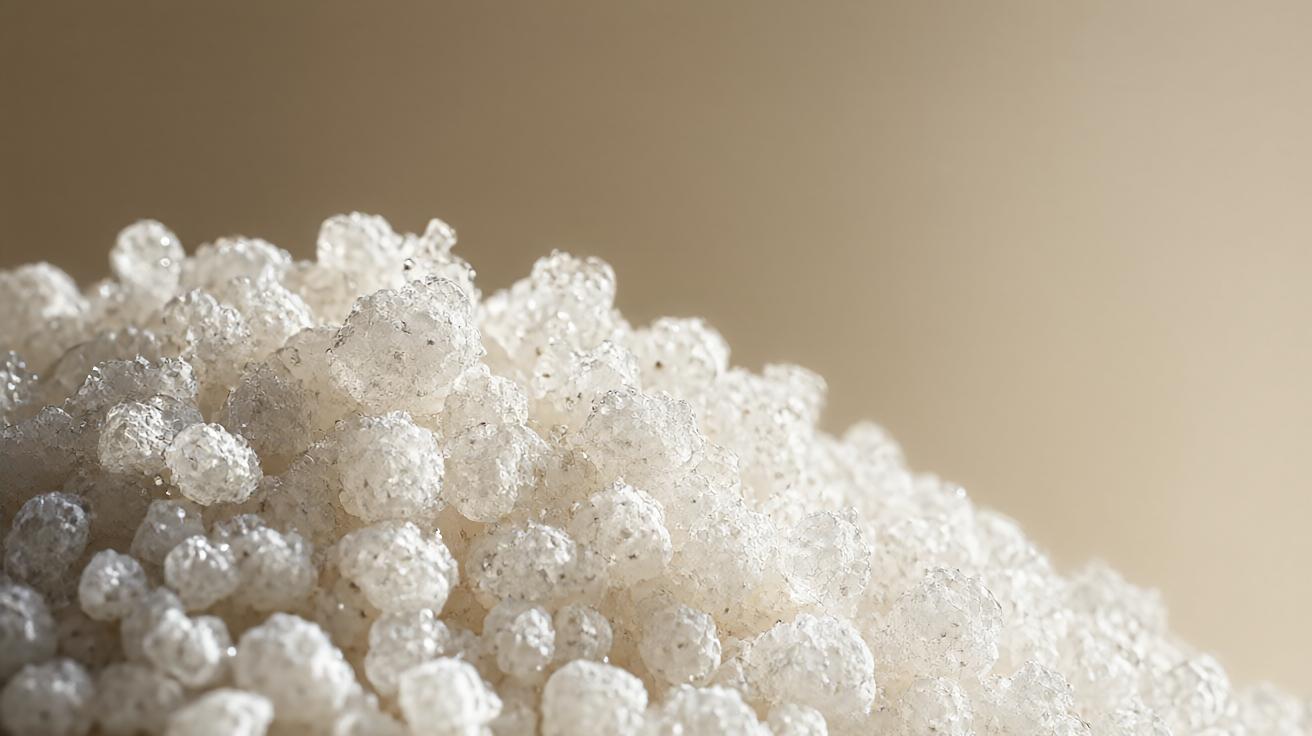
Cation exchange capacity, or CEC, measures how well a medium can hold positively charged nutrient ions such as calcium, magnesium, and potassium against leaching. Perlite has a very low CEC, typically reported between 1 and 5 meq per 100 grams, because its glassy surface offers few exchange sites. In practice this means perlite does not store nutrients; it simply provides structure and drainage, and the nutrient solution passes through to the roots.
Why perlite’s low CEC matters: because the medium holds almost no nutrient reserve, everything you feed is either taken up immediately by the roots or flushed out with the next irrigation. Nutrients pass through rather than accumulate, so you cannot rely on the medium to buffer a missed feeding or a dilute dose. In practice this means more frequent, smaller feedings, careful monitoring of runoff EC, and consistent nutrient solution strength. If you feed too little or too infrequently, plants show deficiency quickly; if you feed too heavily, the excess simply leaches away, wasting fertilizer and potentially polluting runoff.
Vermiculite has a moderate to high CEC, commonly in the range of 100 to 150 meq per 100 grams, thanks to its charged layered lattice. It can hold a meaningful reserve of calcium and magnesium in particular, and it releases them slowly as the root zone dries and rewets. That buffering is helpful in hand-watered or intermittent systems, but it can also complicate nutrient management in recirculating hydroponics, where you want precise control over solution composition.
Because perlite has CEC of 1-5 meq/100g (vs vermiculite’s 100-150), nutrients pass through perlite without being held; in a perlite-heavy mix, you need to feed more frequently or add a buffering medium like coco coir.
The practical takeaway is that perlite behaves as an inert scaffold, while vermiculite behaves as a mild nutrient buffer. If you run a recirculating system with a carefully tuned solution, perlite’s low CEC is an advantage because it does not interfere with your formulation. If you hand-water and want a margin of safety against nutrient depletion between irrigations, vermiculite’s CEC is an asset.
Comparison Table
| Property | Perlite | Vermiculite |
|---|---|---|
| CEC | 1-5 meq/100g | 100-150 meq/100g |
| Nutrient holding | Does not hold nutrients; passes through | Buffers nutrients (Ca, Mg) |
| Water retention (by volume) | ~5-10% | ~40-50% |
| Air-filled porosity | High (30-40%) | Lower when wet |
| pH | 6.5-7.5 (neutral) | 7.0-7.5 (mildly alkaline) |
| Density | Light | Denser, settles |
| Best use | Aeration, drainage, cloning | Seed starting, moisture retention |
pH and Chemical Stability
Perlite is essentially pH-neutral, usually testing between 6.5 and 7.5, and it does not react with nutrient solutions over time. It will not drift, and it will not release minerals in any quantity that affects plant nutrition. This stability is one reason it is so widely used in commercial hydroponic operations.
Vermiculite is mildly alkaline, often testing between 7.0 and 7.5 and sometimes higher depending on source and grade. Its magnesium and calcium content can slowly raise the pH of the root zone, and it can release small amounts of those minerals into the solution. In most hydroponic setups this is minor and easily corrected with pH adjustment, but it is a real factor when you are targeting a narrow pH window, such as for blueberries or certain herbs.
Neither material decomposes in the way organic media do, so both are reusable across multiple crop cycles if cleaned and sterilized. Perlite holds its structure better over time; vermiculite can compress and lose porosity after repeated wetting and drying, especially in fine grades.
Best Uses in Hydroponics
Perlite Best For
Perlite excels in systems where oxygen delivery is the limiting factor. It is the standard medium in drip systems, top-fed containers, and ebb-and-flow beds where rapid drainage prevents root rot. It is also the default choice for cloning and rooting cuttings, because the high air content encourages callus formation and prevents the stem base from rotting. Growers running DWC often add a perlite layer or blend to increase aeration around the upper root zone.
Vermiculite Best For
Vermiculite shines wherever moisture consistency matters more than drainage. It is widely used for seed starting, because the fine, moist, warm environment gives even germination. It suits capillary-based systems, wick setups, and any container that is not irrigated frequently. It is also popular for starting cuttings of species that root slowly and need sustained humidity, and for mixing into seedling and transplant media.
When to Combine
Neither should be used alone in most hydroponic applications. Pure perlite dries too fast and offers no nutrient buffer; pure vermiculite stays too wet and risks root rot in anything but the smallest cells. The value of each comes from blending it with the other, or with a third medium such as coco coir, rockwool, or clay pebbles.
Mixing Ratios and Combinations
A 50/50 blend of perlite and vermiculite is the most common starting point, and it produces a medium with balanced drainage and retention. From there, adjust based on crop and system. For fast-draining drip or ebb-and-flow beds, move toward 70 percent perlite and 30 percent vermiculite. For seed starting and small-cell propagation, 30 percent perlite and 70 percent vermiculite is a better fit.
Many growers go further and build three-component mixes. A popular recipe is one part perlite, one part vermiculite, and one part coco coir, which adds organic buffering and cation exchange while keeping the blend light. Another common mix is perlite with clay pebbles in the lower half of a container for drainage and perlite or vermiculite in the upper half for root contact. When mixing, pre-wet both materials so the dust settles, and always wear a dust mask because dry perlite and vermiculite both release fine silica-bearing particles.
Particle size matching matters. Blending a coarse perlite with a fine vermiculite can create a layered structure where water channels through the perlite and bypasses the vermiculite, defeating the purpose. Aim for similar grade sizes within a mix, and sieve out fines if you want consistent behavior.
Common Mistakes
The most common mistake is using either medium straight, without blending or without pairing it with a more structured material. Pure vermiculite in a large container becomes a waterlogged sponge; pure perlite in a small pot dries out between waterings and stresses the plant. A second frequent error is ignoring grade. Fine vermiculite compacts and reduces aeration over time, while coarse perlite can leave large air gaps that roots cannot bridge in small containers.
A third mistake is overwatering a vermiculite-heavy mix because it looks dry on the surface while staying saturated below. The surface of vermiculite dries and lightens quickly, which misleads growers into irrigating again. Check moisture at depth before watering. A fourth is neglecting pH. Growers who target a tight pH range sometimes blame their nutrient solution when the real drift comes from the vermiculite slowly releasing magnesium and calcium.
Finally, many growers reuse perlite and vermiculite without cleaning them. Both can harbor pathogens and salt residues. Rinse thoroughly, soak in a mild hydrogen peroxide or bleach solution, and rinse again before reusing. Perlite survives this well; vermiculite should be handled gently to avoid breaking down its plates.
Perlite and Vermiculite in the Broader Medium Picture
Perlite and vermiculite are two of the most common inorganic components in soilless culture, but they are rarely the whole story. Most commercial and home hydroponic media combine them with coco coir, rockwool, clay pebbles, or foam to tune water retention, aeration, CEC, and structural stability to the crop and system. Choosing between perlite and vermiculite is really a choice about where on the retention-aeration spectrum your mix should sit, and that choice only makes sense in the context of the full medium. For a wider comparison of all the main options, see our guide to compare hydroponic growing media.
Bulk density is worth noting here: perlite is lighter per unit volume, which matters for hanging baskets and large containers, while vermiculite is denser and settles more. Capillary action differs too, with vermiculite drawing water upward more effectively than perlite, which is why vermiculite is preferred in wick systems. Particle size, as discussed, shapes all of these behaviors. Seed starting and container mix design are ultimately exercises in balancing these properties for a specific crop at a specific growth stage.
Perlite’s bulk density is ~0.05-0.1 g/cm³; vermiculite’s is ~0.1-0.15 g/cm³, making perlite lighter for hanging baskets and vertical systems.
Last reviewed on 3 November 2026
Sources and further reading: (1) “Soilless Culture: Theory and Practice” by Michael Raviv and J. Heinrich Lieth, Elsevier, 2nd edition; (2) University of California Agriculture and Natural Resources, “Container Media for Greenhouse and Nursery Crops” extension publication; (3) Royal Horticultural Society, “Perlite and Vermiculite” growing advice page.
From PDF to Excel in one click
Forget retyping line by line. Upload any bank statement, get a spreadsheet you can actually use. Your files are never stored, and you can test the converter with 3 free conversions.
Try it free