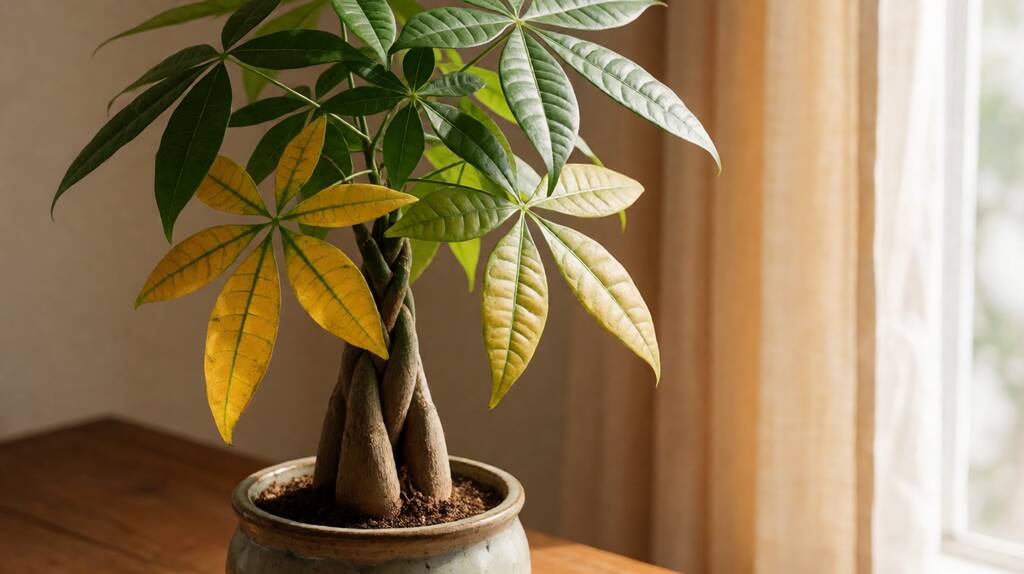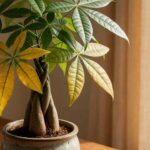

A money tree (Pachira aquatica) is one of the few houseplants where the propagation method you pick decides success or rot before you make the first cut. The braided trunk stores water between rain events and continues to store water after the stem is severed, which is why a stem cutting dropped into a glass of water usually rots at the cambium within two weeks instead of rooting. The same trunk, wounded correctly and wrapped in damp sphagnum, lays down callus tissue at the wound site within three to four weeks and pushes new roots from the callus in five to eight weeks. Two propagation paths exist for Pachira indoors: stem cuttings in moist medium, and air layering on a woody branch. Both work; the choice depends on whether the branch you want to remove can spare a few months without leaves.
Two honest limits up front. A money tree with crown rot in progress is not a propagation candidate; the caudex is already compromised and a new cutting carries the same rot risk. And air layering on a thin, green, non-woody stem typically fails because the callus does not form on tissue that is still elongating.
Why Stem Cuttings in Water Usually Fail
Why Stem Cuttings in Water Usually Fail
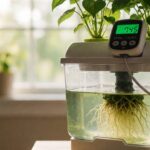
The water-rooting method is taught as the default for pothos and philodendron because those vines root from nodes submerged in water within two to three weeks. Pachira aquatica is not a vine. The trunk is a swollen caudex: it stores water in its cortex and the cambium sits below that water-storing tissue. When you submerge a stem cutting in water:
– The cut end absorbs water faster than it can respire, and the cortex around the wound swells with stored water. – The cambium at the cut surface begins anaerobic fermentation within 5 to 7 days and turns brown and soft. – The stored water in the cutting feeds bacteria already present on the bark. – The cutting turns black at the waterline by day 14.
This is the same mechanism that makes a money tree shipped in wet packing material arrive with soft brown patches at the cut points of the braid. The plant is not rotting because of “germs in the water.” The plant is rotting because its own stored water is creating an anaerobic environment around the wound.
The Medium That Works: Moist Sphagnum or Coarse Perlite
The Medium That Works: Moist Sphagnum or Coarse Perlite
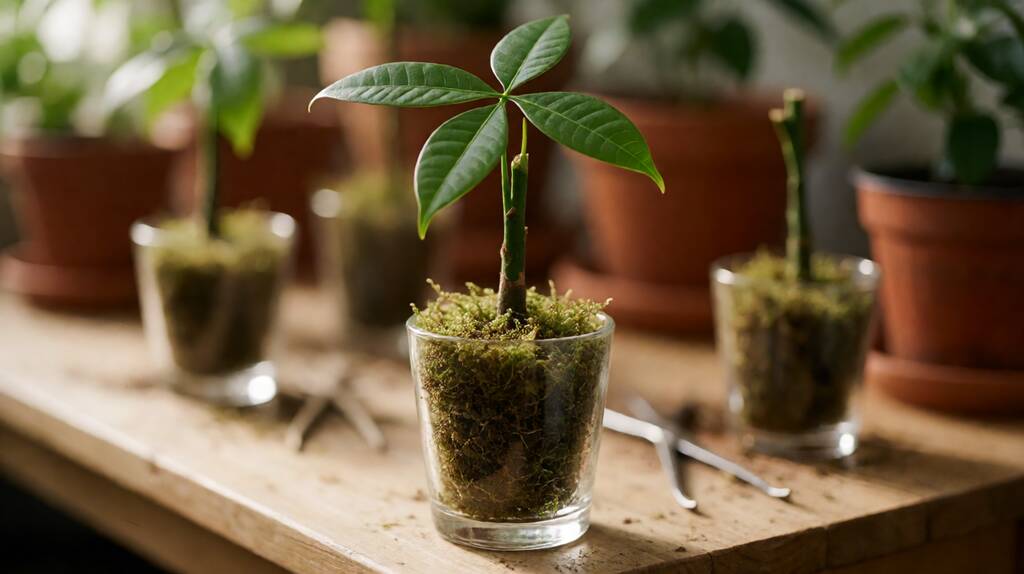
A stem cutting of Pachira aquatica roots in a medium that holds moisture without saturating it. Two reliable choices:
– Long-fiber sphagnum moss, soaked and squeezed out so it is damp like a wrung-out sponge. Moss stays at roughly 60 to 70 percent moisture without staying waterlogged. – Coarse perlite, saturated and drained. Perlite holds moisture on the particle surface but the pore space between particles stays air-filled.
Rooting hormone (indole-3-butyric acid at 0.1 to 0.3 percent, the standard green-powder kind) helps. Dust the cut end and the lower 2 cm of bark before inserting the cutting into the medium. Without hormone, callus formation takes 5 to 7 weeks instead of 3 to 4 weeks, and success rates drop from roughly 70 percent to roughly 35 percent.
The Setup That Roots a Money Tree Cutting
The Setup That Works
Step 1. Pick a semi-hardwood branch. The branch should be 8 to 15 mm in diameter, the bark should still be green but slightly firm when you squeeze it, and the leaves at the tip should be fully expanded palmate leaves, not new unfurled growth. A cutting from a green, fast-elongating tip usually wilts before it roots.
Step 2. Cut at a 45-degree angle with sterilized pruners. Sterilize pruners with 70 percent isopropyl alcohol between cuts to avoid transferring rot organisms from one branch to another. The 45-degree angle exposes more cambium surface to the rooting medium than a flat cut.
Step 3. Remove the bottom 5 cm of leaflets so no leaves touch the medium.
Step 4. Insert the cutting 4 to 6 cm into the medium in a 10 to 15 cm pot. Keep the medium at 22 to 26 degrees C (72 to 79 degrees F) and the air humidity around the cutting at 70 to 80 percent. A clear plastic bag over the pot, propped so it does not touch the leaves, holds humidity without trapping condensation onto the foliage.
Step 5. Wait. Do not tug the cutting to test for roots; tugging damages the new callus. Roots form between week 3 and week 8. The first sign is a small bud pushing from a node above the medium while the cutting still has no roots; that bud is fine, the cutting is alive and moving stored energy upward.
Air Layering: When the Branch Cannot Come Off Yet
Air Layering: When the Branch Cannot Come Off Yet
Air layering is the method for branches you want to keep on the mother plant while they root. The wound stays on the living plant, the branch keeps its leaves, and the cut happens only after roots have formed. For Pachira aquatica this matters because the braided trunks hold sentimental value; cutting a section out of a braid to root it in a pot is permanent, and air layering is not.
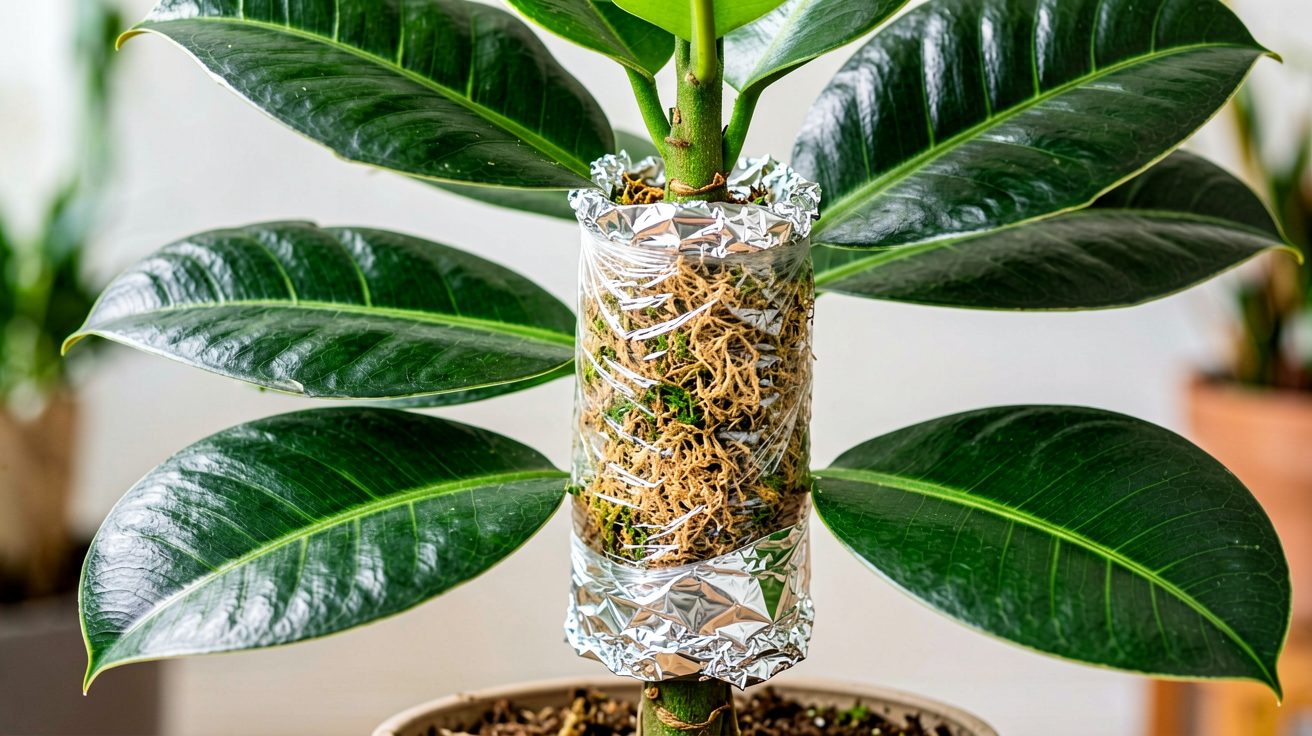
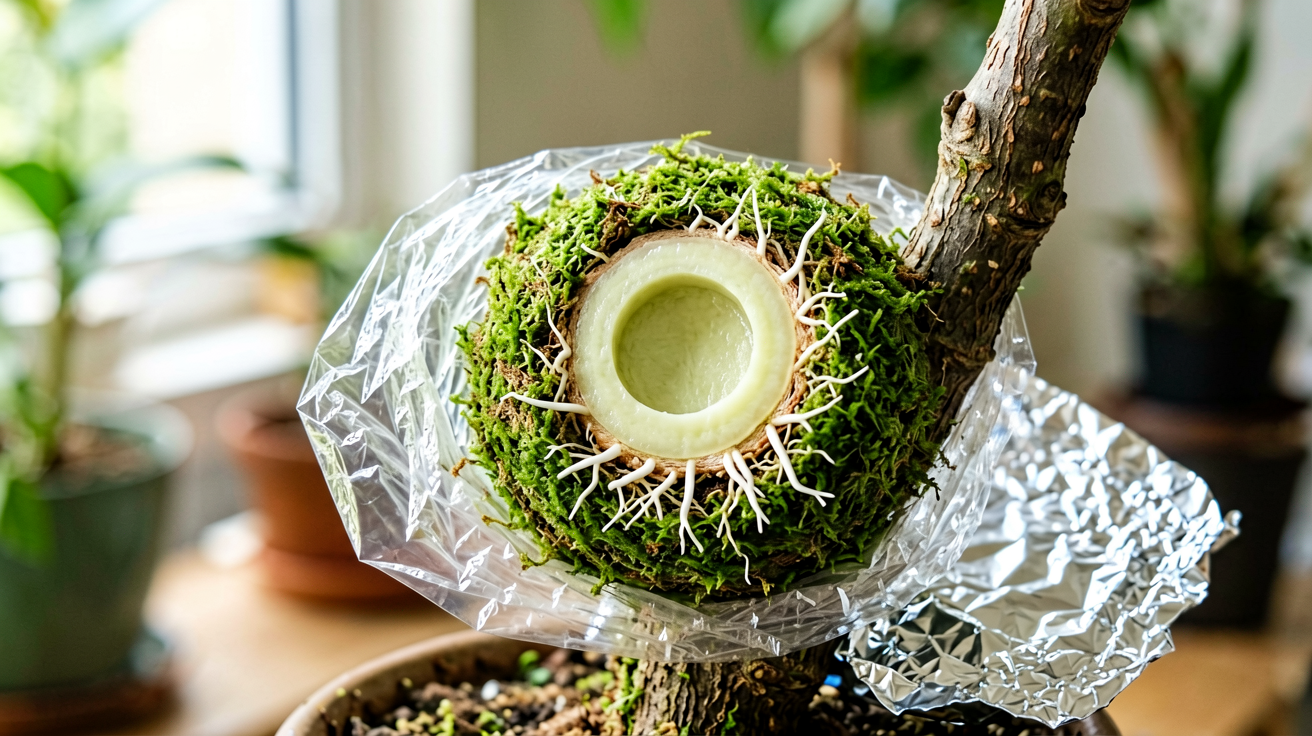
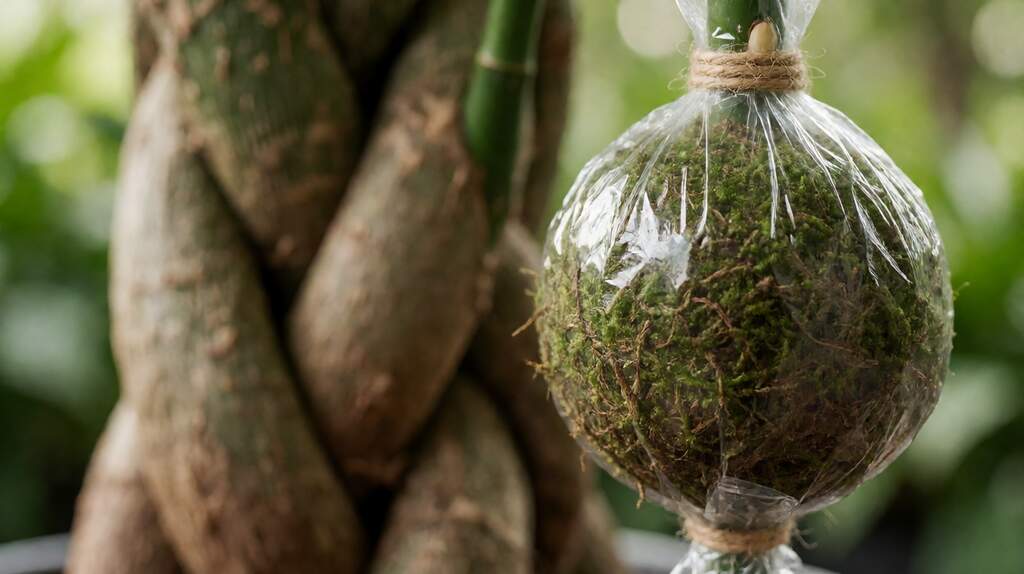
The mechanism. A wound 2 to 3 cm wide is made on a healthy branch 6 to 10 mm in diameter. The wound is wrapped in moist sphagnum and sealed in plastic. The branch above the wound keeps photosynthesizing and sends sugars down to the wound site. The cambium at the wound lays down callus tissue over 3 to 4 weeks, then roots push from the callus. The branch is severed below the new roots, and the rooted section is potted.
Step-by-step.
1. Choose a woody branch. The trunk or a primary branch, 6 to 12 mm diameter, where the bark is light brown and firm. Younger green branches usually do not layer reliably; older gray branches sometimes take 8 to 12 weeks to callus. 2. Make two parallel cuts 2.5 to 3 cm apart on the bark, just deep enough to reach the cambium (a thin green-white layer under the brown bark). Peel the bark between the cuts. 3. Dust the exposed cambium with rooting hormone. 4. Wrap the wound in a 6 to 8 cm ball of long-fiber sphagnum, soaked and squeezed out. Hold the moss against the wound with twine or a wire wrap. 5. Wrap the moss ball in clear plastic film and seal both ends with tape so the moss stays at roughly 70 percent moisture for 4 to 6 weeks. Check at 4 weeks; if the moss is dry, open the plastic, mist the moss, and reseal. 6. Roots are visible through the plastic as white threads entering the moss. Once the root mass is dense (typically 6 to 10 weeks from the wrap), sever the branch 2 to 3 cm below the moss ball with sterilized pruners. Pot the rooted section in the mix described in the soil-and-pot post, water lightly, and keep humidity high for 2 to 3 weeks while the new root mass acclimates.
When Propagation Is Not the Answer
When to Skip Propagation
Sometimes the better move is to keep the plant you have. Propagation is worth the work when the mother plant is healthy and you want a second plant, when a branch has broken off and you want to save it, or when you want to share a cutting with a friend. Propagation is not the fix for a plant that is failing; a money tree dying from overwatering should be diagnosed and rebalanced first, then propagated from the healthy branches six months later.
The Two Methods That Actually Root Pachira
Trouble Signs and What to Do When the Cutting Stalls
A cutting that has not pushed roots or new growth by week 8 is not necessarily a failure. Three checks separate a slow cutting from a dead one.
Squeeze the lower 2 cm of the cutting. A healthy cutting stays firm. A mushy cutting has rot in the cortex and should be removed from the medium, re-cut 2 cm above the rot line, dipped in fresh rooting hormone, and re-stuck in fresh medium. Do not try to save the original cutting; the rot continues even when moved to dry medium because the bacteria are already inside the cortex.
Check the medium moisture. If the medium smells sour or feels waterlogged, the cutting is anaerobic and roots will not form. Re-stuck in fresh medium after cutting above the rot line.
Check for callus formation. Gently scrape the cut surface with a fingernail. A healthy cutting shows a pale, slightly swollen ring of callus tissue at the cambium within 3 to 4 weeks. No callus after 6 weeks usually means the cutting was too green, the hormone dose was too low, or the temperature was below 20 degrees C. Restart with a more woody cutting and fresh hormone.
The healthy timeline looks like this. Week 1 to 2: cutting stays firm, no change. Week 3 to 4: callus forms at the cut, leaves may droop slightly. Week 5 to 6: first white root tips visible at the callus. Week 7 to 8: roots 2 to 4 cm long, new leaf bud at a node above the medium. Week 10 to 12: roots fill the small pot, time to pot up one size in the soil-and-pot mix.
A cutting that follows this timeline in roughly the right window has rooted. Move it to a brighter spot and resume normal watering. A cutting that stalls past week 8 needs troubleshooting, not more time.
Related on the site: the Money Tree Care Guide brings the propagation timing into the wider five-factor care frame, the Air Layering Propagation Guide walks through the air-layering technique in detail, the Money Tree Soil and Pot explains the soil and pot a freshly-rooted cutting should move into, Money Tree vs Money Plant clears up the common-name confusion between Pachira aquatica and Epipremnum aureum, Best Plants for Air Layering lists twelve houseplants that air-layer reliably for cross-species comparison, and Money Tree Watering Requirements shows how the watering rhythm shifts once the new roots are feeding the plant.
If you take one thing from this page: cut at 45 degrees with sterilized pruners, dust the wound with rooting hormone, root in moist sphagnum at 22 to 26 degrees C, and wait at least three weeks before touching the cutting. Air layer woody trunks you cannot bear to lose, and expect visible roots in 6 to 10 weeks. By week eight, a healthy cutting will push its first new leaf from a node above the medium; that leaf is your signal that the caudex has taken up water through the new roots and the plant is now feeding itself.
Turn PDF Bank Statements Into Workable Spreadsheets
Your bank statement is a mess of numbers, but your books shouldn't be. Use our converter to get Excel, CSV, or QBO files — ready for QuickBooks.
Try It Free Now