
A money tree drops leaves for four reasons, and the one that matters is the one you can identify in the first ten minutes. A money tree (Pachira aquatica) that sheds a few leaves after a move, or in late autumn when the days shorten, is doing something normal. A dozen leaves in a week while the soil is wet is not adjusting, it is failing, and what separates those two outcomes is whether the roots still have oxygen. In most cases that reach this page, the plant isn’t dying yet. This page is the diagnosis: how to tell a normal shed from a stress drop, how to separate the four causes, and what to do in the first 72 hours. The species-neutral version is in plant leaves dropping. The pothos (Epipremnum aureum) it is most often confused with tolerates conditions Pachira aquatica does not. money tree vs money plant covers that naming difference.
No university extension service publishes a tested leaf-drop threshold for Pachira aquatica, so the numbers below are reasoned from plant physiology and published houseplant guidance. They are operating figures rather than measured survival times, and their job is to narrow the cause quickly, because cause determines the fix. The trunk and caudex are the decisive evidence: a money tree that has shed every leaf but still has a hard trunk and a firm caudex is dormant or stressed, not dead, and it can push new leaves within 4 to 6 weeks of correct care. The full care frame sits on the money tree care guide.
Why a Money Tree Drops Leaves: Four Mechanisms, Not One
Leaf loss is a symptom, not a cause. A money tree sheds leaves for one of four reasons, and each has a different signature in the pot.
Cold and draft shock
A money tree drops its leaves at 55 degrees F (13 degrees C), and the trunk dies at sustained temperatures below 50 degrees F (10 degrees C). A cold root zone stops water uptake before it stops photosynthesis, so the plant sheds leaves to cut its demand.

Root-zone failure from overwatering
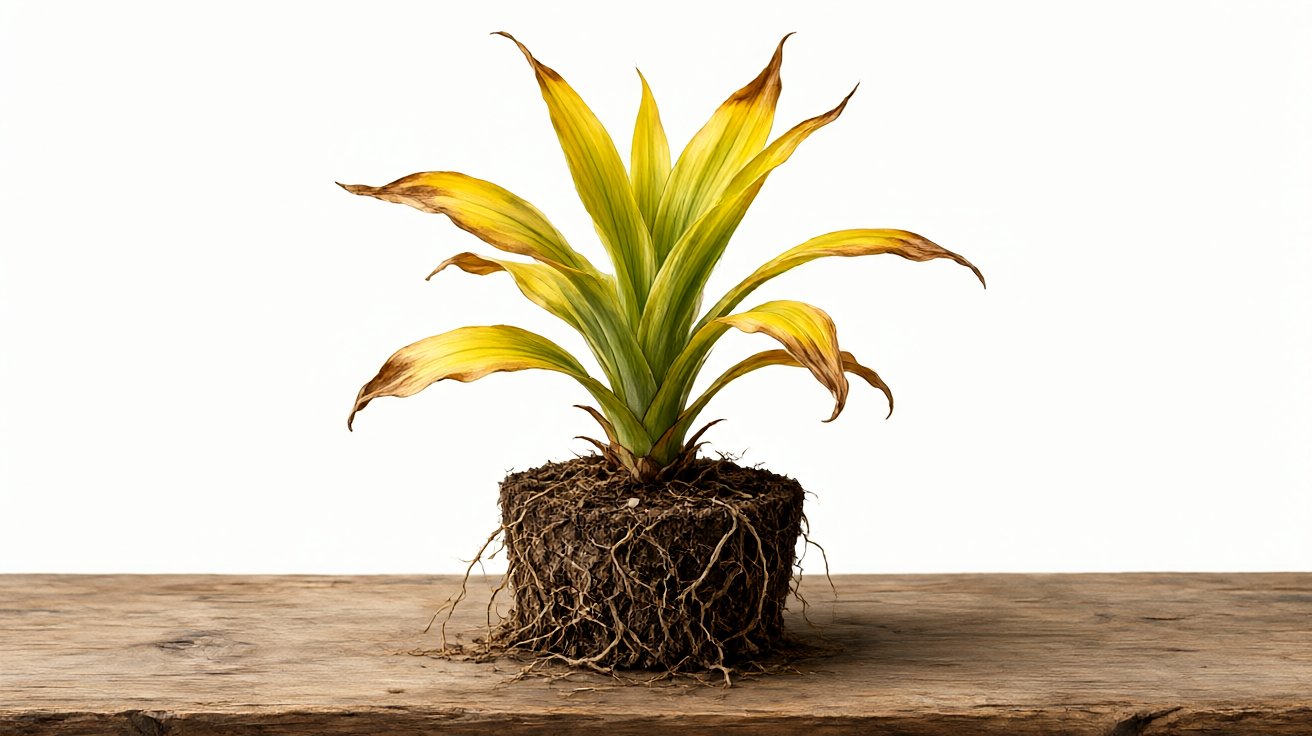
Here is the counterintuitive part, and the most expensive mistake in money tree care. Saturated soil suffocates the fine roots, so the plant cannot draw up the water you give it no matter how much you pour in. The leaves yellow and soften because the plant is starving, not thirsty.
Transplant and move shock
Repotting or moving interrupts root function, and a plant that has just lost root contact with its old soil cannot replace the water it is losing through its leaves. Money trees are sensitive to this because the braided trunk holds a water reserve above the soil line, so a plant that looks fine on day one sheds leaves on day seven.
Dry air, low light, and nutrient withdrawal
Day length sets the photosynthesis rate, which sets how much sugar the plant can spare for its oldest leaves, which is why an autumn shed is seasonal rather than a failure. The same mechanism causes a chronic shed in a dim corner, and dry air pulls water out of the leaf faster than the roots replace it. The two failure types stay separate.
The Drop Test: Three Checks Before You Change Anything
Before you water, move, or cut anything, run this sequence. It takes ten minutes and tells you more than any single symptom.
Check one: the petiole scar
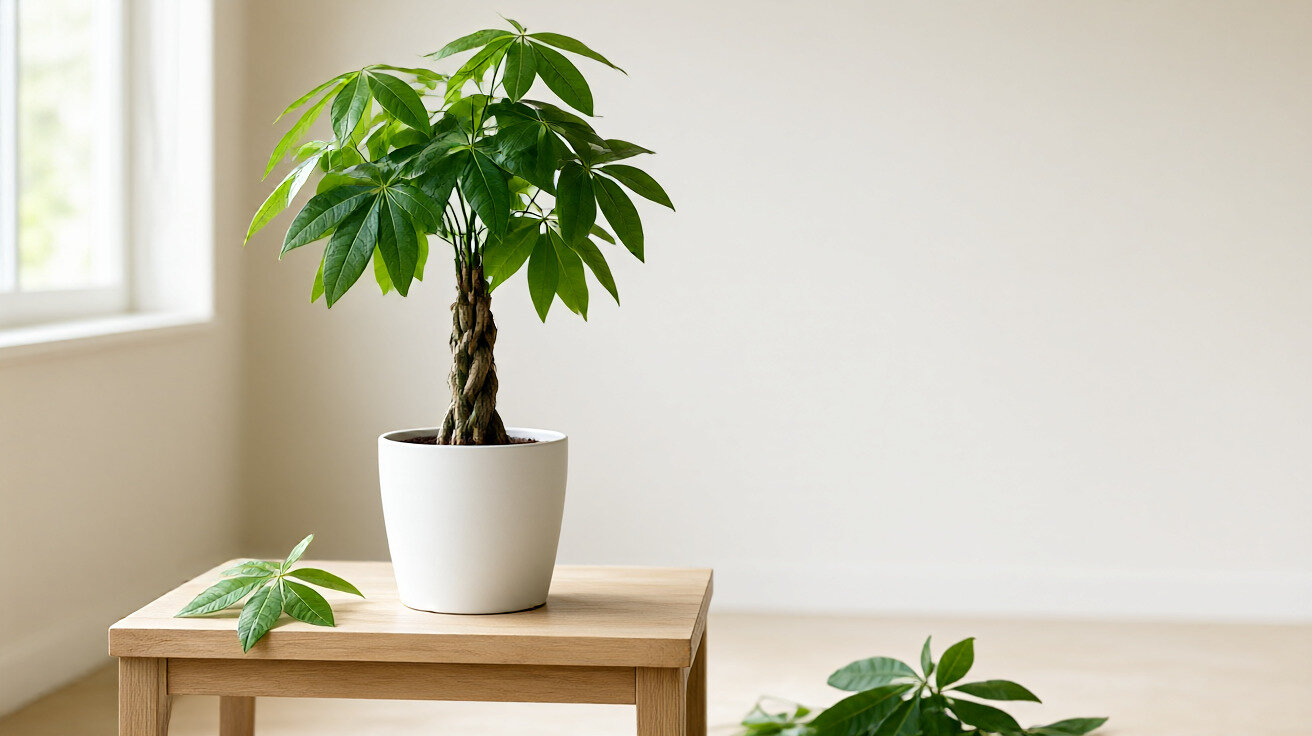
Look at where a fallen leaf joined the stem. A clean, flat, pale scar means the plant pushed that leaf off deliberately through its abscission layer, so the drop was a planned release of an old or damaged leaf. A torn stub or a ragged break means the leaf was pulled off, so the plant was stressed and the loss was not its decision.
Check two: where the soil is
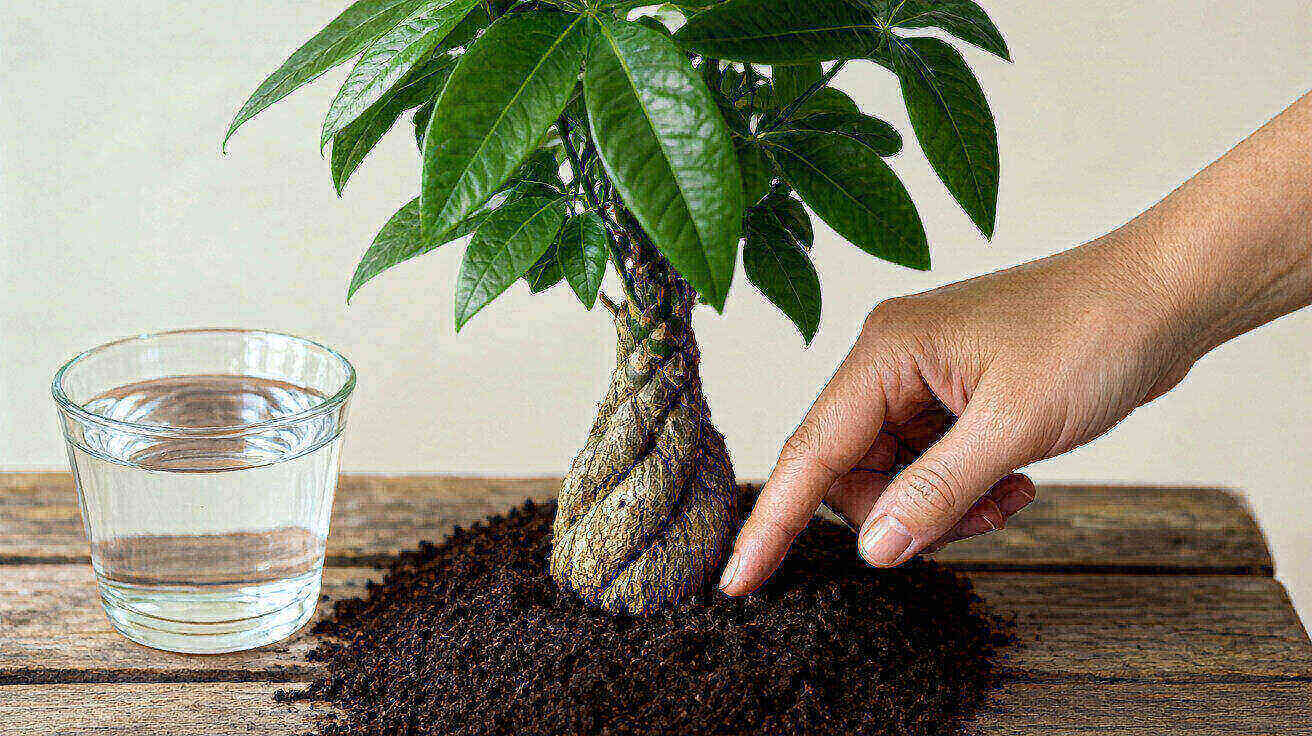
Push a finger 2.5 cm (1 inch) into the soil. Wet and heavy means root-zone failure is the leading suspect. Dry and light means the plant is losing water faster than it can get it, which points to dry air, low light, or a root ball that has shrunk. Soil dry on top and wet at the bottom means uneven watering, and the wet lower layer is where rot starts. The seasonal rhythm, every 7 to 10 days in summer and every 14 to 21 days in winter, is in the money tree watering guide.
Check three: the trunk and caudex
Press the swollen base of the braided trunk. Firm and hard means the stored-water tissue is intact and the tree is worth operating on. Soft, compressible, or hollow means the damage has climbed into the caudex, and no care reverses that. The line between a dormant tree and a dead one is the subject of can you revive a dead money tree.
Cause 1: Cold and Draft Shock, and the 48-Hour Rule
If your money tree dropped leaves while still green within a day or two of a cold snap, a new air conditioner, an open window, or a pot moved onto cold tile, you have a cold event. The root zone matters more than the air temperature: a pot on tile can drop leaves even when the thermostat reads 70 degrees F (21 degrees C), because the tile pulls the root ball to 55 degrees F while the air above stays warm. The year-round band is 65 to 80 degrees F (18 to 27 degrees C), the root zone target is 65 to 75 degrees F (18 to 24 degrees C), and nothing below 55 degrees F (13 degrees C).
What to do in the first 48 hours
Move the plant away from the cold source and off the floor, and check whether the soil is actually wet before you water. If a cold root zone stopped uptake, the soil will often still be damp, and adding water on top of that is how a cold event becomes a root rot event. The recovery timeline and the signs of a plant that has dropped every leaf from cold are in money tree temperature tolerance. Hold a stable 70 degrees F and 50 percent humidity and the caudex firms within 2 to 4 weeks, buds open at the apex in 6 to 12 weeks, and the first fully open leaf follows at 10 to 16 weeks.
Cause 2: Overwatering and Root-Zone Failure
Overwatering causes leaf drop more often than underwatering does, because saturated soil suffocates roots and the plant sheds leaves to cut its water demand. The dropped leaves are usually yellow and soft, and the soil smells sour. The timeline separates this from a cold event: a root-zone failure shows up over weeks rather than days, and by the time you see the leaf litter you are often at the late stage, with a soft trunk base and leaf drop within 48 hours of each watering. The unpotting and pot-downsize rules are in money tree root rot.
What to do when the soil is wet and the leaves are falling
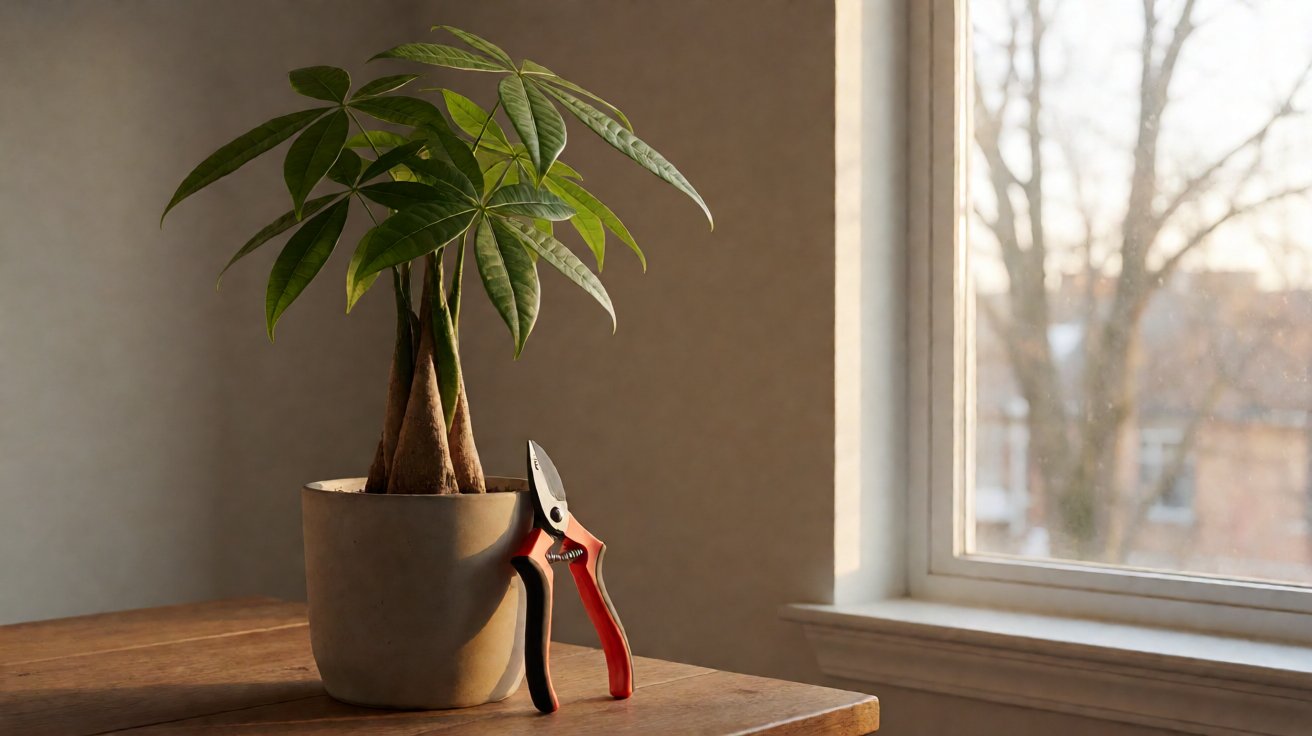
Do not water again, and do not add fertilizer, because it burns the surviving roots on a suffocated root system and removes your last option. Unpot the plant, slide out the root ball, and look. Firm pale roots mean the tree is recoverable. Black, soft, sour roots that shed under your thumb mean the rot has passed the point where trimming helps, and the recovery rate drops to roughly 30 percent.
Cause 3: Transplant and Move Shock
Sudden leaf drop within 2 to 4 weeks of repotting, moving, or a position change is the third mechanism, and the one most often misdiagnosed as a watering failure. The distinguishing detail is that the plant was healthy right up until the event, the soil moisture is normal, and the leaves carry clean scars. Nothing is broken. The plant simply cannot replace the water it is losing while its roots re-establish. Leave it alone, hold the watering rhythm steady, and confirm it has bright indirect light for at least 6 hours a day, or 12 to 14 hours of total light if you add a grow light. More light shortens the window because it raises the sugar supply for new leaves. The placement rules are in money tree light requirements.
Cause 4: Dry Air, Low Light, and Normal Autumn Shed
Not every drop is a crisis. A money tree that sheds a few older leaves from the bottom up in late autumn, with a firm trunk and moist soil, is responding to shorter days. A money tree in a dim corner does the same thing for a different reason, and the difference is the season and the pace. Normal shedding is gradual, a few leaves at a time. Stress-induced shedding is sudden, many leaves within days. If the plant is still producing new growth, the loss is adjustment rather than decline. Two conditions make chronic shedding worse: relative humidity below 50 percent and light below 6 hours of bright indirect per day. The yellowing patterns behind these symptoms are mapped in money tree yellow leaves.
The Drop Pattern Table: Symptom, Timeline, and First Action
Match what you see against the table, then act on the first action column. The timeline column is the most useful one, because timing is the variable people ignore.
| What you see, and where | What it means | Timeline | First action |
|---|---|---|---|
| Green crisp leaves on the floor within 24 to 48 hours of a cold event, soil still moist | Cold or draft shock stopped root uptake | 1 to 2 days | Move it off the floor, away from the draft, do not water yet |
| Yellow soft leaves, sour soil, drop within 48 hours of watering | Root-zone failure from overwatering | 3 to 4 weeks | Stop watering and unpot to inspect the roots |
| Clean petiole scars, firm trunk, drop 7 to 14 days after a move or repot | Transplant or move shock | 2 to 4 weeks | Hold the watering rhythm steady and wait |
| Older leaves bottom-up, firm trunk, steady pace, shorter days | Seasonal or dim-corner shed | Gradual over weeks | Add light, hold humidity at 50 percent or above |
| Pale thinning canopy, soft new growth, pot dries fast | Underwatering or root mass shrinkage | Weeks to months | Water when the top 2.5 cm is dry, then recheck pot size |
What Happens If You Skip the Diagnosis
Skipping the ten-minute test and reaching for the watering can is the most common way a recoverable money tree becomes a dead one. A plant that is cold but not rotted, watered because the leaves look thirsty, moves from a cold shock into root rot in about 3 to 4 weeks. The rot then climbs into the caudex, and once the base of the braid is soft, the tree is gone regardless of care afterward. The same sequence runs when a plant with a firm caudex and dead fine roots gets fertilized, because the salts burn the surviving roots and no root system is left to carry water. The cost of guessing is a dead plant in a month.
What Recovery Looks Like: 72 Hours and 4 Weeks
Run the drop test in the first hour, then follow the timeline. In the first 72 hours, change exactly one variable at a time, because a stressed money tree cannot absorb a second shock while recovering from the first. Hold the root zone at 18 to 24 degrees C, keep relative humidity at 50 percent or above, and do not fertilize until you see new growth. From day 3 to week 4, water only when the top 2.5 cm of soil is dry, and expect the trunk to firm before new leaves. A money tree with a firm trunk and a green scratch test recovers in 4 to 6 weeks of resumed proper care. If nothing pushes within 6 weeks and the trunk has softened, run the scratch, crown, and branch test to separate dormancy from death.
Your money tree isn’t dying. It is telling you which of four things changed, and every one of those four has a fix that starts today. Run the petiole scar test first, because that single look tells you whether the plant made this decision or whether something took it away.
Sources and further reading
New York Botanical Garden, Mertz Library horticulture reference on Pachira aquatica, covering the causes of leaf drop in this species: low humidity, inadequate light, inconsistent watering, overwatering.
University of Missouri Extension, houseplant care and interior plant problem publications, covering the relationship between saturated container soil, oxygen availability in the root zone, and the leaf symptoms that follow.
Clemson Cooperative Extension, plant problem diagnostic publications on overwatering, cold injury and repotting of interior plants, describing the diagnostic sequence and recovery intervals used above.
Iowa State University Extension and Outreach, interior plant management bulletins on watering frequency, light requirements and the seasonal growth rhythm of tropical foliage plants kept indoors.
Last reviewed on 11 November 2026