
A fertilizer recommendation is a mass of nutrient, not product. A soil test reading “1 lb N per 1,000 sq ft” tells how much nitrogen the soil needs; the bag you carry home is nitrogen, phosphorus, potassium and filler mixed. The application rate bridges the two: divide the recommendation by the decimal percent on the label, scale to your real area, and buy the bag that covers it.
Three unit errors cause most over-application: spreading a pound of 10-10-10 to meet a 1 lb N recommendation (a tenth of the nitrogen); spreading 10 lb per 1,000 sq ft on a 100 sq ft bed (ten times the dose); and measuring the bed in feet instead of square feet, drifting by a factor of five. These are unit problems, not plant problems.
Most growers treat the bag as the recommendation, seeing 10-10-10 and assuming the three numbers are doses. They are concentrations; the dose comes from them. The label is an ingredient list with percentages, not a prescription. Once you hold that distinction, the arithmetic is short, and the only hard part is measuring the bed honestly.
What a fertilizer recommendation actually tells you (and what it does not)
A recommendation is stated in pounds of nutrient per area: most vegetable garden guides normalise to 1,000 square feet, many others print per 100. Nitrogen is printed as N, phosphorus as P2O5, potassium as K2O, and the number travels with the crop, not the bag. Mississippi State’s vegetable garden guidance (extension.msstate.edu) builds its rates on the 1,000-square-foot basis, and Iowa State’s home garden rates (yardandgarden.extension.iastate.edu) print most crop ranges per 100. Read the unit before you divide. If the report itself is new, how to read a soil test report is where to start.
What the recommendation does not tell you is which bag to buy, or whether your soil already holds enough of the other two nutrients. It is one number for one nutrient; if the test says 1 lb N per 1,000 sq ft, that is the whole instruction and the rest is your arithmetic. A standard soil test does not even measure nitrogen, because nitrogen moves and leaches too fast, the nitrogen recommendation is a default based on crop and region, while phosphorus and potassium come from the actual test. Penn State’s fact sheet on reading recommendations (extension.psu.edu) makes the same point from the lab side: the nitrogen number is sized from crop need and region history, not from a soil measurement.
The practical upshot is that you never apply a bag to match a recommendation. You apply a calculated mass of product that delivers the recommended mass of nutrient. The bag is just the container the nutrient comes in.
The three numbers you need before you can calculate
You need three things, and none of them is the bag size. First, the recommendation: pounds of nutrient per 1,000 sq ft, from your soil test or an extension guide. Second, the fertilizer analysis, the three numbers on the front of the bag, such as 10-10-10 or 34-0-0, and what the three numbers on a fertilizer label mean is the label side of this work. Third, the area of the bed in square feet. With those three you can compute the dose. Without any one of them you are guessing.
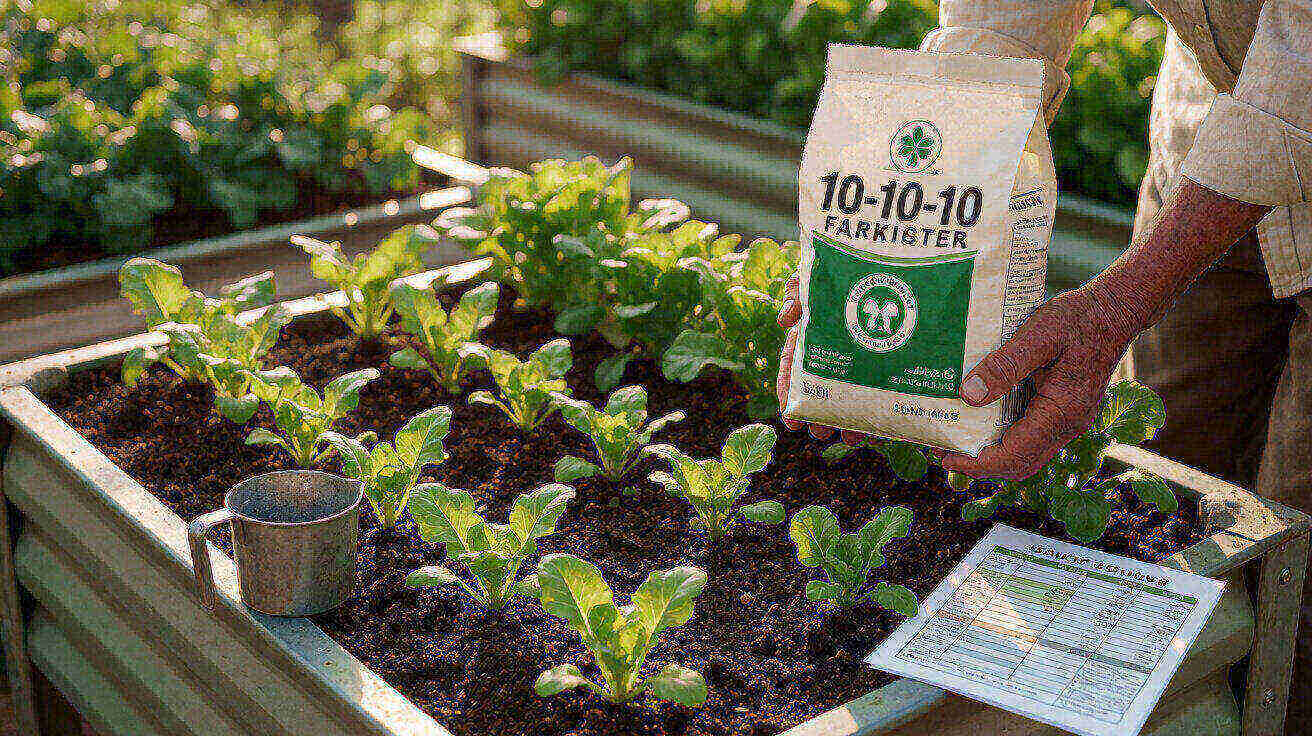
The analysis is a percentage by weight: a 10-10-10 bag is 10% nitrogen, 10% phosphorus as P2O5, 10% potassium as K2O. Convert the percent to a decimal before you use it, 10% becoming 0.10. That conversion is where most errors start, because the percent sign looks like a small number and the decimal like a large one, and the two get swapped. Write it down as 0.10 first, and the swap cannot happen.
Measuring a bed that is not a rectangle
Area is length times width, but gardens are rarely rectangles: split an L-shaped bed into two rectangles, use 3.14 times the radius squared for a circle, and for a curved border take the covering rectangle trimmed 10 to 15% off. Round the final area down, not up: a smaller dose is the safer error.
The calculation, step by step
Step one, recommendation divided by decimal percent. This gives pounds of product per 1,000 sq ft. If the recommendation is 1 lb N per 1,000 sq ft and the bag is 10-10-10, you divide 1 by 0.10 and get 10 lb of product per 1,000 sq ft. That is the standard rate for that product against that recommendation, and it is the number every extension table publishes; UMass Amherst’s fertilizing guidelines (www.umass.edu) run the same division when they turn 0.25 lb of N per 100 square feet into 2.5 lb of 10-10-10.
Step two, scale to your area. Multiply the per-1,000-sq-ft figure by your area, then divide by 1,000. A 100 sq ft bed takes 10 times 100 divided by 1,000, which is 1 lb of product. A 60 sq ft bed takes 0.6 lb. This is the step people skip, and it is the step that turns a correct calculation into a burned garden.
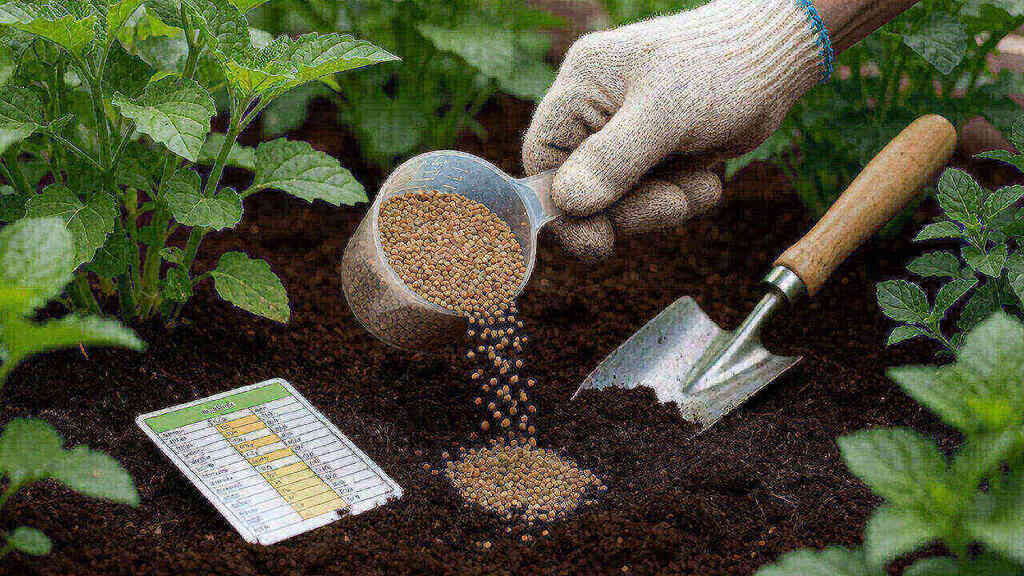
Step three, buy what you need. Convert the pounds to a volume you can measure in the garden. Iowa State’s calculator page (yardandgarden.extension.iastate.edu) notes that a cup of most granular fertilizers weighs about half a pound, so 1 lb is roughly two cups and 0.6 lb a little more than one cup. If the dose is smaller than the smallest bag, split it across several applications or beds. The product decision itself, form, grade and price, is covered in how to choose an NPK fertilizer, and when the choice is organic-first, compost and NPK fertilizer do different jobs. If the dose is larger than one bag, buy the next size up and store the remainder dry.
A worked example, end to end
Take a 10 by 6 foot bed, 60 sq ft, with a recommendation of 1 lb N per 1,000 sq ft and a bag of 10-10-10. Step one: 1 divided by 0.10 equals 10 lb of product per 1,000 sq ft. Step two: 10 times 60 divided by 1,000 equals 0.6 lb for this bed. Step three: at half a pound per cup, that is about one and a quarter cups. Spread it evenly over the 60 sq ft, work it into the top two inches, and water it in. That is the whole job, and the number on the bag was never the dose.
The same chain works for any analysis. A 34-0-0 bag at the same 1 lb N recommendation gives 1 divided by 0.34, or 2.9 lb per 1,000 sq ft, which is 0.17 lb on a 60 sq ft bed. A 24-8-16 bag gives 4.2 lb per 1,000 sq ft, or 0.25 lb on the same bed. The nitrogen recommendation stays the same; only the product amount changes.
When the recommendation is for phosphorus or potassium instead of nitrogen
The same formula works, with one extra conversion. Soil tests and extension guides often state phosphorus as P2O5 and potassium as K2O, and the bag states them the same way, so you can usually use the decimal percent on the bag directly; Utah State’s vegetable fertilization tips (extension.usu.edu) frame their vegetable rates that way. Divide the recommendation by the decimal percent for phosphorus or potassium and you have pounds of product per 1,000 sq ft, same as before.
If you ever need to convert the recommendation itself to elemental phosphorus or potassium, divide by 0.44 for P2O5 to P, or by 0.83 for K2O to K. Most home gardeners never need this, because the recommendation and the bag speak the same oxide language. The reason to know it is that a soil-test report from a university lab may print both, and you want to be sure you are not mixing elemental and oxide numbers in the same calculation.
One caution. When a recommendation lists both nitrogen and phosphorus and potassium, base the whole calculation on nitrogen and accept whatever phosphorus and potassium come along with it. That keeps you from over-applying the other two, which is the more common and more damaging error. If the soil test says phosphorus is already high, switch to a low-phosphorus or nitrogen-only product rather than trying to fine-tune the math. And if the same test flags pH outside the 6.0 to 7.0 band, a correct dose still fails. The reason is the subject of why soil pH makes nutrients unavailable.
The quick reference table
| Recommendation (lb nutrient per 1,000 sq ft) | Product analysis | Product per 1,000 sq ft (lb) | Product per 100 sq ft (lb) |
|---|---|---|---|
| 1 lb N | 10-10-10 | 10 | 1 |
| 1 lb N | 34-0-0 | 2.9 | 0.29 |
| 1 lb N | 24-8-16 | 4.2 | 0.42 |
| 2 lb N | 10-10-10 | 20 | 2 |
| 0.5 lb P2O5 | 0-46-0 | 1.1 | 0.11 |
The table assumes a single nutrient recommendation on a single product. Real beds often need two nutrients at once: pick the product covering the limiting one and accept the surplus of the other, or split the application across two products on different days.
Phosphorus and potassium run the same chain with their own products. One pound of P2O5 divided by 0.46 is about 2.2 lb of 0-46-0 superphosphate, and one pound of K2O divided by 0.60 is about 1.7 lb of 0-0-60 muriate of potash. Mississippi State’s measuring table lists those materials by the pint, the unit the hardware store sells them in: superphosphate and muriate of potash both weigh about a pound per pint, so two cups of either covers one pint.
If you have no soil test
Do not skip the math, but lower the target. Iowa State’s home garden guide is direct about the no-test default: for most perennials, 1 to 2 lb of an all-purpose garden fertilizer per 100 square feet in early spring is enough, and for vegetables the habit is to broadcast and work the product in before planting. Treat that range as a ceiling, not a target, because it knows nothing about what your soil already holds. A soil test is the only way to replace the ceiling with a dose.
The mistakes that put you over the line
Six errors account for almost every over-application. Confusing nutrient with product. Forgetting to scale from 1,000 sq ft to your actual area, over-applying by ten on a small bed. Double-applying by spreading a full dose then side-dressing with the same product two weeks later. Side-dress timing is a calendar question as much as a math one, and when to fertilize by plant type is where each dose lands in the season. Ignoring the soil test because the bag looked small. Applying to wet foliage, which concentrates salt on leaves and burns them even at a correct soil dose. And treating a per-1,000-sq-ft recommendation as per 100 sq ft, over-applying by ten the other way.
If you have already over-applied, the recovery is water, not more fertilizer. Leach the bed with a slow, deep watering over two or three days and let the excess nitrogen and salts wash below the root zone. For how to recognize the damage and what to do next, see the signs that a bed has been over-fertilized.
Containers and buckets
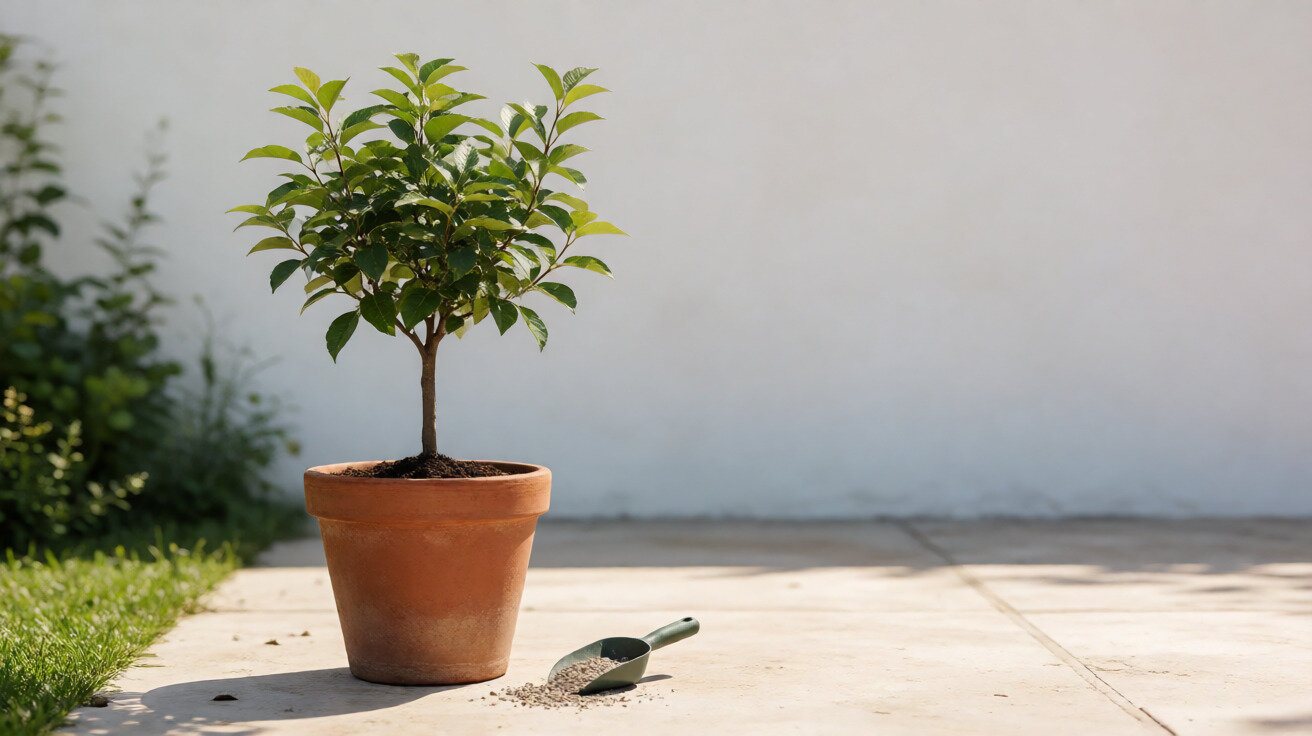
Containers have no meaningful square footage, and their root zone is a fixed volume that dries and leaches on a different schedule. Measure by volume of potting mix, not area, and use a dilute solution rather than granular product: a common starting point is quarter-strength liquid feed every two weeks during active growth. That is a rule of thumb, not a soil-test-derived rate, and the one place in this method where the number is not a calculation.
The same square-footage logic would over-feed a shallow pot, because the root zone is small and the fertilizer has nowhere to go but into the roots. If a container plant shows tip burn after feeding, halve the concentration and lengthen the interval.
The actual number is the decision.
Last reviewed on 28 October 2026.
Turn PDF Bank Statements Into Workable Spreadsheets
Your bank statement is a mess of numbers, but your books shouldn't be. Use our converter to get Excel, CSV, or QBO files — ready for QuickBooks.
Try It Free Now