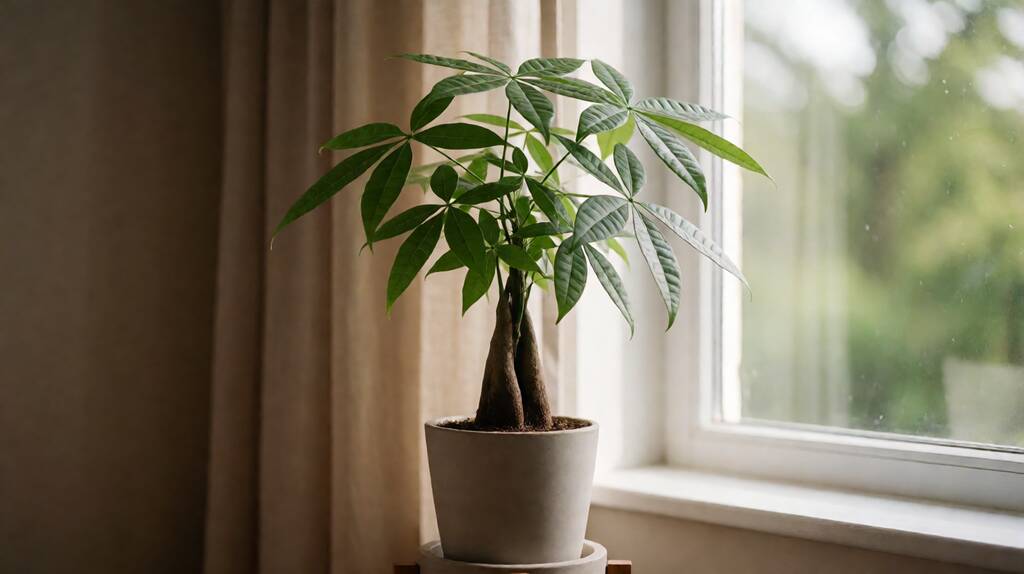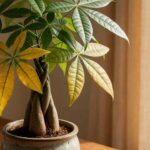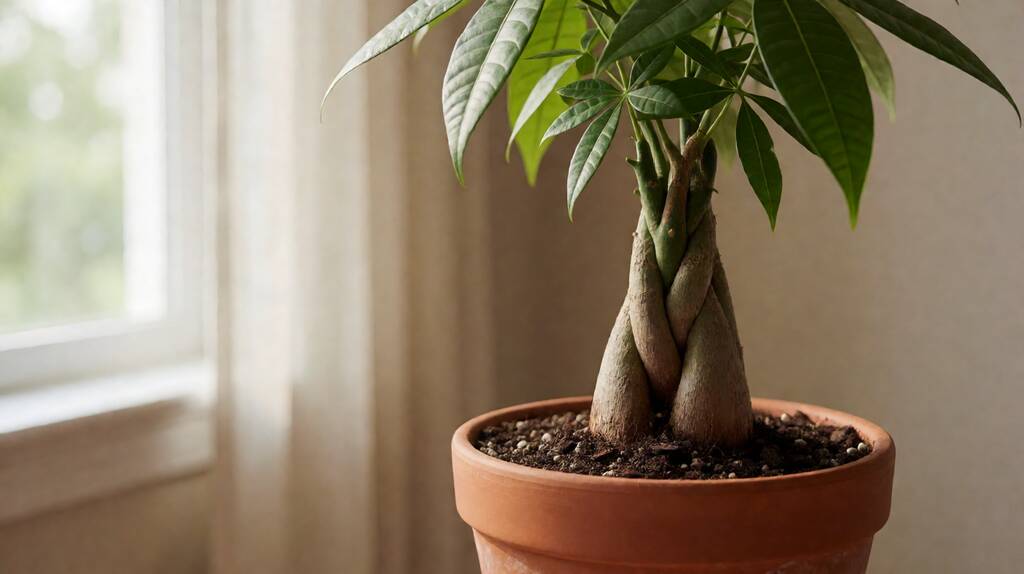

A money tree (Pachira aquatica) does not die from bad soil chemistry. It dies from a soil physics paradox: the same plant evolved in seasonally flooded Central American wetlands where the water table rises over the root zone for weeks at a time, and it also evolved in dry uplands where the same root zone dries out between rains. Indoors, that paradox collapses. The braided trunk (a swollen caudex) stores water between drinks, but the fine roots around the caudex suffocate in soil that stays wet past day five. Most growers pick a soil that holds moisture “because Pachira likes water,” and that choice is the reason over half of all money trees shipped from gift shops arrive with crown rot already in progress.
Two honest limits up front. A pot without a drainage hole cannot be saved by any soil blend; the water still pools over the root crown. And a money tree that has already lost more than a third of its fine roots to rot needs surgery, not a repot, and the recovery post walks through that.
What ‘Well-Draining’ Soil Actually Means in a Pot
What “Well-Draining” Actually Means in a Pot
“well-draining soil” gets repeated so often it has stopped meaning anything. Here is the physics. Three water-holding properties matter for Pachira aquatica:
– Total porosity. A soil’s particle mix leaves 40 to 60 percent of the pot volume as air space when freshly potted. Below 30 percent porosity, the root zone stays saturated past day five and the fine root hairs begin anaerobic fermentation within 72 hours. – Pore size distribution. Large pores (drainage pores, over 0.5 mm) drain by gravity in seconds. Small pores (capillary pores, under 0.1 mm) hold water against gravity and feed the roots between waterings. A good money tree mix sits at roughly 60 percent large pores, 40 percent small pores. – Drainage rate. Water poured into a freshly potted mix should drain from the bottom hole within 8 to 15 seconds. If it takes longer than 30 seconds, the mix is too fine; air exchange at the root surface is already compromised.
Most bagged “tropical plant” mixes are too fine. Peat-heavy mixes hold water like a sponge and the soil column never fully drains between waterings, even when the surface feels dry on day four. Most bagged “cactus and succulent” mixes are too dry. They shed water so fast the caudex never gets a deep drink and the plant drops leaves in protest two weeks later.
The Blend That Solves the Paradox
The Blend That Solves the Paradox
A mix that works for Pachira aquatica uses three components, by volume:
– 40 percent pine bark fines (orchid bark, particle size 6 to 12 mm). Bark creates large drainage pores and breaks down slowly, so the air-space percentage stays high for 12 to 18 months. – 30 percent peat-free coco coir or peat moss. Coir holds small capillary pores that feed the roots between waterings and rewets easily after a dry spell. Peat moss works but turns hydrophobic after a complete dry-out and is harder to re-wet. – 30 percent perlite or pumice. Perlite is cheap and adds permanent large pores; pumice is heavier and the pot stays stable. Either works at 30 percent.
Optional 10 percent addition: coarse horticultural charcoal. Charcoal buffers pH swings from fertilizer salts and keeps the mix sweet for 18 to 24 months. Skip the activated charcoal from pet stores; it is too fine and clogs pores.
Do not add garden soil. Outdoor garden soil compresses to anaerobic mud inside a pot within weeks and the fine roots suffocate. Do not add sand. Play sand or builder’s sand has particle sizes that pack into a concrete-like layer; coarse river sand at 10 percent is fine if you cannot find perlite, but perlite is the safer choice.
The Pot Decision: Size, Material, and the Drainage Hole
The Pot Decision: Size, Material, and the Drainage Hole
The pot is half the soil physics. Three choices matter.
Drainage hole. Non-negotiable. A pot without a drainage hole traps every mineral salt, every fertilizer leftover, and every drop of water the mix did not absorb, and the concentration rises over time until root tip burn shows up as brown leaf margins. If the only decorative pot you own has no hole, keep the money tree in its nursery plastic pot and slide that into the cachepot. Lift it out, water, let it drain, slide it back. That extra 30 seconds per watering saves the plant.
Pot size relative to caudex. The pot diameter should be 2 to 4 cm wider than the caudex at its widest point. Too small and the caudex pushes the root crown against the pot wall; too large and the soil volume holds water past day five every time you water. A money tree in a pot that is too big droops within two weeks of arrival and growers assume it needs more water, which finishes the rot.
Material. Unglazed terracotta breathes through its wall and wicks moisture out of the soil column, which speeds drying by 1 to 2 days per cycle. Glazed ceramic and plastic do not breathe. Either works if you tune the watering frequency to match, but terracotta is the safer choice for a beginner and the easiest way to recover from overwatering.
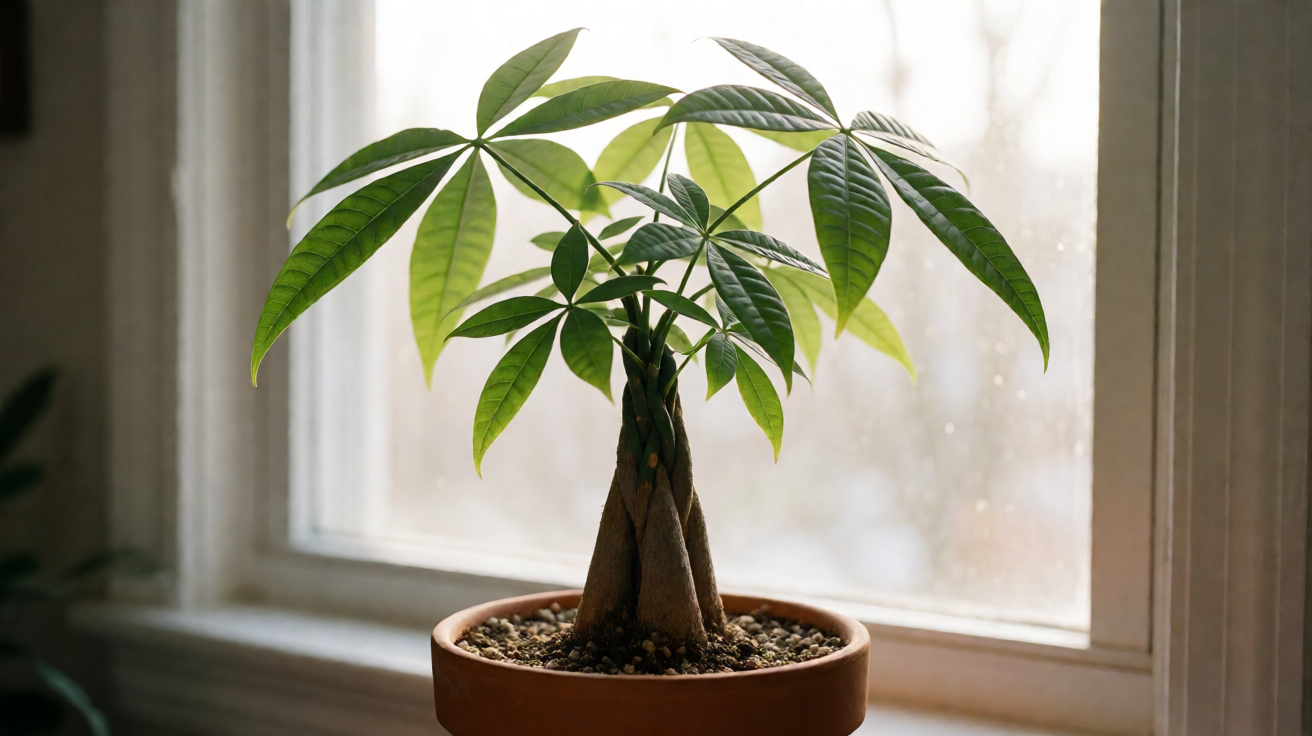
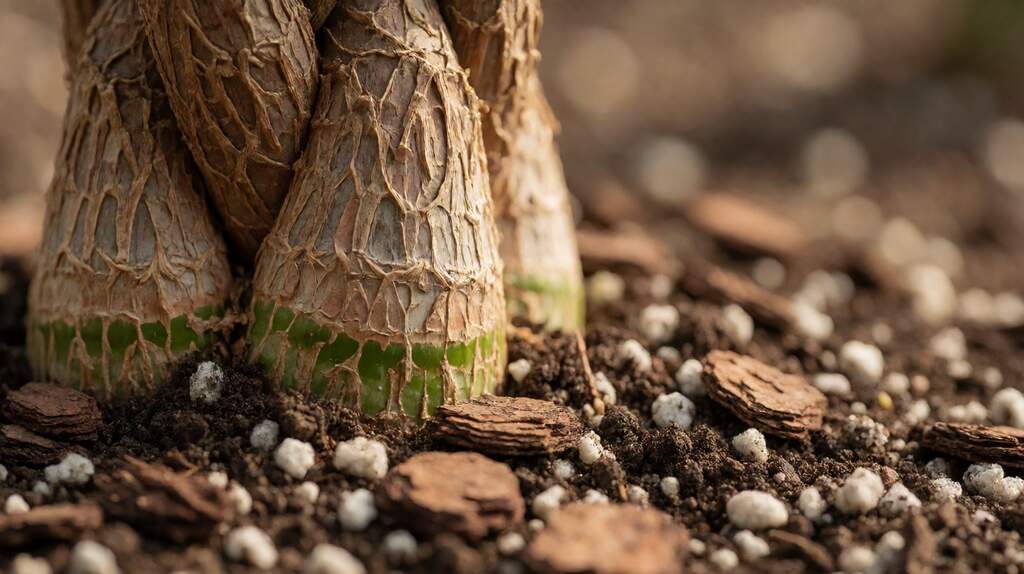
Crown depth. The caudex should sit 1 to 2 cm above the soil line, not buried. Buried caudex traps moisture against the bark and the same tissue that stores water also rots first. A caudex buried by 3 cm or more in a heavy mix is the most common site of crown rot in indoor money trees.
When to Repot: Three Signals and a Window
When to Repot: Three Signals and a Window
Repot only when the plant sends a clear signal. Healthy money trees like being slightly root-bound because the smaller soil volume dries faster and the caudex stays drier.
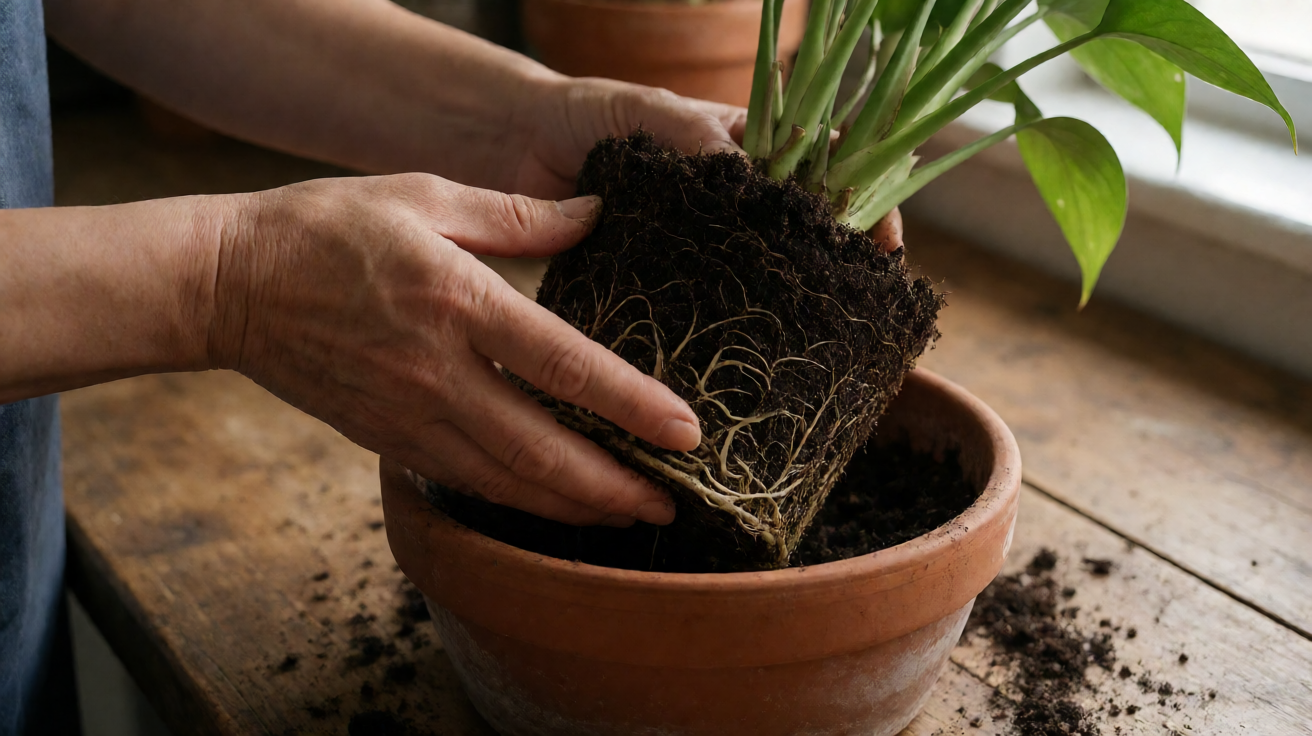
Signal 1: roots circling the pot bottom or poking out of the drainage hole. This is the clearest signal. Lift the pot and look; if roots have formed a dense mat at the drainage hole, the soil column is exhausted and the caudex has nowhere to expand.
Signal 2: water runs straight through the pot without wetting the soil column. Hydrophobic dry soil or compacted old mix means the air space percentage is gone. Repotting restores porosity.
Signal 3: the caudex has visibly outgrown the pot. The trunk diameter is wider than the pot rim, or the caudex is pressing against the wall. Move up one pot size (2 to 4 cm wider), never more.
The window. Repot in active growth, which for indoor money trees under normal room temperatures is spring through early summer. Avoid repotting in late fall or winter when light is low and the plant is in slow growth; the disturbed roots sit in cold, wet soil and crown rot follows within weeks.
Common Mistakes That Cause Crown Rot
Common Mistakes
Bagged “tropical plant” mix straight from the bag with no perlite added. Holds water 40 percent longer than the caudex tolerates.
Pot one size too big because “the plant needs room to grow.” Soil volume exceeds root volume, water sits past day five, crown rot starts.
Potting the caudex below the soil line to “anchor the trunk.” The same tissue that stores water between rain events also rots first when it is buried.
Top-dressing with pebbles for decoration. Pebbles slow surface evaporation, which keeps the top of the soil wet for days. The root crown, which Pachira evolved to keep dry, sits wet.
Repotting into a dry mix and watering heavily to “settle” the soil. Water-logged new mix around disturbed roots is the fastest way to start rot. Water once lightly at repot, then wait 5 to 7 days for new root tips to callus before resuming normal watering.
The Soil Mix and Pot That Keep a Money Tree Alive
The Seasonal Soil Rhythm for an Indoor Money Tree
Soil moisture demand changes through the year because light and temperature both change, and a Pachira aquatica on a windowsill responds to that rhythm even though the soil mix is the same. A simple four-season calibration keeps the soil physics in balance.
Spring (March to May) is the repot window and the start of active growth. The caudex pushes new root tips, the soil column warms to 18 to 22 degrees C, and water uptake roughly doubles compared with winter. Watering frequency climbs from once every 14 days to once every 7 to 10 days. Top-dress the pot with a thin layer of worm castings; the slow-release nitrogen feeds new leaves without burning the caudex.
Summer (June to August) is the highest water demand window, especially if the plant sits in a bright window. Watering climbs to once every 5 to 7 days for a 20 cm pot in bright indirect light, and the top inch of soil dries in roughly three days. Watch the caudex: if it feels softer than usual between waterings, the soil is drying too far between cycles and the bark-fine component is breaking down faster than expected. Plan a repot for the following spring.
Fall (September to November) is the slowdown. Light drops, the caudex sends fewer root signals, and water uptake falls back to once every 10 to 14 days by late October. This is the season most growers overwater because the calendar says “time to water” even though the soil is still damp from the previous cycle. Lift the pot before watering. If it feels heavy, wait.
Winter (December to February) is the lowest water demand window. Soil stays damp 14 to 21 days in an unheated room. Watering climbs back to once every 14 to 21 days, and a humidifier at 50 percent RH keeps the leaf canopy from drying out while the caudex stays nearly dormant.
Related on the site: the Money Tree Care: The Complete Guide for a Healthy Pachira Aquatica brings the soil rule into the full five-factor care frame, Money Tree Watering Requirements applies the dryness test to money trees specifically, Money Tree Light Requirements covers the bright-indirect placement, Reviving a Dead Money Tree walks through the recovery surgery when rot has already started, and Money Tree vs Money Plant clears up the common-name confusion between Pachira aquatica and Epipremnum aureum. For the watering biology that drives this whole soil-and-pot decision, the Houseplant Watering Schedule by Species covers the capillaric mechanism across species.
If you take one thing from this page: a money tree grows in a mix that holds air and drains in under 15 seconds, in a terracotta pot with a drainage hole and a caudex that sits above the soil line. Within two weeks of a correct repot, a money tree that was leaning soft and dropping leaflets will push a new flush of palmate leaves from the apex and the caudex will feel firm again. The plant is telling you its caudex dried out. Trust the trunk; that is what it is for.
From Bank Statement to QuickBooks-Ready File
That manual cleanup you just read about? This tool skips it. Turn your PDF into QBO for QuickBooks without storing your data anywhere.
Start Converting