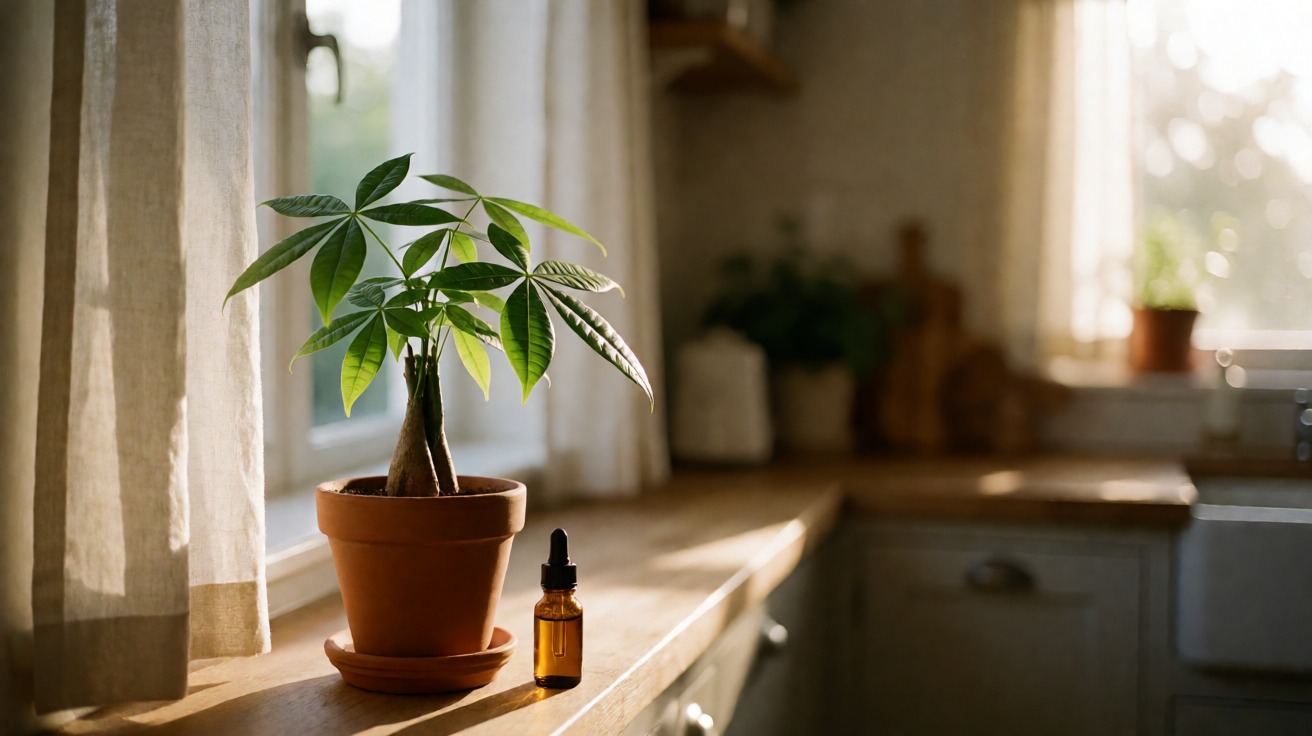

A Pachira aquatica in a four to six inch pot is a low-fertilizer plant, not a no-fertilizer plant. The reason lives in the substrate. Peat-bark mixes hold nutrients in their cation exchange sites the same way they hold water, so a half-strength balanced feed every four to six weeks during the growing season is enough. Most of the brown-edge money trees I see are over-fed, not under-fed.
This article is the mechanism behind that sentence. We will walk through what fertilizer actually does at the root tip, how much nitrogen Pachira can uptake before the osmotic gradient inverts, and what changes visually on the plant when you cross that line in either direction. Halfway in, the running answer is simple. By the end, you will know the number on the bottle, the number in the substrate, and the number the leaf is showing you.
Why Money Trees Get Over-Fertilized More Than Under-Fertilized
The standard tag attached to a nursery-bought Pachira aquatica says something like “fertilize monthly during the growing season.” That is fine advice for a peony in a half-bushel of soil. It is too much for a money tree in a six-inch nursery pot with a peat-bark substrate, for one physical reason: cation exchange capacity.
The peat-bark mix that almost every mass-produced money tree ships in has a CEC of roughly 100 to 150 milliequivalents per 100 grams. That number is high. It means the substrate holds positively charged nutrient ions (calcium, magnesium, potassium, ammonium) on the negatively charged surfaces of the organic matter, then releases them slowly to the root. Each feeding from a watering can adds another dose on top of the previous dose. The substrate does not flush the way a sandy outdoor bed does. By month three, the salt concentration in that small pot can be two or three times what the bottle label was designed for.
This is why the brown edges appear at week five or six, not week one. The plant was fine on the nursery schedule. The plant is now living on a substrate that has accumulated six feedings of nutrients it never used. The fertilizer did not change. The substrate did.
One honest limit up front: if the brown edges are crisp and appear within 24 hours of a feeding, that is acute osmotic burn from a too-concentrated dose, not slow accumulation. The fix is the same (flush the substrate with clear water) but the cause is different.
The Mechanism Behind Fertilizer Burn on a Money Tree
When the salt concentration in the substrate water rises past what the root tips can pull against, the osmotic gradient reverses. Water leaves the root cells and flows into the substrate. The plant begins to lose water through the very organ it uses to take water in. The cells at the leaf margins, which are already the furthest from the root pressure, die first. That is the brown edge.
The threshold for Pachira sits around 150 ppm nitrogen in the substrate solution. The standard indoor liquid fertilizer at full strength delivers roughly 200 to 250 ppm nitrogen per watering. Half-strength delivers 100 to 125 ppm. The half-strength number keeps the plant on the safe side of the 150 ppm threshold, with enough margin that a fresh watering does not push it over.
The same physics explains why “dilute weekly feed” advice from some houseplant influencers fails on a money tree. Diluting does not change the total nitrogen delivered per month. It changes the rate. The substrate still accumulates the same total; the plant just gets it in smaller doses. The half-strength-every-four-to-six-weeks approach, by contrast, delivers less total nitrogen over the same window. The substrate’s CEC handles the supply between feedings.
What N-P-K Ratio and Frequency Actually Work
The short version: a balanced fertilizer with an N-P-K ratio in the range of 3-1-2 to 1-1-1, diluted to half the bottle label strength, applied every four to six weeks from March through September, and not at all from October through February.
The reasoning behind each piece of that sentence:
N-P-K ratio. Pachira in a peat-bark substrate already has phosphorus from the peat. Adding more phosphorus through a 10-10-10 or 20-20-20 balanced feed builds up as runoff salt over six months and never gets used. A 3-1-2 or 2-1-1 ratio adds nitrogen (the limiting nutrient for vegetative growth) and the modest phosphorus the substrate does not already supply. If you only have access to a balanced 10-10-10, half-strength dilutes all three proportionally and works fine; a 3-1-2 is just leaner and cleaner.
Frequency. Money trees push new leaves on a roughly six-week spring-to-summer cycle. Each new leaf is a measurable signal that the previous feeding was sufficient. If you see a new leaf, the substrate is delivering what the plant needs; you can wait the full six weeks before the next dose. If you see no new leaf and no new growth point swelling, the plant is either dormant or the substrate is exhausted; check the season before adding more.
Season. From October to February in the northern hemisphere, photoperiod drops below the threshold that triggers vegetative growth in Pachira. The plant is not actively transpiring; the substrate is not actively drying between waterings; the CEC is not releasing nutrients at the rate the roots can use them. A feeding in mid-January sits in the substrate until March. Stop.
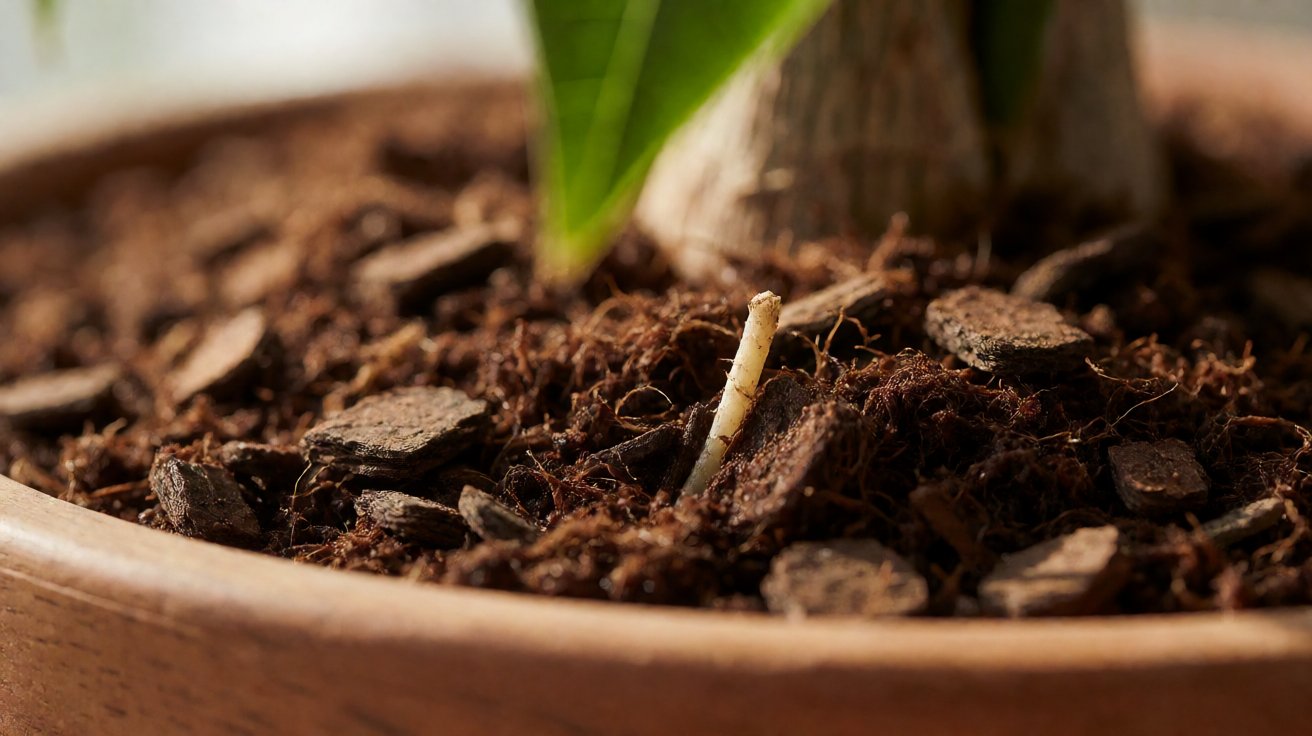
Reading the Leaves: Over vs Under-Fertilized Money Tree
Two symptom patterns show up on a Pachira when the fertilizer schedule is off. They look different. Knowing which one you are seeing is the difference between stopping a feed and starting one.
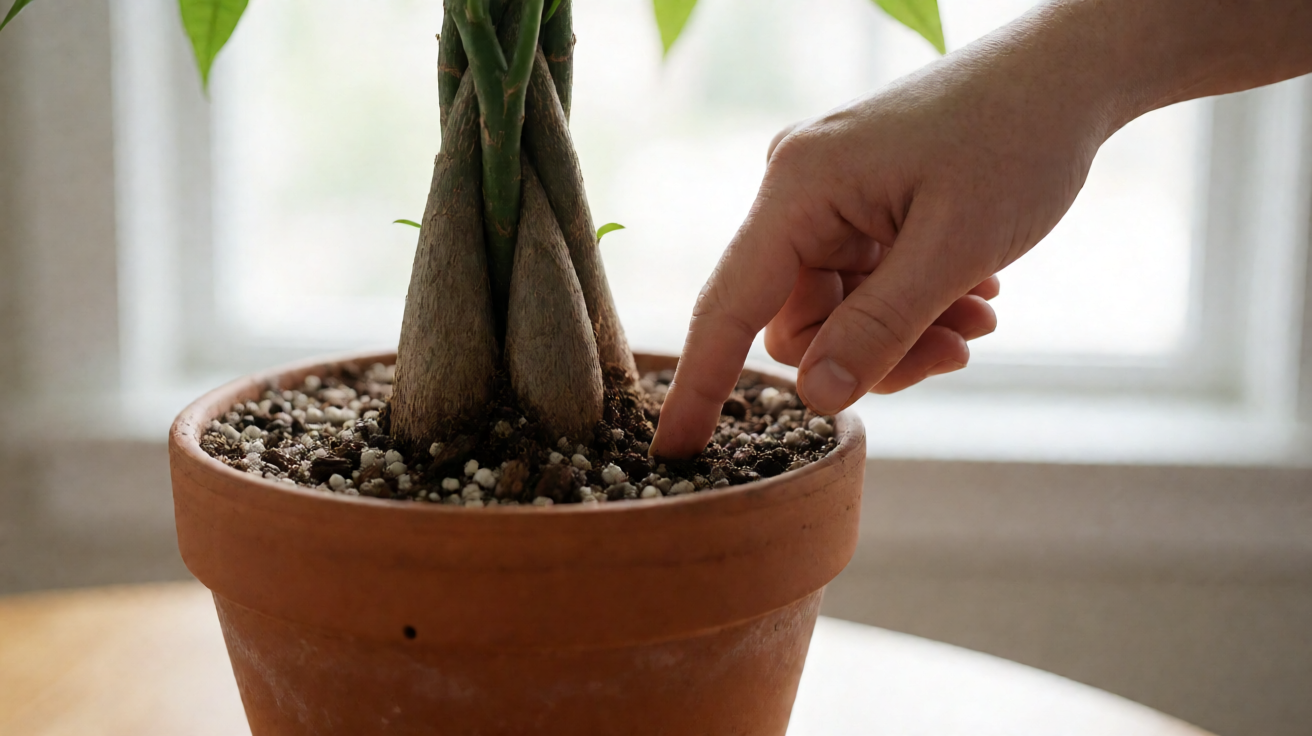
Over-fertilization. The brown margins are crisp, dry, and edged with a thin yellow halo. The newest leaf (the smallest, tightest one at the apex of each branch) shows a softer droop than the older leaves below it. The droop is not the same as a thirsty droop: the lower leaves are still turgid. Touch the substrate. If it is damp and the leaf margins are crisp-browning, you are over-fed.
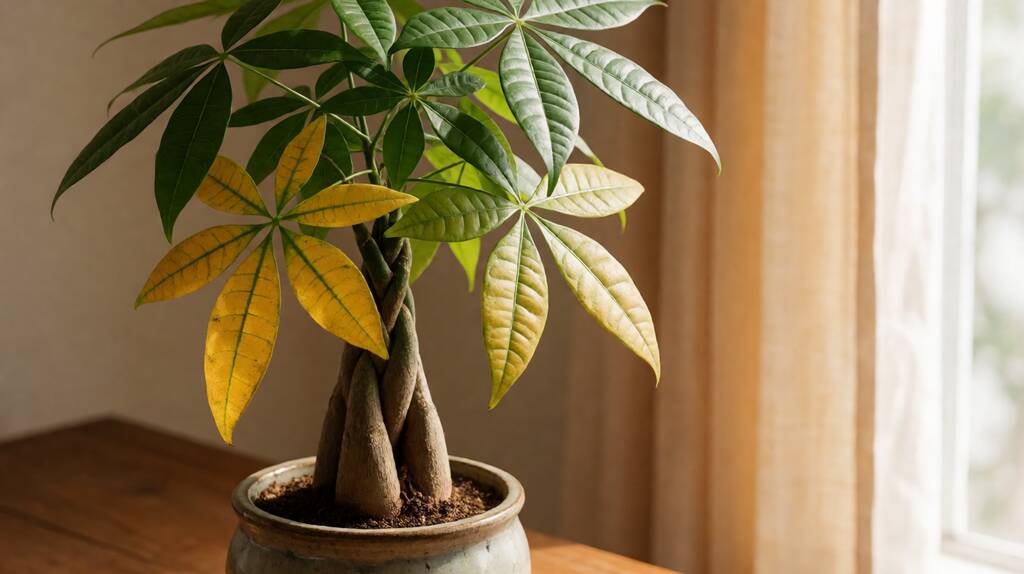
Under-fertilization. The older leaves (lower on the trunk, on the shaded interior branches) go yellow between the veins first. The interveinal chlorosis spreads from the leaf margin inward, leaving the veins green. New leaves are smaller than the previous flush, and the gap between leaf nodes shortens. Touch the substrate. If it has been three months with no feeding and the lower leaves are pale, you are under-fed.
The two patterns point at different fixes. Over-fertilization: flush the substrate with two pot-volumes of clear water, then leave it alone for six to eight weeks before any feeding. Under-fertilization: half-strength 3-1-2 at the next watering, then revert to the four-to-six-week schedule. If you do not see recovery in the next leaf flush, the substrate itself is exhausted and the plant needs a repot into fresh peat-bark, not more fertilizer.
One quiet YMYL boundary: if the symptoms include any burned, blistered, or wet-looking root crown area, or if the leaves are dropping while still soft and green (not yellow), the cause is more likely root rot than fertilizer. Stop feeding entirely, switch to plain water only, and inspect the root crown before resuming any schedule. A fertilizer fed to a rotting root system accelerates the rot.
What Changes in Fall and Winter
By October, most indoor money trees have slowed their leaf push. The substrate still holds the residual nutrients from the summer feedings, plus the CEC is still releasing ions on the watering cycle. A feeding in November adds nitrogen that will not be used until March, accumulating in the substrate in a form that will be visible as crisp leaf margins by week 12.
The clean schedule for the dormant half of the year is: no fertilizer, plain water, same watering frequency as the growing season (use the same finger-soil-moisture test you would in summer, do not let the pot sit wet just because the plant is not pushing leaves). Resume feeding in mid-March, when photoperiod crosses 12 hours in the northern hemisphere. The first spring feeding should be half of what you used the previous September, because the substrate still carries the autumn tail.
How to Choose a Fertilizer When the Aisle Has Twenty Options
The product label matters less than the dilution and the frequency. A 3-1-2 organic fish emulsion at half strength every six weeks, a 2-1-1 synthetic at half strength every four weeks, or a slow-release 6-month granular worked into the top inch of the substrate once per year will all keep a Pachira healthy in a peat-bark substrate. The two failure modes are: too much nitrogen in one dose (causing acute burn at the next watering), and feeding through the dormant months (causing slow salt accumulation that shows up as crisp leaf margins by February).
If you are starting from a new nursery plant, do not fertilize for the first six to eight weeks. The substrate was fertilized at the nursery, often within the last month. Adding more on top of an already-fed substrate is the most common over-feeding accident on a brand-new money tree. Wait until the plant has pushed its first new leaf in your home, then begin the half-strength schedule.
Your money tree isn’t hungry in February. The substrate has the nutrients it needs. Come March, halve the dose on the bottle, water it in, and wait six weeks. The new leaves will be the answer.
Read also: Money Tree Soil and Pot for the substrate side that determines how fertilizer behaves, Money Tree Yellow Leaves: The Five Patterns on Pachira for the symptom side of the same plant, Money Tree Care: The Complete Guide for the cluster corner, Money Tree Temperature Tolerance for the seasonal window that decides when feeding resumes, Money Tree Propagation for the fertilizer-free first six weeks of a new cutting, and Money Tree Pruning for the post-pruning hold on feeding.
From PDF to Excel in one click
Forget retyping line by line. Upload any bank statement, get a spreadsheet you can actually use. Your files are never stored, and you can test the converter with 3 free conversions.
Try it free