
Money tree repotting is simple if you change the smallest thing that works and stop. A money tree (Pachira aquatica) needs a new pot every two years, or sooner when the roots have clearly outgrown the container, and the only two choices that decide whether it survives the move are the pot diameter and the soil’s drainage. Pot it up by one or two sizes, not into a large decorative bin; keep the crown and the braided trunk at the same depth they had before; and do it in early spring, when the plant is about to push new growth that will use the fresh soil. Get those three right and the tree settles in over two to three weeks. Get them wrong and the pot holds water it can no longer take up, and the fine roots start to rot.
The numbers in this page are operating figures, reasoned from container physiology and published houseplant guidance, because no extension service publishes a tested repotting schedule for Pachira aquatica. They are working values, not lab results, and their job is to keep the move from becoming the event that kills the plant. The full care frame, including the year-round light and temperature targets, sits on the money tree care guide.
When to Repot a Money Tree
Repot on a schedule or on a signal, whichever comes first. A two-year cycle is the default for a healthy tree in good soil, but the schedule is the ceiling, not the floor. If any one of the signals below is clear, repot now, even if the last move was months ago.
The four signs the pot is too small
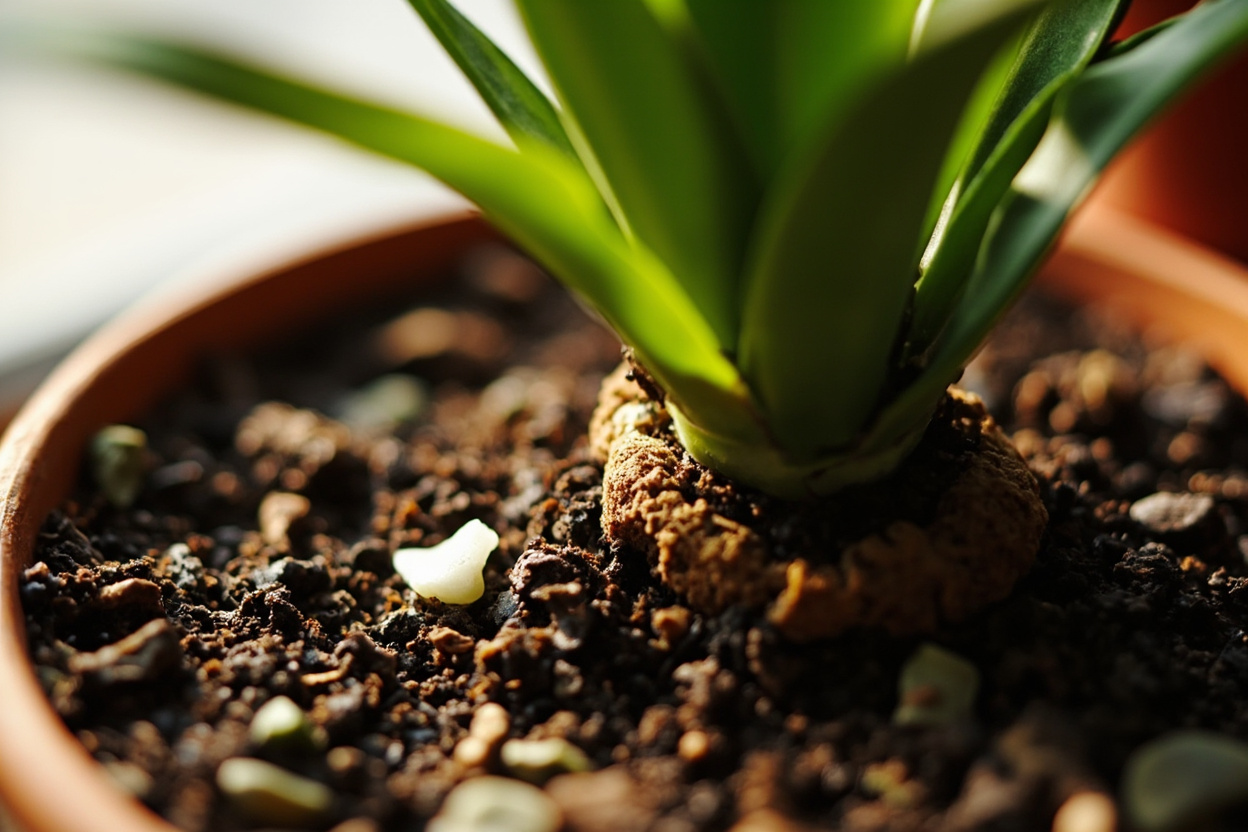
First, water runs straight through the bottom the moment you pour it in, because a packed root ball has no air space left to hold any. Second, roots show around the rim of the pot, or the tree sits higher in the container than it did when you planted it. Third, the pot dries out within a day or two of watering, a sign the soil volume has shrunk to nearly nothing under the root mass. Fourth, growth stalls: the leaves stop expanding and new shoots stay small through a whole growing season. Any one of these, and the tree is root-bound. The watering rhythm that the pot size feeds back into is in the money tree watering guide.

The two-year rhythm and the right season
Repot in early spring, from late February through May in most of the Northern Hemisphere, when the tree comes out of winter rest and has two to three months of active growth to use the fresh soil. Early spring matters because the new roots need light and warmth to spread, and that is exactly what the season supplies. Avoid autumn repotting, when the plant is winding down and the new roots would have to sit in cold soil all winter.
Choosing the New Pot and the Mix
The pot choice is where money tree repotting goes wrong more than anywhere else, because the instinct is to buy a bigger, prettier container. That instinct is the enemy, and the reason is mechanical. A pot that is too large leaves a wide band of soil around the root ball that the roots have not yet reached, and that band holds water long after the inner core is dry. The water sits, the soil stays saturated, and the fine roots that do exist are smothered in anaerobic soil. The pot should hold the root system, not a reservoir around it.
One or two sizes up, never a big jump
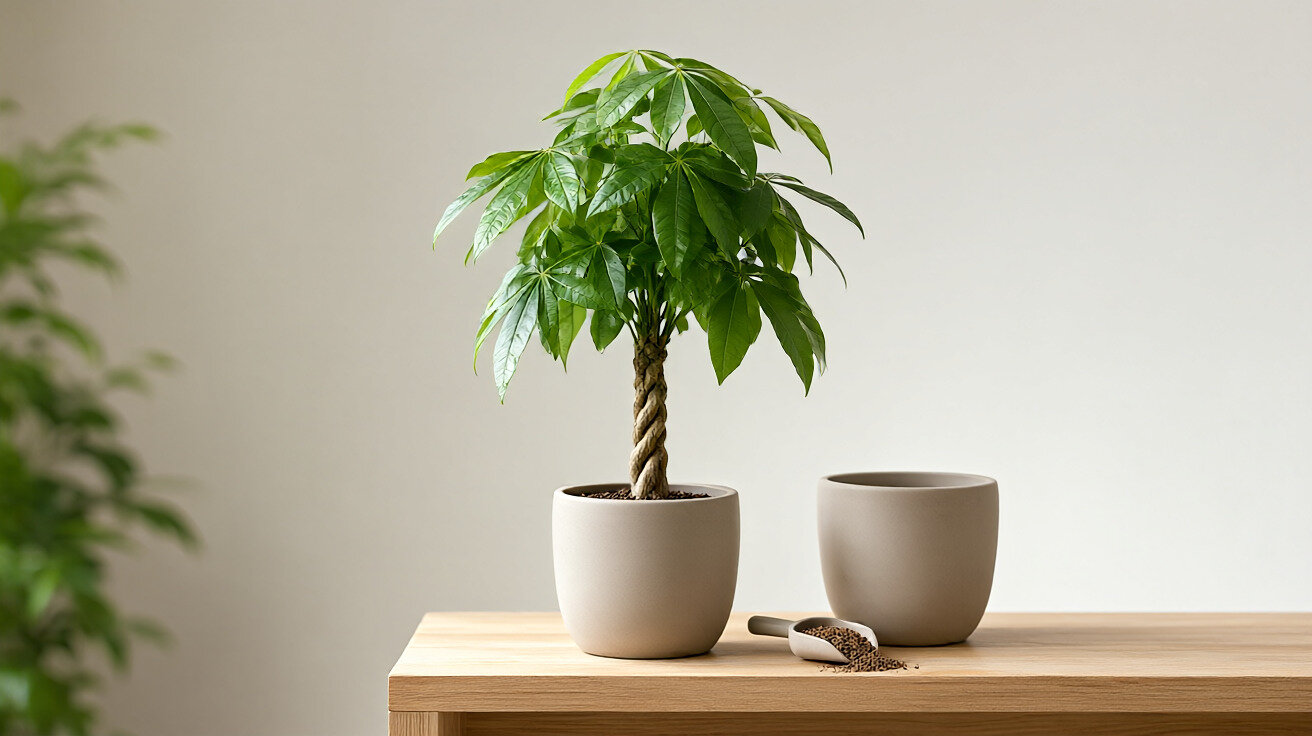
Move up by one to two inches in pot diameter, roughly from a four-inch pot to a five or six-inch pot, or from a six-inch to a seven or eight-inch pot. If the tree is jumping from a small nursery pot into a large planter for the first time, make the biggest single step a two-inch increase, not a four-inch one. A pot with a drainage hole and a fresh, loose mix beats a big pot that will hold water for the next three years. The pot and mix that hold water the least is the subject of money tree soil and pot.
The mix, drainage first
Use a well-draining cactus or succulent blend, or a peat-free potting mix with two to three parts perlite worked through it, so that the soil drains within an hour of watering and still holds a little moisture for the next two days. Never reuse the old soil that has gone black and smelly, because it is packed, the drainage channels have closed, and the roots inside it are the ones you are trying to refresh. A handful of the old soil mixed into the new is fine for continuity, but the base has to drain fast.
How to Repot a Money Tree, Step by Step
The move takes about twenty minutes and one careful pass. Do it slowly, and check the roots at every step, because the roots tell you what the leaves already cannot. Keep the tree upright and the braid vertical, and set the pot back into the same position it will live in so the light is familiar from day one.
The six steps
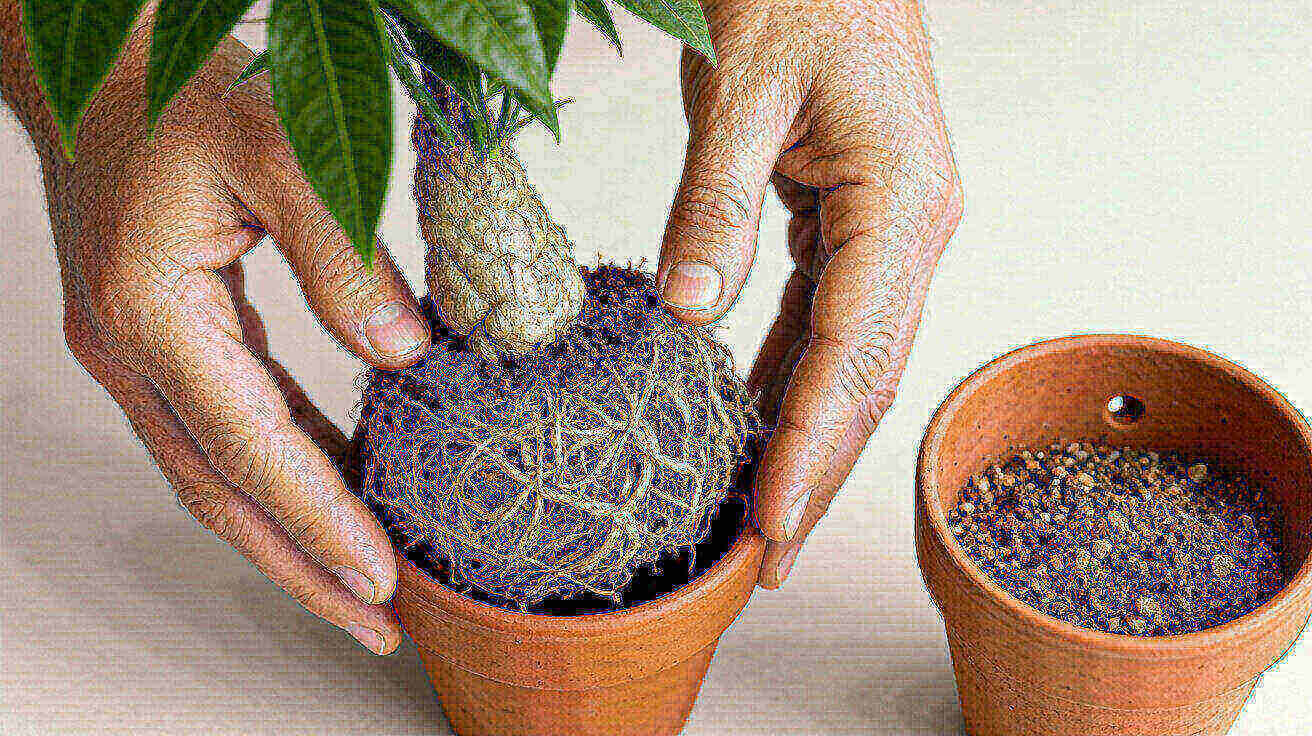
Step one, water the tree the day before and let the pot dry, so the soil releases from the sides when you unpot it. Step two, run a finger around the pot’s inner wall and ease the root ball out; if it is truly stuck, slip a knife between soil and wall rather than pulling the trunk. Step three, tease the circling roots gently from the outside of the ball, and trim away any black, soft, or smelly roots with clean scissors, keeping the firm, pale ones intact. Step four, set the tree in the new pot so the top of the root ball sits about one inch below the rim, and hold it upright while you fill the sides. Step five, water the new soil deeply until it runs clear from the bottom, so the mix settles fully against the roots and there are no air pockets. Step six, place it in bright indirect light for the first two weeks and hold back on watering until the top two to three centimeters of soil are dry. The scratch test that confirms the trunk is still alive before you commit to the move is the dead-money-tree revive test, and the full sequence is at the end of this page.
The First Two Weeks After the Move
The recovery window is short and it runs on two things: stable light and a held-back watering schedule. A freshly repotted tree has had its fine roots disturbed, so it drinks more slowly than it did before, and watering on the old schedule in the new pot is exactly how the saturated-soil failure starts.
Hold the light, steady the water
Keep the tree in the same bright, indirect spot it was in before, about six hours of filtered light a day, and do not move it into full sun or into a colder corner while the roots settle. Water only when the top two to three centimeters of soil are dry, which in the new loose mix usually takes three to five days longer than the packed old soil did. Keep the air at least fifty percent relative humidity, and hold the room in the eighteen to twenty-four degree C band that the roots work best in. The placement and light rules are in money tree light requirements, and the temperature band is in money tree temperature tolerance.
Repotting by Size and Age
Match the pot to the tree, not to the shelf it will eventually sit on. The table pairs pot diameter with growth stage and repot interval, so you can read the correct next step for the size you have.
| Pot diameter | Growth stage | Repot interval | What to check |
|---|---|---|---|
| 4 to 5 inches (10 to 13 cm) | Cuttings and young nursery trees | Every 12 months | Roots circling the wall, fast drying |
| 5 to 6 inches (13 to 15 cm) | Established small tree | Every 18 months | Stalling new growth, wet soil after one day |
| 6 to 8 inches (15 to 20 cm) | Medium mature tree | Every 24 months | Crown rising in the pot, straight-through drainage |
| 8 inches (20 cm) and up | Large established tree | Every 2 to 3 years, or refresh the top soil | Slow roots; a soil top-up often beats a big repot |
When the Trunk Is Braided
Most money trees sold at home centers have the trunks braided together, and that braid changes one thing about the move: the trunk holds a reserve of water in its swollen base, above the soil line. The braid is not a defect and it does not need to be cut, but it does have to stay vertical and braced through the repot, because a braid that leans can twist a young trunk.
Stability and the water reservoir
Leave the braided trunks alone and only work the roots at the soil line. The water stored in the swollen base means the tree tolerates a missed watering or two better than a thin-trunked plant, which is why a braided tree that looks half-dead on day one of a move often still pushes leaves on day ten. Do not bury the braid deeper than it sat before, because the swollen tissue that stores the water is a storage organ, not a stem that roots, and holding it under wet soil invites rot at the very base. The pruning rules that keep the braid tidy after the tree settles are in money tree pruning.
What Goes Wrong, and the Timeline
Three failures account for nearly every money tree that dies in the weeks after a repot, and each has a predictable clock.
The three repotting failures
The first is the pot that is too big, and its failure arrives in four to six weeks: the waterlogged band around the root ball suffocates the fine roots, the lower leaves yellow, and the softening starts at the soil line. The second is the wrong season, when an autumn repot leaves the new roots sitting in cooling soil all winter, and the tree slows to a stop instead of establishing. The third is reusing sour old soil with no drainage, which pulls the tree back into the overwatering failure that the move was supposed to fix. The unpotting and pot-downsize rules that reverse a failed repot are in money tree root rot.
What to do if it is failing after the move
Hold the watering, move it into firmer light, and scratch the bark. A firm, green scratch means the tree is still alive and will recover over four to six weeks; a soft, dark, hollow scratch at the base means the rot has reached the caudex and the tree is beyond saving. The full test sequence is in can you revive a dead money tree. The point of a careful repot is that you never end up here.
Sources and further reading
New York Botanical Garden, Mertz Library horticulture reference on Pachira aquatica, covering the braided-trunk storage tissue, container requirements, and the season in which interior plants recover fastest from transplant.
University of Missouri Extension, container plant and interior plant problem publications, covering the relationship between container volume, soil water retention, and the oxygen available to the fine roots after a transplant.
Clemson Cooperative Extension, interior plant care bulletins on repotting, root-bound symptoms, and the drainage requirements for tropical foliage plants in small containers.
University of California, Division of Agriculture and Natural Resources, houseplant maintenance guidance on transplant depth, soil mix texture, and the first-week watering rhythm after repotting.
Botanica Organica and Royal Horticultural Society indoor plant care pages on Pachira aquatica, covering the repotting interval, pot diameter increases, and the spring timing of the growth flush that makes the move safe.
Last reviewed on 11 November 2026