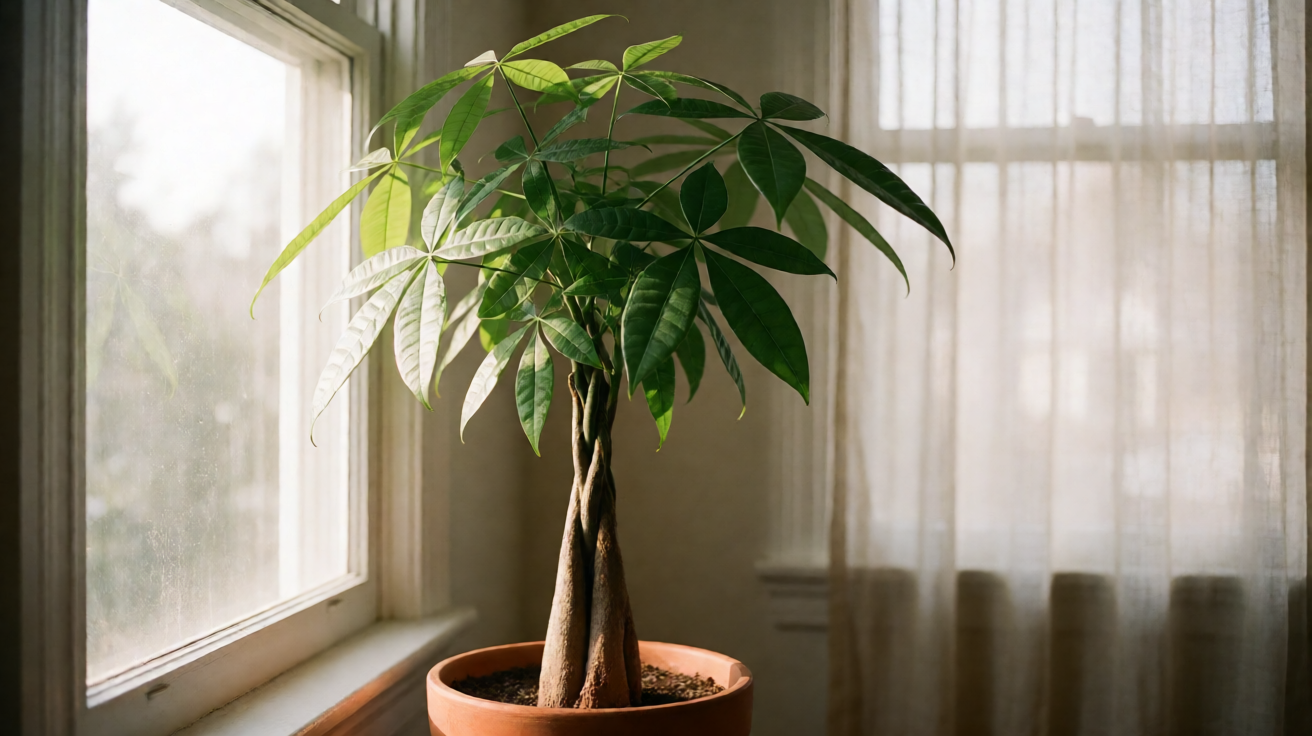

A money tree (Pachira aquatica) needs bright indirect light for at least 6 hours a day, not the low light the gift-shop tag promised, because the braided trunk stores energy from photosynthesis and the canopy cannot refill that reservoir under a 60-watt table lamp.
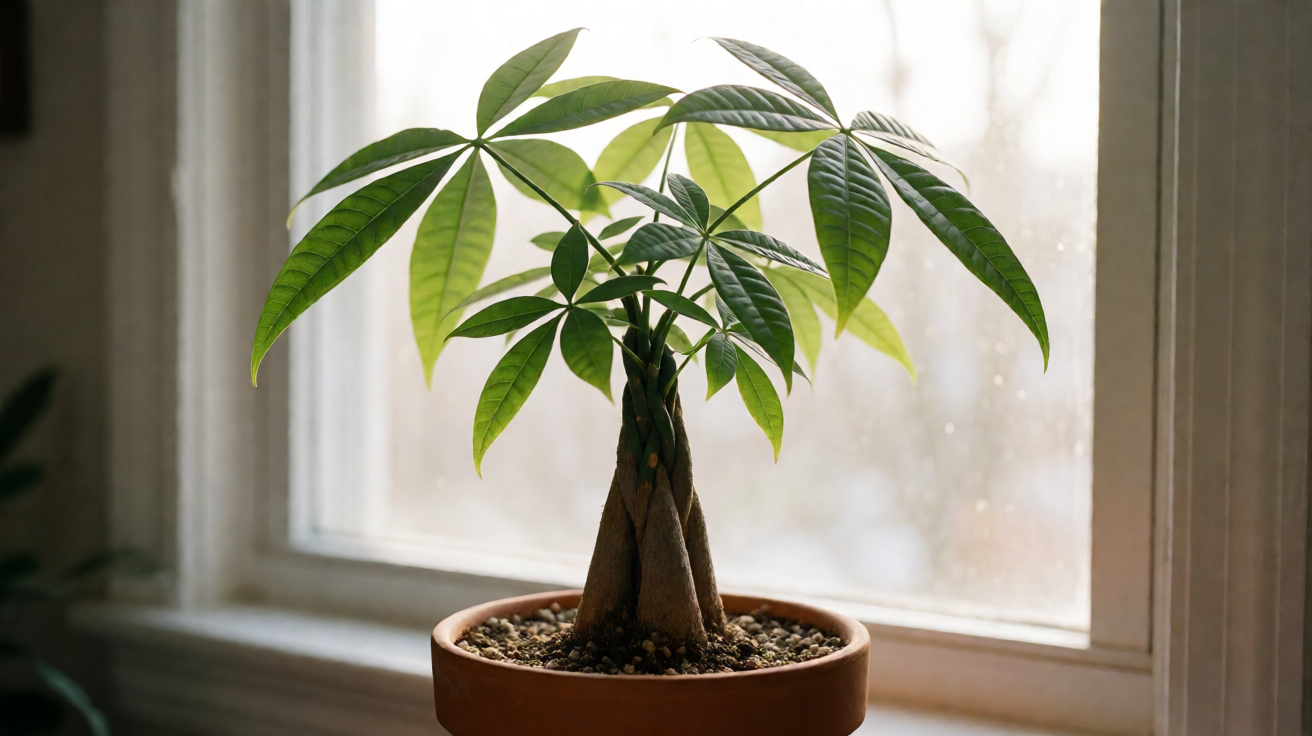
The single most common light mistake is treating Pachira like a pothos. Money plant tolerates a dim corner because it is a low-energy vine; money tree does not, because Pachira aquatica is a tropical houseplant that produces a full canopy of palmate leaves from a swollen caudex (the braided trunk acts as a water-and-energy reservoir that the canopy refill cycles against).
The bright-indirect-light rule is one decision, not four, once the window direction is known. East-facing windows work year-round. South-facing windows work with a sheer curtain in summer. West-facing windows work only in winter when the sun is low. North-facing windows do not work without a grow light in most homes north of the Tropic of Cancer.
One honest limit up front: Pachira aquatica cannot survive in a windowless interior for more than 60 days. If a window is unavailable, a full-spectrum grow light on a 12-hour timer is required, not optional. Treat any placement that lacks both as a temporary stopover, not a permanent home.
The Bright Indirect Light Rule
Bright indirect light means 1,000 to 2,500 foot-candles for at least 6 hours per day. Direct sun through an unshaded south- or west-facing window delivers 8,000 to 10,000 foot-candles and burns the leaves within hours.
A north-facing window delivers 200 to 400 foot-candles and starves the canopy over months. The bright-indirect band sits between the two, and most window directions can hit it with the right distance and the right sheer cover.
A simple test: stand where you plan to put the tree at the brightest time of day. If your shadow is sharp and dark on the floor, the spot is direct sun and the leaves will scorch.
If the spot is fully shaded by a deep overhang or a neighboring building, the spot is too dim and the leaves will yellow. The middle band – diffuse shadow or no shadow – is bright indirect.
The 3-to-6-feet distance from an east-facing window is the textbook sweet spot. Morning sun is direct but only for 2 to 3 hours; the rest of the day is filtered through the room.
Pachira aquatica responds to that rhythm by pushing new leaves within 4 to 6 weeks. Closer than 3 feet and the morning sun hits the canopy directly; farther than 6 feet and the light drops into the low-light band where the tree will not grow.
If your home is open-plan and the brightest spot is 8 to 10 feet from an east window, supplement with a grow light. A 30-watt full-spectrum LED mounted 12 inches above the canopy, on a 12-hour timer, adds enough light to keep the leaves tight and the trunk firm.
Pachira aquatica grows best in 65 to 75 degrees Fahrenheit; below 60 degrees the trunk stops pushing new leaf nodes, and below 50 degrees a single draft can rupture cells in the canopy within hours.
Without that supplement, the tree will survive but it will not push new growth, and the braided trunk will slowly lose its fattened appearance. Household humidity below 30 percent makes the leaf edges crisp and brown even when the light is correct; a humidifier set a few feet from the canopy restores the humidity that bright indirect light usually provides via moisture in the air.
Window Direction: East, South, West, North
East-facing windows are the year-round default for money trees in the Northern Hemisphere. Morning sun is direct but brief (2 to 3 hours), the afternoon is bright indirect, and the light intensity peaks before noon when the air is cooler.
Place the tree 3 to 6 feet from the glass and let it sit. A sheer curtain is not needed in summer because the morning sun is gentle.
In winter the tree can move 1 to 2 feet closer because the sun is lower and weaker. A consistent rotation schedule (a quarter-turn at every other watering) keeps the new growth even on all sides; without rotation, the east-side shoots become so dominant that the trunk visibly leans east within a single growing season.
South-facing windows are the brightest spot in any home, but the intensity is too much for money tree leaves without a sheer curtain from May through August.
Hang the sheer between the glass and the canopy; the tree can sit 4 to 6 feet from the window. In winter the sheer can come down because the sun is low and filtered through the cold air.
South is the strongest light available, and a Pachira aquatica in a south window with a sheer will outgrow one in an east window by a factor of two over a growing season.
West-facing windows are tricky. Afternoon sun is direct and hot, and it sits on the canopy for 3 to 5 hours in summer.
Move the tree 8 to 10 feet from the west window, behind a sheer, or accept leaf scorch on the upper canopy. In winter the west sun is low and weak enough to be safe at 3 to 4 feet, so the placement can rotate seasonally.
A dedicated west-facing shelf is not ideal; a south or east spot is better year-round.
North-facing windows deliver 200 to 400 foot-candles at 3 feet, which is below the floor Pachira aquatica needs. The tree will live for 3 to 6 months in a north-facing spot but the lower leaves will yellow and drop within 60 days.
If a north window is the only option, supplement with a grow light on the canopy side of the tree. With the supplement, a north-facing placement is workable for years.
Without it, the tree will need rescue from the Problem page within a single season.
Low Light Tolerance: What the Gift-Shop Tag Actually Means
The Pachira aquatica gift tag says “tolerates low light” because the braided trunk is a reserve. A tree in a low-light spot survives on stored energy for 60 to 90 days before the canopy starts dropping from the bottom up. That survival window is what the gift tag is selling. It is not a permanent placement.
Low light symptoms appear in this order: small new leaves with long spaces between them, yellowing lower leaves, leaning toward the brightest source visible, and finally a thin, almost translucent appearance to the upper canopy.
Each of these is a sign the tree has spent its reserve and is now living on what little light it gets. Move the tree into bright indirect light and the symptoms reverse within 8 to 12 weeks; the upper canopy refills, the lower leaves return, and the lean corrects.
Low light tolerance is a feature of the trunk, not the species. Pachira aquatica evolved in seasonal Central American wetlands where the canopy of taller trees filters the sun. The trait is real, but it is a survival trait for the canopy, not a happy condition. Treat low light as a temporary placement during a windowless apartment remodel, not a permanent home.
A common test for whether a spot is too dim: read a paperback book at the spot at midday without leaning toward a lamp. If the print is sharp, the spot has at least 300 foot-candles and a money tree will survive but not thrive.
If the print is dim, the spot is too dark for any Pachira and a grow light is needed for any green plant beyond a snake plant or ZZ.
Rotation, Phototropism, and the Leaning Trunk
Pachira aquatica leans toward the brightest source it can find, a growth pattern called phototropism. New leaves emerge on the bright side; old leaves thin on the dim side. Without rotation the canopy becomes lopsided and the trunk curves. A consistent rotation schedule – a quarter-turn every two weeks – keeps the canopy symmetrical.
Quarter-turn every two weeks is the simplest schedule. At each watering, rotate the pot 90 degrees. The trunk barely moves during the two-week interval, so the lean is corrected gently rather than abruptly.
Some growers rotate at every watering for a tighter canopy; that is fine, just keep the rotation direction consistent so the tree is not cycling lean back and forth.
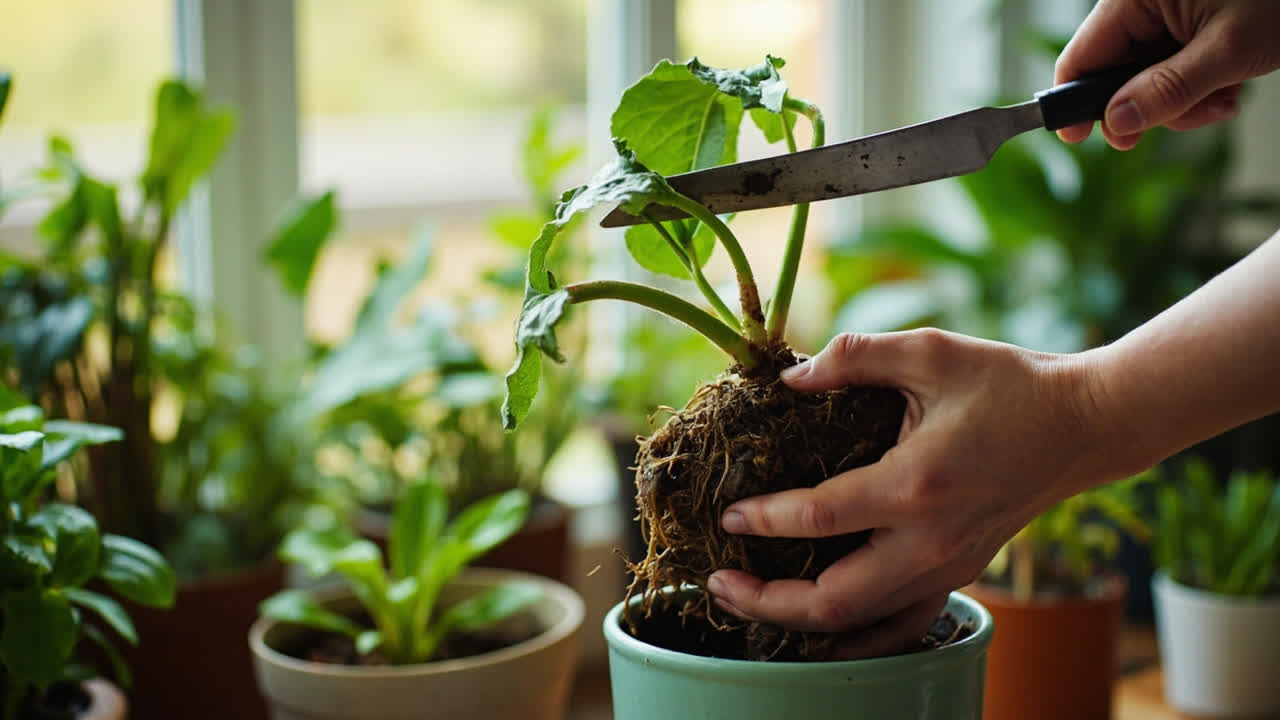
A pot-bound tree that has stopped pushing new growth for 12+ months may also be signaling it needs a repot into fresh soil; bright indirect light plus fresh well-draining soil is what re-energizes the canopy.
If you propagate a Pachira aquatica leaf-node cutting under bright indirect light rather than direct sun, the cutting roots within 4 to 6 weeks and can be potted up to start a new braided-trunk tree.
The lean is correctable while the trunk is still thickening. A mature braided-trunk Pachira aquatica over 4 years old has hardened wood; rotation prevents further lean but rarely reverses a heavy existing curve. Newly shipped trees under 3 feet tall respond well to a consistent rotation schedule; the trunk straightens within 60 to 90 days if the new spot has even light on all sides.
Phototropism is the mechanism. Cells on the dim side of the stem elongate faster than cells on the bright side, bending the trunk toward light. The braided trunk is several stems grown together; each stem responds independently, so the rotation has to keep all stems even. A spot 6 inches from a one-sided window will produce a one-sided braid over years even with weekly rotation.
Grow Lights: When a Window Is Not Enough
A full-spectrum LED grow light on a 12-hour timer adds 4 to 6 hours of effective bright indirect light per day. The fixture should be mounted 12 to 18 inches above the canopy; closer than 12 inches and the leaves curl from the heat, farther than 18 inches and the foot-candle count drops below the bright-indirect threshold.
The 30-watt to 45-watt range is enough for one money tree; anything above that wastes electricity and burns leaves.
Set the timer for 12 hours that match the daylight the tree would receive outside. In temperate homes, 7 AM to 7 PM is a clean default. Pair the timer with the natural daylight so the tree gets a full 12 to 14 hours of light total, not 12 hours of grow light on top of 12 hours of dim daylight.
Use a full-spectrum bulb (color temperature 4,000 to 6,500 Kelvin, marketed as “daylight” or “cool white”). Warm-white bulbs (2,700 Kelvin) lack the blue wavelengths that drive leaf growth; the canopy will stretch toward the warm light and become leggy. Mirrored reflectors under the fixture double the effective intensity without doubling the wattage.
A money tree pushed into strong bright indirect light without a half-strength fertilizer regime will outgrow its nitrogen reserve within 3 to 4 months and the older leaves will yellow and drop. Pair any new bright-indirect placement with a half-strength 20-20-20 feeding every 30 days from March through September. Recovery from yellow-leaf nitrogen decline is visible within 10 to 14 days once the half-strength feeding resumes.
Placing the grow light directly above the canopy produces even, balanced growth. Placing it to one side reproduces the phototropism lean in the opposite direction; if you must place a grow light to one side, rotate the pot every week to balance the growth. The mirror trick: a cheap clip-on reflector from a hardware store, positioned under the bulb, doubles the useful output and avoids the lean.
Seasonal Light Changes: Summer Outside, Winter Inside
A money tree can spend late spring through early fall outdoors in bright shade. The transition is sharp: indoor trees moved suddenly into full sun will scorch. Move the tree into a shaded patio or under a tree canopy for 4 to 7 days before any direct sun exposure. The first week in shade prepares the canopy for the higher light of the outdoors without shocking the leaves.
Bring the tree back inside before nighttime temperatures drop below 55 degrees Fahrenheit. The ideal indoor temperature range for a tropical houseplant like money tree is 65 to 75 degrees Fahrenheit year-round; outside that band growth slows or stalls.
A single night below 50 ruptures cells in the leaves and stems within hours, and direct sun exposure to a non-acclimated canopy during the first 3 days outside will scorch it.
The trunk will usually survive if the scratch test still shows green tissue, but the canopy can drop overnight. Move the tree back inside on the calendar date of your region’s first frost, not when the temperature drops, because the calendar is the reliable signal.
Outdoor summer placement is not required. A money tree that lives indoors year-round in bright indirect light grows well and lives 10+ years in the same spot. The outdoor season is a bonus, not a necessity. Treat it as an optional rest period that does not require lifting a finger from the indoor rhythm. For the complete species care walkthrough – soil mix, temperature, fertilizer, repotting, and propagation – see the money tree care guide.
Indoor winter placement often shifts because the sun is lower and weaker. A tree that was 6 feet from an east-facing window in summer may need to move to 3 feet in winter to keep the same foot-candle count. A south-facing window with a sheer in summer becomes the brightest winter spot without the sheer. Adjust the placement each October and reset it in April.
Turn That PDF Into a Spreadsheet in Minutes
You've seen how to do it manually — now let the tool handle the heavy lifting. Upload your bank statement and get Excel, CSV, or QBO in a few clicks.
Try It Free