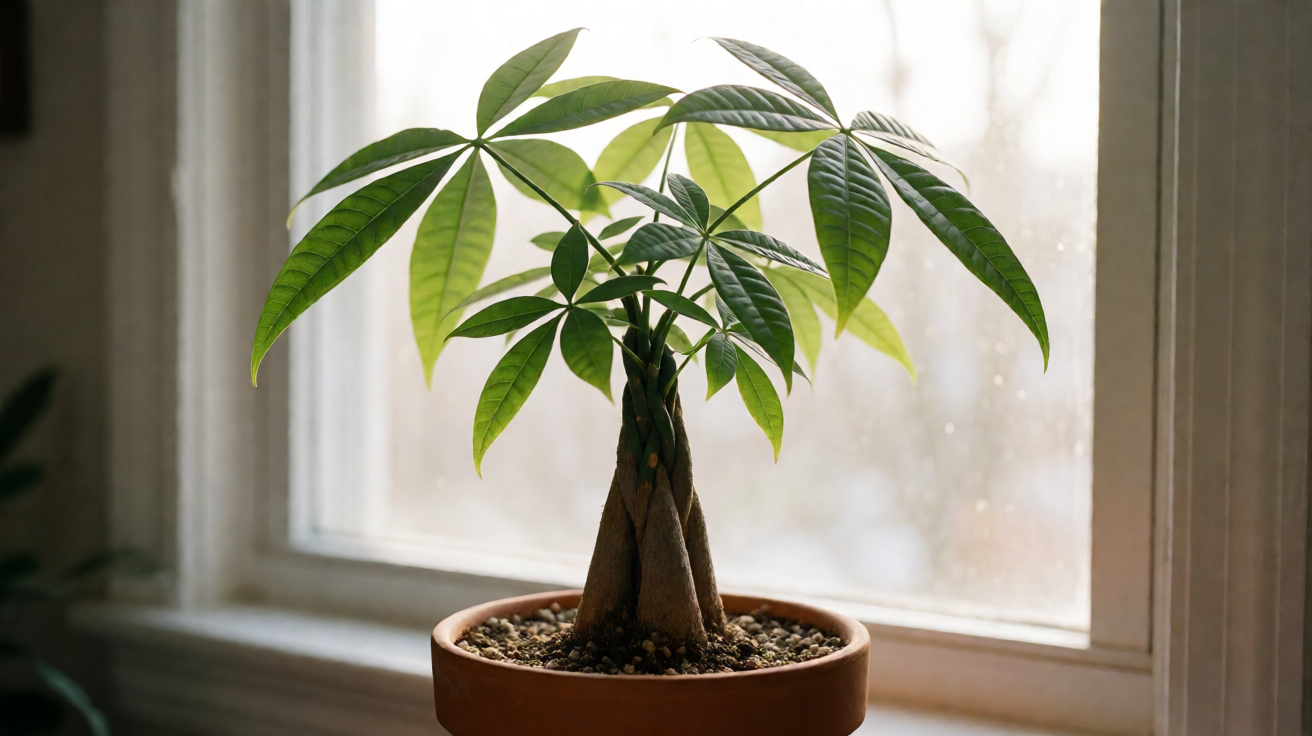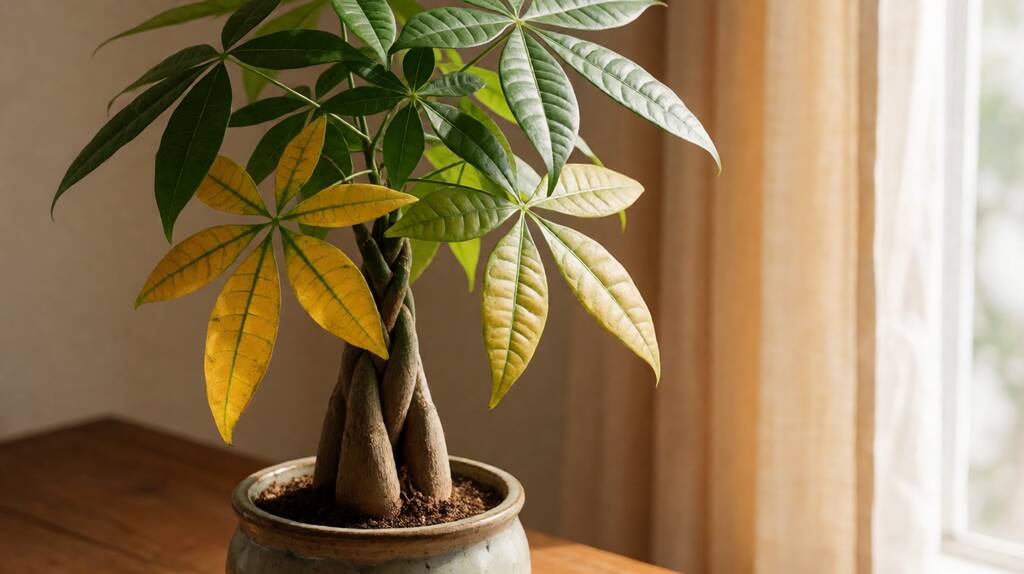

Yellow leaves on a money tree (Pachira aquatica) are not one problem; they are five different problems wearing the same symptom. The five causes each show up in a different pattern on the canopy: lower leaves only, all leaves uniformly, whole canopy pale, interveinal on older leaves, or single branches after a move. Read the pattern first, then act, because the right response to overwatering (stop watering) is the wrong response to underwatering (water now). Most money trees that arrive with widespread yellowing have more than one cause running at once, usually overwatering plus low light, and the fix has to address both.
Two honest limits up front. Yellow leaves that are already fully yellow will not turn green again; the chlorophyll is gone. The fix is to stop more leaves from yellowing while the plant pushes new green growth. And a money tree with a soft caudex and yellowing lower leaves is in crown-rot territory; the diagnosis page covers the recovery surgery for that case.
The Five Yellowing Patterns on a Money Tree
The Five Yellowing Patterns on Pachira
Pattern 1: Yellowing on Lower Leaves Only
Pattern 1: lower leaves only, oldest leaves first.
The plant is pulling mobile nutrients (nitrogen, magnesium) out of old leaves to feed new growth at the apex. Two causes fit:
– Overwatering. Soil stays wet past day five, fine roots suffocate and rot, the plant cannot pull fresh nutrients and starts mining old leaves for stored nitrogen. Yellowing starts from the leaf tip and creeps inward along the midrib. The pot feels heavy when you lift it; the soil surface may smell sour; new growth at the apex is small or absent. – True nitrogen deficiency. Rare indoors because most bagged mixes and fertilizers include nitrogen, but it shows up if the plant has been in the same pot for two or more years without repotting or fertilizer. Yellowing is uniform across the whole leaflet, including the veins, and starts on the oldest leaves first.
The split: lift the pot. If it feels waterlogged, the cause is overwatering. If the soil dries within 5 to 7 days and the pot feels light, the cause is nitrogen.
Pattern 2: Whole Canopy Pale and Yellowing
Pattern 2: all leaves uniformly yellow or pale, new growth small.
The whole canopy is pale and the new leaves open smaller than older leaves. Two causes:
– Low light. Pachira aquatica needs bright indirect light for at least 6 hours a day. Under low light the plant cannot photosynthesize enough sugar to maintain chlorophyll, so it produces pale, thin new leaves and sheds older leaves that cost more energy than they return. The companion symptom is leggy growth: long gaps between leaves and a leaning trunk toward the window. – Cold damage. Sustained exposure below 55 degrees F (13 degrees C) yellows the whole canopy as the chlorophyll breaks down. The companion symptom is leaves that drop while still partly green and a caudex that feels cooler than room temperature when you cup it in your hand.
The split: check light first. If the plant sits more than 2 meters from a window or under a 60-watt-equivalent table lamp, light is the cause. If light is adequate and the caudex is cool, cold is the cause.
Pattern 3: Yellow Between Green Veins on Older Leaves
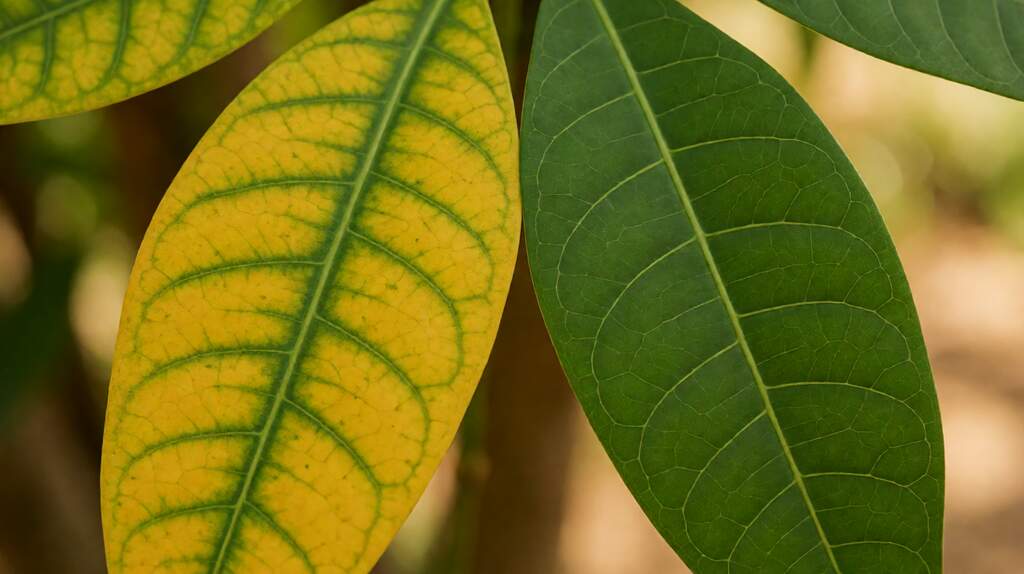
Pattern 3: yellow with green veins, older leaves first.
Interveinal chlorosis (yellow between green veins) on older leaves is a magnesium or iron deficiency. It rarely shows up on indoor money trees in the first year. It does show up if the plant has been in the same soil for two or more years and the soil pH has drifted above 7.0, which locks out iron and magnesium even when the soil contains them.
The fix is a freshwater flush: water the plant with distilled or rainwater until 20 to 30 percent of the pot volume drains out the bottom. Repeat in two weeks if the pattern has not improved. Long-term, repot in the soil-and-pot mix within six months.
Pattern 4: Yellow Leaves With Brown Tips or Margins
Pattern 4: yellow leaves plus brown leaf margins or tips.
Two causes present together:
– Fluoride or chloride toxicity. Tap water in many cities contains fluoride and chloride at levels that accumulate in leaf tips over months. Pachira aquatica is moderately sensitive. Yellow tips with crispy brown edges on multiple leaves is the pattern. Switch to filtered or rainwater and the new growth will be clean within two months. – Salt buildup from fertilizer. Fertilizing at full strength in dry soil pushes salts past the root surface and they concentrate at the leaf margins, where the transpiration stream ends. Flush the soil as described above and resume fertilizer at half strength.
Pattern 5: Yellowing on a Single Branch Only
Pattern 5: yellowing on a single branch only.
A single branch turning yellow while the rest of the canopy stays green is root damage in the section of root mass feeding that branch. Three causes:
– The plant was rotated abruptly and the sun-facing branches got sunburn while the now-shaded branches did not. – Mechanical root damage. The plant was moved, dropped, or repotted recently and the roots on one side are bruised. The branch fed by those roots yellows while the rest of the plant is fine. – Pests at the petiole base. Mealybugs, scale, or spider mites feeding at the joint where the leaf stem meets the branch can cut off nutrient flow to that single branch. Check the petiole bases with a magnifier; white cottony tufts, brown bumps, or fine webbing is the diagnostic.
The fix for a single yellow branch is to leave it alone if pests are not present; pruning it stresses the plant further. The yellowed branch usually drops its leaves within two weeks and the plant redirects energy to the healthy branches. If pests are present, treat the whole plant with 70 percent isopropyl alcohol on a cotton swab for mealybugs, or insecticidal soap for scale and mites.
The Pachira-Specific Triage
The Pachira-Specific Triage
If you cannot yet read the pattern, run through this short list in order:
1. Lift the pot. Heavy = overwatering. Light = underwatering or root loss. 2. Smell the soil. Sour = anaerobic rot. Clean = soil is fine. 3. Press the caudex. Soft and compressible = rot in progress. Firm = caudex is healthy. 4. Check light. 6 or more hours of bright indirect? Yes/No. 5. Check petiole bases. Pests visible? Yes/No.
That triage takes 60 seconds and narrows the cause to one of the five patterns above. Most money tree yellowing falls into Pattern 1 (lower leaves + overwatering) or Pattern 4 (yellow + brown tips from tap water), and both resolve within two months of correct watering plus filtered water.
The Pattern Match That Saves a Money Tree
A Two-Week Symptom Diary for Diagnosis
When the five-pattern read does not give a clear answer, a two-week symptom diary often does. The diary takes 30 seconds per day and turns a vague “yellowing” complaint into a chart the cause becomes obvious on.
Day 1: write down which leaves are yellow (lower only, whole canopy, single branch, interveinal), how the caudex feels (firm, slightly soft, soft), and how the soil feels a finger-depth down (dry, slightly damp, wet). Take a phone photo from one fixed angle.
Day 3 to 7: every other day, repeat the caudex feel and soil check. Note any new leaves or dropped leaves.
Day 14: review. If only the older leaves yellowed and new growth is clean, the cause was overwatering (pattern 1) or tap-water salt buildup (pattern 4). If new growth is also pale, the cause is light, nutrients, or root damage and the plant needs a longer intervention. If a single branch yellowed while the rest stayed healthy, root damage or pests (pattern 5) is the answer.
The diary works because money tree yellowing is rarely one cause acting for one day. It is two or three causes acting for two to four weeks, and the timeline of which leaves yellowed in which order sorts the primary cause from the secondary. Most pattern-1 cases resolve within two weeks of correct watering; pattern-2 and pattern-3 cases need longer, often 6 to 10 weeks.
Related on the site: the Money Tree Care Guide ties Pachira-specific yellowing into the full five-factor care frame, the Houseplant Yellow Leaves Diagnosis provides the species-agnostic five-step diagnostic this map builds on, Brown Leaf Tips on Houseplants covers the brown-tip pattern when yellow pairs with crispy margins, Money Tree Watering Requirements explains the overwatering factor that drives pattern 1, the Money Tree Soil and Pot covers the soil and pot that prevent pattern 1 in the first place, and Money Tree Light Requirements connects low light to pattern 2 of the map.
If you take one thing from this page: read the pattern before you act. Lower leaves only means overwatering or nitrogen; whole canopy pale means low light or cold; interveinal yellow means pH drift; yellow with brown tips means tap-water salt buildup; single-branch yellow means local root damage or pests. Match the response to the pattern, not to the symptom. Within two months of correct watering, brighter light, and switched-to-filtered water, a money tree that lost half its canopy to yellowing will push a flush of new palmate leaves from the apex and the caudex will feel firm again. The plant is not dying. It is asking you to read the canopy.
From PDF to Excel in one click
Forget retyping line by line. Upload any bank statement, get a spreadsheet you can actually use. Your files are never stored, and you can test the converter with 3 free conversions.
Try it free