
A money tree is not toxic to cats and dogs, and that sentence is the answer most people searching this need. The ASPCA toxic plant database lists Pachira aquatica under Money Tree with the field “Toxic Principles: None,” which puts it on the non-toxic side of the list. The catch is that the same entry still lists nausea, vomiting and loose stool as clinical signs, so the plant is non-toxic in the sense that matters most and not risk-free in the sense that no gardener means.
There is one genuine exception hiding in the story, and it comes from the seed, not the foliage. There is also a second problem that causes more emergency calls than the plant ever will: at least three different species are sold under the name “money tree” in the same aisle, and they sit in three different toxicity classes. This page separates them, starting with what the two authorities that maintain pet toxicity data publish about Pachira aquatica, then the identification test, then the first 30 minutes after a pet nibbles a leaf. If you already know you own a Pachira aquatica and want the care requirements that keep it healthy enough to keep, those sit on the money tree care guide.
What ASPCA and NC State Actually Publish About Pachira aquatica
The two databases that pet owners are pointed toward do not say the same thing, and the disagreement is instructive rather than confusing.
The ASPCA entry: Toxic Principles, None
The ASPCA Animal Poison Control Center entry for Money Tree lists the scientific name as Pachira aquatica, the family as Malvaceae, the toxic principles as None, and the clinical signs as nausea, vomiting and loose stool. Non-toxic on this list does not mean symptom-free. It means the plant has no identified compound that causes systemic or severe gastrointestinal injury. The ASPCA preamble adds that any plant material may cause vomiting and gastrointestinal upset in dogs and cats, and that non-toxic plants are not expected to be life-threatening. A leaf of Pachira aquatica can produce an unhappy stomach, and it is not expected to kill.

The NC State entry: low severity, and the toxic part is the seed
North Carolina State Extension’s plant database gives Pachira aquatica a different framing. It lists low severity poison characteristics, names the toxic principle as cyclopropenoid fatty acids, possibly toxic and carcinogenic, identifies the poison part as seeds, and describes symptoms in cats as mild to moderate gastrointestinal distress including vomiting, diarrhea and drooling.
The two entries describe the same plant from different angles, and the resolving detail is which part of the plant is in question. The leaves are the part in every houseplant, and the leaves are the part with no toxic principle on the ASPCA list. The seeds are the part with the compound, and the NC State entry says plainly that houseplants never produce seeds. The fruit is a woody brown capsule roughly 12 inches long that splits open when ripe, which describes a mature outdoor tree, not the braided seedling in a four-inch pot on your desk.
The Seed Exception, and Why It Almost Never Applies Indoors
The honest risk statement for this species is narrow: the seeds contain cyclopropenoid fatty acids, the seeds are the toxic part, and indoor plants do not set seed. That is not a loophole, it is a description of the biology. Pachira aquatica needs to reach roughly 4 to 5 years and be planted outdoors before it flowers, and it will not flower when braided, which is the form almost every houseplant sold under this name takes.
So if the plant in your home is a braided or single-trunk juvenile in a nursery pot, the toxic part is not present, and the risk profile is the one ASPCA describes. “Money tree seeds are toxic” circulates online as a standalone fact that skips the part about the seeds existing in the first place.
What remains is ordinary and worth taking seriously. A cat that eats several leaves may vomit, and the mechanism is not mysterious. Plant material that a cat cannot digest triggers vomiting through mechanical irritation of the stomach lining and, in some cases, through the sheer volume of indigestible bulk. That depends on how much was eaten and on the plant’s fiber content, which is why a torn-up leaf of a softer plant tends to come back up while a small amount of a tough, waxy leaf tends to pass through. Symptoms in cats generally appear within hours of ingestion, not minutes.
Three Plants Sold as “Money Tree,” Three Toxicity Classes
Here is where the danger actually lives. Money tree is a common name, not a species, and the name is applied to at least three plants in the same retail category. Their toxicity classes have nothing to do with each other.
Jade plant, Crassula ovata: toxic, mechanism unknown
The ASPCA lists Jade Plant under the scientific name Crassula argentea, which is the same plant most growers and houseplant sites call Crassula ovata. It is toxic to dogs, cats and horses, the toxic principles are listed as unknown, and the clinical signs are vomiting, depression and incoordination. The mechanism being unknown is not reassurance, it is a reason to treat the ingestion seriously rather than casually. Jade is also the plant most often mistaken for a money tree, because it is a succulent with a thickened woody stem that looks like a miniature caudex at a glance, and because it shares the “money plant” name in some regions.
Money plant, Epipremnum aureum: toxic, insoluble calcium oxalates
The ASPCA lists Devil’s Ivy, with the additional common names Pothos, Golden Pothos, Taro Vine and Ivy Arum, scientific name Epipremnum aureum, toxic to dogs, cats and horses. The toxic principle is insoluble calcium oxalates, and the clinical signs are oral irritation, pain and swelling of the mouth, tongue and lips, excessive drooling, vomiting and difficulty swallowing. Here the mechanism is sharp and physical. Calcium oxalate crystals are needle-shaped and they physically abrade the mouth and throat tissue on contact, which is why the drooling and the oral swelling arrive before anything else does. The plant that causes the most pets to drool on contact is very often the plant the owner called a money tree.
Money tree, Pachira aquatica: non-toxic foliage
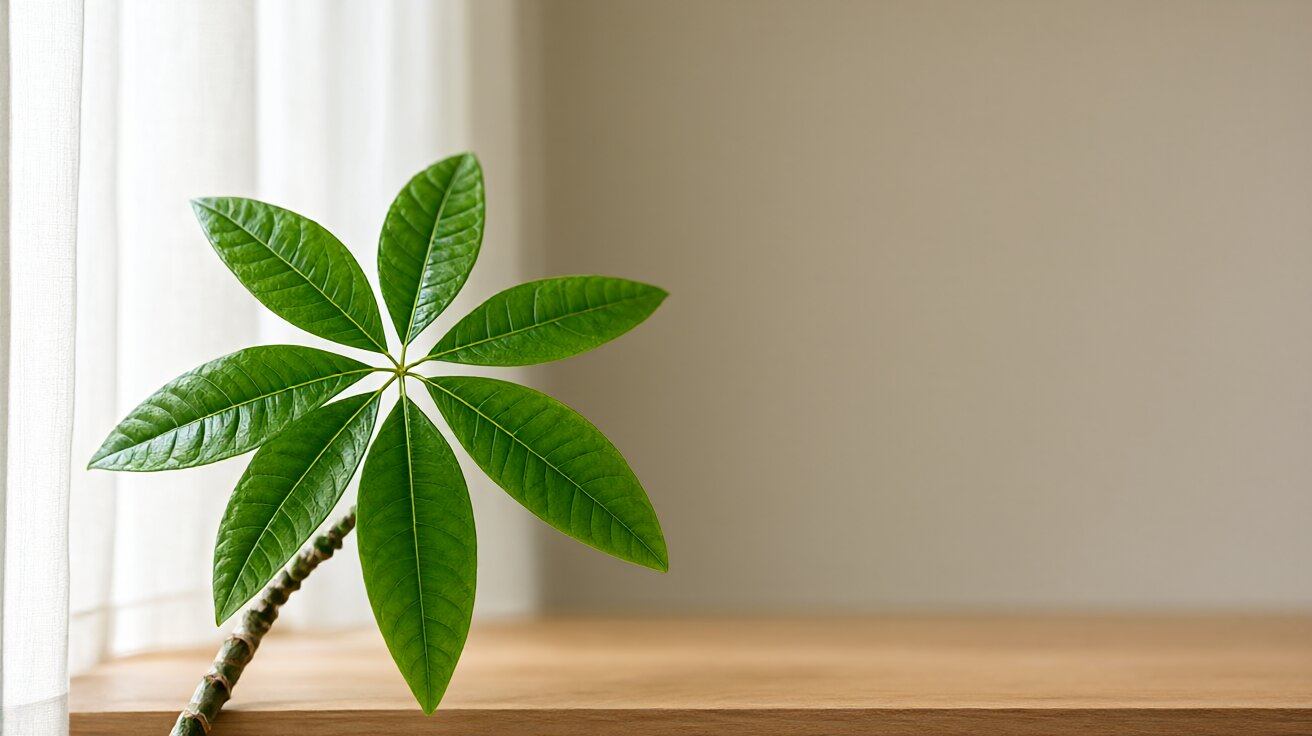
And then there is the one you came to read about, with no toxic principle on the ASPCA list, a palmate leaf made of 5 to 9 leaflets, a swollen braided caudex, and seeds that never appear in a houseplant. The same confusion happens with bird of paradise, where three unrelated species share one common name and two of them are toxic, and that page explains why the same confusion happens with bird of paradise in a different family.
| Common name | Species | Toxicity class | Toxic principle | Clinical signs | Toxic part |
|---|---|---|---|---|---|
| Money tree | Pachira aquatica | Non-toxic | None identified | Nausea, vomiting, loose stool | Leaves only if eaten in quantity |
| Money plant, pothos | Epipremnum aureum | Toxic | Insoluble calcium oxalates | Oral irritation, swelling, drooling, vomiting | All parts, sap |
| Jade plant | Crassula ovata (syn. Crassula argentea) | Toxic | Unknown | Vomiting, depression, incoordination | All parts |
| Mass cane | Dracaena massangeana | Toxic | Saponins (steroidal glycosides) | Vomiting, lethargy, drooling | All parts, sap |
For comparison, mass cane is a different plant entirely, toxic through saponins rather than oxalates, and how Dracaena saponins cause vomiting in cats covers that mechanism. The point of the table is that toxicity follows the compound, and the compound follows the species. When money tree and money plant are not the same species, the safety question inherits whichever row actually describes the plant on your shelf.
How to Tell Which Plant You Own in Thirty Seconds
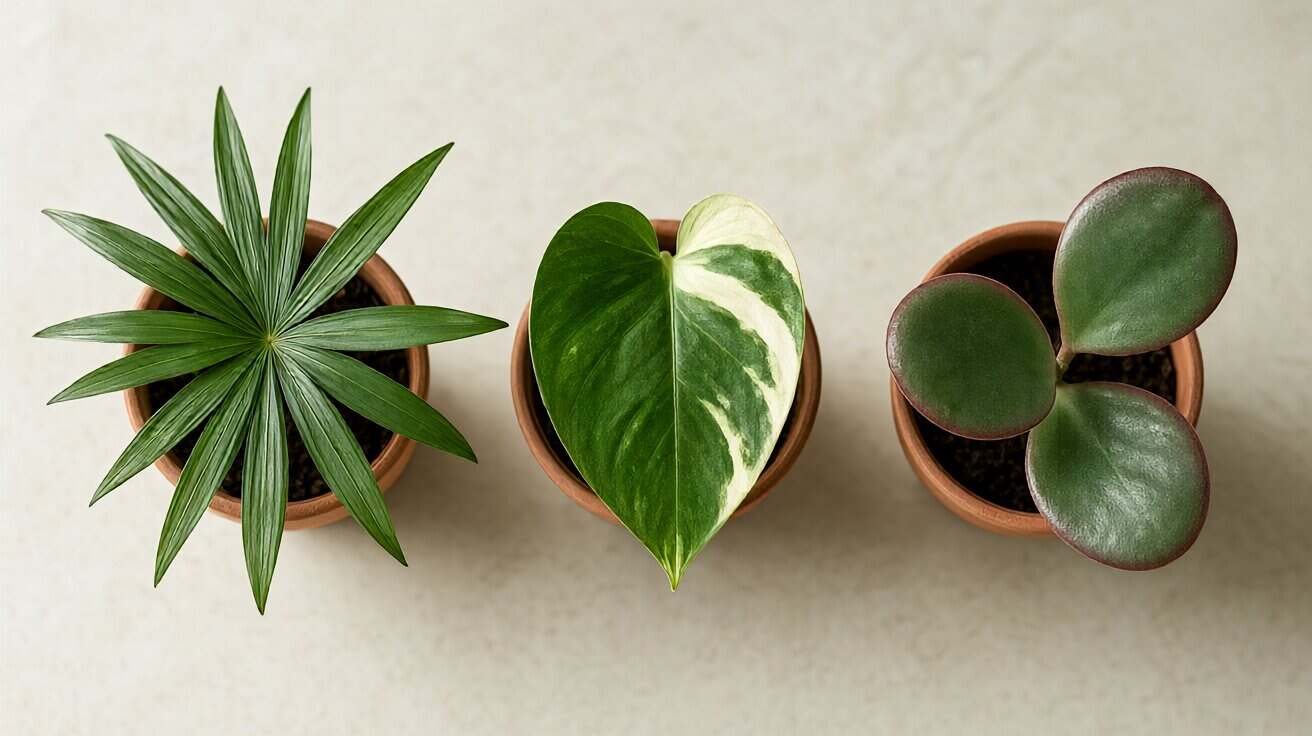
Before you can act on a toxicity class you need the right species, and the label in a garden center is unreliable on this point. The leaf shape settles it in one look.
- Five to nine leaflets radiating from one point, like fingers of a hand. That is a Pachira aquatica, the non-toxic one.
- One heart-shaped leaf per node, often variegated, on a trailing vine. That is Epipremnum aureum, the calcium oxalate plant.
- Thick, oval, fleshy leaves opposite each other on a woody stem, with a reddish margin in sunlight. That is Crassula ovata, the jade plant, and it is the toxic one of the three.
Two more checks take ten seconds. A Pachira aquatica has a swollen, braided or single woody caudex at the base, which is a water reservoir the plant uses between waterings, and its trunk is soft and fibrous rather than woody in the way a jade stem is. If you are still unsure, the identifying guide on money tree vs money plant runs the leaf and trunk test step by step.
What to Do in the First Thirty Minutes After a Pet Nibbles
Once the species is confirmed, the protocol is short and the order matters, because the only irreversible damage in these cases happens in the mouth.
- Remove the plant from reach, not the pet from the room. Move the pot to a shelf the cat cannot reach. If a leaf is still in the mouth, gently remove it. Wiping the mouth with a damp cloth clears residual sap and, for the calcium oxalate plants, removes crystals before more contact injury occurs.
- Check the mouth for the specific signs of the species you identified. For pothos, look for red, swollen or blistered lips and tongue, and excessive drooling. For jade, look for vomiting and unusual unsteadiness. For Pachira aquatica there is no characteristic oral sign, so the thing to watch is the stomach.
- Call the ASPCA Poison Control Center at (888) 426-4435 if the plant is a toxic species or the symptoms are more than mild. The line is staffed 24 hours and takes a consultation fee. If your cat is struggling to breathe, has a swollen tongue or seems collapsed, skip the phone call and go straight to the emergency vet.
- Do not induce vomiting unless a veterinarian tells you to. For the oxalate plants, forcing vomiting can push more crystals and plant matter into the esophagus and stomach than the original bite did.
- Offer water, and hold food for a few hours. If nothing comes back up and the cat seems normal, most cases end there. For a non-toxic species with a mild episode, the same hotline number is the fastest route to a second opinion.
What Happens If You Wait
The timeline is short and it is the reason step 5 above exists. For a non-toxic species, a single leaf eaten by a healthy adult cat produces nausea or loose stool within a few hours and resolves on its own, typically within 12 to 24 hours, with no treatment beyond withholding food briefly and offering water. What does not resolve on its own is continued access to the plant. A cat that is allowed to keep chewing does not experience one episode, it experiences a repeating one, and the timeline then changes from hours to days.
For the oxalate plants the escalation is faster and it is visible in the mouth first. Crystals that stay in contact with oral tissue produce swelling that can worsen over 6 to 12 hours, and a cat that cannot swallow properly because of a swollen tongue stops drinking. Dehydration follows the inability to drink, and it is the mechanism that turns a mouth injury into an emergency, not the injury itself. For the jade plant, whose toxic principle is simply unknown, the published signs include incoordination and depression, so a cat that ate a jade leaf needs watching for at least 24 hours rather than checking in five minutes and forgetting.
Here is the practical skip-cost: if you skip the species check and assume every “money tree” is the non-toxic one, and your plant is actually pothos, then a drooling cat at 2 am looks like mild stomach upset instead of calcium oxalate contact injury, and the swelling that needed attention by morning gets treated with a night of waiting. The identification step takes thirty seconds. The waiting is what costs.
Prevention Without Surrendering Your Plants
Most pet-owning households solve this by picking non-toxic species and putting them where a cat cannot reach them. Both halves matter, and the second half is the one people skip.
- Place the plant up, not aside. A shelf that a cat cannot reach is more reliable than a floor-level pot the cat has decided to investigate. Cats climb, so the shelf has to clear the cat’s reach, not the human’s.
- Give the cat something else to chew. The behavior that produces the ingestion is the behavior you redirect. A grass kit or a cat-safe chew toy takes the interest off the toxic plant.
- Soil is the quiet risk. A cat that knocks a pot over and eats a mouthful of potting mix gets a dose of whatever fertilizer is in it, a different toxicity question from the plant and one that no plant list covers.
- Check the neighbors, not just the plant you asked about. If your home has a pothos vine trailing from a shelf and a jade plant on the windowsill, both need to move to the same standard of care as the money tree, because both are more dangerous than the money tree.
For a full inventory rather than a single species, a wider list of non-toxic houseplants covers the picks and the ones to avoid.
Money Tree Pet Safety and the Rest of the Picture
The verdict on Pachira aquatica is favorable, and the reason is not that the plant is harmless. It is that the part of the plant with a toxic compound is the part a houseplant never grows. Your money tree is not the villain in this story, the label on the pot is, because the label hands the same common name to a plant that is fine and a plant that is not.
Take thirty seconds today, look at the leaf on your desk, and confirm it has fingers and not a heart. If it does, the plant stays, and the only thing left to sort out is the growing conditions that keep it that way. The plant was never the problem. The label was.
Last reviewed on 12 November 2026
Sources and further reading
ASPCA Animal Poison Control Center, toxic and non-toxic plant database entries for Money Tree, Devil’s Ivy (Pothos) and Jade Plant, listing scientific names, family, toxicity class, toxic principles and clinical signs, plus the 24-hour Poison Control hotline at (888) 426-4435.
North Carolina State Extension, Gardener Plant Toolbox entry for Pachira aquatica, covering low severity poison characteristics, the seed as the poison part, cyclopropenoid fatty acids as the toxic principle, mild to moderate gastrointestinal distress in cats, and the note that houseplants never produce seeds.
University of Missouri Extension, interior plant and houseplant care publications, on the general point that any plant material eaten by cats and dogs can produce vomiting and gastrointestinal upset.