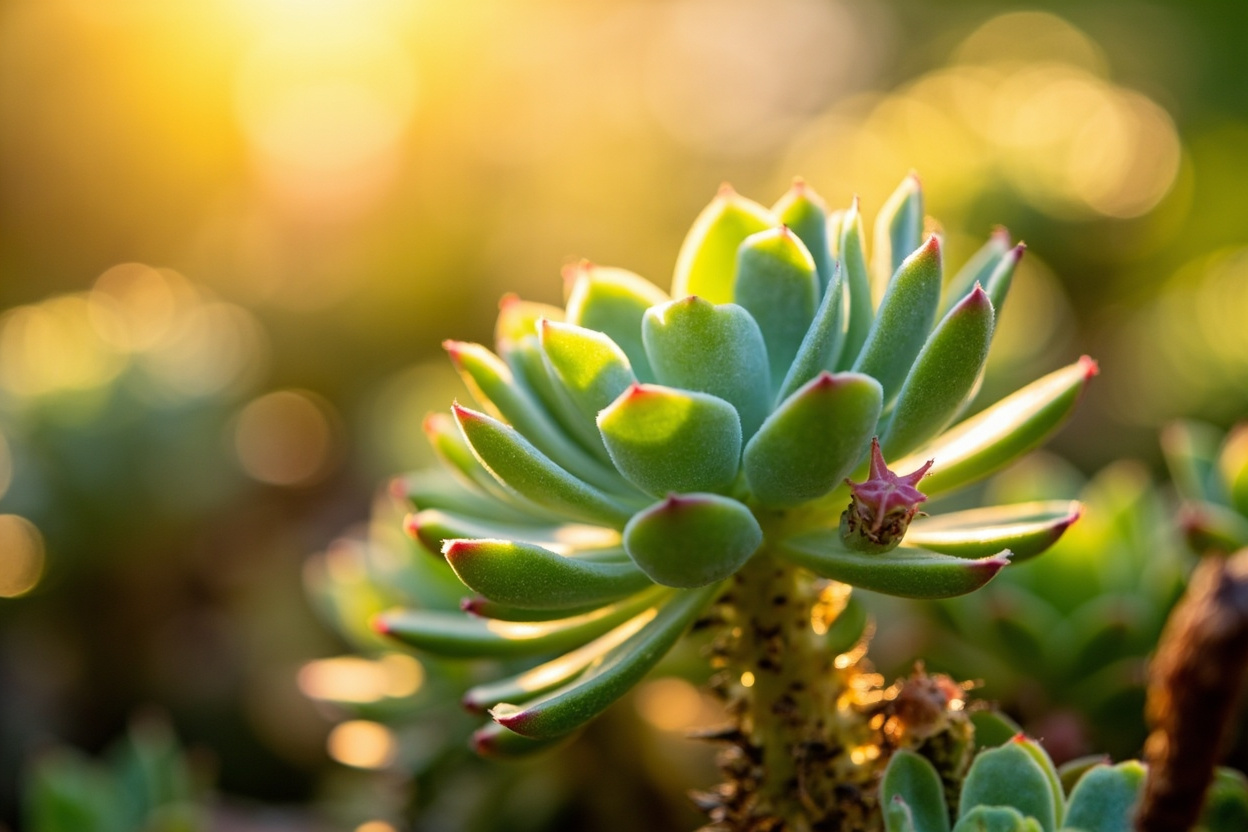

Sedum light requirements are non-negotiable — this is a full-sun genus that stretches, weakens, and refuses to flower with anything less than six hours of direct sunlight per day. If you’ve been treating your sedum like a typical houseplant and placing it in a bright corner, the stretching you’re seeing is the plant starving for light. The good news: the fix is simple, and sedum responds fast once you get it right.
This guide covers the exact light thresholds for sedum — how much sun, what direction, how to identify and fix etiolation, how to move sedum outdoors without burning it, and what to expect from indoor growing. Whether your sedum is a potted ‘Autumn Joy’ on a patio or a trailing Donkey Tail in a hanging basket, the principles below apply across the genus. For a complete overview of sedum care including soil, watering, and variety selection, our sedum plant care complete guide covers the full picture.
Start with the threshold below — it’s the single number that determines whether your sedum thrives or merely survives.
The 6-Hour Direct Sun Threshold
Sedum needs a minimum of six hours of direct sunlight per day to maintain compact growth and produce flowers. Eight hours is optimal. This is not a “bright indirect light” situation — sedum evolved on open rocky slopes and dry meadows where sunlight is unfiltered for most of the day. A sedum placed in a bright room with indirect light will survive for weeks, but it will stretch, weaken, and refuse to flower. The flowering threshold is particularly unforgiving: fewer than six hours of direct sun means no flower buds, regardless of how healthy the plant looks otherwise.
The distinction between direct and indirect light matters because most indoor environments — even sunny rooms — deliver indirect light through window glass. Direct sunlight means the plant receives unobstructed rays that cast a sharp shadow. Test this at midday: hold your hand 15cm above the plant and look at the shadow. Sharp edges = direct sun. Fuzzy, faint shadow = indirect light. If you’re getting fuzzy shadows, your sedum is light-starved regardless of how bright the room feels to your eyes.
East-facing windows provide 3-4 hours of direct morning sun — insufficient for upright varieties but workable for low-growing types like ‘Dragon’s Blood’ and ‘Angelina.’ South-facing windows deliver 6-8 hours of direct sun in the Northern Hemisphere and are the minimum for upright varieties. West windows offer 4-6 hours of intense afternoon heat — enough for sedum but potentially scorching in zones 8+ without acclimation. North-facing windows are unusable for sedum regardless of variety.
Etiolation — What Stretching Looks Like and Why It’s Permanent
Etiolation is sedum’s response to insufficient light: the plant elongates its internodes — the spaces between leaves — in a desperate reach toward a light source. Stems become longer, thinner, and paler. Leaves space out, shrink in size, and lose their color intensity. The plant leans visibly toward the nearest window or light source. This is not a nutrient deficiency or a watering problem — it is purely a light problem, and it is the single most common sedum complaint from new growers.
The critical thing to understand about etiolation is that it is permanent on the affected tissue. The stretched stem will never compact, the wide leaf spacing will never close, and the pale color will never fully recover. You can increase light and the new growth will be compact and properly colored, but the old growth remains stretched forever. This is why prevention matters more than correction — once etiolation sets in, your only options are living with an ugly plant or cutting it back to the last compact node and starting over.
For mild etiolation — slight leaning, modestly wider leaf spacing — simply moving the plant to a location with 6+ hours of direct sun will correct the problem going forward. The new growth will be compact, and over a full growing season the plant’s overall appearance improves significantly. For severe etiolation — stems stretched to twice their normal length, leaning heavily, top-heavy and at risk of snapping — cut the stem back to the last set of tightly spaced leaves. Let the cut end callus for 2-3 days, then water sparingly. The cut stem will produce new, compact shoots from the remaining nodes.
From PDF to Excel in one click
Forget retyping line by line. Upload any bank statement, get a spreadsheet you can actually use. Your files are never stored, and you can test the converter with 3 free conversions.
Try it freeSunscald and Light Acclimation — Moving Sedum Into Full Sun
While sedum demands full sun, moving a plant abruptly from low light to intense direct sun causes sunscald — brown, crispy patches on leaves and stems where the tissue has been literally burned by ultraviolet radiation the plant wasn’t prepared to handle. Sunscald damage is an entry point for fungal infection and never heals; the affected leaves remain scarred until they naturally drop. This is the paradox of sedum light management: too little causes etiolation, too much too fast causes sunscald.
The solution is a 7-10 day acclimation protocol. Start by placing the sedum in a location that receives morning sun only (east-facing, or dappled shade after 11am). Every two days, increase direct sun exposure by one hour. By day 7-10, the plant should be tolerating full-day direct sun without damage. During acclimation, watch for the earliest sign of sunscald — a slight bleaching or yellowing on the upper leaf surfaces — and pull back by 30 minutes of exposure if you see it. This protocol works for moving indoor sedum outdoors in spring, or for relocating a container from a shaded patio to an open, sunny spot.
Sunscald and etiolation are easy to confuse but look different on close inspection. Sunscald appears as flat, brown, crispy patches on the upper surfaces of leaves that face the sun — the tissue looks burned. Etiolation appears as elongated, pale stems with widely spaced, smaller-than-normal leaves — the plant looks stretched and weak. Sunscald means too much light too fast; etiolation means too little light for too long. The fixes are opposite: acclimate down for sunscald, acclimate up for etiolation.
Growing Sedum Indoors — Windows and Grow Lights
Indoor sedum is possible but requires honest expectations. A sedum grown indoors under artificial light will never achieve the compact form, vivid color, or heavy flowering of an outdoor plant in full sun. What you get instead is a surviving plant that looks acceptable from a distance but lacks the architectural quality that makes sedum worth growing in the first place. That said, if outdoor space isn’t an option, the right setup produces a respectable result.
For upright varieties indoors, a south-facing window is the bare minimum — and even then, most growers supplement with a full-spectrum LED grow light positioned 30-45cm above the plant, running 12-14 hours daily. Look for a light rated at 2500-4000 lux at plant height; anything less produces the same stretching you’d get from an east-facing window alone. Low-growing varieties like ‘Angelina’ and ‘Dragon’s Blood’ are more forgiving and can perform reasonably well in a bright south-facing window without supplemental light, though their color will be less vivid than outdoor-grown specimens.
Trailing varieties — Donkey Tail, Jelly Bean, Burro’s Tail — occupy a middle ground. They need bright light but are more sensitive to harsh afternoon sun than upright types. An east-facing window with 4-5 hours of gentle morning sun works well, or a south-facing window with the plant set back 60cm from the glass to filter the harshest midday rays. These varieties etiolate more slowly than upright types but are more prone to leaf drop from sunscald if acclimated poorly.
The honest bottom line: indoor sedum survives, outdoor sedum thrives. If you have access to a balcony, patio, or garden bed that gets 6+ hours of direct sun, your sedum will always outperform anything you can grow indoors. For a deeper dive into how light affects succulent health across genera, our succulent light requirements guide covers the physiological mechanisms that drive etiolation and sun stress. And if you’re comparing sedum to other succulents for your space, the haworthia light guide shows how a shade-tolerant succulent handles the same indoor conditions differently.
Light Needs by Sedum Variety — Upright vs Low-Growing vs Trailing
Not all sedum varieties have identical light needs, and matching your conditions to the right variety prevents most problems before they start. Upright varieties — ‘Autumn Joy,’ ‘Matrona,’ ‘Stardust,’ ‘Stefco’ — are the most demanding. They need 8+ hours of direct sun to maintain their signature compact, architectural form. Below 6 hours, they etiolate within weeks. These are outdoor-only plants in most climates; indoor upright sedum under grow lights is a compromise that rarely satisfies.
Low-growing groundcovers — ‘Dragon’s Blood,’ ‘Angelina,’ ‘Blue Spruce,’ ‘Tricolor,’ ‘Lemon Ball’ — are more flexible. They perform well with 5-6 hours of direct sun and tolerate light afternoon shade in hot climates (zones 8-9). Their spreading habit means they adapt to partial coverage by leaning toward available light rather than stretching vertically. This makes them the best choice for gardeners with east-facing exposures or dappled afternoon shade. They’re also the most viable indoor sedum option under grow lights.
Trailing varieties — Donkey Tail (Sedum morganianum), Jelly Bean (Sedum rubrotinctum), Burro’s Tail (Sedum burrito) — prefer bright indirect light with 4-5 hours of gentle direct sun. They’re native to cliff faces in Mexico where they grow under the partial shade of overhangs and adjacent vegetation. Harsh afternoon sun scorches their plump leaves; deep shade causes rapid stem elongation and leaf drop. An east-facing window or a shaded south-facing patio hits the sweet spot. For a broader comparison of how different succulents handle light, our echeveria light guide covers the shade-tolerance spectrum across genera. The key difference: echeveria tolerates bright indoor light better but etiolates faster when light drops below its threshold, while sedum is slower to stretch but demands more total light to flower.
Seasonal Light Changes and What to Do About Them
Winter light is weaker and shorter in duration, and sedum responds by entering dormancy — not etiolation. Dormant sedum slows or stops growing, may drop some leaves, and looks ragged by March. This is normal. Do not compensate with fertilizer or extra watering; the plant is resting, not starving. Resume normal care when you see new growth at the base in spring, typically when daytime temperatures consistently exceed 10°C.
Spring is the critical acclimation window. As day length increases and sun angle rises, sedum breaks dormancy and produces new growth that is highly sensitive to sunscald. If the plant spent winter indoors or in a sheltered spot, follow the 7-10 day acclimation protocol before moving it to full summer exposure. Spring is also the best time to divide overgrown clumps and take cuttings — the increasing light fuels rapid root development.
Summer brings peak light intensity, and in zones 8-9, afternoon sun can scald even well-acclimated sedum. If you see bleaching or browning on upper leaf surfaces during heat waves, provide temporary afternoon shade with a 30% shade cloth or move containers to an east-facing position. In zones 3-7, full summer sun is rarely too intense for sedum — the greater risk is overwatering during summer rains. Autumn’s declining light triggers flowering in upright varieties, which is exactly what you want: the shorter days and cooler temperatures initiate bud formation for the late-season display that makes sedum valuable in the garden.