With over 400 sedum species available, choosing the right variety comes down to three decisions: growth habit (upright, low-growing, or trailing), hardiness zone, and whether you’re planting in ground or containers. If you’ve grown ‘Autumn Joy’ and want to expand beyond that one familiar variety, the options can feel overwhelming — but a handful of proven performers cover almost every garden situation.
This guide covers the 15 best sedum varieties across three growth categories — upright for borders and cut flowers, low-growing for ground cover and rock gardens, and trailing for hanging baskets and elevated displays. We’ve organized each variety by hardiness zone, growth habit, and ideal planting situation so you can match the right stonecrop to your space. For the full sedum care foundation, our sedum plant care complete guide covers light, watering, and soil in one place.
Start with the upright varieties below — they’re the most popular entry point and the most cold-hardy.
Upright Sedum Varieties — Borders, Cut Flowers, and Focal Points
Upright sedum — now classified in the Hylotelephium group (formerly Sedum spectabile and S. telephium) — grows 30-60cm tall with dense, flat-topped flower heads that bloom from late summer through autumn. These are the workhorses of the late-season garden: when most perennials have finished flowering, upright sedum is just getting started. The flower heads persist through winter, adding structural interest to bare borders.
‘Autumn Joy’ (S. spectabile) is the variety most gardeners start with, and for good reason. Its broad flower heads open pink in late summer, deepen to rose in autumn, and finish copper-brown in winter. It reaches 45-60cm tall, thrives in zones 3-9, and tolerates poor soil, drought, and neglect better than almost any other perennial. The one weakness: in rich soil or humid climates, stems can flop open in the centre by mid-summer. Plant it in lean soil and full sun to keep growth compact.
‘Matrona’ offers a step up in sophistication. Bronze-tinged stems support pale pink flower heads above dark green foliage with a reddish edge. It’s slightly shorter (40-50cm) and notably more wind-resistant than Autumn Joy — the thicker stems resist flopping even in exposed sites. Zones 3-9. ‘Stardust’ (S. spectabile) produces pure white star-shaped flowers that bloom late in the season, making it an excellent choice for moon gardens and pale color schemes. Zones 4-9.
‘Neon’ (S. spectabile) delivers hot pink flowers on compact 35-45cm stems. It’s the best choice for smaller borders and large containers where Autumn Joy would overwhelm the space. Zones 3-9. ‘Brilliant’ offers true hot pink (not the muted rose of Autumn Joy) on 40-50cm stems with blue-green foliage that makes the flowers pop. Zones 3-9. All upright varieties are perennial — they die back to the ground in winter and re-emerge from the same root system each spring. Cut the dried stems back to 5cm above ground in late winter before new growth appears.
Low-Growing Sedum Varieties — Ground Cover, Rock Gardens, and Carpeting
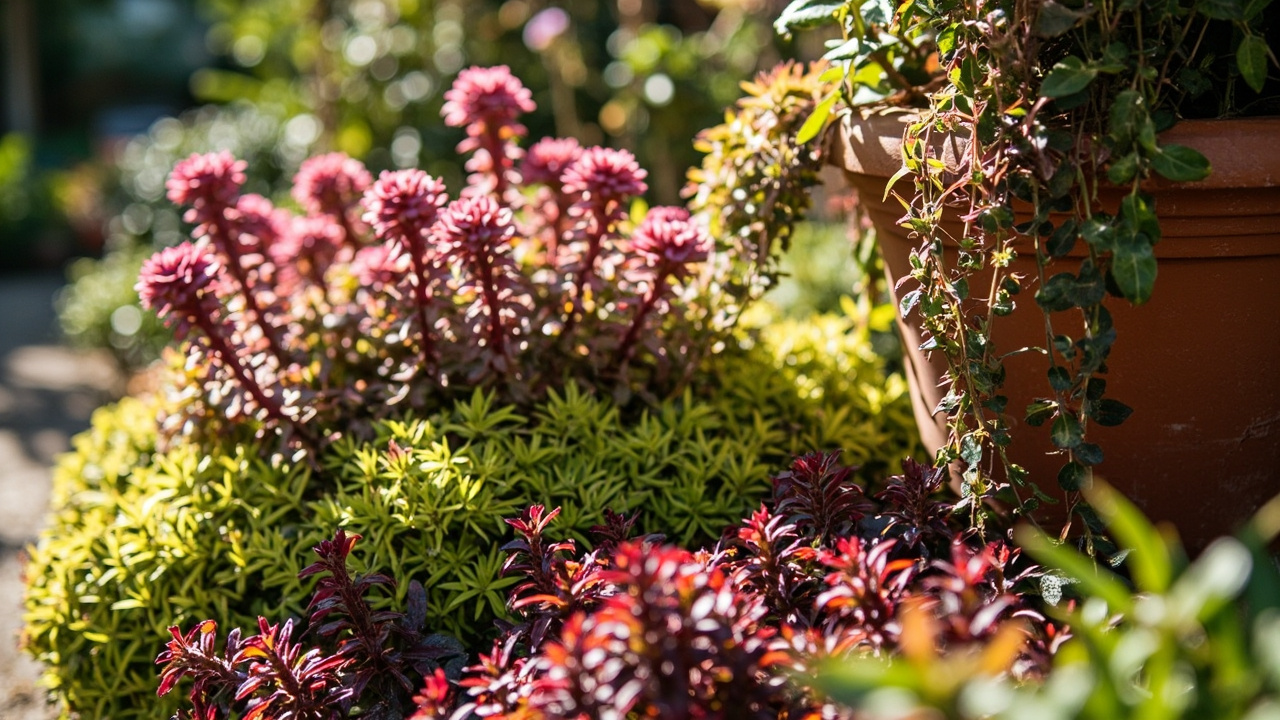
Low-growing sedum (S. spurium, S. kamtschaticum, S. acre group) spreads horizontally rather than vertically, forming dense mats 5-15cm tall. These are the varieties for rock gardens, slope stabilization, gap-filling between stepping stones, and any situation where you need living ground cover that thrives on neglect. Once established, they suppress weeds effectively and require virtually no maintenance.
‘Dragon’s Blood’ (S. spurium) is the most popular low-growing variety for good reason. Its green leaves with red edges turn deep burgundy in autumn, and it produces clusters of tiny pink flowers in mid-summer. It spreads 30-45cm per year, thrives in zones 3-9, and handles light foot traffic — making it suitable for planting between flagstones. For a complete sedum care overview including soil and light needs, our sedum light requirements guide covers what these groundcovers need to stay compact.
‘Angelina’ (S. rupestre) is the color star of the low-growing group. Its chartreuse-yellow foliage stays vibrant year-round, shifting to orange-gold in autumn. Lime-green flowers appear in early summer. Zones 2-9 — it’s one of the cold-hardiest sedum varieties available. ‘Blue Spruce’ (S. reflexum) offers striking contrast with blue-green needle-like leaves that resemble a miniature conifer. Yellow star-shaped flowers in summer. Zones 3-9. Plant Angelina and Blue Spruce together for a textured, color-contrast groundcover that looks intentional.
‘Tricolor’ (S. spurium variegated) features leaves edged in white and pink. It’s a slower spreader than Dragon’s Blood and Angelina, making it better suited to containers, small rock garden pockets, and the front of borders. Zones 3-9. All low-growing varieties spread by rooting stems — they self-propagate by sending out runners that root where they touch soil.
Trailing Sedum Varieties — Hanging Baskets, Shelves, and Cascading Displays
Trailing sedum (S. morganianum, S. rubrotinctum, S. burrito) produces stems that cascade 30-90cm, making them the stars of hanging baskets, high shelves, and tall planters. These varieties are grown for their foliage rather than flowers — the cascading stems of plump leaves are the main attraction. They’re the most visually dramatic sedum group but also the most cold-sensitive.
Donkey Tail (S. morganianum) is the iconic trailing sedum: thick, overlapping grey-green leaves coat hanging stems that reach 60cm or longer. It’s the most commonly available trailer and the most forgiving — it tolerates brief dry periods that would kill other trailing varieties. Zones 10-11 only. In any cooler climate, it must overwinter indoors in a bright south-facing window.
Jelly Bean (S. rubrotinctum) is the most colorful trailer. Its plump, bean-shaped leaves turn bright red at the tips when grown in full sun, creating a gradient from green at the base to crimson at the stem tips. Stems sprawl 30-45cm. Zones 9-11. Burro’s Tail (S. burrito) has rounder, softer leaves than Donkey Tail and shorter stems (30-40cm). It’s more delicate — leaves detach at the slightest touch. Zones 10-11.
Important care note for all trailing varieties: they’re fragile. Position hanging baskets and shelves where they won’t be brushed, bumped, or caught by passing clothing. Every touch knocks off leaves, and while the plant recovers, it looks bare and ragged for weeks. ‘Cape Blanco’ (S. spathulifolium) is a compact low-grower often grouped with trailers — its silvery rosettes stay under 10cm tall and it tolerates more shade than most sedum. Zones 5-9. It’s an excellent choice for container edges and fairy gardens where you need small-scale texture without the fragility of true trailing types.
Hardiness Zones — Which Sedum Survives Your Winter
Hardiness is the single most important factor in choosing a sedum variety. Upright and low-growing varieties are genuinely cold-hardy — most survive winters down to USDA zone 3 with simple mulch protection, and some (Angelina, Dragon’s Blood) handle zone 2. Trailing varieties are a completely different story: Donkey Tail, Jelly Bean, and Burro’s Tail are zone 10-11 plants that die at temperatures below 7°C. In any climate colder than zone 9, trailing sedum must be grown as a houseplant or overwintered indoors.
For cold-climate growers, the winter survival protocol is straightforward: stop fertilizing by August (late fertilization produces tender growth that frost kills), reduce watering gradually through autumn, and apply a 5cm layer of gravel mulch around the base after the ground freezes. Never use organic mulch like straw or leaves on sedum — it holds moisture against the stems and causes rot. In zones 3-4, consider wrapping upright varieties with horticultural fleece during the coldest weeks of January and February, when temperatures can drop low enough to damage even dormant root crowns.
Don’t panic when upright sedum dies back to the ground in winter. This is normal dormancy, not death. The root system survives underground and sends up new shoots in spring. Many growers leave the dried flower heads standing through winter for visual interest and to feed seed-eating birds.
Choosing Sedum by Space — Containers, Borders, Slopes, and Green Roofs
Matching variety to space is the final decision — and getting it right means the difference between a sedum that merely survives and one that genuinely thrives. For containers and pots, trailing varieties (Donkey Tail, Jelly Bean) suit hanging baskets; compact uprights (‘Autumn Joy’, ‘Neon’) work in large pots (25cm+ diameter); and low-growers (Angelina, Tricolor) thrive in shallow bowls and trough containers. For borders and beds, space upright varieties 30-45cm apart. They’ll look sparse in year one but fill in completely by year two, providing late-season color when other perennials have faded.
Slopes and banks are where low-growing sedum earns its keep. Dragon’s Blood and Angelina planted 20cm apart will cover a slope within one growing season, preventing erosion where mowing is impossible. Their shallow, spreading root systems bind soil effectively without the aggressive invasiveness of traditional groundcovers like ivy or vinca. For green roofs and xeriscape plantings, specialist species like S. sexangulare, S. acre, and S. album tolerate extreme drought, shallow soil (as little as 5cm depth), and wind exposure that would kill ornamental varieties. These aren’t the prettiest sedum species, but they’re the ones engineered by evolution for the toughest conditions — and they’re the reason sedum dominates the green roof industry across Europe and North America.
From PDF to Excel in one click
Forget retyping line by line. Upload any bank statement, get a spreadsheet you can actually use. Your files are never stored, and you can test the converter with 3 free conversions.
Try it free