
The best soil for Bird of Paradise is a bark-heavy, well-draining mix with perlite — roughly 60% drainage material and 40% organic matter. This ratio mimics the loose, airy tropical floor conditions Strelitzia roots need to thrive in a pot.
Standard potting soil fails Bird of Paradise because it is too dense. Most commercial mixes contain peat or coco coir as the base, which holds moisture for 5-7 days — far too long for Strelitzia roots that need oxygen between waterings. In heavy soil, roots suffocate and begin to rot within 72 hours at temperatures below 60°F (15°C). The plant survives but never thrives: leaves yellow, new growth stalls, and the root system slowly decays from the bottom up.
This guide covers the exact soil recipe, how to choose the right pot, when and how to repot, and what to watch for in the critical weeks after transplanting.
The Best Soil Mix for Bird of Paradise: The 60/40 Rule
Bird of Paradise grows from a thick rhizome system that needs both moisture and oxygen. The ideal mix balances water retention with drainage — roughly 60% drainage material (perlite, orchid bark, pumice) and 40% organic matter (coco coir, compost, worm castings). This ratio allows water to flow through while keeping the root zone moist for 3-5 days in warm conditions, not 7-10.
A proven recipe: 2 parts orchid bark (½-inch chunks), 1 part perlite (medium grade), 1 part coco coir (pre-soaked), ½ part worm castings. The bark creates air pockets, perlite prevents compaction, coir retains light moisture, and castings provide slow-release nutrition. Mix thoroughly before potting. The soil pH should land between 6.0 and 7.5 — slightly acidic to neutral. If your tap water is hard (alkaline), the pH creeps upward over months; repotting every 2-3 years resets this naturally.
For Strelitzia care fundamentals, the same soil principles apply whether the plant lives indoors or outdoors — but outdoor potted plants in summer may need 10-15% more bark to compensate for increased evaporation.
Why Standard Potting Soil Kills Bird of Paradise
The problem with standard potting soil is not what it contains — it is how it behaves when wet. Peat-based mixes absorb water like a sponge and release it slowly. In a 14-inch pot at 60°F (15°C), the bottom 4 inches of peat-heavy soil can remain waterlogged for 8-12 days after a single watering. Strelitzia roots in that zone suffocate, die, and begin to rot. By the time you smell the sour soil odor, 30-50% of the root system may already be non-functional.
Bird of Paradise roots are thick, white, and fleshy — designed to store water and nutrients during dry spells. They are not designed to sit in saturated soil. Unlike pothos or peace lily that tolerate wet feet, Strelitzia roots begin decaying within 72 hours of waterlogging at temperatures below 60°F (15°C). Above 75°F (24°C), evaporation speeds up and the risk decreases — but the bottom of a dense soil mass still stays wet long after the surface looks dry.
See the Bird of Paradise problems guide for how root rot manifests and why early detection matters.
How to Choose the Right Pot for Bird of Paradise
Pot size, material, and drainage all affect how the soil mix performs. The rule: choose a pot 2-3 inches larger in diameter than the current root ball. A pot that is too large holds excess soil that stays wet for weeks; a pot that is too small chokes the roots and causes circling.
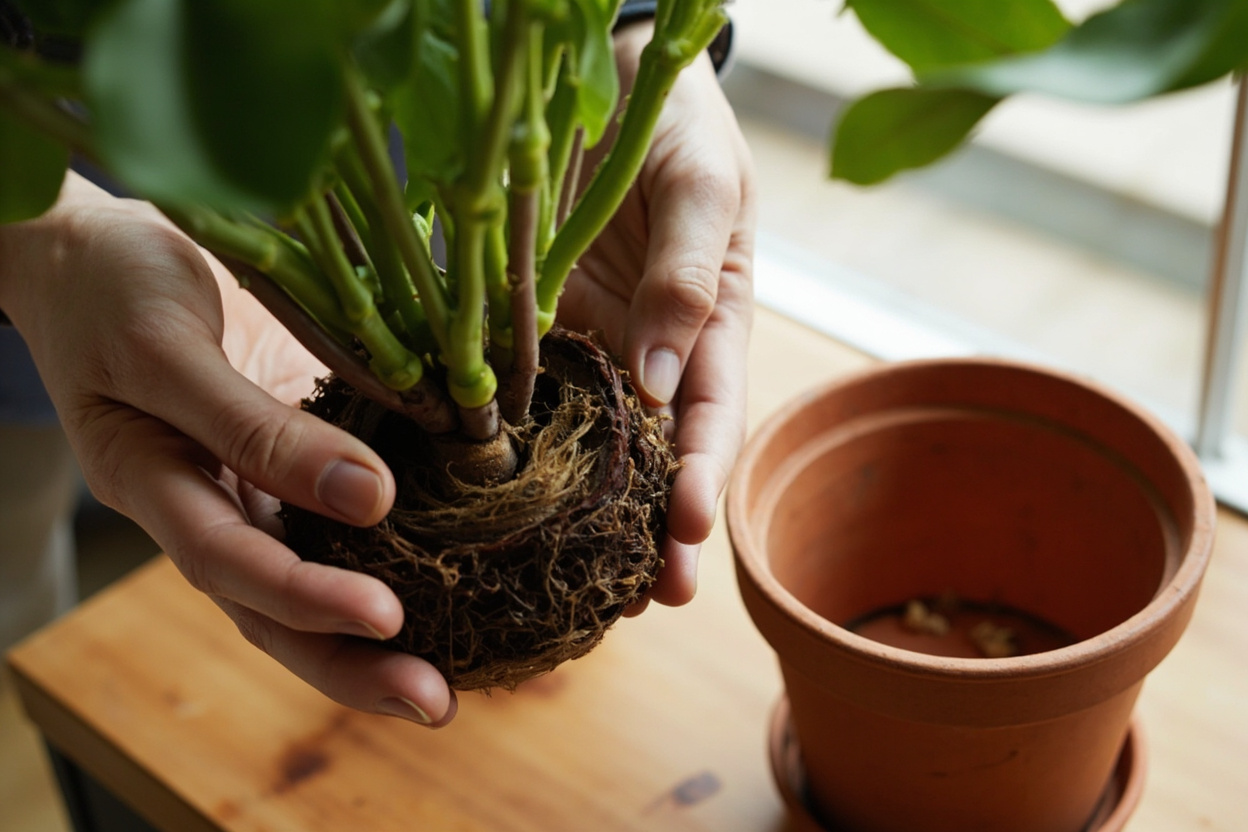
Figure: A Bird of Paradise root ball held during repotting, showing thick white roots and dark soil — a healthy root system ready for a fresh bark-based mix.
Holes matter more than material. Terracotta pots breathe, allowing soil to dry 20-30% faster than sealed ceramic or plastic. If your Bird of Paradise lives in a room below 65°F (18°C), terracotta is safer precisely because it wicks moisture away from the root zone. In dry, heated rooms above 75°F (24°C), plastic or glazed ceramic retains moisture longer and reduces watering frequency. Either way, at least two ½-inch drainage holes are non-negotiable. One hole clogs; two provide redundancy.
Checking soil moisture before every watering is easier when you can feel the pot weight — lift it. A light pot means dry soil; a heavy pot means moisture below the surface.
When and How to Repot Bird of Paradise
Repot Bird of Paradise every 2-3 years in spring (March-May), when active growth resumes. Signs it is time: roots growing through drainage holes, soil drying out within 2-3 days, water running straight through without being absorbed, or the plant becoming top-heavy and tipping over.
Step 1 — Water the plant 24 hours before repotting. Moist soil holds together better and reduces transplant shock. Dry soil crumbles and tears roots during removal.
Step 2 — Remove the plant by tilting the pot and sliding the root ball out. If it sticks, run a knife between the soil and pot edge. Do not pull the plant by the stems; Strelitzia leaves tear easily and the crown is fragile.
Step 3 — Inspect the root system. Healthy roots are white or light tan and firm. Black, mushy, or hollow roots are rotten — trim them with sterilized scissors until you reach clean, white tissue. Remove all loose old soil by gently shaking or rinsing with lukewarm water.
Step 4 — Place 1-2 inches of fresh soil mix at the bottom of the new pot. Position the root ball so the crown sits ½ inch below the rim. Fill around the sides with mix, pressing lightly to eliminate air pockets. Do not pack firmly —_strelitzia roots need air space.
Step 5 — Water thoroughly until water runs from the drainage holes. This settles the soil. Place the plant in bright, indirect light for 4-6 weeks. Avoid direct southern sun during recovery — stressed roots cannot support large leaves in high light.
Root pruning is optional for most repottings. If the root ball is extremely tight and circling, trim up to 20% of the outer roots with sterilized scissors. This encourages new growth but creates temporary stress. Expect drooping within 3-5 days — this is normal transplant shock, not underwatering. New growth appears within 2-4 weeks when the root system re-establishes.
Aftercare: Helping Bird of Paradise Recover From Repotting
The first 4-6 weeks after repotting are critical. The root system is re-establishing and cannot support the full canopy. Water sparingly — only when the top 2 inches of soil feel dry. Overwatering in the first month after repotting is the #1 killer because damaged roots cannot process normal moisture levels.
Do not fertilize for 4-6 weeks. Fresh soil mix contains enough nutrients, and fertilizing before roots recover causes salt burn on damaged tissue. After 6 weeks, resume a balanced liquid fertilizer at half strength for two feedings, then move to full strength.
If leaves droop within the first week after repotting, resist the urge to water more. Drooping is transplant shock, not thirst. Check the soil — if it is moist, wait. If it is bone dry throughout the entire pot, give a light watering. Most Strelitzia recover from transplant shock within 7-14 days when kept in stable conditions: 65-75°F (18-24°C), bright indirect light, and no drafts.
Turn PDF Bank Statements Into Workable Spreadsheets
Your bank statement is a mess of numbers, but your books shouldn't be. Use our converter to get Excel, CSV, or QBO files — ready for QuickBooks.
Try It Free Now