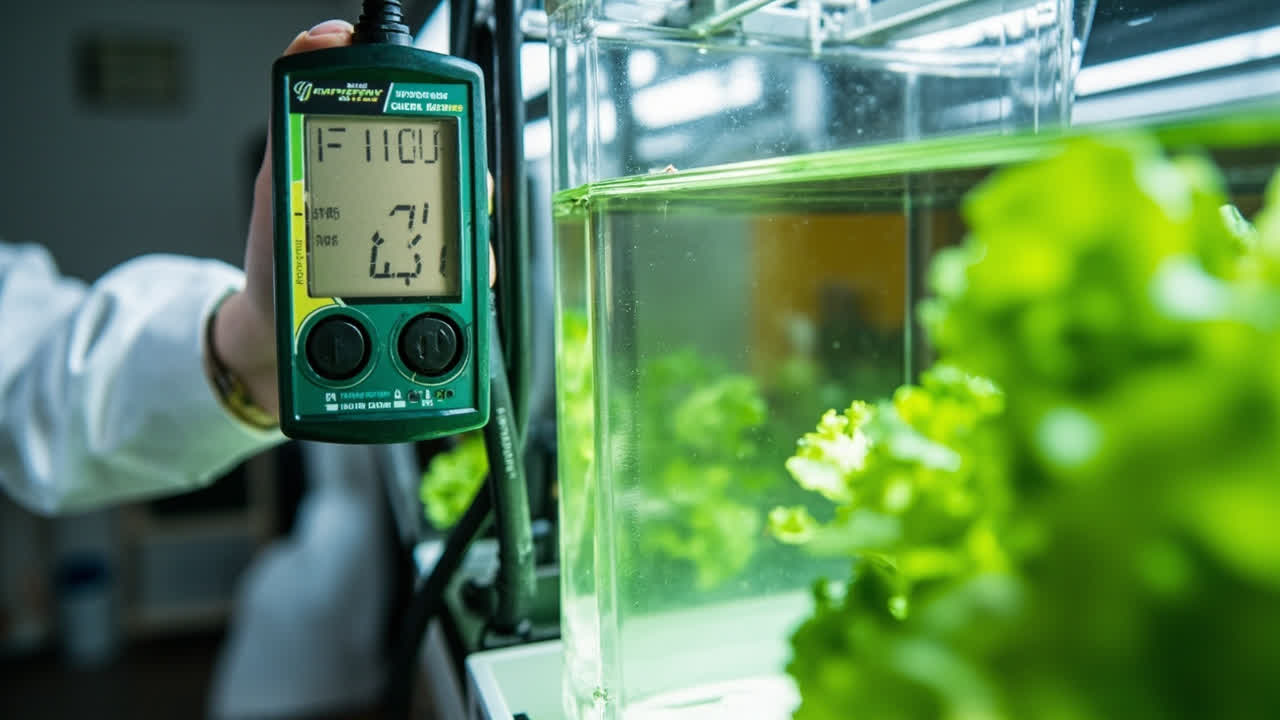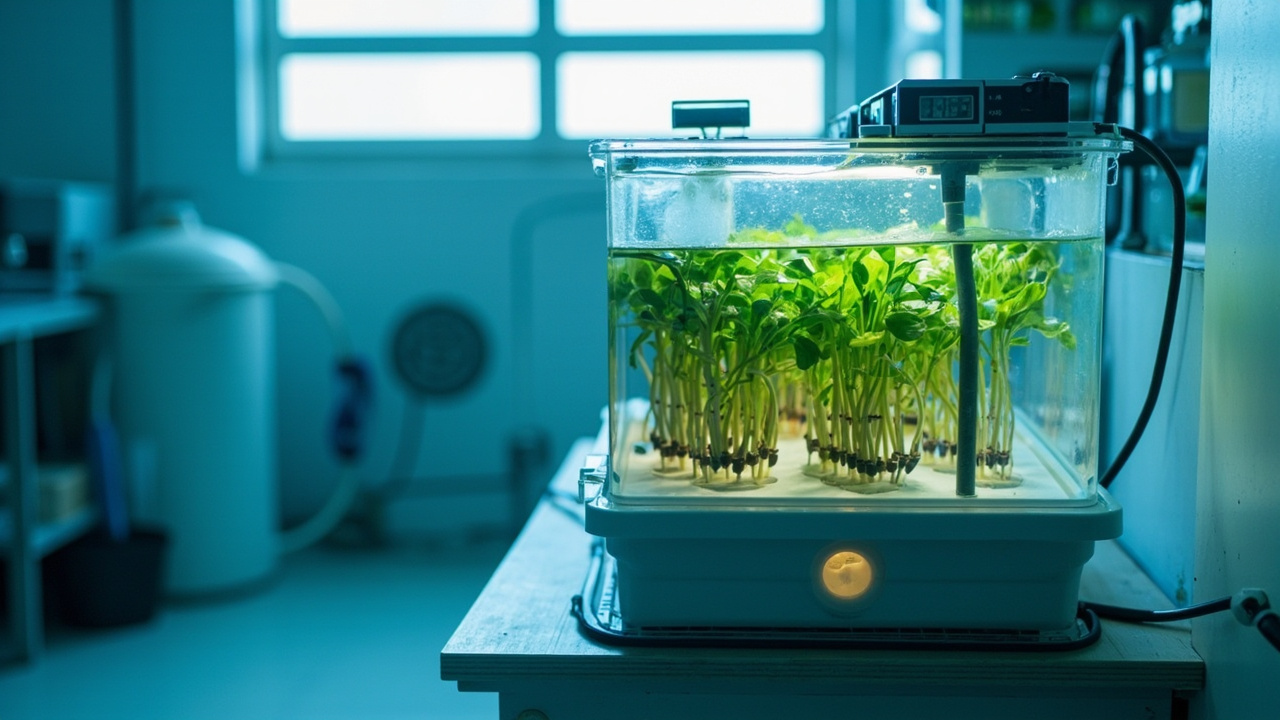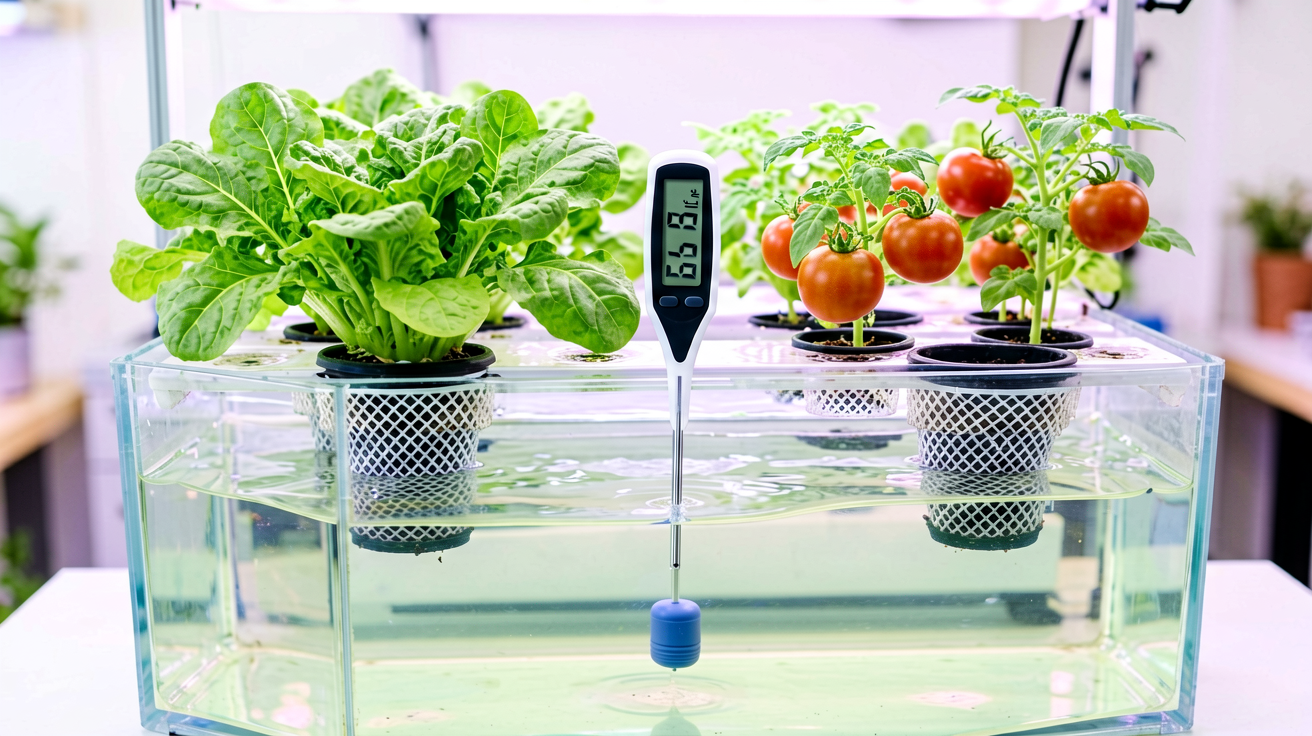

Reservoir water temperature is the variable your pH meter cannot see, and most home growers miss it. Hold the right band for your crop and the rest of the hydroponic system finally has the dissolved oxygen and root metabolism it needs. Miss it, and the same nutrient solution that worked last week produces wilting, bolting, blossom-end rot, or root rot in the root zone for no visible reason.
The reason is dissolved oxygen. Cold water holds more of it than warm water, and roots are heavier oxygen consumers in warm water than in cold. The gap between what the water can supply and what the roots demand widens with every degree past about 75 F. Below 60 F, the same chemistry runs in reverse: the water is rich in oxygen but the roots slow their metabolism so much that plant growth stalls in the nutrient solution.
This page is the canonical reference for per-crop reservoir temperature in home hydroponics. It covers the mechanism most guides skip, the full crop matrix for the eight crops home growers actually run in deep water culture, nutrient film technique (NFT), Kratky, drip, ebb and flow (flood and drain), and aeroponic systems, what happens outside the band, how to measure, and how to bring a too-warm or too-cold reservoir back into range without buying more hardware than you need. For the broad mechanism and cooling options, see our reservoir water temperature guide. For the cool-season versus warm-season tier model with four crops in narrative form, see hydroponic water temperature by crop.
Why Reservoir Temperature Is the Hidden Variable Behind Root Problems
A reservoir that runs 5 to 10 degrees outside a crop’s working band produces symptoms that look like nutrient deficiency, fungus, or bad seed stock. Pale new growth on lettuce and basil. Interveinal yellowing across the canopy. Wilting despite wet roots in net pots. Blossom-end rot on the first tomato fruit set. Lettuce sending up a flower stalk in week four. None of those symptoms point at a thermometer, but every one of them points back at the reservoir, the air pump output, and the nutrient solution that the roots can no longer pull.
Two mechanisms drive the failure. The first is dissolved oxygen: warm water holds less of the gas that roots need to respire, and warm roots need more of it. The second is pathogen growth rate: Pythium, the oomycete behind most root rot in DWC and recirculating hydroponic systems, doubles roughly every 20 degrees Fahrenheit. A reservoir at 80 F grows Pythium colonies many times faster than the same reservoir at 65 F, and the roots that survive the lower oxygen lose the competition anyway.
For most home growers, the fix is not a chiller. It is a thermometer, an hour of measurement at the same time each day, and one or two cheap physical changes (paint, shade, frozen water bottles, or relocating the reservoir off the floor). The full playbook is at the bottom of this page. First, the mechanism that explains why all of it works in any hydroponic system, from a five-gallon Kratky jar to a fifty-gallon RDWC reservoir, from a countertop herb garden under a grow light to an indoor growing setup or a greenhouse NFT run.
What Reservoir Temperature Actually Controls
Three variables move together when reservoir water temperature moves: dissolved oxygen, root metabolism, and pathogen growth rate. Understanding each one separately is the difference between chasing symptoms in the nutrient solution and fixing the cause inside the reservoir.
Dissolved oxygen falls as water warms. Approximate values for clean, well-aerated water at sea level: about 8.5 to 9 mg/L at 70 F, about 7.5 mg/L at 80 F, and about 5 mg/L at 90 F. The exact number on a given day depends on the air stone output, the salinity of the nutrient solution, and how much surface agitation the reservoir gets from the water pump and air pump, but the direction is fixed by the physics of gas solubility in water.
Root metabolism rises with temperature. Root cells respire faster, demand more oxygen, and pump nutrients more aggressively when warm. The plant is doing what it should. The problem is that the water can no longer keep up with the demand at the same moment, so the electrical conductivity (EC) and total dissolved solids (PPM, TDS) in the root zone rise even as the plant starves. NPK uptake, calcium uptake, micronutrient uptake (iron, manganese, zinc, copper, boron, molybdenum), and the rest of the nutrient solution all sit right there in the water, but the root membranes cannot pull them across without oxygen to power the active transport.
Pathogen growth rate also rises with temperature. Pythium, the most common root-rot pathogen in recirculating hydroponic systems, grows fastest between roughly 70 and 90 F. Holding the reservoir in the crop’s working band does not sterilize the system, but it removes the temperature edge that lets opportunistic pathogens outcompete the roots.
Together these three variables explain why a reservoir that works at 68 F fails at 78 F with no other change to the system, even when the pH is locked, the EC is in band, and the air pump is running. The crop-specific bands in the next section are the practical translation of this mechanism into home setup, whether the system is DWC, NFT, Kratky, drip, or aeroponic. For the broader reservoir water temperature range and the cooling options, the sibling guide covers the full mechanism in narrative form.

Crop x Temperature Matrix: The Optimal Range for Each Crop
Use this matrix as the working reference. Most home growers hold one reservoir at one temperature; pick the band that matches the crops you actually run, and accept that crops outside that band will lose yield or fail. The matrix covers the eight crops home hydroponic setups see most often. Numbers are in degrees Fahrenheit with Celsius in parentheses.
Lettuce: 60 to 70 F (16 to 21 C). Most vigorous growth clusters at 64 to 68 F. Above 72 F, expect the first signs of bolting within 7 to 14 days. Above 78 F, expect Pythium signal in the leaf lettuce within a week.
Tomato: 65 to 75 F (18 to 24 C). Optimum at 70 to 73 F. Below 60 F, expect visible growth stall in 7 to 10 days and phosphorus uptake to drop sharply. Above 78 F, expect blossom-end rot on the first fruit set within 10 to 14 days. For variety-specific ranges and feeding detail, see our hydroponic tomato growing guide.
Pepper: 65 to 75 F (18 to 24 C). Optimum at 70 to 74 F. Same stall pattern as tomato below 60 F, same blossom-end rot risk above 78 F. Peppers tolerate the upper edge a little better than tomatoes but punish cold snaps harder.
Basil: 65 to 70 F (18 to 21 C). The narrowest band on this page. Above 72 F with low dissolved oxygen, Pythium root rot sets in within 48 hours. Below 60 F, expect growth to visibly slow within a week. Basil is the crop that punishes mistakes fastest and rewards tight management hardest.
Strawberry: 65 to 72 F (18 to 22 C). Above 75 F, flower set drops sharply and the plant diverts energy into runners. Below 60 F, expect berry size and sweetness to fall. Strawberries reward a stable, narrow band more than any other fruiting crop on this list.
Cucumber: 65 to 75 F (18 to 24 C). Optimum at 70 to 74 F. Below 65 F, expect yield to drop 15 to 25 percent within two weeks. Cucumbers handle the upper edge better than strawberries but lose flowers above 80 F.
Microgreens: 60 to 68 F (16 to 20 C). Most microgreens prefer the cool-season leafy band and bolt or turn bitter above 72 F. The short cycle means a temperature spike is usually recoverable between crops, but a consistently warm reservoir costs flavor across every cut.
Kale, bok choy, arugula, spinach: 60 to 70 F (16 to 21 C). Same band as lettuce, with kale tolerating the cold edge a little better and bolting a little later. Treat the cool-season leafy group as a single reservoir profile.
The pattern: cool-season crops want the 60 to 70 F band, warm-season fruiting crops want 65 to 75 F, and the middle-band crops (basil, strawberry, cucumber) sit in the overlap and punish excursions hardest. If you run one reservoir, pick the band that matches the dominant crop and accept that basil rides with the warm-season reservoir because its tolerance overlaps there better than it does in the cool-season band.
What Happens Outside the Optimal Range
Outside the crop-specific band, three failure modes show up in predictable order. They are not random. They are the same mechanism wearing different clothes.
Too warm, the slow failure: roots stop pulling in calcium and magnesium. New growth goes pale. Interveinal yellowing appears on the lower leaves. The grower adds more nutrient solution, which raises the EC and adds more salt to an already oxygen-limited root zone, and the plant gets worse. This is the most common warm-reservoir presentation in home setups and is the one most often misdiagnosed as a calcium or NPK deficiency, prompting a pH or Cal-Mag adjustment that does not solve the underlying problem.
Too warm, the fast failure: roots go brown and slimy. The plant wilts despite standing in wet nutrient solution. The stem base turns dark at the waterline. This is Pythium, and it shows up fastest in basil, lettuce, and young seedlings; algae blooms in the same warm reservoir accelerate the oxygen strip. For the diagnostic steps and rescue protocol, see root rot in DWC and the broader common hydroponic problems guide.
Too cold, the slow failure: root metabolism slows in the reservoir. Phosphorus uptake drops, as does the uptake of nitrogen, potassium, and calcium. The plant stops putting on new growth but does not die. Tomatoes and peppers are the most sensitive; lettuce, kale, and spinach will sit at 55 F for two to three weeks without dying, then resume growth once the reservoir warms back. Warm the reservoir to 68 F within seven days and most cold-stalled crops recover without fruit loss.
Too cold, the fast failure: ice formation or a chiller that overshoots. Rare in home setups unless the reservoir sits in an unheated garage in winter. If the water approaches 40 F, move it to a warmer room or add a small aquarium heater set to the crop’s minimum.
How to Measure Reservoir Temperature
The cheapest diagnostic in hydroponics is a thermometer in the reservoir, read at the same hour every day. The cost is two to fifteen dollars. The payoff is catching every failure mode on this page before the plants show symptoms.
What to use. A glass floating thermometer, a submersible digital probe, or an aquarium thermometer all work. Infrared thermometers read the surface of the water, which sits 1 to 3 degrees above the bulk temperature in a stratified reservoir, so infrared is a quick check, not a final reading. A wall thermometer in the grow room reads air, not water, and the two can differ by 5 to 10 F under lights. A pH meter or EC meter in the reservoir tells you nothing about temperature, so the thermometer is a separate tool you have to add.
Where to place it. Submerge the probe in the reservoir, away from the air stone outlet (which gives a falsely cool reading) and away from the wall (which gives a falsely warm reading if the reservoir is dark-colored). Middle of the bulk water, halfway down, is the most representative point.
When to read it. Same hour every day, late afternoon if possible. A reservoir that reads 72 F at 9 a.m. can climb past 78 F by 4 p.m. in a warm room, putting the entire afternoon window outside the safe band. One reading per day is not enough during summer or in grow rooms with inadequate ventilation. Log the reading; the trend matters more than any single number, and the trend is what separates a stable reservoir from one drifting toward root rot.
What to log. Date, time, water temperature, ambient air temperature, and any change you made to the system that day. Three days of readings is enough to see whether the reservoir is stable or drifting. For the broader measurement context and what to do when the readings are off, see the reservoir water temperature guide.
How to Control Reservoir Temperature
Control options sit on a spectrum from zero cost to serious hardware. Pick the cheapest method that holds the reservoir inside the crop’s band. Most home growers never need a chiller.
Paint or insulate the reservoir. A black plastic tub in a bright room absorbs a surprising amount of heat. Wrapping the outside with reflective foil, a white reflective cover, or styrofoam can drop the daytime peak by 3 to 6 F. Cost: a few dollars. Best for: small to mid-size DWC tubs in warm rooms.
Shade and relocate. Heat from lights rises and pools low in the room. Lifting the reservoir onto a shaded shelf off the floor, out of direct light, often drops the peak by 2 to 4 F without any hardware. Cost: zero. Best for: any setup where the reservoir is currently on the floor under lights.
Increase air pump output. More agitation raises gas exchange at the surface and slightly lowers water temperature, while raising dissolved oxygen directly. Not a substitute for true cooling in warm climates, but a free improvement on any system. Cost: a larger air pump, twenty to forty dollars. Best for: marginal cases where the reservoir is 2 to 4 degrees too warm.
Frozen water bottles. Two 1-liter bottles swapped twice a day can hold a small DWC tub in range through a heat wave. Cost: zero beyond freezer space. Best for: small home setups during short warm spells. Not a long-term solution.
Water chiller. A dedicated hydroponic chiller (or a repurposed aquarium chiller) is the only reliable solution for a reservoir that sits 5 or more degrees too warm every day. Cost: one hundred to several hundred dollars plus electricity. Best for: warm climates, large reservoirs, or commercial-scale setups where the cheaper methods cannot keep up.
Small aquarium heater with thermostat. For the cold-side failure, a submersible aquarium heater set to the crop’s minimum (typically 60 to 65 F) prevents the winter stall in unheated rooms. Cost: fifteen to thirty dollars. Best for: garages, basements, and any setup where the reservoir falls below 55 F in winter.
Match the method to the scale. A single 5-gallon DWC tub in a cool basement does not need a chiller. A 50-gallon RDWC in a 78 F garage does. The full reservoir maintenance routine covers refill cadence and nutrient-top-off temperature too.
Setting Up Your Reservoir for Stable Temperature
Stable beats optimal. A reservoir that holds 68 to 70 F every day outperforms one that swings from 64 to 76 F, even when the average is the same. Three setup choices make the difference.
Pick the right reservoir. Opaque, light-colored containers hold more stable temperatures than clear or black ones. White or natural-colored food-grade plastic is the default. Avoid black plastic in bright rooms without insulation. If your plants are sitting in rockwool cubes, net pots, clay pebbles, hydroton, LECA, coco coir, perlite, or vermiculite, those growing media add a small buffer between the root zone and the reservoir, but the water temperature still dominates the root temperature. Soilless does not mean temperature-less.
Match reservoir volume to system load. A larger reservoir buffers temperature swings better than a small one. A 20-gallon tub under four lettuce plants changes temperature slowly; a 5-gallon tub under the same four plants changes temperature every time the lights cycle. For most home setups, the rule is: bigger is more forgiving. For the system-type context (DWC, NFT, Kratky, drip, aeroponic, ebb and flow), our hydroponic systems explained guide covers how each system buffers temperature differently.
Match pump and air-stone output to the reservoir volume. A reservoir that warms past 75 F with the air pump and water pump running at full output needs more aeration, not just cooling. The air stone is the cheapest dissolved-oxygen upgrade in any hydroponic system; an undersized air stone in a warm reservoir is the most common cause of the slow warm-water failure described above. Pair the right air pump with the right air stone for the reservoir volume, and the same pump that pushes water through NFT channels or feeds a drip system will keep DO in range.
Set up the daily check. Thermometer in the reservoir. Read at the same hour every day. Log the number. Adjust one variable at a time. The hydroponics guide is the cluster hub for first-time setups. For terminology used in this page (dissolved oxygen, RDWC, nutrient solution, root zone), the hydroponics glossary covers every term in one place.
Stable temperature in the crop’s band is the single highest-leverage variable in home hydroponics. Once it is dialed, the nutrient solution the roots could never pull before becomes available to them, and the pathogens that were outcompeting them lose their edge. Most growers who fix this variable first stop chasing nutrient, pH, fertilizer, and pathogen problems altogether, and start running a system that holds its EC, pH, and PPM without the daily firefighting.
Turn any PDF statement into a clean sheet
Skip the typos and the hours of copying. Our converter handles any bank statement format and outputs Excel, CSV, or QBO for QuickBooks. No file retention, free to try.
Convert your statement