
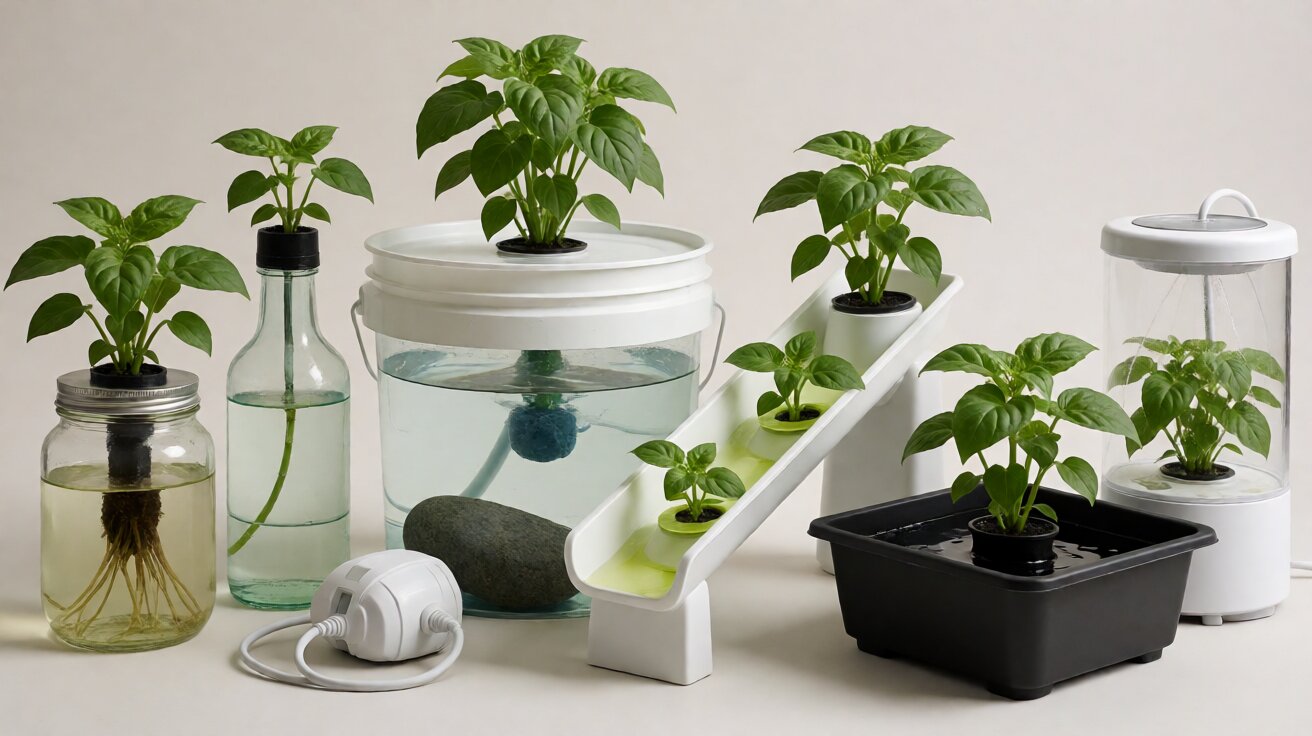
Every hydroponic system, no matter how it looks, is doing one thing: it carries nutrient solution to the roots while giving those roots air. The water is the food. The oxygen is the part most systems get wrong. Six types dominate home growing: nutrient film technique, deep water culture, deep flow technique, ebb and flow, the wick and Kratky passive setups, and aeroponics. They are not interchangeable. Each one answers two questions differently. What holds the plant in place, and where does the oxygen come from. Get those two right and the rest is setup. If you are still working out what a hydroponic farm even is, start with our walkthrough of what a hydroponic farm actually is before picking a type.
That single question is the whole choice. A wick jar on a shelf and a misted aeroponics tower both grow the same lettuce, but they fail in opposite ways and need very different hands on them. Once you see that through line, the list stops looking like six products and starts looking like one decision with six answers.
The one variable that decides everything: where oxygen meets the roots
Soil does two jobs for a root at once. It holds the plant up, and it is full of air pockets between the grains. Pull the plant out of the ground and you lose the air. Water is dense. Dissolved oxygen sits in it only up to a low limit, and it runs out fast once a root drinks. So any soilless system has to manufacture the oxygen that soil used to give for free, and it does that in exactly one of three ways: it leaves part of the root dry, it bubbles the water, or it turns the water into spray.
That choice sets the failure mode. A system that leaves roots exposed to air is fast but fragile. Stop the power and the water stops moving, and the root dries out within hours. A system that holds roots in deep water is forgiving when the lights stay on, but if the air pump dies the roots can suffocate in a day or two. You cannot pick a system without knowing which of those two you are accepting.
There is a second lever that runs through all six: nutrient strength. Water has no buffer. Add too much and the root is literally burned, which shows up as brown, dry tips on the oldest leaves. Keep the solution in the roughly 1.2 to 2.4 mS/cm range that most crops like, hold pH near 5.5 to 6.5, and measure it the way we do in our reservoir EC and pH calibration walk-through.
Nutrient film technique (NFT): the fast-failing, fast-growing one
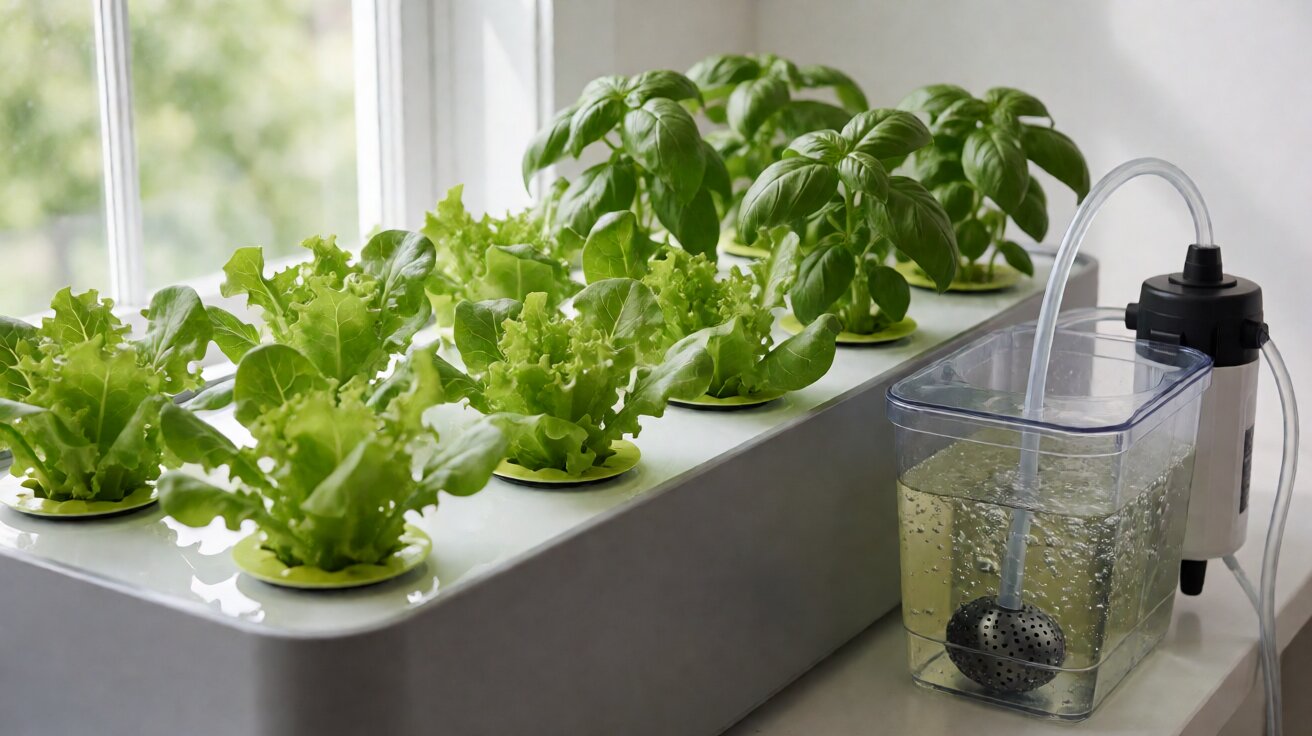
NFT runs a thin stream of nutrient solution, usually just a few millimetres deep, down a gently sloped channel. The plant sits in a net cup with its roots spilling into the channel. The bottom of the roots is kissed by the moving film, the top is bare to the air. A submersible pump lifts the solution to the high end, gravity pulls it down, and it drains back to a reservoir. That film of moving water is the whole point: very little water, recycled fast, and the roots breathe because most of them are not submerged.
The trade-off is speed in both directions. Lettuce and basil shoot up in a good NFT channel. But a power cut stops the flow, and the roots start drying out within hours, not days. In a hot room the water also heats and the dissolved oxygen drops, which makes a bad week worse. NFT is the system you run when you will actually check it daily and you have a backup plan for the pump.
Deep water culture (DWC) and deep flow technique (DFT): the forgiving deep bath
DWC floats the plant on a lid over a deep tank, roots dangling into the solution. An air pump pushes air through a stone at the bottom and keeps the water oxygen-rich. It is the single most forgiving active system for a beginner, because the water body is big and slow to change. You top it up as the plant drinks and it keeps going. One bucket, one air pump, and you are growing.
DFT is the same idea with a pump cycling solution through the roots instead of leaving them in a still bath. It is the middle ground between a calm tank and a fast NFT channel. Where DWC suits a few plants in big buckets, DFT suits a raceway of greens running continuously. Both share the same weakness. Kill the oxygen and the submerged roots will suffocate, so the air pump is not optional, it is the system.
Start here if you are new. Our step-by-step starter builds the first bucket in a single afternoon, and once you have picked a type, the at-home hydroponic guide covers the real setup, the light, and the schedule that goes with it.
Ebb and flow (flood and drain): the wet-dry cycle
Ebb and flow sits the plants in pots of inert media, usually clay pebbles, rockwool, or coco coir, in a tray above a reservoir. A timer runs a pump that floods the tray, the plants drink for ten to twenty minutes, and then gravity drains the water back below. The flood feeds the roots. The drain pulls fresh air into the same root zone that just got soaked. It is the wet-dry rhythm that most soil-grown plants already know, turned into a schedule.
The reason that makes it versatile. The inert medium between floods means a plant does not sit in water all day, so fruiting crops like peppers and strawberries, which would drown a pure deep-water setup, can live in a flood tray. You swap the whole tray of crops out and in, which is why it is the type people use when they want to grow more than one thing on the same table.
Wick and Kratky: the no-electricity starting point
These two are the passive end of the list. A wick draws solution up a rope or fabric into the growing medium with no moving part at all. Kratky fills a container with solution, floats the net pot on the lid, and lets the plant drink down the water level over time, the roots reaching into deeper and deeper nutrient as the line drops. Neither needs a pump, a timer, or a plug. Failure is slow, not instant.
That is also the ceiling. No circulation means no fresh oxygen pushed to the roots, so both cap out at leafy greens and herbs. They are the cheapest thing you can build, from a few dollars of materials up to around fifteen for a proper Kratky jar, and they are the best first lesson in what a plant wants from its solution.
Aeroponics: mist instead of water
Aeroponics holds the roots in the air and mists them with a fine spray of nutrient solution on a timer. The root gets maximum air exposure and the nutrient in one pass, which is why cuttings and fast greens take off quickly in it. It is also the most demanding. Mist nozzles clog, the pump and timers fail, and a stopped system dries out faster than any other on this list. If you are weighing it against a water system for the first time, read the honest aeroponics vs hydroponics breakdown before you commit.
All six side by side
The numbers are starting points, not gospel. The real range shifts with crop, season, and room temperature, and the air pump, not the pump size, is what keeps an active system alive. Use this as the shape of the decision, then check each choice against your own space and power.
| System | Root oxygen source | Power | Failure mode | Best for |
|---|---|---|---|---|
| Wick | Air pockets in medium | None | Very slow | Herbs, small plants |
| Kratky | Air as water drops | None | Slow | Lettuce, spinach, herbs |
| Deep water (DWC) | Air pump and stone | Air pump | Fast if the pump dies | Leafy greens, beginners |
| Nutrient film (NFT) | Exposed upper roots | Water pump | Very fast | Fast greens, herbs |
| Ebb and flow | Drain cycle pulls air in | Pump plus timer | Medium | Fruiting crops, mixed |
| Aeroponics | Roots fully in air, mists | Mister pump | Fast if the mist stops | Cuttings, fast greens |
Match this table to the crops you actually want, not to the one that sounds most advanced. For leafy greens, deep water or nutrient film grow the fastest and stay the simplest. For tomatoes and peppers, move to a flood tray or a drip setup, because fruiting plants ask for more oxygen than a passive jar can give. For tight space, a thin channel packs more plants into less floor. For a room where the power is unreliable, the wick and Kratky passive setups are the only two that do not depend on it at all.
Which one to pick: a decision in four questions
Run these four in order, because each one narrows the field.
What are you growing? Leafy greens and herbs go to deep water or nutrient film. Fruiting crops, pepper, tomato, strawberry, go to ebb and flow or drip. If you are mainly rooting cuttings, aeroponics rewards the extra effort.
How much space do you have? A shelf wants Kratky or a single deep-water bucket. A spare room wants a flood tray or a channel bank. A wall wants vertical drip.
Can you trust the power? If an outage is likely, the passive setups are the only safe ones. For anything active, a battery backup for the air pump is not optional. The pump is the system.
How many minutes a day will you actually spend on it? Two minutes points to Kratky. Twenty points to ebb and flow on a timer. The moment you want to change what you are growing without rebuilding, the answer is ebb and flow. The moment you want the fastest greens in the least floor, it is nutrient film.
The cheapest and safest path is to start passive, learn the solution, then step up. A Kratky jar runs on almost nothing and teaches you nutrient strength and pH for free. Graduating to a deep-water bucket adds one air pump and more forgiveness. Moving to a channel or a flood tray is when you start growing fruit, and it is the point where you match the solution to a proper nutrient schedule instead of guessing. None of these cost more than the next idea on this list. What costs time is starting with a system you cannot maintain, and the only fix for that is picking one you will actually keep running.
Pick the system that matches the root oxygen your crop asks for, not the one that is easiest to look cool running. The roots will tell you the answer within a week. Watch where they grow.
From PDF to Excel in one click
Forget retyping line by line. Upload any bank statement, get a spreadsheet you can actually use. Your files are never stored, and you can test the converter with 3 free conversions.
Try it free