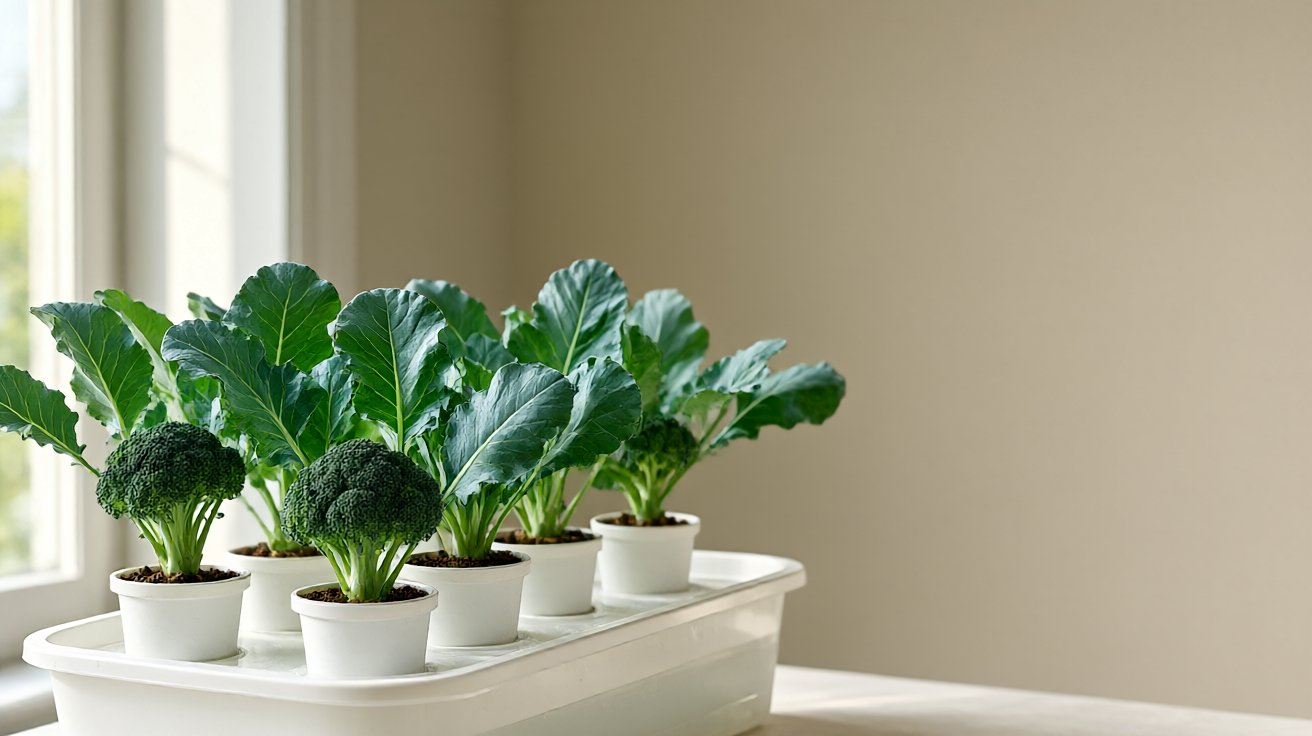

Broccoli is the one crop in this series where the feed and the temperature pull in opposite directions. The Oklahoma State University Extension table of optimum EC and pH for hydroponic crops puts broccoli at 2.8 to 3.5 mS/cm and pH 6.0 to 6.8, the highest band of any crop it lists except tomatoes. Lettuce (Lactuca sativa) runs 1.2 to 1.8 and spinach (Spinacia oleracea) 1.8 to 2.3. Broccoli wants nearly double that.
What most growers get wrong is the temperature. They read that broccoli is a cool-season crop, they run the reservoir at the same 20 to 22 C they run everything else at, and they get a magnificent leafy plant with nothing on top of it. The head is an inflorescence, an immature flower bud cluster, and it forms on a temperature schedule, not a nutrient schedule.
What Hydroponic Broccoli Needs From You
The four numbers below decide most of the outcome before you buy a seed packet. Everything else in this guide is downstream of them.
- EC 2.8 to 3.5 mS/cm. The published optimum for broccoli, from the Oklahoma State University Extension crop table. It is the highest figure in that table for any leafy or heading vegetable.
- pH 6.0 to 6.8 in the solution. The same table. That band sits above the 5.5 to 6.5 root-zone optimum the same source recommends for hydroponics generally, because broccoli is a heavy feeder and a heavy feeder on a narrow pH band runs out of something first.
- Water at 16 to 20 C. The average daily temperature range FAO gives for broccoli in a soilless system. This is a growing-season figure for the whole plant, not a reservoir setpoint.
- 40 to 50 cm between plants. The spacing FAO recommends, and the reason it gives is the most important sentence in this guide.
Those four figures come from three different sources, and they are worth keeping separate. The EC and pH band is from an extension crop table written for a recirculating reservoir. The temperature and the spacing come from FAO’s greenhouse and aquaponic guidance for a crop in a soilless system. Neither one was measured on a home system, and the honest reading of the evidence is that they are starting points rather than settled values.
For how the weekly top-off and drain schedule works once you are feeding at this strength, see the weekly hydroponic feeding rhythm. For the general question of which crops suit a home system at all, the best plants for hydroponics is the honest starting point, and it now includes broccoli in its crop table.
The Nutrient Band: Why Broccoli Wants More Than Lettuce
Broccoli is a heavy feeder by every measure that matters. Cornell’s controlled environment feed rates put cole crops at 125 ppm nitrogen for propagation and 175 ppm for production, in the same band as tomatoes at 200 ppm and above the 125 to 150 ppm of lettuce and other light feeders.
Extension soil guidance puts broccoli at 120 pounds of nitrogen per acre, which is the same figure it gives for cabbage and above the 100 for lettuce. Two independent systems, one conclusion: this is a crop that eats.
The translation into a nutrient solution number is the useful part, and it is where most home growers go wrong. There are two different numbers you will meet for broccoli, and they are not measuring the same thing.
The Two Numbers You Will Read, And Why Both Are Right
Oklahoma State University Extension gives 2.8 to 3.5 mS/cm, an absolute reading on your meter, for a recirculating reservoir. Cornell’s hydroponic feed tables give nitrogen in ppm, and Cornell’s own handbook is explicit that a target figure has to have the base EC of the source water subtracted from it to know how much fertilizer was actually added, because its recipes are written for reverse osmosis water with almost nothing already dissolved.
So the two numbers are correct and they are measured in different currencies. The EC figure counts every salt in the solution, including the ones your tap water brought with it. The nitrogen figure counts only what you added. If your tap water reads 0.3 mS/cm before you add anything, then a solution that has to carry 175 ppm of nitrogen will sit noticeably higher on the meter than a reverse osmosis system carrying the same nitrogen. Measure your source water once and the disagreement disappears.
Run your meter at the absolute number and your nitrogen is set by the recipe. Run your meter at a number above your source water and your nitrogen is set by the recipe too. Pick one convention before you plant, write it on the wall next to the reservoir, and never mix them.
The comparison below puts broccoli against the crops it gets confused with. The EC and pH figures are from the Oklahoma State University Extension crop table. The feed class is from Cornell’s controlled environment nitrogen rates.
| Crop | EC (mS/cm) | pH | Feed class |
|---|---|---|---|
| Broccoli | 2.8 to 3.5 | 6.0 to 6.8 | Heavy feeder |
| Cabbage | 2.5 to 3.0 | 6.5 to 7.0 | Heavy feeder |
| Spinach | 1.8 to 2.3 | 6.0 to 7.0 | Heavy feeder |
| Lettuce | 1.2 to 1.8 | 6.0 to 7.0 | Light feeder |
| Basil | 1.0 to 1.6 | 5.5 to 6.0 | Light feeder |
| Tomatoes | 2.0 to 4.0 | 6.0 to 6.5 | Heavy feeder |
Broccoli sits between cabbage and tomatoes on that table, and it is worth saying which species this is. Broccoli is Brassica oleracea var. italica, the same species as the cabbage and kale on this list, which is why the brassica advice travels across all three.
It is not a lettuce crop that happens to make a head, and treating it like one is the mistake that produces a season of leaves and nothing to harvest. If you are coming from the kale guide, note that kale is the exception rather than the rule: the hydroponic kale guide covers an Iowa State result where kale yield was flat across EC 1.0 to 5.0 mS/cm, which is a tolerance broccoli does not share.
Source water matters more here than in a light feeder, because the crop you are feeding hard at the top of its band is also the one whose micronutrients fall out of range first. University of Missouri Extension gives the limits worth checking once: boron below 0.5 ppm, dissolved oxygen above 6 ppm, calcium below 150 ppm, magnesium below 75 ppm, sodium below 50 ppm, chloride below 70 ppm, sulfates below 90 ppm, and an alkalinity band of 40 to 160 ppm.
Hard water in particular will drag your pH up and your EC up at the same time, and at this strength the tank tells you late.
Which System Holds a Broccoli Plant
Broccoli is heavy, top-heavy, and long. FAO’s guidance is explicit that media beds are the recommended method because broccoli is a large and heavy crop at harvest, and the numbers back it up: a full-grown plant reaches about 47 inches tall and 20 inches wide, with a shallow root system and a prominent taproot. The head alone is worth a couple of hundred grams at market weight.
That rules some systems out on physical grounds. A nutrient film channel sized for lettuce will not carry a 47-inch broccoli plant, and neither will a shallow tray. A deep water culture bucket will physically hold the plant, but the plant has to sit somewhere the wind does not reach it, because a mature broccoli head on a thin stalk in a draft is a snapped stalk.
For the full comparison of the six approaches and where each one breaks, the six hydroponic system types covers which reservoir you are actually feeding.
A media bed or a deep bucket with support is the working answer. A nutrient film channel built for salad greens is not, and the reason is weight and reach, not nutrient delivery. Broccoli drinks fine from a thin film. It simply falls over.
What the Roots Need
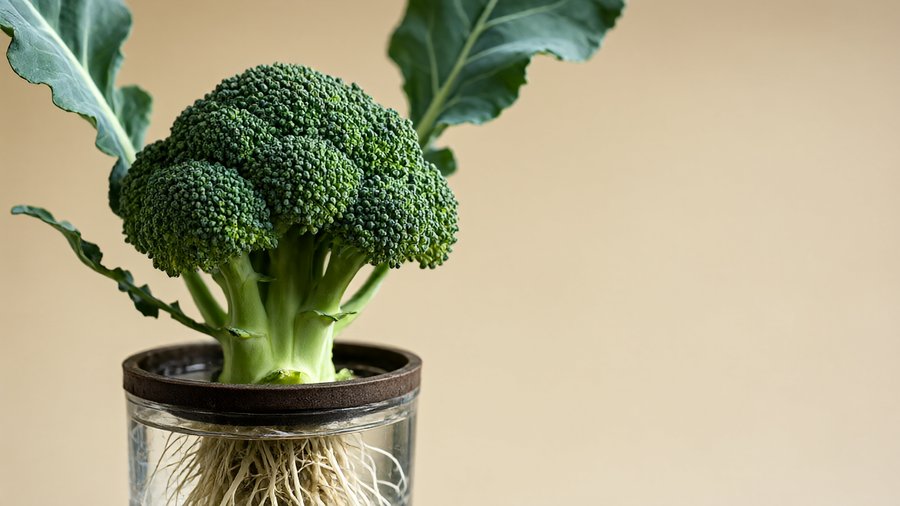
Broccoli has a shallow root system with a prominent taproot, and it wants the taproot in oxygenated medium rather than in still solution. That points at media over a bare net pot in a deep reservoir.
The oxygen target is the same one Missouri Extension sets for hydroponics generally, dissolved oxygen above 6 ppm, and warm water holds less of it. That links the root requirement directly to the temperature requirement in the next section. Cold water and root oxygen are the same problem wearing two hats.
The Cold Requirement: Vernalization, Not Just Cold
There are two different cold requirements here and they are easy to confuse. North Carolina State Extension notes that sprouting broccoli is a frost-tolerant cool-season crop, that optimal head development happens between 54 and 68 F, that higher temperatures lead to poor head formation, and that growth slows below 41 F.
Most American varieties are annuals that form heads of immature flower buds 50 to 70 days after emergence without needing vernalization at all. Biennial types, more common in northern Europe, do require chilling below 50 F for floral development.
So for most home growers, cold is not a vernalization trigger. It is a rate limit. The head forms anyway, but the temperature decides how fast, and how good.
The number that matters most comes from the broccoli breeding literature. Wurr and colleagues built a vernalization model for broccoli that puts the upper temperature limit for vernalization at 23.6 C, with the maximum rate of head initiation at 15.8 C for the cultivar Shogun. Work by Bjorkman and Pearson found that once floral development is initiated, the process is arrested by temperatures exceeding 30 C.
Both figures are quoted in the peer-reviewed summer broccoli breeding literature, including the HortScience papers on the summer hybrids bred for the eastern United States.
Now put that beside the general hydroponic guidance. The Oklahoma State University Extension fact sheet says water temperature of 72 to 75 F is optimal, which is 22 to 24 C. The FAO range for broccoli is 13 to 18 C average daily temperature.
A reservoir running at 72 to 75 F is running at the very top of the band where a broccoli head still initiates, and on a hot afternoon the plant body sees air temperatures well above the 23.6 C limit. The general hydroponic number and the broccoli number are not the same number, and a warm reservoir can hold a plant at the exact edge of not setting a head.
For the reservoir figures across the whole crop range, the reservoir temperature matrix by crop has the full table, and the hydroponic lettuce guide covers the opposite error, which is that cold water costs you dissolved oxygen in a crop that never needed it.
What You Can Do Without a Chiller
You do not need a chiller. You need the reservoir out of direct sun and the room not too warm. FAO puts broccoli at 13 to 18 C average daily temperature, which is achievable in a room with reasonable air movement and a reservoir in shadow. It also puts the growth time at 60 to 100 days from transplant, so a summer crop started in June is a crop you harvest in September, and one started in August is a crop that sets its head in the coolest part of the year and holds it there.
What you should not do is run the broccoli reservoir warm because the room is warm. Add ice in small amounts overnight and top the tank back up in the morning, or run the tank at the cool end of the general 18 to 22 C band that deep water culture systems hold and accept the slower growth. The head sets on the cool nights. The leaves do not care what the water does.
Sowing Broccoli: The Timeline Is Not Short
Broccoli is not a 30-day crop. FAO gives germination of 4 to 6 days at 25 C, then a growth time of 60 to 100 days from transplant. North Carolina State puts head formation at 50 to 70 days after emergence for most American varieties. Those numbers overlap only because one counts from emergence and the other from transplant, so the honest total from sowing to harvest is somewhere around 100 to 130 days.
The transplant step is where the time goes, and it is where most home growers get caught. FAO’s guidance is to transplant seedlings into the system once they have 4 to 5 true leaves and are 15 to 20 cm tall. That is a substantial plant, and it means the tray stage is not a weekend project. It also means the seedling has a head start on the root system before it ever sees nutrient solution, so it transplants into the system rather than into a bucket of clear water with nothing to eat.
Two crops that live near broccoli on this site are worth separating from it here. The hydroponic spinach guide covers a crop with a seed you prepare before you plant, and it bolts in heat where broccoli simply stops setting heads.
And broccoli microgreens is the same species grown as a cotyledon-stage tray crop harvested in under two weeks, which is a different product from a 47-inch plant with a head worth cutting. If you want the tray crop, that page is the right one. This guide is for the head.
Plan the calendar before you buy the seed. A crop sown too late in the season will spend its last weeks in exactly the warm conditions that stop it setting, and you will get the leaves and none of the head.
Spacing: The Number That Decides Head Size and Stem Integrity
FAO recommends 40 to 70 cm between plants, which is 3 to 5 plants per square metre, and then says the thing that matters most in this whole guide: position seedlings 40 to 50 cm apart, because closer spacing produces smaller central heads. The reason is not crowding in the general sense. Broccoli grows a large inflorescence on a thick stalk, and the head forms by expanding flower buds that need light and room. A head that cannot expand stays small and loose.
The same guidance warns that wider spacing helps when the crop will be harvested in hot humid weather, to reduce head rot. Extension soil guidance for cole crops puts broccoli rows at 60 to 90 cm and plants at 30 to 40 cm apart, with wider spacing recommended for the same reason.
There is a second reason to space broccoli out, and it is the opposite reason. Hollow stem, the disorder where the inside of the stalk splits open, is linked to wide spacing and rapid growth. More on that in the next section, because it is the part of this guide that changes what you do.
For the general spacing arithmetic, how many plants your system holds, and why a density number is a consequence rather than a preference, see the plant spacing guide.
Close spacing gives you small heads and wide spacing gives you hollow stems. The 40 to 50 cm figure is the compromise, and it is the number FAO actually tells you to use rather than the wider range it also permits.
What Goes Wrong: Hollow Stem, Brown Bead, and Loose Heads
Hollow stem is the failure mode that grows fastest. It starts as small elliptical cracks in the inner stem tissue, the cracks enlarge and merge as the stem grows, and eventually they form a cavity that can run the length of the stalk and into the head. It often rots from the inside as a secondary pathogen moves in. The plant looks healthy right up until you cut it.
Here is where the advice splits, and the split is worth understanding rather than averaging.
University of Massachusetts Extension says hollow stem is commonly attributed to boron deficiency, then immediately undercuts that: although boron deficiency has caused hollow stem in controlled greenhouse settings, it has not been found to consistently be associated with the disorder in field settings, and boron applications are not recommended to manage it.
What it lists instead, as the favourable conditions, are wide plant spacing and high nitrogen or potassium levels. University of California IPM adds high temperatures combined with high levels of nitrogen and large stem diameters, and notes that wide spacing may also contribute.
Then there is the causal diagnosis that separates the two. University of Minnesota Extension lists hollow stem on a broccoli head as having two possible causes: nitrogen toxicity and boron deficiency, and distinguishes them by what you see. Boron deficiency turns the florets brown. Nitrogen toxicity leaves the head clean and splits the stem. University of California IPM gives the other half of the tell: when boron deficiency is involved, the interior of the cracked stem cavity is darkened.
So the table below is the practical version. Cut a stem open and look.
| What you see | What it is | What to change |
|---|---|---|
| Florets turning brown | Boron deficiency | Test boron in the source water and keep the pH band |
| Dark lining inside the cracked cavity | Boron involved | Same test, and check the water source |
| Clean split stem, healthy green head | Rapid growth, hollow stem | Cut nitrogen back and tighten spacing |
| Brown bead, loose head, uneven buds | Heat stress during head fill | Cool the air, not just the reservoir |
| Strap-like leaf blades, narrow new growth | Molybdenum deficiency, whiptailing | Raise pH toward 6.5 or higher |
Two more conditions sit around this one. Wisconsin Extension notes that broccoli and cauliflower require high amounts of molybdenum, and that in early season cauliflower and broccoli, molybdenum-deficient plants have strap-like leaf blades, the disorder called whiptailing, because molybdenum becomes unavailable in acidic conditions. The advice is to raise the pH to 6.5 or higher.
That is inside the broccoli band of 6.0 to 6.8, so you have room, but only if you are running the top of it. Michigan State Extension notes that boron deficiency may occur on acidic media below pH 6.0 or alkaline media above pH 7.0, which brackets the whole range you are working in.
Heat stress is the other one, and it is the one that arrives with the season rather than with a mistake. The Purdue University vegetable crops report on a 2025 spring broccoli trial records three physiological disorders of the broccoli head after heat stress: brown bead, loose head, and uneven bud development.
The same report is where the diagnosis of hollow stem gets its clearest statement. It quotes Dr. Bjorkman directly: hollow stem is more often the result of rapid growth driven by high nitrogen levels, warm temperatures, abundant water, and wide in-row spacing, and if growers frequently experience it, reducing in-row plant spacing may help lower its incidence and severity.
Fast growth is the mechanism, and four things drive it: nitrogen, heat, water, and space. That is a list of levers you can pull, which is a better position than being told your boron is low.
For the general nutrition rules that apply across crop families, including the family patterns that put broccoli between the leafy and fruiting groups, see the NPK chart for vegetable crops. That chart lists hollow stem as a sign of boron deficiency more often than a ratio problem, which the extension sources above now put in a more precise light.

Harvesting: One Head, Then the Shoots
Cut the main head when the beads are tight and still dark green, before any of them open. A broccoli head that has started to show yellow is a head that has spent its sugars on the process, and the window between tight and loose is short in warm weather and longer in a cool one.
Leave the plant in place after the cut. Broccoli sends side shoots from the remaining leaf axils, and those shoots are smaller than the main head but they come from a root system you have already paid for at 2.8 to 3.5 mS/cm. A well-fed broccoli plant that has been cut will keep producing for several weeks if the water stays in range and the air stays cool. This is the single most underused return in the whole crop, and it is a direct consequence of the feed band being where it is.
Harvest in the cool part of the day if you can. The stems are the most fibrous part of the plant, and a stem cut warm and left in a warm room is a stem that toughens faster than one cut at 8 in the morning. Keep the cut heads cool and out of direct light from the moment they come off.
One thing to plan for: this is a crop that occupies a bed for months. A single media bed planted with broccoli in spring is a bed that cannot carry a fast crop until the broccoli is finished, and if your system is a small bucket, the same trade applies in miniature. Before you fill a bed, know when it comes out.
Cut the head tight, leave the plant, and let the side shoots pay for the feed.
Sources and further reading
- Oklahoma State University Extension, “Electrical Conductivity and pH Guide for Hydroponics,” HLA-6722, for the optimum EC and pH band for broccoli of 2.8 to 3.5 mS/cm and 6.0 to 6.8, the solution pH of 5 to 6 that holds the root zone at 6 to 6.5, the general water temperature of 72 to 75 F, complete solution replacement every two weeks, and daily pH and EC checks at the same time of day.
- Cornell University Controlled Environment Agriculture, “A Recipe for Hydroponic Success,” for cole crop nitrogen feed rates of 125 ppm for propagation and 175 ppm for production against 125 to 150 ppm for light feeders, and for the rule that a target EC figure must have the base EC of the source water subtracted from it.
- University of Missouri Extension, “Hydroponic Nutrient Solutions,” G6984, for the source-water limits of boron below 0.5 ppm, dissolved oxygen above 6 ppm, calcium below 150 ppm, magnesium below 75 ppm, sodium below 50 ppm, chloride below 70 ppm, sulfates below 90 ppm, and alkalinity of 40 to 160 ppm.
- Food and Agriculture Organization of the United Nations, Small-scale aquaponic food production, Appendix 1, for broccoli pH 6 to 7, spacing of 40 to 70 cm, germination of 4 to 6 days at 25 C, growth time of 60 to 100 days from transplant, average daily temperature of 13 to 18 C, transplanting at 4 to 5 true leaves and 15 to 20 cm tall, media beds because broccoli is a large heavy crop at harvest, and the note that closer spacing produces smaller central heads.
- Food and Agriculture Organization of the United Nations, Good Agricultural Practices for greenhouse vegetable production in the South East European countries, for the optimum root-zone pH of 5.5 to 6.5 for hydroponic crops, and for the spacing requirement that avoids high densities to prevent disease and uses lower densities for long-cycle crops.
- North Carolina State Extension, “Basics of Broccoli Production,” for optimal head development between 54 and 68 F, slowing growth below 41 F, chilling below 50 F for floral development in biennial types, head formation 50 to 70 days after emergence in most American varieties, the shallow root system with a prominent taproot, and full-grown plants reaching about 47 inches tall and 20 inches wide.
- Wurr and colleagues, reported in HortScience, for the broccoli vernalization model with an upper temperature limit of 23.6 C and maximum rate of head initiation at 15.8 C for the cultivar Shogun, and for the finding of Bjorkman and Pearson that floral development once initiated is arrested above 30 C.
- University of Massachusetts Extension, “Brassicas, Hollow Stem,” for the cracking that begins as small elliptical cracks in the inner stem tissue, the favourable conditions of wide spacing and high nitrogen or potassium, and the finding that boron applications are not recommended to manage the disorder.
- University of California Integrated Pest Management, “Hollow stem of cole crops,” for the association of high temperatures with high nitrogen levels and large stem diameters, and for the darkened interior of the cracked cavity when boron deficiency is involved.
- University of Minnesota Extension, for the two causes of hollow stem on a broccoli head, nitrogen toxicity and boron deficiency, and for the browning of florets that distinguishes the boron case.
- Purdue University Vegetable Crops Hotline, 2025 spring broccoli evaluation, for the disorders of brown bead, loose head, and uneven bud development after heat stress, and for the finding of Dr. Bjorkman that hollow stem is more often the result of rapid growth driven by high nitrogen, warm temperatures, abundant water, and wide in-row spacing.
- University of Wisconsin-Madison Extension, “Growing broccoli, cauliflower, cabbage, and other cole crops in the home garden,” A3684, for the high molybdenum requirement of broccoli and cauliflower, the whiptailing of strap-like leaf blades in early season crops, the need to raise pH to 6.5 or higher, and the high boron requirement of cole crops.
- Michigan State University Extension, Cole Crops Integrated Pest Management, E3231, for the finding that boron deficiency may occur on acidic media below pH 6.0 or alkaline media above pH 7.0, and may play a role in broccoli and cauliflower hollow stem.
- Government of Newfoundland and Labrador, Department of Fisheries and Aquaculture, AgriFoods Cole Crops, for the broccoli spacing of 60 to 90 cm between rows and 30 to 40 cm between plants, and the wider spacing recommended for crops harvested in hot humid weather to reduce head rot.
Last reviewed on November 28, 2026. Updated as new evidence and extension guidance are checked.