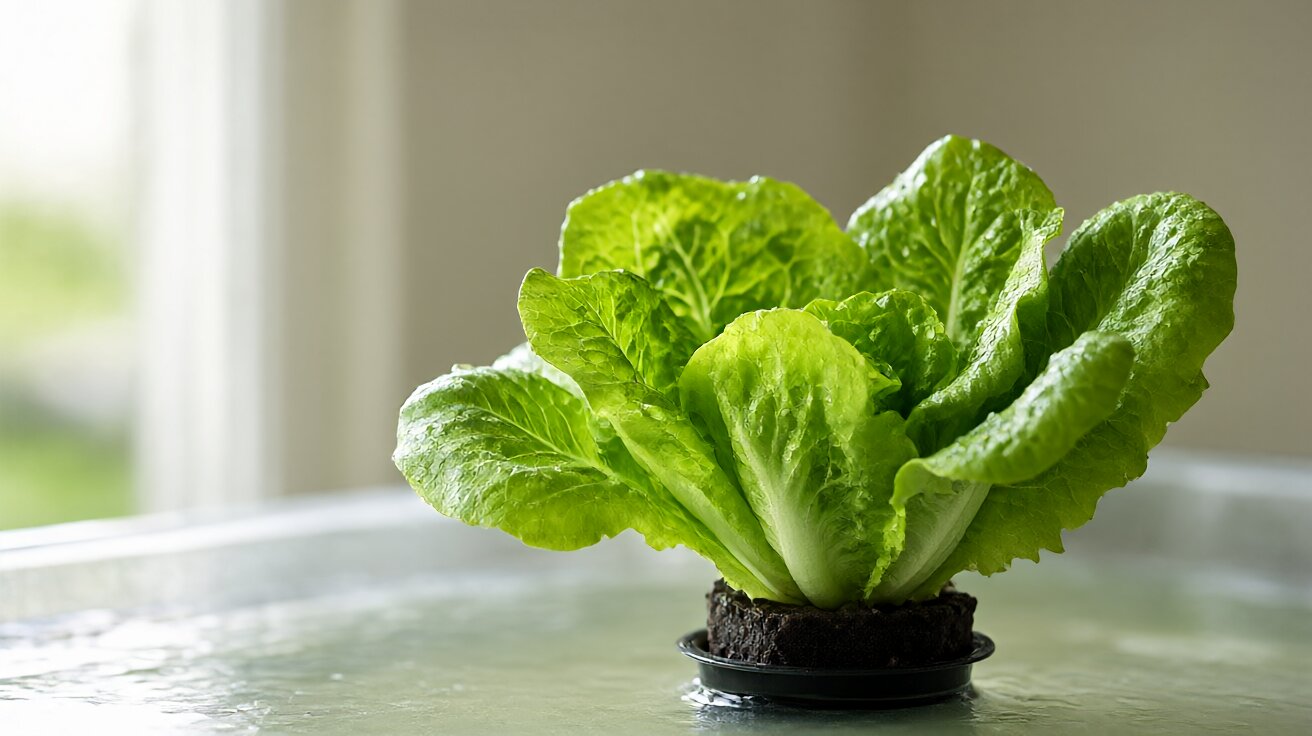

Hydroponic lettuce is the easiest crop to start and the easiest to ruin. Lettuce has no woody stem, no fruit to ripen, and no long wait before you find out whether you are good at this. Give it the right numbers and you cut a head in 30 to 40 days. Give it the wrong ones and it bolts, or the outer leaves go bitter and soft while the center stays small.
The reason is that lettuce is fast, shallow-rooted, and unforgiving of drift. Its roots sit in the same reservoir you are measuring, so every error compounds over weeks instead of hours. A tomato will forgive a missed feeding because it has months and a deep root ball. Lettuce has neither. This guide covers the numbers that matter, the order to set them in, and the two mistakes that end more lettuce harvests than any pest ever will.
What Lettuce Actually Needs From You
Four numbers decide whether the plant succeeds: pH, nutrient concentration, water temperature, and light. Everything else, including the reservoir size, the air pump, and the size of the net pot, is a supporting decision. Lettuce (Lactuca sativa) is fast and shallow-rooted, which is why those four numbers move it so quickly once they drift.
Those four are not independent. Warm water holds less dissolved oxygen, so a reservoir that is too warm does two things at once: it starves the root of oxygen and it accelerates root-zone chemistry, which pushes pH down faster. Meanwhile a plant that is not getting enough light cannot photosynthesize fast enough to use the nutrients you are dissolving for it.
The chain runs in one direction and it is worth holding in your head. Light drives photosynthesis, photosynthesis drives the demand for nitrogen, nitrogen uptake releases hydrogen ions into the solution, and the falling pH locks out iron, which shows up as yellowing in the new growth. A dim window at the end of that chain produces the same visible symptom as a feeding error at the start of it.
pH: the number you check most often
Hydroponic lettuce grows between pH 5.5 and 6.0. Below 5.5, the micronutrients lock up and the leaves yellow even though the solution is full of them. Above 6.0, iron turns into a form the roots cannot absorb, which shows up as yellowing between the veins of the newest leaves. Because nitrogen uptake releases hydrogen ions into the water, a reservoir drifts downward on its own. You are not adjusting a number, you are correcting a direction of travel.
Check the pH every two or three days from the day the first true leaf appears. If you skip that check for a week, the correction you need is no longer a small adjustment. The reservoir will have walked down toward 5.0, iron will have locked out, and the leaves that show the damage are the newest ones, which are the ones you cannot afford to lose in a 30-day crop.

Nutrients: match the concentration to the stage
Seedlings and young plants want a weaker solution than mature heads. A common approach is to run around 0.5 dS/m for the first two weeks after germination, then increase toward 1.0 to 1.2 dS/m as the leaves expand. Use a complete two-part or three-part hydroponic nutrient rather than a general-purpose houseplant fertilizer, which will not have the right ratio of magnesium, sulfur, and micronutrients for a soilless system. If you want the weekly detail rather than the stage detail, the hydroponic nutrient schedule lays out what changes when.
What you must not do is raise the concentration because the plant looks pale. Pale leaves are usually a light or nitrogen-uptake problem, and adding more nutrients to a plant that cannot photosynthesize faster creates the burned, brown-edged leaves that look exactly like over-fertilization. Dark green new growth with yellowing old leaves is a light problem, not a feeding problem.
Water temperature: cold water is a mistake people make in summer
Let reservoir water reach 75 to 80 F (24 to 27 C) and dissolved oxygen falls to the point where root rot becomes likely without any visible sign of it happening. Aim for 65 to 70 F (18 to 21 C). In a warm room, this is the hardest number on the list to hold, and it is the one that most often ends a crop quietly.
The root-zone dissolved oxygen figure to keep in mind is 5 mg/L or higher. Below that, the plant is not growing so much as surviving on what it can scavenge, and a second plant in the same bucket will fail before the first shows anything wrong.
Light: the ceiling on everything else
Lettuce wants 12 to 16 hours of light per day. A sunny windowsill in winter will not deliver that, which is the usual reason an indoor lettuce harvest tastes bitter and grows small. If you are using a grow light, the distance from the canopy matters more than the wattage claim on the box, and a light too far away is the same as too little light.
Setting Up a First Lettuce Reservoir
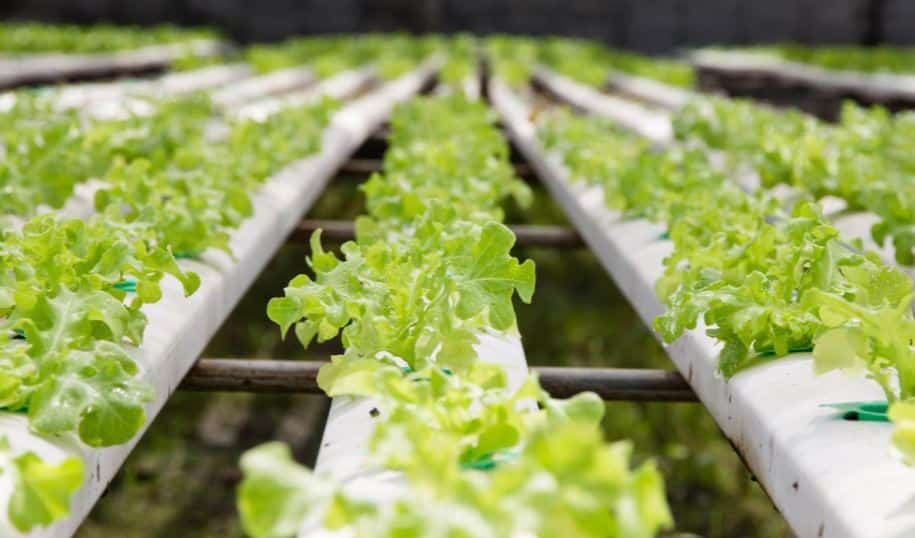
Build the system before you buy the seed, and check three things when you assemble it. The comparison of the seven hydroponic systems is worth reading before this part, because the type you build decides which of the three things below becomes the hard one. First, the reservoir has to be opaque, because light hitting the solution feeds algae, and algae competes with the roots for the same nutrients. Second, the lid has to fit the net pots without gaps, for the same reason. Third, the reservoir needs to hold enough solution that the level does not drop past the bottom of the net pots during a hot week, and that volume should be about 4 liters per plant.
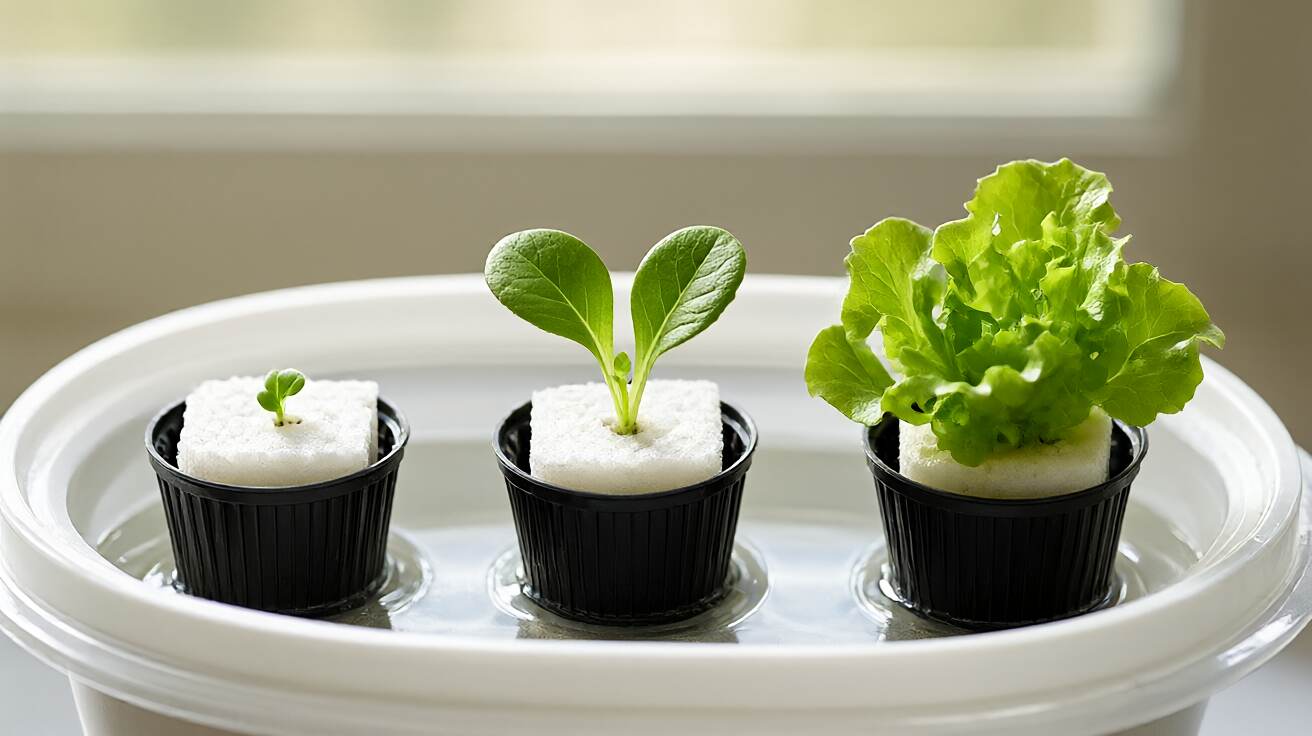
For the growing medium, rockwool cubes and clay pebbles both work, and they fail in different ways. Rockwool holds water in its structure, so it keeps the root zone wet and it can suffocate roots if you do not manage the level. Clay pebbles sit in a film of solution with air around the root ball, which is more forgiving of a missed aeration cycle but needs a pump running reliably. The comparison of rockwool, coco coir, and clay pebbles breaks down how each one holds water and air, which is the part that decides whether your root zone drains. Whichever you use, the first task is not feeding. It is getting the seed to germinate with just water and light around it.
The order that works
- Soak the medium, then place the seed one centimeter deep. Do not bury it deeper.
- Keep the reservoir at pH 6.0 with plain water and no nutrients for the first week, while the root establishes.
- Once the first true leaves appear, start nutrients at half strength and raise to full strength over about a week.
- Check pH every two or three days, and every day once the plant is growing fast.
- Harvest the outer leaves first, and take the whole head once it reaches the size you want.
That order is not arbitrary. Adding full-strength nutrients to a seedling is the fastest way to burn roots that have not yet built enough mass to handle the osmotic load, and the seedling rarely recovers from it.
Germination itself takes 7 to 14 days at 65 to 70 F (18 to 21 C). The seed does not care about your nutrient schedule during that window, and adding nutrients early is a common and expensive way to lose a batch before it starts.
The Two Mistakes That End Most Lettuce Harvests
Root rot that starts where you cannot see it
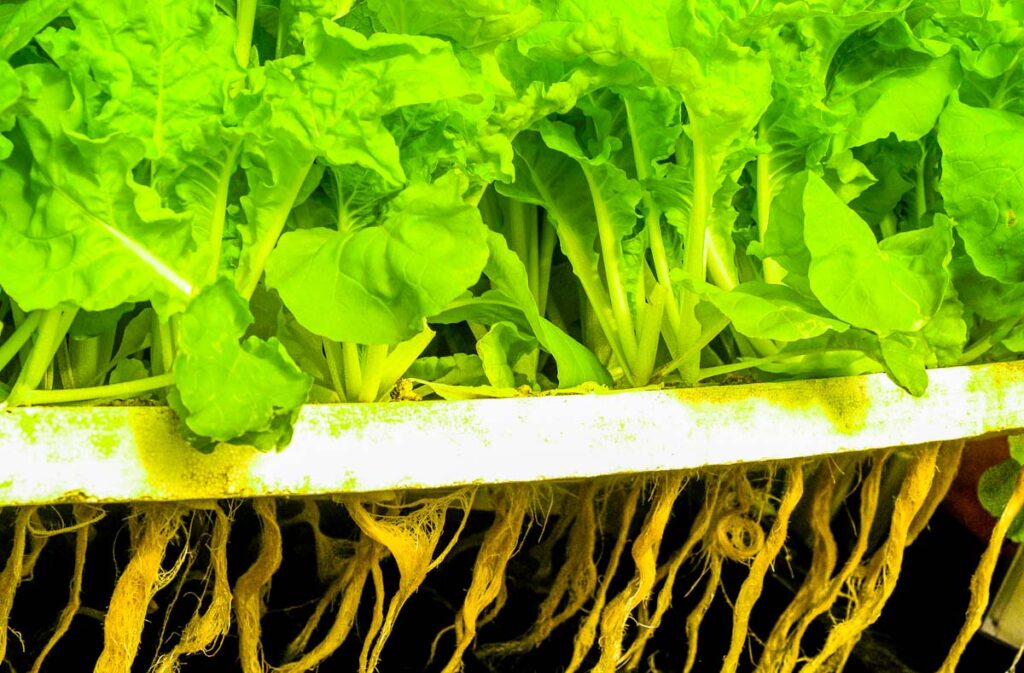
The outer leaves collapse and the head softens, and by the time you look at the roots they are brown and slimy. The cause is usually warm water plus insufficient oxygen, not overwatering in the sense of too much liquid. A reservoir that has been at 78 F for a week can hold enough oxygen for a slow-growing crop and not enough for a fast one.
Keep the water cold and keep the air pump running. Prevention is more effective than rescue here, so keep the water cold and keep the air pump running. The reservoir temperature matrix by crop shows the working band for each common crop, which makes the 72 F threshold visible rather than abstract. If you do find rot, remove the affected roots, and if more than half the root mass is gone, the plant will not recover regardless of what you do to the solution.
The timeline is what makes this worth preventing. Hold the reservoir above 72 F and bolting signals appear in 7 to 14 days in leaf lettuce. Hold it above 78 F and the risk of root pathogens moving in shows up within about a week. Both windows are shorter than the 30 to 40 days a lettuce plant needs to reach harvest, so a single hot week in a warm room can decide the outcome of a crop that took a month to start.
Bitter, small heads
This is a light and heat problem, not a nutrient problem. Lettuce that bolts sends up a flower stalk and turns bitter, and the trigger is long days plus high temperature. In an indoor setup with a weak light and a warm room, you get the version of this that never quite bolts but never fills out either. The head stays small and the leaves develop a bitter edge.
You cannot fix this with fertilizer. You can slow it with cooler air around the leaves, which matters more than the temperature of the nutrient solution, and you can fix the light. Both together are the difference between a 150-gram head and a 300-gram head from the same seed and the same bucket.
If the heads come out small and bitter, the answer is light and air temperature, not the solution. This is the single most misread result in a home lettuce crop, because the pale, thin leaves look exactly like a feeding problem and the instinct is to add more nutrient. Adding nutrient to a light-limited plant moves the pH, burns the leaf margins, and leaves you with the same small head and a second problem on top of the first.
How Much Lettuce Can You Grow in One System?
Spacing is set by the mature head size rather than the seed size. A butterhead or looser-leaf type needs roughly 20 to 25 cm (8 to 10 inches) of canopy space, and a romaine needs closer to 30 cm (12 inches). Vertical towers and dense planting systems look productive in photos but produce small heads, because each plant is shading the ones next to it.
Reservoir volume is the other limit, and the plant spacing guide works through the density numbers per system type. Plan on about 4 liters per plant, which gives enough water to keep the nutrient concentration stable between daily checks. A single reservoir with a good pump is easier to keep stable than several small ones, because the concentration drift you are correcting averages out over a larger volume.
| Stage | pH | EC | Water temp | Light per day |
|---|---|---|---|---|
| Germination to first true leaves | 5.8-6.0 | 0 to 0.5 dS/m | 65-70 F (18-21 C) | 12-16 hours |
| Seedling to 4 true leaves | 5.5-6.0 | 0.5 dS/m | 65-70 F (18-21 C) | 12-16 hours |
| Vegetative growth to harvest | 5.5-6.0 | 1.0-1.2 dS/m | 65-70 F (18-21 C) | 12-16 hours |
| Bolting or heat stress | 5.5-6.0 | Reduce | Below 68 F (20 C) | Keep at 14-16 hours |
Stage determines concentration, concentration determines how fast the plant can pull nitrogen out of the solution, and nitrogen uptake is what moves the pH down, which is why a single flat target cannot serve a 45-day crop. These four stages are the numbers most guides collapse into a single line. A flat target is either too weak for a mature head or too strong for a seedling, and the damage from each is invisible until the plant is past the point of recovery. The stage table is also the fastest way to tell which of your four numbers is actually wrong.
Cutting the Harvest
Lettuce does not need to be pulled. Cut the outer leaves at the base once they reach the size you want, leaving the center growing. A well-lit plant can give you three or four cuts this way before you take the whole head. Taking the outer leaves also keeps the plant from shading itself, which is why a cut-and-come-again harvest produces a larger final head than picking only once.
Cut in the morning, while the leaves are still hydrated from the night. A head cut at midday has already lost water through transpiration, and that is the difference between a crisp leaf and one that wilts in the bowl before you serve it. Cut in the morning when the leaves are hydrated, and take the whole head if you are not sure the plant will reshoot, since a heavily harvested lettuce may not regrow well. If you do plan to regrow, leave at least a third of the leaves and a few centimeters of stem above the medium.
The full cycle from seed to finished head runs about 45 to 60 days: 7 to 14 days of germination, 7 to 10 days of seedling establishment, and 30 to 40 days of vegetative growth after transplanting.
Where Hydroponic Lettuce Fits in Your System
Lettuce is a good first crop for a reason that has nothing to do with how forgiving it is. It is fast, it shows you a result inside six weeks, and it is sensitive enough to tell you that your setup is wrong before you invest in a crop that takes three months to reveal the same mistake. Getting a lettuce harvest right teaches you your reservoir’s behavior, your pH drift, and your light’s real output.
The physical limits are what they are for every crop: roots need oxygen at their surface, leaves need light, and both scale with the size of the plant.
None of this is unique to lettuce. It is the same reservoir behaviour every crop asks of you, which is why the first ninety days of a new hydroponic system is worth reading once before you grow anything expensive in it. Lettuce is simply the fastest way to find out what your setup actually does.
The Numbers That Decide a Lettuce Harvest
Lettuce is not a forgiving crop, but it is a fast teacher. Set the pH at 5.5 to 6.0, run 0.5 dS/m until the plant has four true leaves and then 1.0 to 1.2, keep the water between 65 and 70 F, and give it 12 to 16 hours of light. Check the pH every two or three days, because it will drift down on its own.
Set the four numbers first and change one at a time. If the heads come out small and bitter, the answer is light and air temperature, not the solution. If the outer leaves soften and the roots turn brown, the answer is water temperature and oxygen, not the amount of water. Solving the right problem is the whole skill with this crop, and it takes about six weeks to find out whether you have it.
Last reviewed on November 14, 2026
Sources and further reading
University of Arkansas System Division of Agriculture, Hydroponic Lettuce Production (Extension publication, nutrient solution and pH guidance). University of Florida IFAS Extension, Controlled Environment Agriculture and hydroponic leafy vegetable nutrient management (Extension). University of Minnesota Extension, Growing lettuce in hydroponics (Extension). Cornell University Controlled Environment Agriculture, hydroponic lettuce production and light requirements (University). North Carolina State University Extension, hydroponic leafy greens production (Extension). Penn State Extension, hydroponic vegetable production fundamentals (Extension).