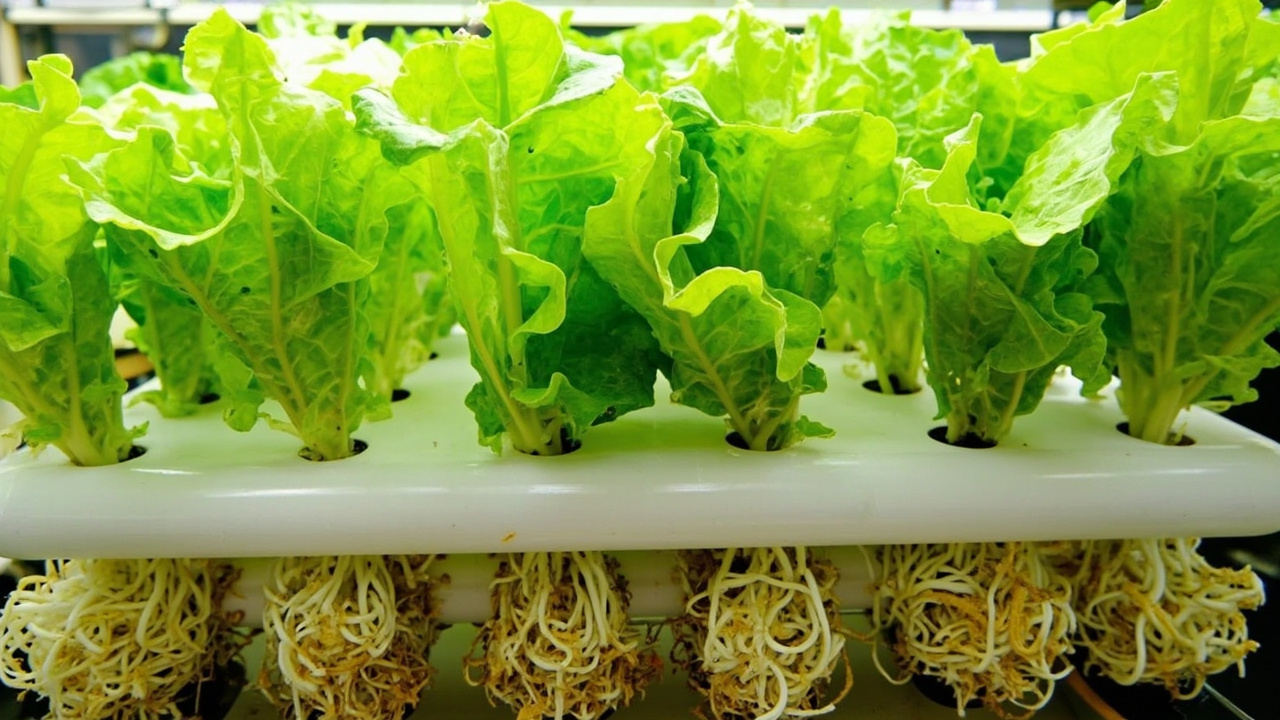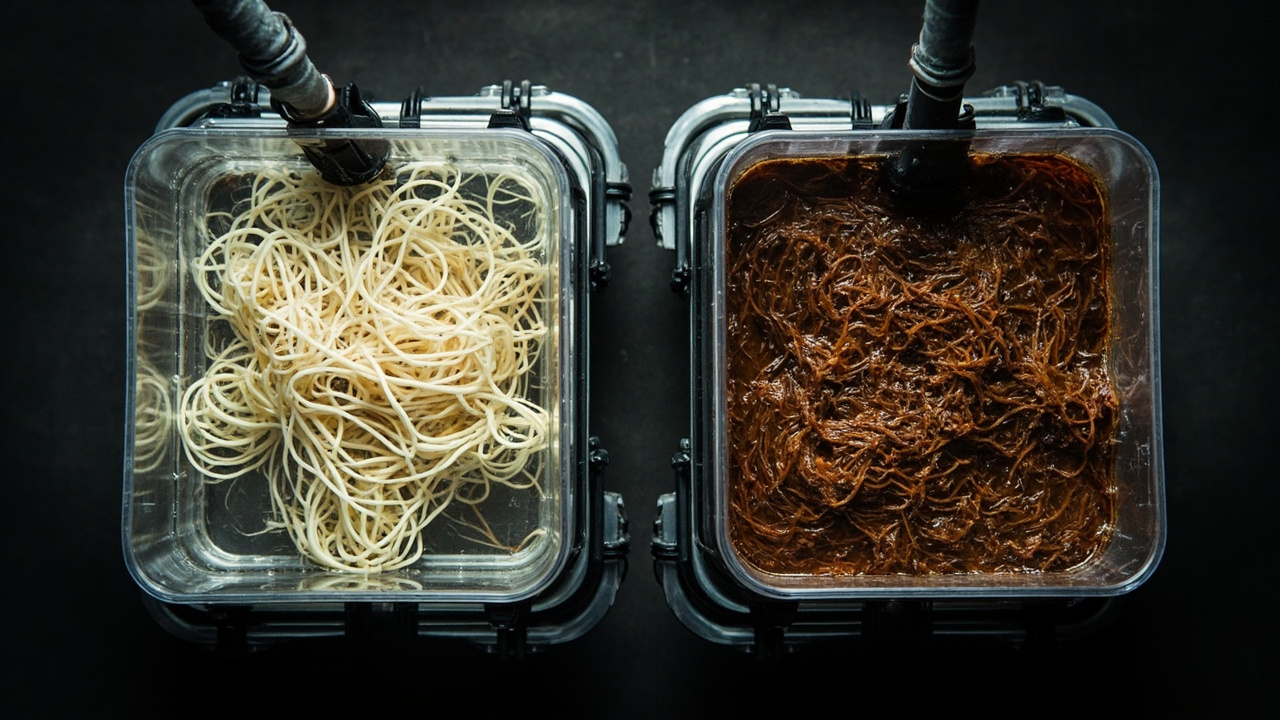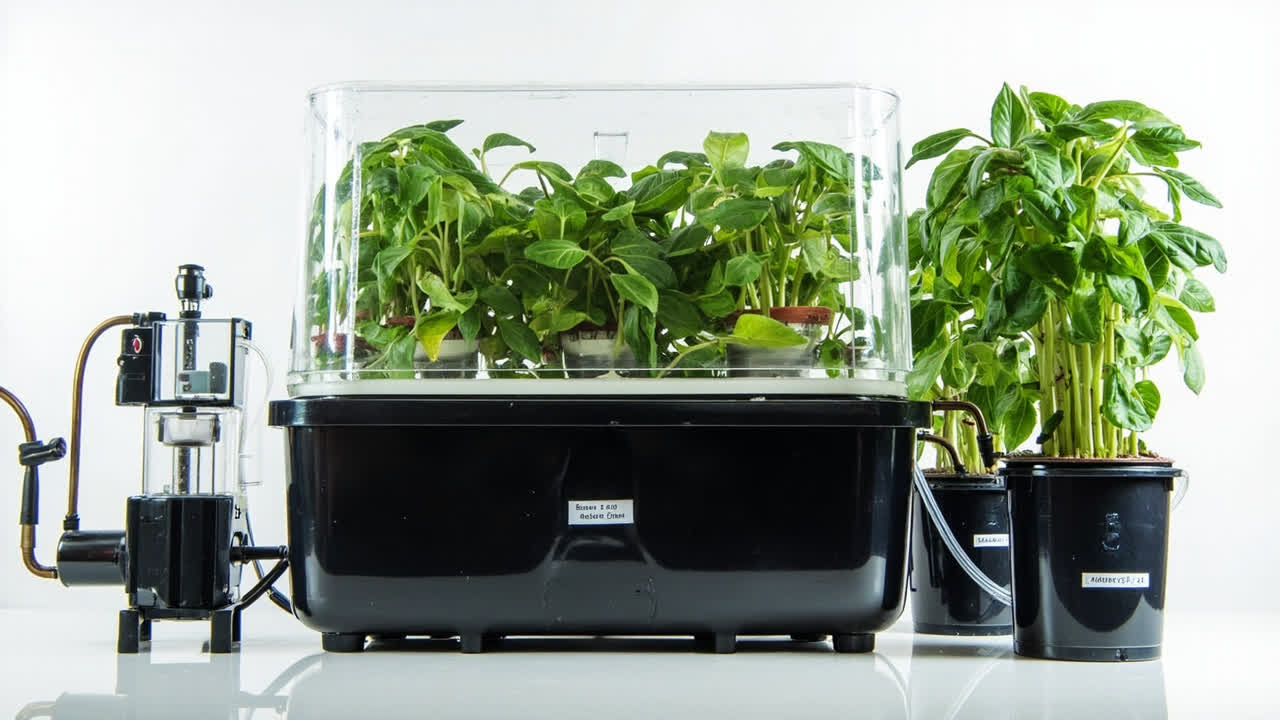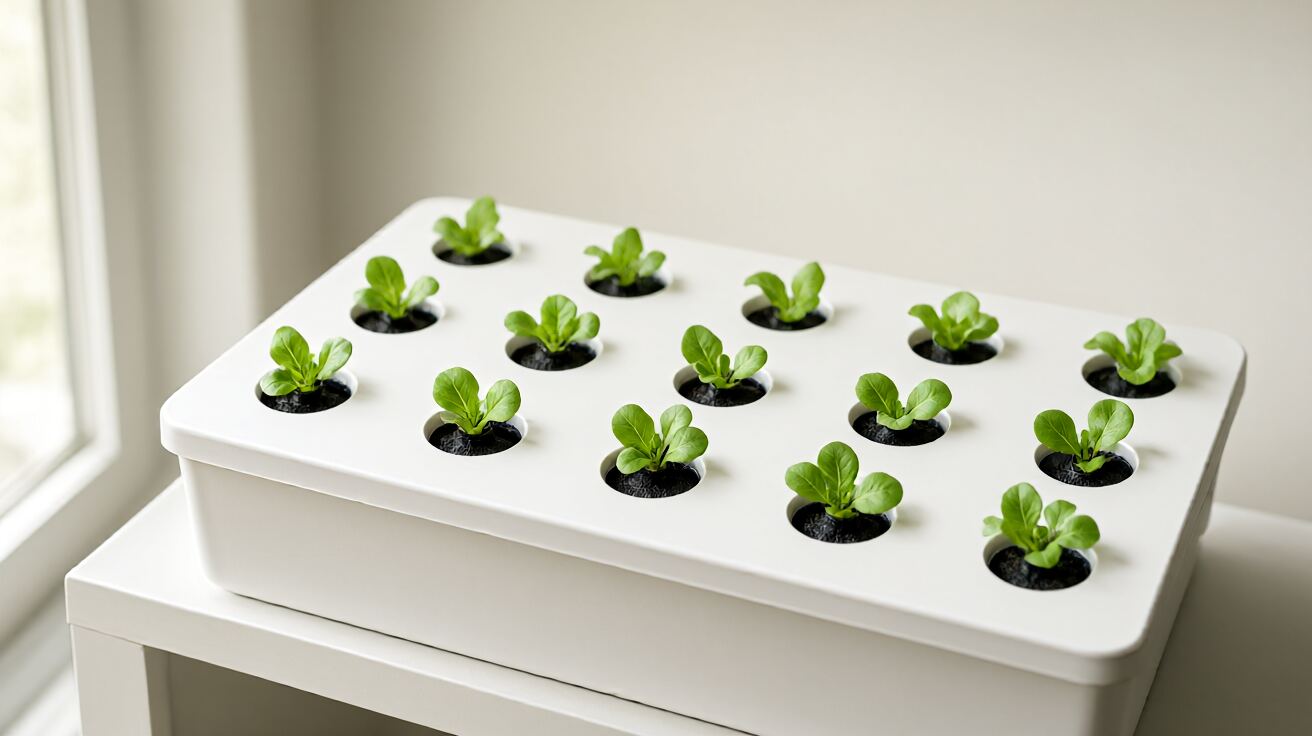

Hydroponic plant spacing is not a style choice. It is set by how your system delivers water and air, and every extra plant you fit past that number costs you head size, not just head count. A deep water culture bucket running at 3 to 4 plants per square foot produces full heads, while the same bucket crowded to 8 per square foot produces a lot of small ones. The spacing number decides which of those two you get, and it is fixed before you buy a single net pot.
Two failure modes follow from getting it wrong. The first is overpacking: canopies touch, air stops moving across the leaf surface, and disease moves in. The second is underpacking: you pay for the shelf, the light, and the reservoir, then grow a third of what it could hold. The most common error behind both is treating spacing as a single number for the whole system, when it is really four numbers, one per system type, each set by a different physical constraint. The numbers are published, they are metric, and they are consistent across extension services. Once you know which system you run, the arithmetic takes a minute.
Why Density Is Set by System Type, Not by Choice
The University of Kentucky Extension service, in its hydroponic lettuce production guide, publishes planting density for each system type side by side. Deep water culture runs at 3 to 4 plants per square foot, which is 35 to 40 plants per square metre. Nutrient film technique sits at about 2 plants per square foot, or 30 per square metre. Drip irrigation needs only 1 to 2 plants per square foot, which is 20 to 25 per square metre. Ebb and flow lands at about 2 plants per square foot, or 25 per square metre.
Those four numbers are not arbitrary. Each is the point where the root zone stops running out of something, and each row differs because the limiting variable differs. Each density is the ceiling that one physical limit imposes, not a spacing that tastes good.
Deep Water Culture: Roots in Water, So Air Is the Limit
In deep water culture every root hangs in the same reservoir, so the constraint is dissolved oxygen. The same Kentucky guide lists water use for deep water culture as high volume, greater than 4 litres per plant, over a gallon per plant. That much water against that many roots means the roots consume oxygen faster than the surface can replace it unless you aerate. The density ceiling in deep water culture is therefore set by the air stones, and once you exceed it the last plants in get the least oxygen.
That is why the same source recommends aeration on roughly 4 litres of air per minute for every 2 to 4 square metres of growing area in a densely planted trough, and why the FAO technical factsheet on hydroponics for smallholder vegetable production warns that in a densely planted trough the oxygen demand for the plants alone could push levels below the minimum.

Nutrient Film Technique: Flow Sets the Spacing
In nutrient film technique the roots sit in a thin film of solution rather than a reservoir. The Kentucky guide describes water use as low volume with the thin film, and the FAO factsheet specifies that the flow for each grow pipe should be no greater than 1 to 2 litres per minute. With that little water moving, every plant in a channel has to take what arrives at its hole. The FAO factsheet sets a minimum of 21 centimetres between the centre of each plant hole to allow adequate space for leafy greens, and typical NFT channels are drilled on 7 to 8 inch centres, which is 18 to 20 centimetres.
So in nutrient film technique the spacing question becomes a flow question. Space the holes closer and you split the same litre per minute across more roots, which lowers the oxygen available per root, which is why nutrient film technique tolerates a lower plant count than deep water culture even though the water volume is smaller. The same mechanism makes the medium do less work in a film system than it does in a reservoir system.
Drip and Ebb and Flow: The Substrate Sets the Ceiling
Drip irrigation carries the lowest density of the four, 1 to 2 plants per square foot, because each pot needs its own emitter line and its own delivery. Ebb and flow, at about 2 plants per square foot, needs enough gap between pots for the tray to flood evenly and for the root zone to drain back down between cycles. In both, the substrate does the anchoring, so it also does the water holding and the aeration, and the spacing protects that balance.
You can read the seven hydroponic systems at a glance for the mechanics of each one, and how the medium does less work in nutrient film technique if you want to know why the spacing numbers differ so much between systems.
The Numbers in One Table
Here is the density reference for leafy greens and herbs, which is what most home systems grow. The first two columns come from the University of Kentucky Extension hydroponic lettuce guide. The centre-to-centre column comes from the FAO hydroponics factsheet and from Alabama Cooperative Extension’s greenhouse lettuce production guidance, which specifies a standard spacing of 8 inch centres, equal to 2.25 plants per square foot, for raft-grown lettuce.
| System type | Planting density | Metric density | Centre to centre | What sets the limit |
|---|---|---|---|---|
| Deep water culture | 3 to 4 plants/ft2 | 35 to 40 plants/m2 | 6 to 8 in (15 to 20 cm) | Dissolved oxygen in the reservoir |
| Nutrient film technique | about 2 plants/ft2 | 30 plants/m2 | 7 to 8 in (18 to 20 cm) | Flow rate down the channel |
| Ebb and flow | about 2 plants/ft2 | 25 plants/m2 | 8 in (20 cm) | Even flooding and free drainage |
| Drip irrigation | 1 to 2 plants/ft2 | 20 to 25 plants/m2 | 8 to 12 in (20 to 30 cm) | Emitter delivery per pot |
One note on the deep water culture row. The University of Kentucky guide also states that respacing strategies, meaning gradually increasing the distance between plants as they grow, can be applied by liquid-based systems to optimise space use efficiency and improve airflow while improving overall yield. So the 3 to 4 per square foot figure is not the spacing you start at. It is the spacing you finish at.
Working Out Your Own Plant Count
Two numbers decide it: the area your plants occupy, and the volume of water you have. Start with the area, because that is the constraint most home growers hit first.
From Shelf Area
Measure the canopy footprint, not the shelf. A 50 by 100 centimetre shelf is 0.05 square metres. At the nutrient film technique density of 30 plants per square metre that is 1.5 plants. At the deep water culture density of 35 to 40 per square metre it is 1.75 to 2 plants. Either way, the honest answer is two plants on that shelf, and adding a third means stacking vertically rather than crowding.
A 60 by 120 centimetre area is 0.072 square metres, which supports two plants in nutrient film technique and two or three in deep water culture. A home system feels small next to a greenhouse not because home systems are worse, but because a commercial raft is 4 by 8 feet, or 2.88 square metres of growing area, and at the deep water culture density of 35 to 40 per square metre that raft carries between 100 and 115 sites.
From Reservoir Volume
Volume is the second constraint, and the one that is easy to forget. The Kentucky guide puts deep water culture water use at greater than 4 litres per plant. So a 20 litre bucket, a common home deep water culture reservoir, supports fewer than five plants. Five is the ceiling and four is comfortable. A 10 litre bucket supports two. A 40 litre bucket supports ten.
This is also why you should build the reservoir before you count the holes. The reservoir volume fixes your plant count, and drilling holes that the reservoir cannot support is the most expensive mistake in the whole build.
For nutrient film technique the volume rule does not apply in the same way, because water use is low volume with the thin film. There the channel length and the hole spacing do the work, and the FAO factsheet is blunt about the consequence of ignoring it: the higher the plant density, the smaller the plants and greater the input costs per unit. That trade is stated as a fact in commercial aquaponics guidance, and it holds at home scale for exactly the same reason.
Spacing by Crop, Not Just by System
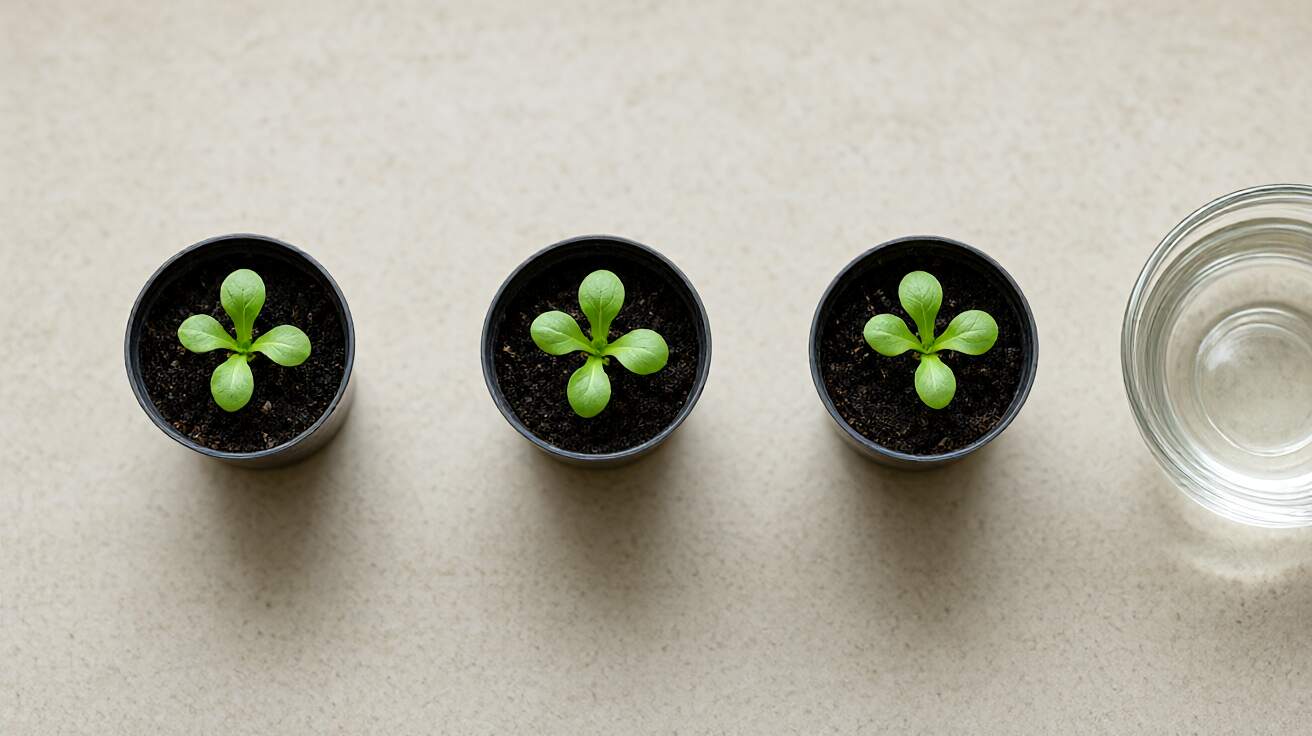
Density figures are for leafy greens and herbs, because those are what hydroponic density research actually measures. Other crops follow the mature canopy width, not the seedling size. A lettuce seedling looks tiny in 20 centimetres of space, then fills it completely at harvest, which is exactly the point at which crowding starts costing you.
For leafy greens and herbs the practical ranges are 6 to 8 inch centres for lettuce and 8 to 12 inch centres for the larger herbs. If you are deciding what to grow rather than how densely to grow it, which crops actually suit a home system is the right next read. Two crop-stage rules matter more than the spacing table itself, and both come from the Kentucky guide: seedlings are ready to transplant once they have 3 to 4 true leaves and roots have visibly emerged from the plug, usually 14 to 21 days after seeding, and harvest comes 21 to 35 days after transplant at a head weight of 100 to 210 grams. The spacing is what you hold constant while the plant moves through that cycle.
Respacing: The Second Spacing Decision
The Kentucky guide makes respacing an explicit technique for liquid-based systems, and it is the step most home growers skip. Respacing means starting closer than your final density and moving plants apart as they grow.
The mechanism is simple. A seedling occupies a fraction of the space its mature canopy will need, so planting at final spacing from day one leaves empty gaps that never earn anything. Respacing fills those gaps early, then gives each plant the room it needs later. The Kentucky guide states that respacing improves airflow and overall yield, and FAO guidance on greenhouse vegetables puts the starting point at 25 by 25 centimetres for butterhead lettuce and 30 by 30 centimetres for crisphead and loose-leaf types.
On a deep water culture lid that means starting with holes roughly 5 centimetres apart and moving to 8 to 10 centimetres as heads fill out. Nutrient film technique channels are drilled once, so respacing happens by lifting and re-seating plants along the channel. Respacing turns the density figure from a target into a schedule.
What Happens If You Overpack
This is the failure mode worth planning against, because it does not announce itself. The first sign is not disease. It is size.
Alabama Cooperative Extension makes the distinction that matters here: with most vegetable crops, maximizing yield is a function of yield per area, but in lettuce production yield efficiency revolves around crop cycles per area, because leafy greens sell by the head, not by weight. Standard lettuce harvest weights are 5 to 6 ounces per head on a 30 day cycle from transplant to harvest. If you double the plant count in the same footprint, you do not double the harvest, you split it. You get more heads and each one is lighter.
The timeline runs roughly like this. In the first two weeks after transplant the seedlings have 3 to 4 true leaves and are still establishing, so crowding costs almost nothing yet. Between day 14 and day 21 the canopies begin to touch and leaf-to-leaf air movement drops. From day 21 the canopy holds humidity against itself, and the Kentucky guide notes that in a dense canopy humidity can sit above 85 percent, the condition under which Botrytis gray mold establishes, with the first sign being a soft rot of lower leaves under a grayish-brown fuzzy growth.
So the sequence runs: crowding, then stalled growth, then a leaf problem you will misdiagnose as a nutrient issue. The crop that looks diseased was usually overpacked first.
And if you go the other way, the arithmetic is unforgiving in a different currency. The Kentucky guide puts lettuce yield at 0.4 to 1.2 pounds per square foot of growing area per crop cycle. An unused square foot of deep water culture at that range is half a pound of lettuce that you paid for in light, reservoir and shelf space but never harvested.
The One-Minute Check Before You Drill
Before you commit to a plant count, confirm four things:
- Which system you are running. That picks the density row, because the four rows differ by a factor of two.
- Your growing area in square metres, measured from the canopy footprint rather than the shelf dimensions on the box.
- Your reservoir volume divided by 4 litres, which gives the deep water culture ceiling. This is a hard number, not an estimate.
- The hole count and hole spacing on your lid, because that is what your system will actually deliver regardless of what you intended.
Then read the first ninety days of a new system if the routine is still unfamiliar, because density only works if the pH and EC behind it hold steady. The Kentucky guide is specific that solution replacement every 3 to 4 weeks keeps the balance from drifting, and a crowded system consumes water and nutrient faster than a sparse one, so the drift arrives sooner.
The Number That Decides Your Capacity
Hydroponic plant spacing is a consequence, not a preference. System type sets the ceiling, crop sets the canopy, your space sets the arithmetic. Get those three in agreement and the rest of the build gets easier, because you will not be troubleshooting a crowded system while still learning to run a clean one.
Count the holes, then plant. The order matters.
Sources and further reading
University of Kentucky Extension, Center for Crop Diversification, hydroponic lettuce production guide (CCD-CP-63), for planting density by system type, water use per plant, respacing strategy, transplant timing, harvest window, head weight, light targets, and yield per square foot.
Alabama Cooperative Extension System, Greenhouse Lettuce Production, for standard 8 inch centre spacing at 2.25 plants per square foot, harvest weight of 5 to 6 ounces per head, the 30 day transplant to harvest cycle, and the heads per square foot versus yield per square foot distinction.
FAO, Hydroponics systems for smallholder vegetable production technical factsheet, for the 21 centimetre minimum between plant holes, the 7 to 8 inch NFT channel centres, the 30 centimetre minimum trough depth, the 4 litres of air per minute per 2 to 4 square metres aeration rule, and the flow rate limit of 1 to 2 litres per minute per grow pipe.
University of Kentucky aquaculture extension, Greenhouse Crops and Cropping Systems for Commercial Aquaponics (SRAC 5009), for the 4 by 8 foot raft layout and the effect of plant density on head size and input cost per unit.
Last reviewed on November 13, 2026