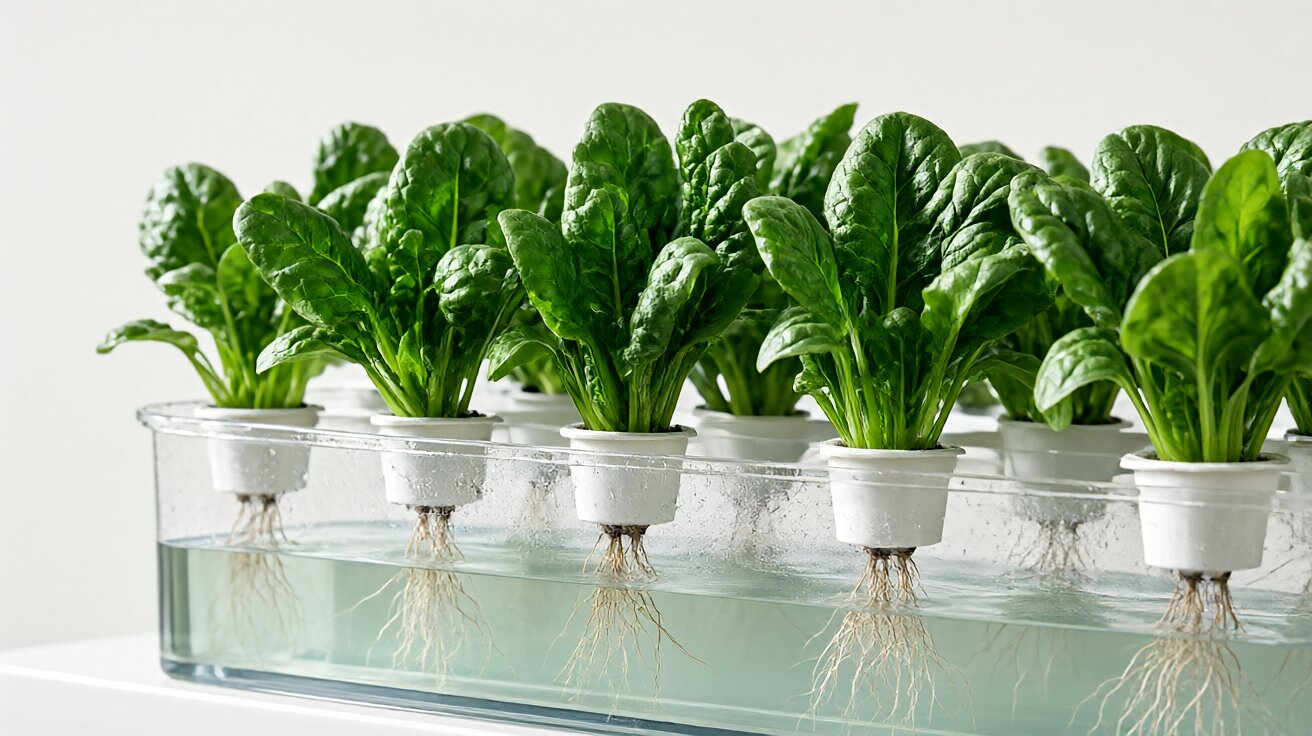

Hydroponic spinach is not lettuce with a different leaf. Spinach (Spinacia oleracea) wants a stronger nutrient solution than the leafy greens you are already growing, colder water than almost any crop on this site, and a seed you prepare before you plant it. Get those three right and you cut leaves from one crown for weeks. Get them wrong and you get one bitter handful and a reservoir full of brown roots.
The reason is physiological. Spinach is a cool-season crop that bolts the moment conditions turn against it, because a bolted plant that flowers still completes its life cycle and makes seed. A lettuce plant bolted early is simply a failed lettuce. A spinach plant that bolts early still tells you it wanted a cooler room and a stronger feed. This guide covers the numbers that decide a spinach harvest and the two mistakes that end more spinach crops than any pest ever will.
What Hydroponic Spinach Needs From You
Four numbers decide whether the crop succeeds: pH, nutrient concentration, water temperature, and light. Everything else, including the reservoir size, the air pump, the net pot, and the variety you choose, is a supporting decision.
Those four numbers are not independent. Warm water holds less dissolved oxygen, so a too-warm reservoir starves the root of oxygen and feeds root pathogens at the same time. A stronger solution raises the osmotic gradient the root has to pull water across, and past the optimum the plant spends energy on osmotic work instead of filling leaves.
Each number pushes the others, so set the whole set and then change one thing at a time. That is the difference between growing spinach and guessing at it.
| Parameter | Value for hydroponic spinach | Source |
|---|---|---|
| Nutrient strength (EC) | 1.8 to 2.3 mS/cm | OSU Extension |
| Solution pH | 6.0 to 7.0, target 6.5 | OSU Extension; Virginia Tech Extension |
| Reservoir temperature | About 68 F (20 C), 65 to 75 F workable | Cornell CEA |
| Air temperature | 75 F (24 C) day, 66 F (19 C) night | Cornell CEA |
| Dissolved oxygen | 8 mg/L, crop failure below 3 mg/L | Cornell CEA |
| Light | 17 to 22 mol per square meter per day | Cornell CEA |
| Critical day length | 13 to 14 hours triggers flowering | e-GRO Alert 2.1 |
| Seed germination | 65 to 70 F (18 to 21 C) | UGA Extension |
| Plant growth | 60 to 77 F (15 to 25 C) | UGA Extension |
The number to write on the wall is EC 1.8 to 2.3 and pH 6.5. Everything else on that table is a variable you manage.
The Nutrient Band: Why Spinach Wants More Than Lettuce
Most home growers read that leafy greens want a light feed, and they feed their spinach the way they feed their lettuce. Spinach is not a light feeder.
Cornell University groups spinach with cabbage, kale, Swiss chard, and mustard greens as a heavy feeder, and sets its nitrogen rate at 175 to 200 ppm for production. Lettuce, arugula, watercress, and spring mix sit in the light-feeder group at 125 to 150 ppm. Spinach sits between lettuce and tomato, and it needs the feed that gap implies.
That is why the band sits where it sits. Oklahoma State University Extension puts hydroponic spinach at an optimum EC of 1.8 to 2.3 mS/cm with a solution pH of 6.0 to 7.0, and recommends pH 5.5 in the solution and 6.0 to 6.5 in the root zone. That is why the working target lands at 6.5.
The Two EC Numbers You Will Read, And Why Both Are Right
You will meet a second number for spinach and it will not match the first. Cornell University’s hydroponic baby spinach handbook sets EC at 1.3 plus or minus 0.1 mS/cm above the source water, at pH 5.6 to 6.0. Both figures are correct. They are measuring different things.
An EC meter reads every dissolved salt in the solution, including the salts already dissolved in your tap water. Cornell writes that the base EC of the source water must be subtracted to know how much fertiliser you actually added, so its figure is a dosing instruction for a raft system running reverse osmosis water.
The Oklahoma State figure is the absolute reading in a recirculating reservoir, where the substrate holds no salt and the solution carries the full strength on its own. For a home system, the absolute number is the one to run.
If your tap water reads 0.3 mS/cm before you add anything, then a Cornell-style target of 1.3 above source water means your meter should read about 1.6, and a mid-range Oklahoma State target means about 2.0. Measure your source water once and the two numbers stop disagreeing.
| Crop | EC (mS/cm) | pH | Feed class |
|---|---|---|---|
| Spinach | 1.8 to 2.3 | 6.0 to 7.0 | Heavy feeder |
| Lettuce | 1.2 to 1.8 | 6.0 to 7.0 | Light feeder |
| Basil | 1.0 to 1.6 | 5.5 to 6.0 | Light feeder |
| Strawberry | 1.8 to 2.2 | 6.0 | Fruiting crop |
| Tomato | 2.0 to 4.0 | 6.0 to 6.5 | Heavy feeder |
For how the weekly top-off and drain schedule works with that band, see the hydroponic nutrient schedule. For the system-specific feeding differences, the comparison of the seven hydroponic systems covers which reservoir you are actually feeding.
Starting Spinach From Seed: Priming Changes the Timeline
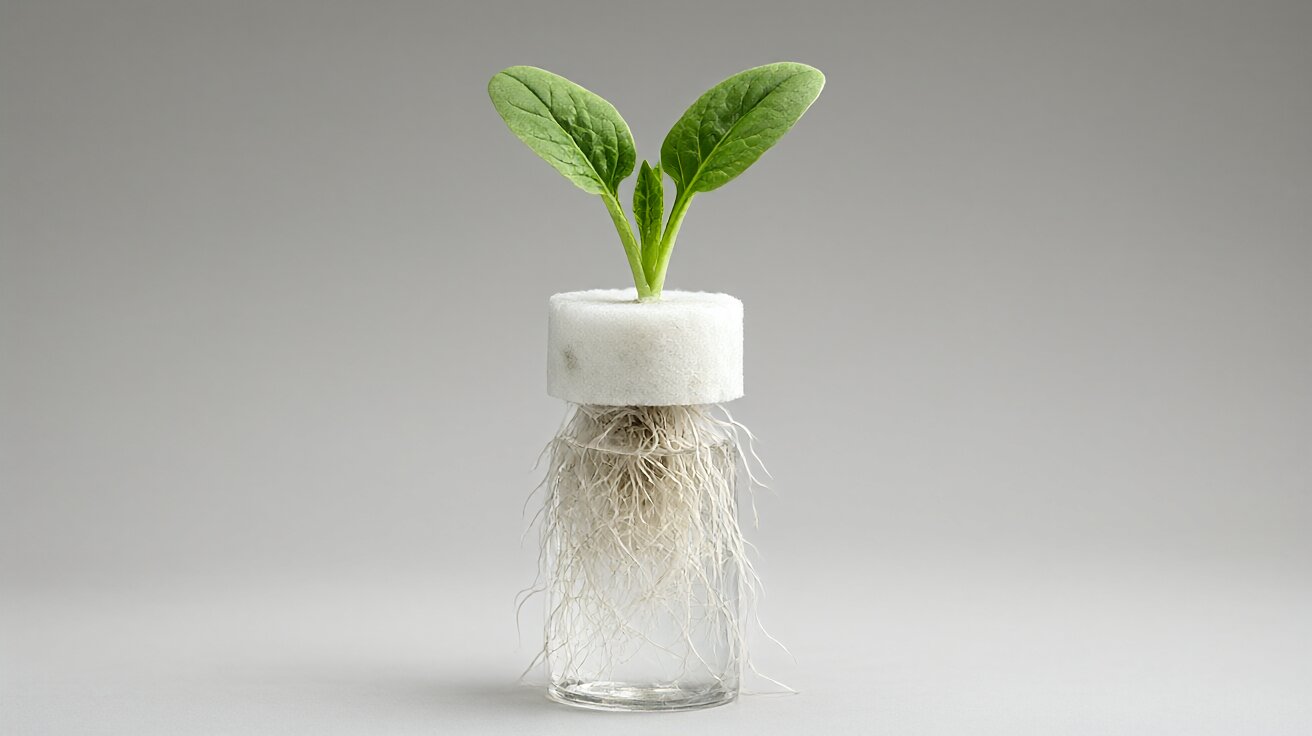
Spinach seed germinates slowly and badly. University of Georgia Extension says plainly that germination is normally low and slow compared to other leafy greens, and that it takes three things to fix it in a warm greenhouse: improved germination, heat-tolerant cultivars, and the right system.
The reason is physical. Spinach seed has a hard shell, and it carries inhibitors inside that resist water. Priming is the cheapest way to buy back the weeks you do not have.
Three Priming Methods That Work
- Soak the seed in water for 18 hours, then move it straight into rockwool slabs you have already pre-soaked.
- Soak the seed in a 0.5 percent sodium hypochlorite solution for 4 hours, leach it in clean water for 15 hours, then soak it in 0.3 percent hydrogen peroxide until it germinates.
The first method is the one a home grower should use. It costs nothing but a day and a bowl of water. Untreated spinach seed commonly takes 10 to 14 days to emerge, and soaking hastens it: a 24-hour soak followed by a day or two of air drying and a week in a sealed container in a cool place gives you seed that emerges in roughly half that time. Ten days of waiting is a week of growing you never get back.
Germination and Seedling Conditions
Spinach seed germinates best at 65 to 70 F (18 to 21 C) and grows at 60 to 77 F (15 to 25 C). Below the germination band, emergence stretches past two weeks and the seedlings arrive weak and uneven. Above the growth band they bolt before they fill out.
Give the seedlings a short day during establishment. e-GRO Alert 2.1, the Cornell University grower alert on bolting in hydroponic lettuce and spinach, reports that cooler temperatures and short photoperiods of less than 13 hours during the seedling stage delay bolting in the seedlings that follow. Total light drives transplant dry weight, not day length, so you can run a long day later and still raise a heavy plant. Short days early, long days late.
For the density that works with these root systems, see the plant spacing guide.
Which System Fits Spinach
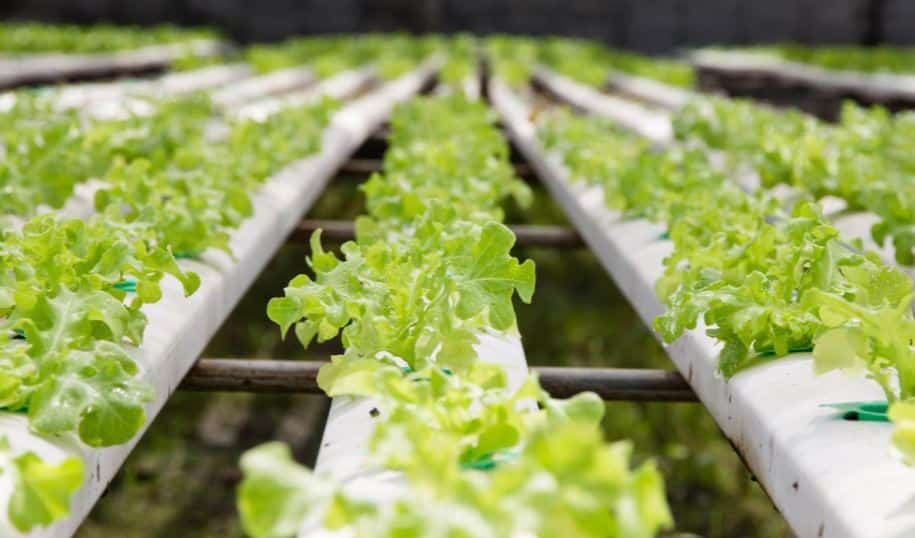
Spinach grows in almost any soilless system, which is one reason it is such a forgiving first crop. It wants a small root volume, shallow water, and a root mass you can lift out intact. The system matters less for spinach than for any other crop in this series, which is why it is the one to learn on.
Deep water culture fits best. Cornell’s baby spinach protocol is a pond system with trays floating on solution and aeration running before the plants go in, and University of Georgia Extension names deep water culture as the system that makes summer production workable.
Kratky works and it is cheapest, but the water level drops as the plant drinks and you lose control of the EC near the end of the cycle. Nutrient film technique also works, but it does not give you the root buffer a pond provides.
The full comparison, including the systems to skip for a leafy crop, is in the types of hydroponic systems. Which crops suit which system, and which to grow in soil instead, is covered in best plants for hydroponics.
Keeping the Reservoir Cold Enough
This is where most home spinach crops are lost, and the failure is not subtle. Warm water holds less dissolved oxygen, the root loses the oxygen it needs for active uptake, and a warm nutrient solution is the exact condition the root pathogens of spinach need. Heat is the single most expensive mistake you can make in this crop.
Cornell sets the target at about 68 F (20 C) with a workable range of 65 to 75 F, treats dissolved oxygen of 8 mg/L as the number with crop failure below 3 mg/L, and sets the air at 75 F by day and 66 F at night.
The pathogen threshold is what turns comfort advice into plant pathology. Pythium root rot is most aggressive above about 73 F (23 C), and yield falls at every temperature tested, because the fungus is not slowed by the same conditions that slow the plant. The crop you are saving and the disease you are avoiding sit on the same thermometer, moving in opposite directions.
What You Can Do Without a Chiller
If you cannot hold the reservoir at 68 F, you have three honest options and one of them is better than the other two.
- Add frozen bottles of water to the reservoir and top off with them instead of tap water. This pulls the temperature down without diluting the solution, which a jug of cold tap water would do.
- Move the reservoir to the coolest part of the room, away from a window that heats up in the afternoon, and shade it.
- Run spinach as a cool-season crop between October and March and accept that summer spinach in a warm room is a project you will fight.
The third option is the one most growers reject and the one that works. A chiller is the professional answer, and where e-GRO reports that chilling the pond to 68 F delayed bolting by three to four days in warm climates while also reducing Pythium infection, the chiller does two jobs at once. Cool beats clever.
For the temperature bands across every crop in one place, including the 60 to 70 F band that spinach shares with kale, bok choy, and arugula, see the reservoir temperature matrix by crop.
Bolting: Temperature Before Day Length
Every grower is told that spinach bolts because the days get long. That is true and it is half the story, and the half that gets the blame is the half that matters least.
Spinach is an obligate long-day plant, meaning flower initiation requires long days, with a critical day length of 13 to 14 hours depending on cultivar. Past that threshold the plant commits to flowering. That part is real.
But the most common cause of premature bolting in spinach is high temperature, and it beats the photoperiod in practice. e-GRO Alert 2.1 states it directly: in hydroponic baby leaf production, if temperatures are moderate, bolting is not a problem even when supplemental lights are used. Under temperatures above 80 F, bolting can occur quickly. The same 16-hour photoperiod that bolts nothing in a cool room bolts everything in a warm one.
This inverts the usual instruction, and it changes what you do about it. A grower who thinks the problem is the clock cuts photoperiod and keeps a warm reservoir. A grower who knows the problem is heat cools the room and the water, and keeps the photoperiod needed for growth. Heat bolts spinach. Long days only tell it when.
The hydroponic lettuce guide sets lettuce as a facultative long-day plant with a threshold closer to 12 hours, which is why lettuce bolts on a long day long before spinach does.
The Two Mistakes That End Most Spinach Harvests
Mistake one: feeding it like lettuce
The first mistake is running the lettuce numbers on a spinach reservoir. If you mix to the strength that keeps lettuce sweet and tender, you are about a third light on the nitrogen that spinach wants. The leaves come out small, pale, and thin with almost no flavour. Spinach is a heavy feeder. Lettuce is not.
Here is the timeline. You mix to EC 1.2 because that is the lettuce band. The plants establish fine, because a young plant is not yet demanding.
Three weeks in, as the roots fill the root zone, the plant draws down the available nitrogen faster than the solution can supply it. The new leaves come in smaller and paler than the old ones, which is the signature of a nitrogen shortage rather than a light shortage. Most growers read it as a light problem and add hours to the grow light, which produces a plant that is thin, pale, and stretched.
The fix is not light. It is strength. Mix to EC 2.0 for spinach and let the leaves fill out.
Mistake two: a warm reservoir
The second mistake is a reservoir that sits at 75 F because the room does. The timeline is faster and the outcome is worse, because this mistake does not slow the crop down, it kills it. Cool water is the difference between a crop and a compost heap.
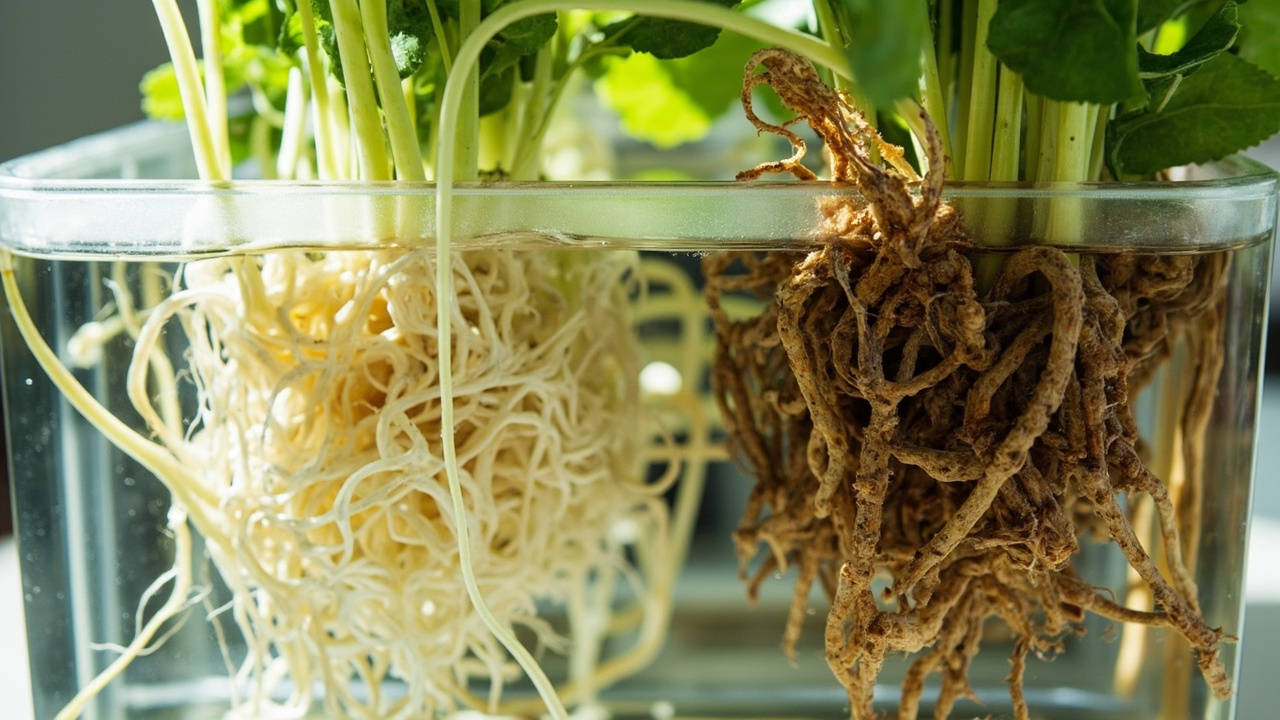
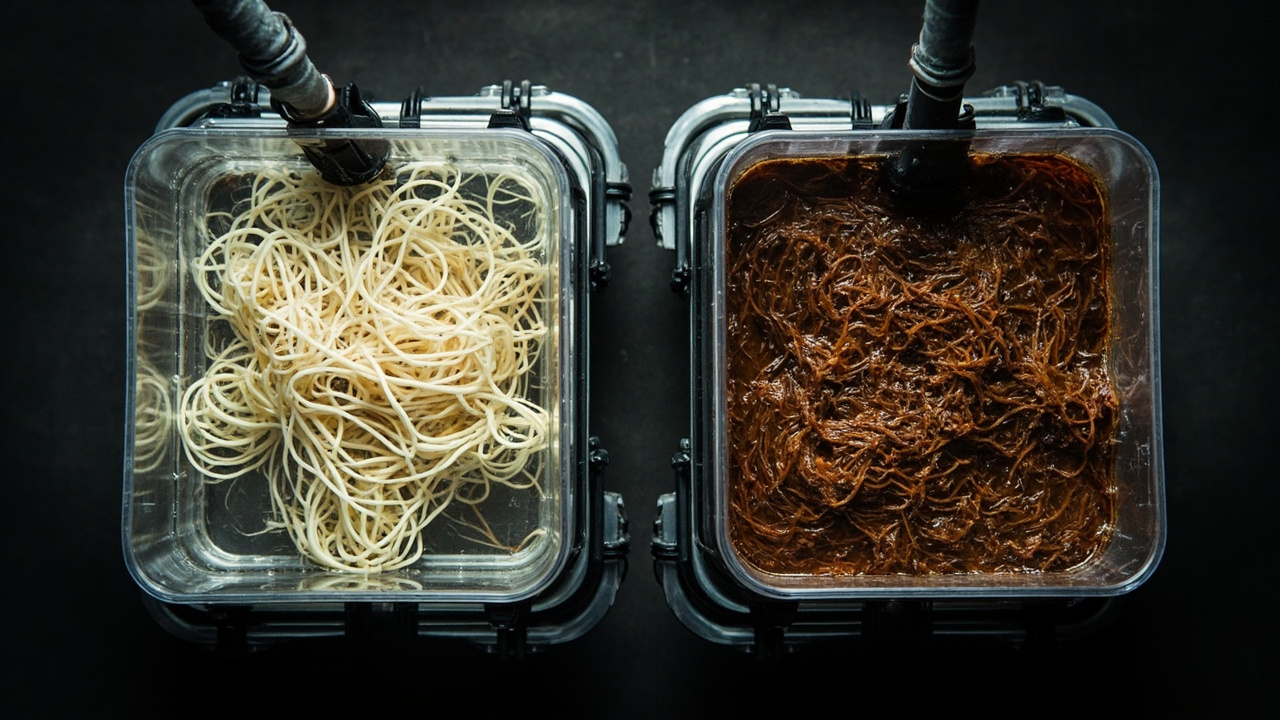
Days 1 to 10: the water warms, dissolved oxygen falls toward the 3 mg/L failure line Cornell sets, and the root tip, furthest from the aeration, starts to brown. Days 10 to 20: Pythium colonises the weakened root, and because the same warm water that starved the root feeds the pathogen, the infection accelerates instead of stalling. By day 25 to 30 the plant pulls up easily, and the roots are brown and slick rather than white and fuzzy.
Harvesting Spinach
Spinach gives you a harvest choice that no other crop in this series does, and it depends on your system. If you can change the solution, cut it more than once.
In a commercial raft, the harvest is a single shear above the media, about 16 days after sowing, with the whole crop coming off at once. Cornell is emphatic that growers should not attempt a second cut, because pathogens build up in the solution and can destroy both current and later crops. That advice assumes a shared reservoir running for years.
In a home deep water culture reservoir you can take two or three cuts from one crown by cutting the outer leaves and leaving the crown to regrow. It works because you control the reservoir and can change the solution between cuts. If your system does not let you change the solution, treat spinach as a single-cut crop.
Full-size spinach from seed to first harvest runs about 40 to 50 days in a home system, longer than the commercial baby leaf figure because commercial growers shear at baby leaf size under 17 to 22 mol of light.

The Numbers That Decide a Spinach Harvest
Spinach is not a forgiving crop, but it is a fast teacher. Set the pH at 6.5, run the solution at EC 2.0, hold the reservoir near 68 F and the air at 75 F by day and 66 F at night, keep the light at 17 mol or better, and prime the seed before you sow it. Check EC and pH every day, and replace the solution every two weeks.
Set the four numbers first and change one at a time. If the leaves come out small and pale, the answer is nutrient strength, not light. If the crop bolts in week three, the answer is temperature, not the length of your day. If the roots are brown and the plant pulls up easily, the answer is reservoir temperature and oxygen, not the amount of water. Solving the right problem takes about seven weeks to find out whether you have it.
Last reviewed on November 19, 2026
Sources and further reading
Oklahoma State University Extension, Hydroponic Production of Edible Vegetable Crops (HLA-6722), optimum EC and pH by crop, nutrient solution management and solution replacement schedule. University of Georgia Extension, How to Grow Greenhouse Spinach During Georgia Summers Using Hydroponics (C-1304), germination and growth temperatures, priming methods, deep water culture for summer production.
Cornell University Controlled Environment Agriculture, Hydroponic Baby Spinach Handbook, pond set points and harvest protocol. Virginia Tech Extension, Hydroponic Production of Edible Crops: System and Crop Comparisons (SPES-466), nutrient solution EC progression for spinach by growth stage. e-GRO Alert 2.1, Bolting of Hydroponic Lettuce and Spinach (Cornell University), daylength response and bolting temperature thresholds.