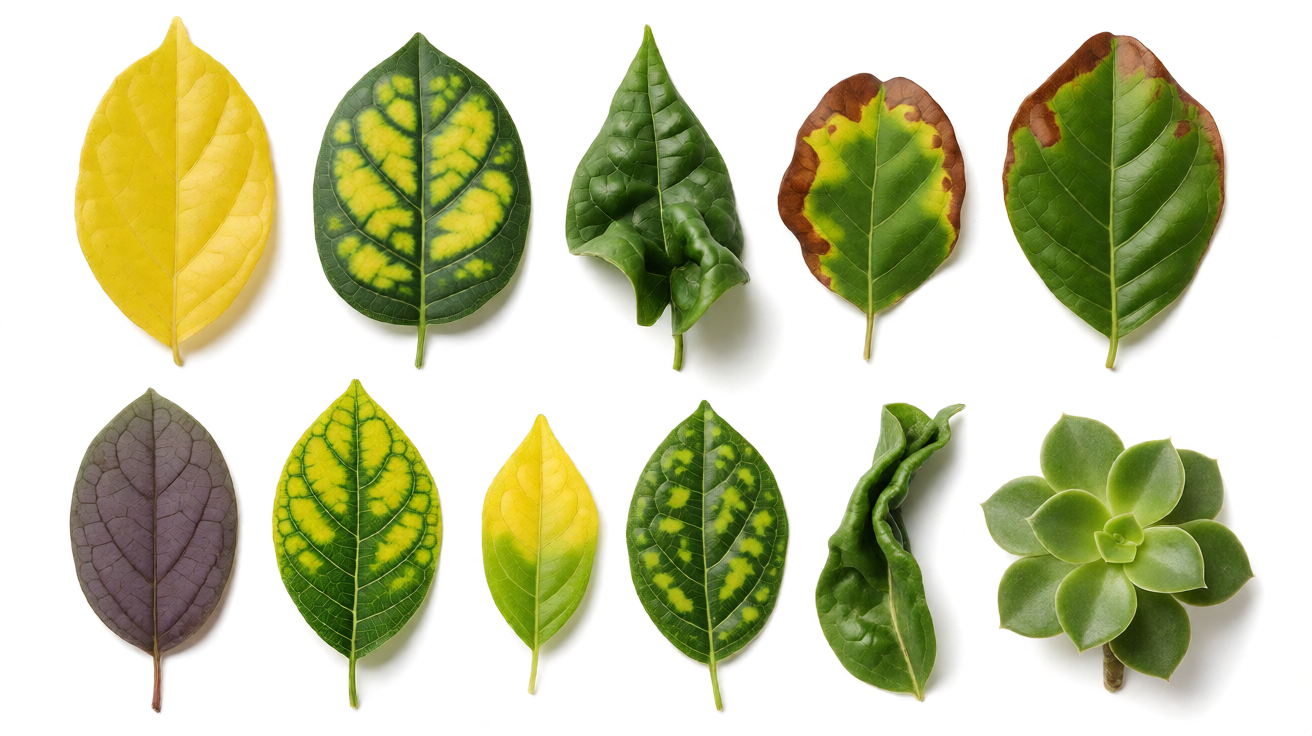

Nutrient deficiencies in indoor plants follow predictable visual patterns. The same yellow leaf that looks alarming in a snapshot tells a different story when you can read its location, distribution, and timing against a reference. This chart maps the 10 most common nutrient deficiencies to the specific symptoms you will see, ranked by how often each one actually shows up in houseplants, so you can diagnose within minutes and start the right fix within the hour.
The honest answer is that most indoor plant deficiencies are not single-nutrient problems. They are usually a combination of three underlying causes: pH drift in the potting mix (which locks out specific nutrients even when they are present), salt buildup from mineral-laden water or over-fertilization, and root damage from overwatering that prevents uptake even when the nutrients are available and accessible. Treating the symptom without checking the cause is the most common mistake, and it is why a “calcium deficiency” diagnosis often fails to fix yellow leaf edges when the real problem is dry soil preventing calcium uptake.
Use this chart as a triage tool. Start at the symptom you see, narrow to the likely deficiency, then check pH, watering, and root health before reaching for a fertilizer. This approach resolves 80 to 90 percent of indoor deficiency cases without needing a soil test.

How to Use This Chart
Diagnose in three passes. Pass 1: locate the symptom. Old leaves (lower, older growth) or new leaves (upper, growing tips)? Old leaves signal mobile-nutrient deficiencies (nitrogen, phosphorus, potassium, magnesium) because the plant relocates those nutrients from old tissue to new growth when supply is short. New leaves signal immobile-nutrient deficiencies (calcium, iron, boron, sulfur) because those nutrients cannot be relocated once deposited.
Pass 2: check the pattern. Interveinal chlorosis (yellow between green veins) points to magnesium or iron. Uniform yellowing across the whole leaf points to nitrogen or sulfur. Marginal scorch (brown edges) points to potassium or salt buildup. Necrotic spots point to calcium or boron. Purple tinting points to phosphorus.
Pass 3: check the cause before treating. Most deficiency symptoms in indoor plants have a non-nutrient cause: pH out of range (most common, blocks uptake of iron and manganese), overwatering (damages roots and blocks all uptake), underwatering (concentrates salts and blocks uptake), compacted or exhausted soil (no nutrients left to uptake), or cold soil (slows microbial activity that makes nutrients available). Test pH with a $10 meter before adjusting fertilizer. Check soil moisture with a finger 1 inch deep before assuming water is right.
The 10 Most Common Nutrient Deficiencies in Indoor Plants
The deficiencies below are ordered by frequency in houseplants. Nitrogen, iron, and magnesium cover roughly 70 percent of diagnosed cases; the rest are uncommon but worth recognizing.
1. Nitrogen (N) — Most Common, 30 to 40 Percent of Cases
Where you see it: Older, lower leaves first. Uniform pale green to yellow across the entire leaf, including the veins. Progression moves up the plant from bottom to top as the deficiency worsens.
Why it happens: Nitrogen is the most water-soluble nutrient and leaches out of pots quickly with each watering. Plants in pots smaller than 6 inches, plants watered frequently with no fertilizer, and plants in mostly peat or coir-based mixes (low inherent nitrogen) all run short within 2 to 4 months of the last feeding.
How to fix: Apply a balanced liquid fertilizer (5-5-5 or 10-10-10) at half the label rate, once per week for 3 weeks. Skip slow-release granules for acute deficiency — they release too slowly. New green growth should appear within 10 to 14 days. Resume a normal fertilizing schedule after the plant recovers.
2. Iron (Fe) — Very Common, 20 to 25 Percent of Cases
Where you see it: New, upper leaves first. Bright yellow leaf blade with veins remaining sharply green (interveinal chlorosis). In severe cases the entire new leaf is yellow or nearly white.
Why it happens: Iron is usually present in potting mixes but becomes unavailable when pH rises above 6.5. Most peat-based mixes start near pH 5.5 but drift up to 6.8 to 7.2 within 6 to 12 months as the peat buffers wear off and irrigation water (often slightly alkaline) accumulates. Other triggers: waterlogged soil (oxygen-starved roots cannot uptake iron), cold soil below 60°F, or excessive phosphorus from over-fertilization (which binds iron into insoluble compounds).
How to fix: First, test the potting mix pH. If above 6.5, lower it gradually with a chelated iron drench at label rate plus a top-dress of pine bark fines or elemental sulfur (1 teaspoon per 6-inch pot). Do not over-acidify — target pH 5.5 to 6.5. Foliar spray with diluted iron chelate works within 48 hours for fast recovery. Do not apply iron to soil with pH above 7.0 — it converts to insoluble form and provides no benefit.
3. Magnesium (Mg) — Common, 10 to 15 Percent of Cases
Where you see it: Older, lower leaves first. Interveinal chlorosis — yellow tissue between green veins. Often starts at the leaf margins and moves inward, leaving a green “Christmas tree” pattern along the central vein and main laterals. In some species, the yellow areas develop reddish or purple tints.
Why it happens: Magnesium is mobile and relocated from old leaves to new growth under shortage, same as nitrogen. Soils low in magnesium (most peat-based soilless mixes, all-orchid-bark mixes, and many tropical plant substrates) run short within 4 to 6 months. Excess potassium from aggressive fertilizing also blocks magnesium uptake.
How to fix: Foliar spray with 1 tablespoon Epsom salt (magnesium sulfate) dissolved in 1 gallon water. Apply to both leaf surfaces in early morning. Repeat weekly for 3 weeks. Soil drench works too but slower — dissolve 1 tablespoon Epsom salt in 1 gallon water and water the plant thoroughly. Recovery visible in 7 to 14 days.
4. Calcium (Ca) — Less Common, 5 to 10 Percent of Cases
Where you see it: New, upper leaves first. Distorted, cupped, or stunted growth. Necrotic (dead, brown) spots at leaf margins and tips. In fruiting plants, blossom-end rot on the fruit (the classic tomato problem). Roots may be short and stubby.
Why it happens: Calcium is immobile once deposited, so deficiencies show on new growth. The most common indoor cause is inconsistent watering — calcium moves with the transpiration stream, and dry soil halts the flow. Other causes: low-calcium water (rainwater or distilled water used exclusively), high potassium or magnesium from fertilizer blocking calcium uptake, or low-calcium substrates (pure peat, pure coir).
How to fix: First, fix watering consistency. Calcium uptake requires continuously moist (not waterlogged) soil. Then apply a calcium nitrate foliar spray (1 teaspoon per gallon water, mist leaves) every 5 to 7 days for 3 weeks. Crushed eggshells, gypsum, or dolomitic lime work as long-term soil amendments but take 3 to 6 months to release calcium — use them for prevention, not acute correction.
5. Potassium (K) — Uncommon Indoors, 3 to 5 Percent of Cases
Where you see it: Older, lower leaves first. Marginal scorch — leaf edges turn brown and crispy, progressing inward. Yellowing between veins in advanced stages. Stems may be weak and floppy.
Why it happens: Less common indoors because most balanced fertilizers include adequate potassium. Causes are usually over-fertilization (excess potassium blocks magnesium and calcium uptake, paradoxically producing a cascade of deficiencies) or root damage that prevents uptake despite potassium being present.
How to fix: If over-fertilization is suspected, flush the soil with plain water (run 4 to 6 pot-volumes through the pot to leach excess salts) and withhold fertilizer for 4 to 6 weeks. Resume with a half-strength balanced formula. For genuine potassium shortage, apply a 0-0-20 or similar potassium-only fertilizer at half label rate once per week for 3 weeks.
6. Phosphorus (P) — Uncommon Indoors, 2 to 4 Percent of Cases
Where you see it: Older, lower leaves first. Dark green to bluish-green coloration, sometimes with purple or bronze tints on undersides. Stunted growth overall. Delayed flowering or no flowering on flowering species.
Why it happens: Phosphorus deficiency in houseplants is usually caused by cold soil (below 60°F, common in winter on windowsills) rather than actual shortage — cold temperatures slow microbial activity that converts organic phosphorus into plant-available forms. Also triggered by pH below 5.5 or above 7.0 (both lock out phosphorus), or by iron or zinc toxicity from over-fertilization.
How to fix: Move the plant to a warmer location if cold is the cause. Test pH and adjust to 6.0 to 6.5 if needed. Apply a half-strength bloom-booster fertilizer (1-3-1 or similar) once per week for 4 to 6 weeks. Do not exceed label rates — phosphorus toxicity is real and creates iron and zinc lockout.
7. Sulfur (S) — Rare Indoors, 1 to 2 Percent of Cases
Where you see it: New, upper leaves first. Uniform pale green to yellow across the entire leaf, including veins (similar pattern to nitrogen but on new growth instead of old). In severe cases, leaves are small and the plant is stunted.
Why it happens: Sulfur deficiency is rare indoors because most tap water contains sulfate and most fertilizers include sulfur in their formulation. The most common cause is exclusive use of distilled or rainwater for years with a sulfur-free fertilizer. Some high-pH soilless mixes with prolonged use can also run short.
How to fix: Switch to a balanced fertilizer that includes sulfur (most do, check the guaranteed analysis) or supplement with Epsom salt (magnesium sulfate) at 1 tablespoon per gallon of water, applied as a soil drench once per month. Recovery visible in 2 to 4 weeks.
8. Manganese (Mn) — Rare Indoors, Less Than 1 Percent of Cases
Where you see it: New, upper leaves first. Interveinal chlorosis similar to iron, but with smaller, more numerous yellow patches and smaller necrotic spots along veins. Veins remain green but the pattern is finer than the iron pattern.
Why it happens: Almost always pH-related. Manganese becomes unavailable above pH 6.5 and toxic below 5.5. Indoor plant deficiencies typically show in mixes that have drifted alkaline over 12+ months.
How to fix: Test pH first. If above 6.5, lower gradually with a chelated manganese drench at label rate. Foliar spray with diluted manganese sulfate gives faster results. Do not exceed label rates — manganese toxicity produces brown leaf speckles and stunted roots.
9. Boron (B) — Rare Indoors, Less Than 1 Percent of Cases
Where you see it: New, upper leaves first. Distorted, thickened, or brittle new growth. Tip dieback. Hollow stems in severe cases. Terminal buds may die, triggering lateral branch growth and a bushy, stunted appearance.
Why it happens: Boron deficiency is extremely rare indoors because the required amount is tiny and most tap water plus most fertilizers supply it incidentally. The most common cause is exclusive use of highly purified water (RO, distilled) for years with a low-boron fertilizer. Boron toxicity is more common than deficiency indoors.
How to fix: Switch to a complete fertilizer that includes boron and use tap water (or remineralized RO water) for irrigation. Recovery is slow and may require 2 to 4 months of consistent feeding to restore normal new growth. Severely distorted leaves will not recover — only new growth will look normal.
10. Zinc (Zn) — Very Rare Indoors, Less Than 1 Percent of Cases
Where you see it: New, upper leaves first. Small leaves with shortened internodes (rosetting). Interveinal chlorosis similar to manganese but with broader necrotic patches.
Why it happens: Almost always caused by high pH (above 7.0) or phosphorus toxicity from over-fertilization. Indoors, this deficiency shows up in long-neglected plants in old, exhausted potting mix that has drifted strongly alkaline.
How to fix: Repot into fresh potting mix and resume normal fertilizing. Foliar spray with zinc sulfate at label rate gives faster results. Test pH and adjust to 6.0 to 6.5 if needed.
The Hidden Cause Most People Miss: pH Lockout
If you have applied fertilizer for 4 to 6 weeks and the deficiency symptoms have not improved, pH lockout is the most likely cause. The same iron, manganese, or zinc you applied is physically present in the soil but chemically unavailable to roots because the pH is wrong. No amount of additional fertilizer fixes this — only pH correction does.
| pH range | Nutrients locked out | Common cause indoors |
|---|---|---|
| Below 5.0 | Phosphorus, calcium, magnesium | Sulfur toxicity, very acidic peat overuse |
| 5.0 to 5.5 | Phosphorus, manganese toxicity risk | Fresh peat mix, organic acid buildup |
| 5.5 to 6.5 | Optimal range for most houseplants | Target zone — most nutrients available |
| 6.5 to 7.0 | Iron, manganese, zinc starting to lock out | Aged peat, alkaline tap water, lime accumulation |
| 7.0 to 8.0 | Iron, manganese, zinc severely locked out; phosphorus limited | Hard water, lime-based fertilizers, neglected mix |
A simple $10 to $20 soil pH meter from a garden center or hardware store takes the guesswork out. Probe the soil at root depth (2 to 3 inches), water the plant normally first, then read 30 minutes later. If pH is outside 5.5 to 6.5 for the species you are growing, correct it before continuing fertilizer applications.
The Second Hidden Cause: Root Damage
Healthy roots uptake nutrients; damaged roots cannot, regardless of how much fertilizer is in the soil. The most common indoor root damage is from overwatering, which suffocates roots and creates conditions for root rot fungi (Pythium, Phytophthora, Fusarium). Other causes: pot-bound plants circling roots with nowhere to grow, compacted soil that excludes air pockets, fresh unaged manure or compost that burns tender root tips.
Before treating any deficiency, check root health. Slide the plant out of the pot and look at the roots. Healthy roots are white to tan, firm, and springy. Damaged roots are brown or black, soft, and may smell sour. If roots are damaged, address that first — no fertilizer will help until new roots grow. For more on this, see our complete guide on how to save a plant with root rot for the diagnostic and recovery protocol.
Quick Reference: Deficiency-by-Symptom Lookup
Use this reverse lookup if you see a specific symptom and want to narrow the candidates.
Yellow Leaves (Chlorosis)
- Old leaves, uniform yellow, including veins → Nitrogen
- Old leaves, yellow between green veins → Magnesium
- New leaves, yellow with green veins → Iron
- New leaves, yellow between fine veins with small necrotic spots → Manganese
- New leaves, uniform pale yellow-green → Sulfur
Brown or Necrotic Spots
- Old leaves, marginal scorch (edges browning) → Potassium
- New leaves, tip burn with distorted growth → Calcium or boron
- New leaves, fine speckled necrotic patches → Manganese
- Random spots after fertilizer application → Salt burn (chemical injury, not a deficiency)
Distorted or Stunted Growth
- New leaves cupped, curled, or small → Calcium
- Terminal buds dying, bushy lateral growth → Boron
- Shortened internodes, rosetting, small leaves → Zinc
- Overall slow growth with dark green or purple tint → Phosphorus
Treatment Protocol: The Three-Step Approach
Step 1: Diagnose the deficiency using the chart above. Identify the most likely candidate based on symptom location and pattern.
Step 2: Check pH and root health before applying fertilizer. Correct pH to 5.5 to 6.5 if outside the range. Address root damage if present. Skip this step only if you are certain the deficiency is genuine and the soil conditions are correct.
Step 3: Apply the targeted treatment at half-strength to avoid chemical burn. Use foliar spray for fastest recovery on iron, manganese, magnesium, and zinc. Use soil drench for nitrogen, phosphorus, potassium, and calcium. Repeat weekly for 3 weeks, then resume normal fertilizing at full strength.
What to Do Now
If you are diagnosing an actual plant right now, start with a $10 soil pH meter and a 30-second root check. The chart above will then narrow your treatment to one or two specific deficiencies, and the targeted fix will work within 1 to 4 weeks depending on the nutrient.
For the broader context of timing your feeding — when to feed each plant type, how the schedule changes by season, and what to skip during dormancy — see our fertilizer schedule by plant type guide. It gives you week-by-week protocols for 12 common categories of houseplants, matching the right NPK ratio to each growth cycle.
For the broader context of fertilizing indoor plants correctly — including NPK ratios, schedule timing, and choosing the right fertilizer type — see our complete guide to indoor plant fertilizers. For diagnosing related problems like yellow leaves (which can be deficiency, overwatering, or light stress), our indoor plant leaves turning yellow guide walks through the full triage.
From Bank Statement to QuickBooks-Ready File
That manual cleanup you just read about? This tool skips it. Turn your PDF into QBO for QuickBooks without storing your data anywhere.
Start Converting