Grow lights supplement natural sunlight by delivering photons that indoor plants need for photosynthesis — a process that slows down or stops entirely when a windowsill receives fewer than 200 micromoles of photons per square meter per second (μmol/m²/s). For most home setups — a shelf of pothos in a north-facing apartment, a fiddle leaf fig in an interior corner — a simple LED bar light in the 24 to 40 watt range is sufficient to keep plants healthy without the expense or complexity of a full grow tent kit. growing hydroponics for related context. aeroponic systems for related context.
If you have been looking at options online, the range is confusing for a reason: the market covers everything from $15 “grow bulbs” at hardware stores to $300 quantum board setups marketed toward cannabis hobbyists. Most of what exists online is written for one of those extremes. This article is for the middle — the person with a shelf of four plants in a dim apartment who just wants those plants to stop stretching toward the window.
What follows is not a product ranking. It is a framework for understanding which type of grow light fits your specific situation, what specs actually matter, and what is not worth buying regardless of how it is marketed.
Why Indoor Plants Often Need Supplementary Light
Modern apartment layouts compound the problem. Deep room plans, north-facing windows, large furniture blocking natural light, and winter sun angles that never reach interior corners all reduce the photons available to your plants. A south-facing windowsill at noon in summer can deliver 800 to 1,200 foot-candles of light. The same room eight feet from that window in winter might deliver fewer than 100.
Low light causes etiolation — the stretching, pale, leggy growth that happens when a plant reaches for photons it is not receiving. It is not a disease, but it is a signal. If you are seeing it in plants that should be low-to-medium light species, the room itself is the bottleneck. The plant is telling you it needs more photons, not more water or fertilizer.
Before buying a grow light, confirm the gap. Our guide to indoor plant light requirements covers the PPFD thresholds each plant category needs to thrive, not just survive.
When Natural Light Falls Short
Plants are categorized by their light tolerance, and the categories exist because different species evolved under radically different photon densities. A snake plant tolerates low light because it originated in arid African rock formations where cloud cover was common. A monstera evolved in jungle understories where dappled light still reached it for hours. Both are considered low-to-medium light plants — but their minimum PPFD requirements differ by a factor of two or more.
If your space consistently fails to meet those minimums, a grow light is not an accessory. It is the primary light source. Treating it as optional is the most common reason indoor plants decline in apartments without obvious cause. Low-light species like pothos, ZZ plants, and peace lilies are the most forgiving of limited photons — and if you are new to indoor gardening, starting with best indoor plants for beginners is the best way to build confidence before investing in grow light infrastructure.
How Grow Lights Work: The Specs That Actually Matter
Grow lights generate photons; plants absorb photons. The metric that describes photon delivery is PPFD — photosynthetic photon flux density. It measures how many photons actually reach a square meter of leaf surface per second, expressed in μmol/m²/s. This is the spec that determines whether a light will work for your plants. It is not the same as lumens, which describe brightness as perceived by human eyes.
PPFD vs. Lumens: Why the Difference Matters
Lumens favor the green and yellow wavelengths that human eyes are most sensitive to. Plants care about blue and red wavelengths. A high-lumen cheap LED might output mostly green light — useless to a plant even if the room looks bright. PPFD tells you what the plant actually receives, which is why it matters far more than the wattage number on a box.
The practical test: if you are comparing two lights for a shelf setup, look for the PPFD chart the manufacturer publishes (good brands publish them; cheap ones rarely do). At 12 to 18 inches of distance, a light suitable for low-to-medium light houseplants should deliver at least 150 to 250 μmol/m²/s. Below 100 PPFD, you are essentially running a very expensive lamp for decoration.
What Color Temperature Means for Plant Growth
Color temperature, measured in Kelvin (K), describes the color of the light source. A 6500K tube appears blue-white and mimics the noon sun. It drives compact, vegetatively healthy growth — good for seedlings, herbs, and most tropical houseplants under artificial light. A 3000K bulb appears warm white or amber and skews toward red wavelengths that trigger flowering and fruiting responses.
For growing houseplants on a shelf, 6500K is the default recommendation. It is what most “full spectrum” LED grow lights actually are, and it covers every stage of growth you will encounter with common tropical plants. The marketing term “full spectrum” is largely redundant — any quality 6500K LED is already providing the wavelengths plants use most.
Using a warm 3000K bulb as your primary grow light for tropical foliage plants is not wrong, but it tends to produce slightly elongated growth compared to 6500K. For decorative houseplants, that matters.
Wattage as Coverage Proxy
Watts describe how much electricity a light draws — not how much useful light it delivers to your plants. Two lights at 40 watts can have radically different PPFD outputs at plant level depending on diode quality, reflector design, and spectral output. Use wattage as a rough coverage estimate: a 24 to 40W LED bar typically covers a shelf area of roughly 2 feet by 1.5 feet at the right distance. A 100W quantum board can cover a 3-foot by 3-foot area.
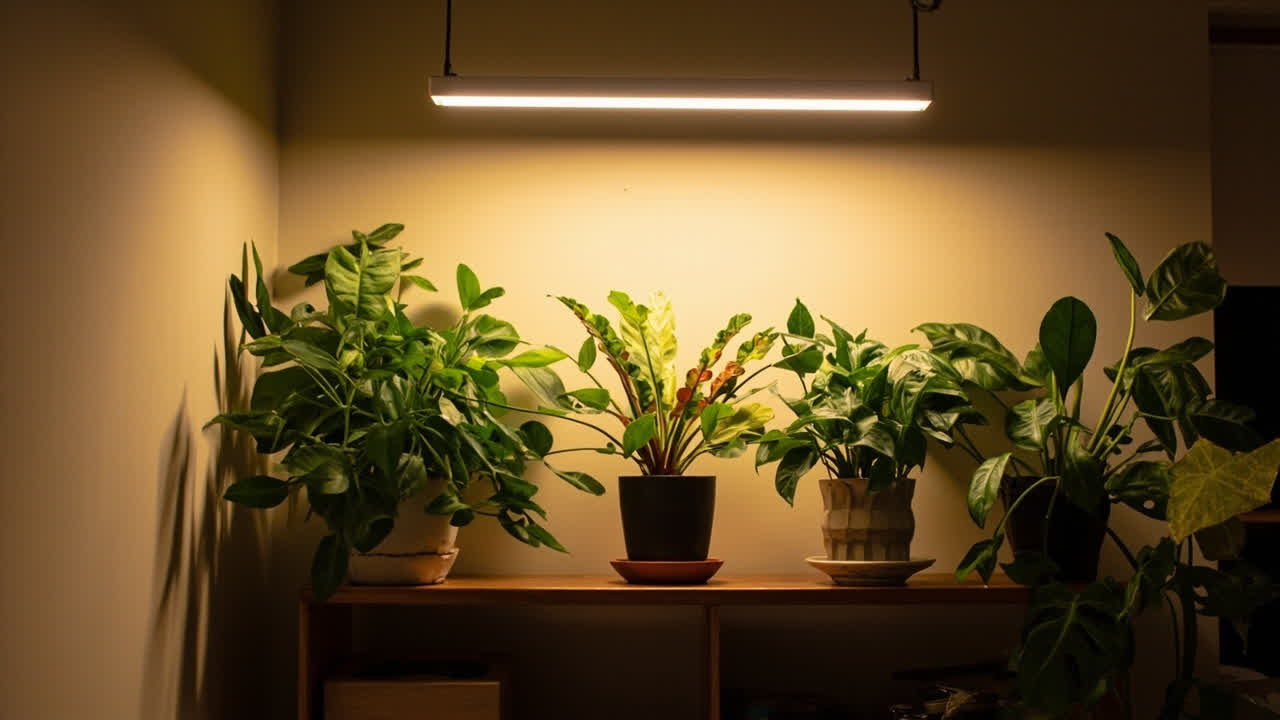
More watts in a small space is not always better — it can mean more heat, which matters if your plants are close to the light and your room already runs warm. Most home grow light setups do not need active cooling.
The Main Types of Grow Lights for Home Use
LED Bar Lights
The dominant type for home shelf setups in 2026 and for good reason. LED bar lights are slim, low-heat, and designed to mount underneath shelving — which is exactly where you want them for a plant shelf. A 24 to 40W LED bar delivers enough PPFD for 3 to 5 medium light plants on a standard shelf without running hot.
They are not designed for growing large fruiting plants, but for the target audience of this article — shelf-growers with tropical houseplants — they are the right tool at the right price point. Brands vary; look for ones that publish PPFD charts and have existed long enough to have real user reviews from indoor gardeners, not just cannabis communities.
T5 Fluorescent Tubes
The reliable older technology. T5 tubes are adequate — not exciting, not cutting-edge — and they have a long track record in indoor gardening. A two-tube T5 fixture at 24 to 54 watts covers a comparable area to an LED bar but runs slightly warmer and requires more vertical clearance.
They remain a practical choice if you already have T5 fixtures or are working with a very tight budget. The light quality is good for plant growth. The trade-off is bulk and heat compared to LED, and they are less efficient per watt.
Grow Bulbs and Socket Adapters
The category most beginners encounter first. A “grow bulb” screws into a standard lamp socket — intuitive, affordable, available everywhere. The problem is coverage. A single grow bulb typically delivers useful light only within a 6 to 12 inch radius from the bulb. That is enough for one medium plant directly underneath. It is not enough for a shelf of four.
If you are buying a grow bulb because it is the only option available locally, treat it as supplemental to a window, not as a primary light source. Three bulbs in a three-bulb floor lamp will cover more area, but you will spend as much as a decent LED bar and still not match its performance.
Clip and Spot LED Lights
Small, focused lights that clip onto a shelf edge or pot rim. They are the right tool for a single large plant — a fiddle leaf fig, a bird of paradise in a floor pot, a monstera that has stretched lopsided toward a window. A 15 to 20W clip LED can deliver enough PPFD to re-balance a plant that is reaching asymmetrically.
For multiple plants, they become impractical quickly — you need one per plant, and cable management becomes a problem. Think of them as targeted correction tools, not primary multi-plant lighting solutions.
Full Grow Tent Setups
A grow tent with an integrated light kit is a complete enclosed system — reflective interior walls, inline ducting, a dedicated LED panel, and a controlled environment. It works exceptionally well. It also takes up floor space, looks industrial in a living room, and represents a level of commitment most home plant owners are not ready for.
If you are growing orchids, citrus, or other plants that genuinely need high-intensity light year-round, a tent is a legitimate investment. For a shelf of pothos, snake plants, and philodendrons — the majority of indoor plant purchases — it is overkill that most people will not sustain.
What Makes a Grow Light “Good Enough” for House Plants
The Three Specs That Decide Whether a Light Works
When evaluating any grow light — regardless of type or price — check these three things:
1. PPFD at your plant’s distance. Not the theoretical maximum at 6 inches, but the actual output at the distance your plants will sit. If you are mounting a bar light 12 inches above your plants, that is the number that matters.
2. Coverage area matches your setup. A light that claims 40W but delivers useful PPFD only in a 6-inch circle is not a 40W shelf light — it is a 40W single-plant light. Match coverage to your actual shelf dimensions.
3. Run time automation with a timer. Plants need consistent dark periods — most tropicals do best with 12 to 16 hours of light daily. A light without a timer or without an easy timer solution leads to irregular schedules, which stress plants more than moderate constant light. If you are just starting to learn how your plants respond to additional light, our guide to low light indoor plants can help you understand which species give you the most visual feedback as you dial in your setup.
When a Budget Light Is Actually Fine
A basic LED bar light in the $25 to $40 range will outperform most expensive-looking “grow bulb” setups for a multi-plant shelf. The reason: bar lights are designed for homogeneous coverage across a defined area. A grow bulb concentrates light in the center and falls off sharply at the edges.
You do not need a quantum board, a cobalt fixture, or a Mars Hydro. You need enough photons distributed evenly across your shelf. For that use case, a budget LED bar from a brand that publishes real PPFD data is entirely sufficient.
Grow lights increase humidity loss from leaves — the higher photon output accelerates transpiration. If you are running lights in a room that already runs dry (air conditioning, radiators, north-facing rooms in winter), read our guide to how to increase humidity for indoor plants before running lights as your only intervention. growing hydroponics for related context. soilless medium for related context. apply worm castings for related context.
What We Skipped and Why
Overpowered Setups Most Homes Do Not Need
Quantum board LED panels — the high-output panels popular in cannabis cultivation — typically deliver 800 to 1,500 PPFD at 18 inches. That is intense. Most tropical houseplants are adapted to understory light and perform well at 200 to 500 PPFD. Running a quantum board at full strength over a 2×2 foot shelf of pothos is like using a pressure washer to rinse a salad.
Commercial grow tent kits with multi-light setups, inline fans, and carbon filters exist because they solve specific problems: sealed environments, high-heat-producing lights, odor management for flowering cannabis. None of those are problems for a shelf of tropical houseplants in a living room.
Marketing Terms That Do Not Mean What They Sound Like
“Full spectrum” grow bulbs at the hardware store are often just 6500K white LEDs with a sticker upgrade. The “full spectrum” label implies something scientifically complete, but any quality white LED in the 5000K to 6500K range already covers the wavelengths plants use. You are not missing anything by not buying the $60 “full spectrum specialist” bulb versus the $15 standard LED equivalent.
“50W equivalent” claims describe the bulb’s brightness as perceived by humans. The actual electrical draw might be 8 to 12 watts. The real output — in PPFD at plant level — may be modest. When in doubt, compare actual wattage draw, not equivalency claims.
“Grow lights for succulents and herbs” marketed as separate categories are mostly the same technology with different packaging. A 6500K LED bar covers both use cases. The separation is a marketing decision, not a horticultural one.
Best Grow Light for Your Setup: The Quick Decision Guide
The right light depends on your actual situation. Use this guide to self-select — then buy once and observe how your plants respond before adding more lights.
A shelf or rack with 3 to 5 plants — An LED bar light in the 24 to 40W range with a built-in timer is the default recommendation. Mount it underneath the shelf so the light shines down onto the plants below. This covers low-to-medium light tropicals like pothos, philodendron, heartleaf fern, and most pothos varieties.
A single large floor plant — A clip or freestanding LED spot light in the 15 to 20W range positioned 8 to 12 inches from the foliage. Good for fiddle leaf figs, bird of paradise, large monsteras that have started reaching asymmetrically.
Budget setup under $30 — A two-tube T5 fluorescent fixture from an aquarium or hydroponics store is the most cost-effective path at this budget. It works, it is well-understood, and replacement tubes are inexpensive and available everywhere.
Serious indoor gardening hobbyist with a dedicated space — A quantum board panel or a complete grow tent kit if you are growing light-hungry species like orchids, citrus, or edible plants that genuinely need higher PPFD than a windowsill can provide in winter.
Do not buy a grow light at all if: you have south-facing or unobstructed east-facing windows and are growing low-light species like snake plants, ZZ plants, pothos, or peace lilies. These plants survive and grow — slowly — in the light they are already getting. Adding a grow light will speed growth, but it is not correcting a deficiency.
Stretching or pale growth is not always a light problem. When leaves lose their color and the plant reaches inconsistently, it can signal several things — one of which is insufficient photons, but others include nutrient deficiencies, overwatering, and root health issues. Our piece on indoor plant leaves turning yellow covers the diagnostic sequence so you can rule out or confirm light as the cause before spending money on a setup you may not need.
Start with one light, one timer, and 4 to 6 weeks of observation. Plants tell you whether the light is working — new growth is compact and dark green, not etiolated and pale. If that baseline is working, you can add a second light for another zone. If it is not, you have data: either the PPFD was too low at plant distance, the coverage area was too small, or the timer schedule was wrong. Each is a fixable variable.
The goal is not the most light. It is enough light, consistently delivered, over the hours your plants actually need it.
Turn That PDF Into a Spreadsheet in Minutes
You've seen how to do it manually — now let the tool handle the heavy lifting. Upload your bank statement and get Excel, CSV, or QBO in a few clicks.
Try It Free