Feed a Calathea once every 4 to 6 weeks during active growth, using a balanced liquid fertilizer diluted to half the label rate, and stop feeding entirely when growth slows in fall and winter. That single rule covers most indoor Calathea, and the rest of this page is about the small exceptions that prevent leaf burn and salt buildup.
Calathea is not a hungry plant. The instinct to feed it like a tomato or a tropical flower is the fastest way to scorch the leaf edges and lock salts into the soil. The right approach is light, scheduled, and tied to the room temperature and the soil underneath, not to the calendar alone.
The Safe Calathea Fertilizer Schedule
The feeding schedule is a seasonal window, not a fixed interval. Calathea push new leaves actively when the room is warm, the light is bright, and the days are long. Feed then, and pause when any of those three drop.
- Spring (March to May): start feeding as soon as you see the first new roll of growth, at half-strength every 4 weeks. Skip the first feeding if the Calathea was repotted within the last 8 weeks, since fresh potting mix already has nutrients.
- Summer (June to August): continue half-strength every 4 to 6 weeks. In a bright, warm room where the plant is pushing a new leaf every 4 to 6 weeks, lean toward 4 weeks. In a stable indoor room with moderate light, 6 weeks is enough.
- Fall (September to November): stretch to every 6 to 8 weeks and stop as soon as the plant stops producing new leaves. Calathea slow down before they fully stop, and the last feeding should happen while growth is still visible.
- Winter (December to February): no fertilizer at all unless the room stays between 70 and 80°F / 21 and 27°C and the plant is still actively growing. Cooler rooms mean dormant roots, which cannot use the nutrients and will only store them as salts.
Feeding works only when the wider routine in the Calathea care guide is already stable. Fertilizer on a Calathea in the wrong light or the wrong humidity produces fast but weak growth that the plant cannot sustain, and the visible result is the same crispy-leaf decline you would see from underwatering.
What Type Of Fertilizer Calathea Needs
A balanced liquid fertilizer is the safest pick, with an N-P-K ratio close to 3-1-2 or 10-10-10, diluted to half the rate on the label. Liquid formulas are easier to control than slow-release spikes, and the half-strength dilution gives the plant enough to grow without overwhelming the fine Calathea roots.
Calathea can be sensitive to the fluoride and chloride salts in some tap waters and in some cheaper fertilizer formulas. A urea-free or low-salt formula reduces leaf-edge burn, especially in homes with hard tap water. The trade-off is that low-salt formulas are usually more expensive, and a careful half-strength dose of a standard balanced formula is a perfectly acceptable substitute if the plant is otherwise doing well.
Skip foliar feeding entirely. Misting fertilizer onto Calathea leaves burns the foliage and leaves residue that blocks the leaf pores. All feeding should go through the soil, after a normal watering so the roots are not hit with dry fertilizer salts.
Watering Before And After Feeding
Calathea roots take up fertilizer best from already-moist soil, and they are easily burned by fertilizer applied to dry soil. The sequence is: water normally first, let the pot drain, then apply the half-strength fertilizer solution as the next drink within an hour or two. The pre-water protects the fine root tips and ensures the fertilizer is distributed evenly through the mix instead of sitting in one concentrated spot.
Once a month during the active growing season, skip the fertilizer entirely and flush the pot with 2 to 3 pot-volumes of plain, room-temperature water. The flush dissolves accumulated salts and carries them out the drainage holes, which is the simplest way to prevent the white crust on the soil surface and the brown leaf edges that come with salt buildup. A pot that has been fed every month for 4 to 5 months without a flush is overdue.
Fertilizer is safest when it follows the moisture checks in the Calathea watering guide. If the top 2 to 3 cm of soil are still damp, the fertilizer can wait. Pouring fertilizer into a pot that does not yet need water is the most common cause of over-fertilization in Calathea.
Soil Conditions That Change The Schedule
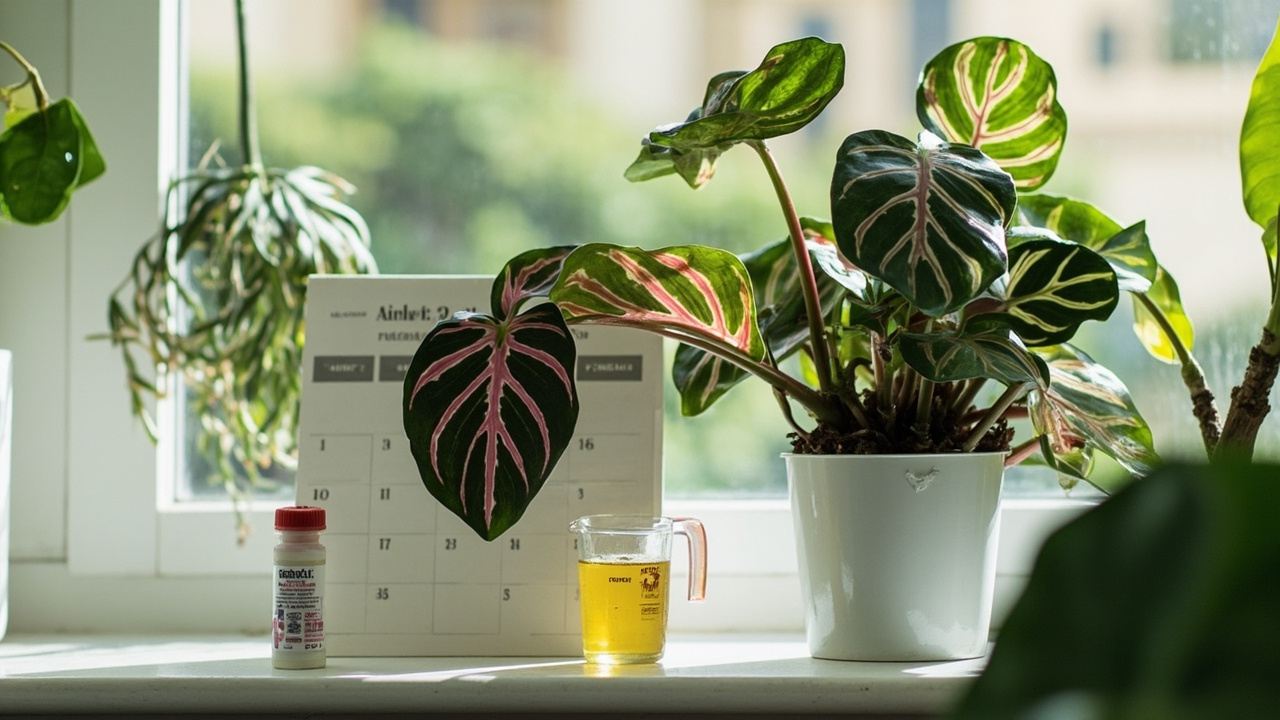
The mix underneath the plant changes how often the Calathea needs feeding, and how often it needs a flush. A dense, compost-heavy mix holds salts longer than a chunky, barky mix, because the smaller particles give the salts more surface area to stick to. A pot in a chunky mix can usually run on the same schedule as the routine above; a pot in a dense mix should be flushed more aggressively and may tolerate a longer interval between feedings.
Old, broken-down mix is the worst case for salt buildup. After about 18 to 24 months, the bark and coir particles have decomposed into a finer texture that holds water and salts together, and the same half-strength dose that worked at month 6 is suddenly too much for the root zone. Repot into fresh mix every 2 years, or top-dress the first 2 to 3 cm of soil once a year, to keep the salt-absorption surface from accumulating past the point of safe feeding.
A dense mix holds salts longer, which is why the Calathea soil requirements matter before feeding. The right airy structure lets salts move through the pot and out the drainage holes instead of collecting in the lower half of the root ball.
Signs You Are Feeding Too Much
Over-fertilization shows up in two places at once: the leaf edges and the soil surface. Watch both before adjusting the schedule.
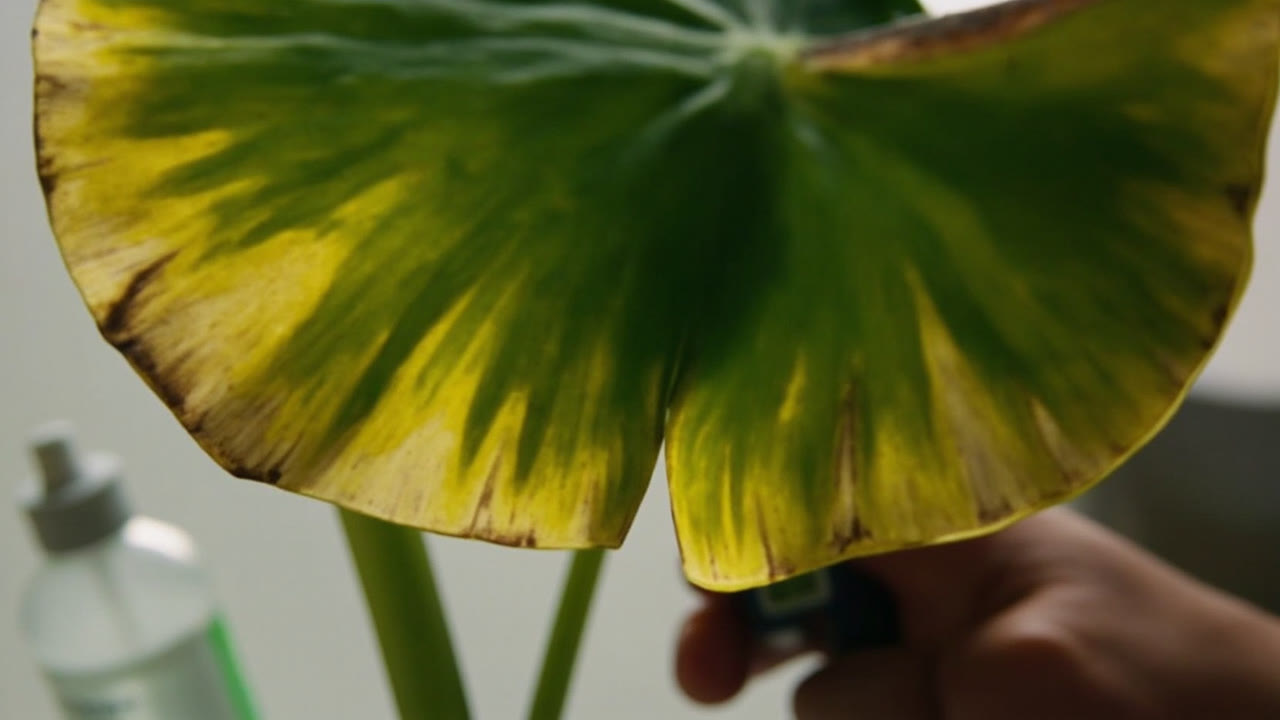
- Brown, crispy leaf edges that progress inward: classic salt burn. The damage usually appears on the older leaves first, then the new ones. Pause feeding, flush the pot thoroughly, and resume at a lower dilution.
- White or yellow crust on the soil surface or pot rim: mineral salt buildup. Scrape off the crust, flush the pot, and stretch the interval to 6 to 8 weeks during the next feeding season.
- Stalled new growth despite warm conditions: the roots are working too hard to manage salt concentration and have stopped pushing new leaves. Flush, pause for 6 to 8 weeks, then resume at half the previous dilution.
- Soft, translucent leaf spots that turn brown: severe salt burn, sometimes with bacterial rot following. The plant is asking for a full reset: flush, withhold fertilizer for 2 to 3 months, and consider repotting into fresh mix.
- Leaves yellowing from the tip rather than the base: different from the natural aging yellow that starts at the base. Pause feeding, flush, and check the water source for fluoride and chloride.
Brown margins are not always fertilizer damage, so compare symptoms with the Calathea brown leaves guide. Low humidity and tap-water sensitivity produce a similar pattern, and adding more fertilizer to a humidity problem makes the leaf burn worse, not better.
When Temperature Tells You To Stop Feeding
Calathea roots go semi-dormant below about 65°F / 18°C, even if the leaves are still alive. A pot sitting near a cold window in winter may be too cool to use fertilizer, while the same plant in a warm living room at 72°F / 22°C is still actively growing and can use a winter feeding every 8 weeks. The temperature is a more reliable signal than the date on the calendar.
Watch for the first sign of slowed growth as the cue to stop, and watch for the first new roll of leaves in spring as the cue to start again. Calathea in a stable indoor environment may keep slow growth through the entire year, in which case a very dilute feeding every 8 to 10 weeks is enough to support that pace. Calathea in a room with a strong winter swing should rest completely until the room warms back up.
If the room is cool, check the safe range in Calathea temperature tolerance before feeding again. Fertilizer applied to semi-dormant roots is the single most common cause of leaf burn that shows up in early spring, when the grower resumes the spring schedule before the plant is actually ready to take up nutrients.
From PDF to Excel in one click
Forget retyping line by line. Upload any bank statement, get a spreadsheet you can actually use. Your files are never stored, and you can test the converter with 3 free conversions.
Try it free