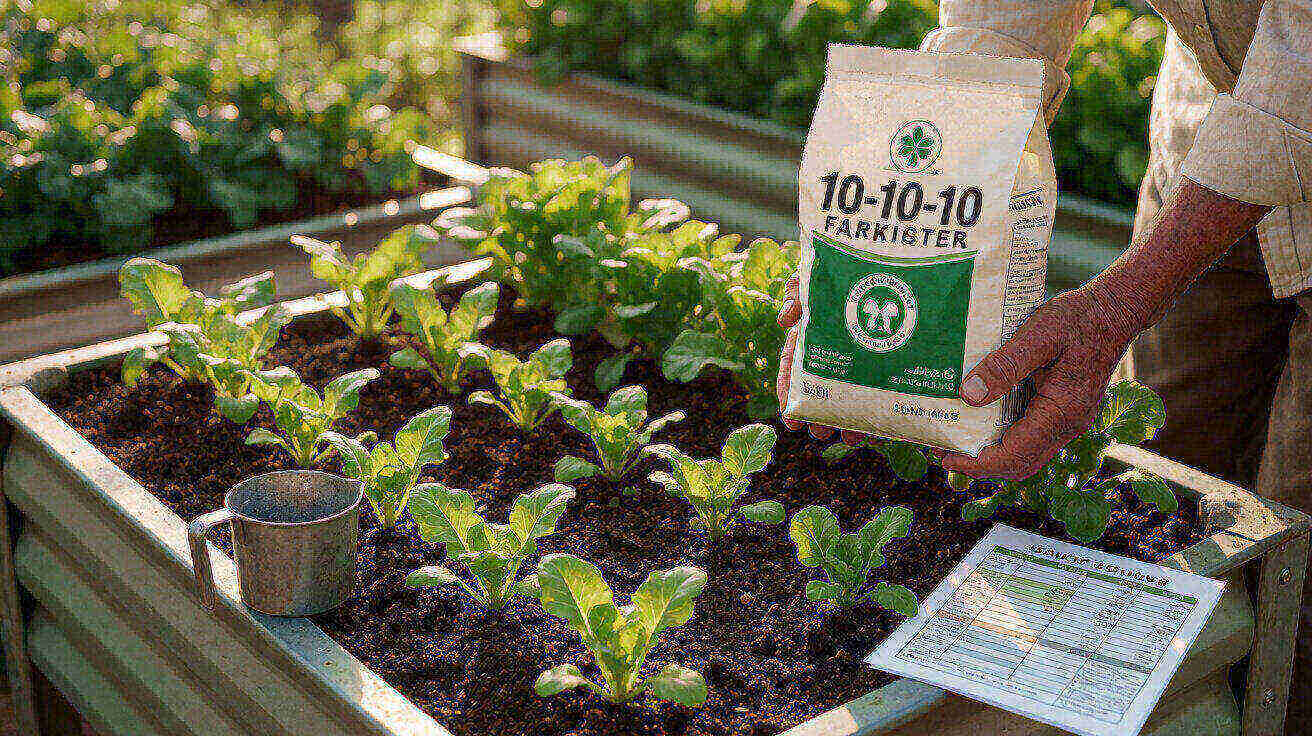

A fertilizer recommendation is a mass of nutrient, not product. A soil test reading “1 lb N per 1,000 sq ft” tells how much nitrogen the soil needs, and the bag you carry home is nitrogen, phosphorus, potassium, and filler mixed. The fertilizer application rate bridges those two: divide the recommendation by the decimal percent on the label, scale to your real area, and buy the bag that covers it. That is the whole method, from standard extension science.
Three unit errors cause most over-application: reading 1 lb N per 1,000 sq ft and spreading a pound of 10-10-10 (a tenth of the nitrogen); computing 10 lb per 1,000 sq ft and spreading 10 lb on a 100 sq ft bed (ten times the dose); and measuring the bed in feet instead of square feet, drifting by a factor of five. These are application-time unit problems, not plant problems.
Most growers treat the bag as the recommendation, seeing 10-10-10 and assuming the three numbers are doses. They are concentrations; the dose comes from them. The label is an ingredient list with percentages, not a prescription. Once you hold that distinction, the arithmetic is short, and the only hard part is measuring the bed honestly.
What a fertilizer recommendation actually tells you (and what it does not)
A recommendation from a soil test or extension guide is stated in pounds of nutrient per 1,000 square feet: nitrogen as N, phosphorus as P2O5, potassium as K2O. It travels farm to farm regardless of which fertilizer is on the shelf.
What the recommendation does not tell you is which bag to buy, how many pounds of product to spread, or whether your soil already holds enough of the other two nutrients. It is one number for one nutrient. If the soil test says 1 lb N per 1,000 sq ft, that is the whole instruction, and the rest is your arithmetic. A standard soil test does not even measure nitrogen, because nitrogen moves and leaches too fast; the nitrogen recommendation is a default based on crop and region, while phosphorus and potassium come from the actual test.
The practical upshot is that you never apply a bag to match a recommendation. You apply a calculated mass of product that delivers the recommended mass of nutrient. The bag is just the container the nutrient comes in.
The three numbers you need before you can calculate
You need three things, and none of them is the bag size. First, the recommendation: pounds of nutrient per 1,000 sq ft, from your soil test or an extension guide. Second, the fertilizer analysis, the three numbers on the front of the bag, such as 10-10-10 or 34-0-0. Third, the area of the bed in square feet. With those three you can compute the dose. Without any one of them you are guessing.
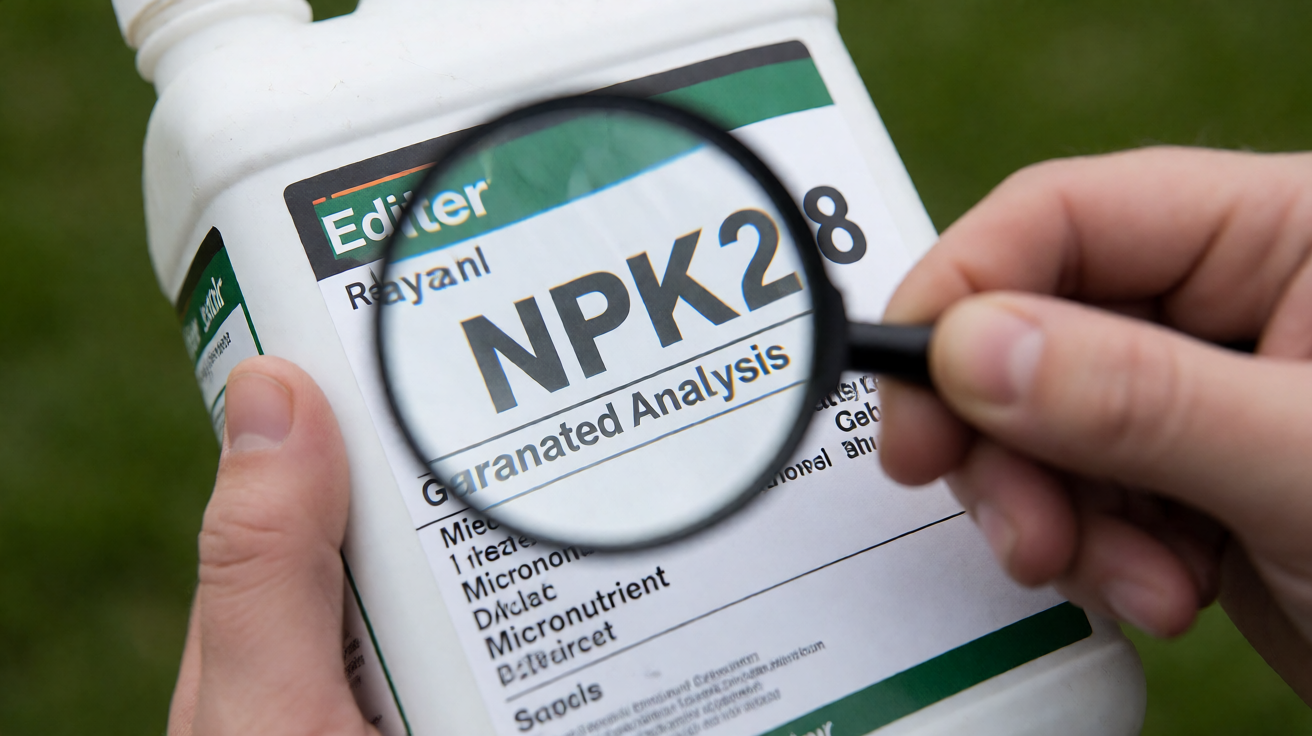
The analysis is a percentage by weight. A 10-10-10 bag is 10% nitrogen, 10% phosphorus as P2O5, and 10% potassium as K2O. To use it in the formula you convert the percent to a decimal: 10% becomes 0.10. That conversion is where most errors start, because the percent sign looks like a small number and the decimal looks like a large one, and the two get swapped. Write it down as 0.10 before you divide, and the swap cannot happen.
Measuring a bed that is not a rectangle
Area is length times width, but gardens are rarely rectangles. For an L-shaped bed, split it into two rectangles and add the areas. For a circle, use 3.14 times the radius squared. For a curved border, approximate with a rectangle that covers the longest and widest points, then trim 10 to 15% off, because overestimating area overestimates the dose and underestimating underestimates it. Round the final area down, not up: a smaller dose is the safer error.
The calculation, step by step
Step one, recommendation divided by decimal percent. This gives pounds of product per 1,000 sq ft. If the recommendation is 1 lb N per 1,000 sq ft and the bag is 10-10-10, you divide 1 by 0.10 and get 10 lb of product per 1,000 sq ft. That is the standard rate for that product against that recommendation, and it is the number every extension table publishes.
Step two, scale to your area. Multiply the per-1,000-sq-ft figure by your area, then divide by 1,000. A 100 sq ft bed takes 10 times 100 divided by 1,000, which is 1 lb of product. A 60 sq ft bed takes 0.6 lb. This is the step people skip, and it is the step that turns a correct calculation into a burned garden.
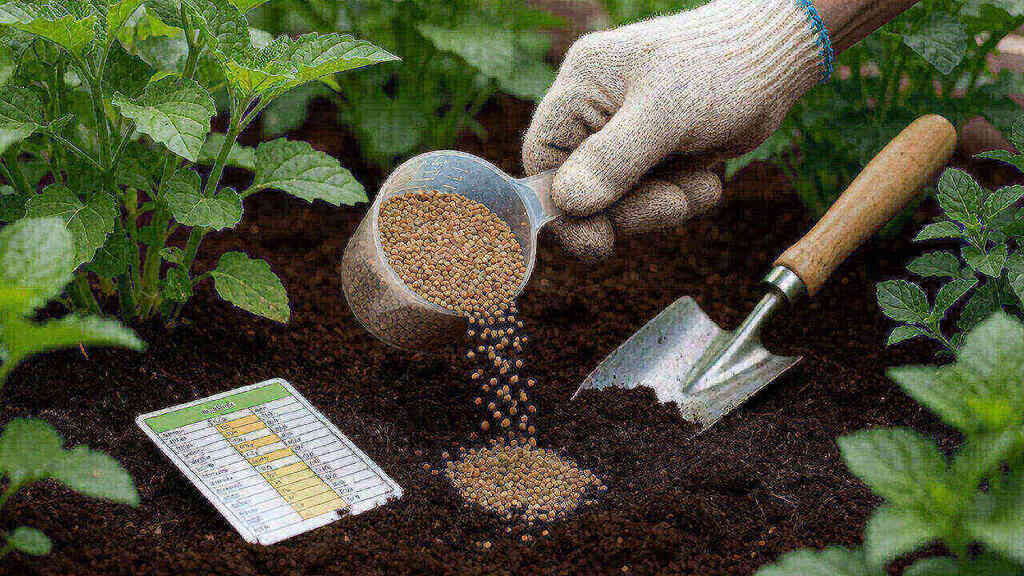
Step three, buy what you need. Convert the pounds to a volume you can measure in the garden. One cup of granular fertilizer weighs about half a pound, so 1 lb is roughly two cups, and 0.6 lb is a little more than one cup. If the dose is smaller than the smallest bag, buy the smallest bag and split it across several applications or several beds. If the dose is larger than one bag, buy the next size up and store the remainder dry.
A worked example, end to end
Take a 10 by 6 foot vegetable bed, which is 60 sq ft, with a recommendation of 1 lb N per 1,000 sq ft, and a bag of 10-10-10. The analysis is 10% nitrogen, so the decimal is 0.10. Step one: 1 divided by 0.10 equals 10 lb of product per 1,000 sq ft. Step two: 10 times 60 divided by 1,000 equals 0.6 lb of product for this bed. Step three: at half a pound per cup, that is about one and a quarter cups. You spread one and a quarter cups evenly over the 60 sq ft, work it into the top two inches, and water it in. That is the whole job, and the number on the bag was never the dose.
The same chain works for any analysis. A 34-0-0 bag at the same 1 lb N recommendation gives 1 divided by 0.34, or 2.9 lb per 1,000 sq ft, which is 0.17 lb on a 60 sq ft bed. A 24-8-16 bag gives 4.2 lb per 1,000 sq ft, or 0.25 lb on the same bed. The nitrogen recommendation stays the same; only the product amount changes.
When the recommendation is for phosphorus or potassium instead of nitrogen
The same formula works, with one extra conversion. Soil tests and extension guides often state phosphorus as P2O5 and potassium as K2O, and the bag states them the same way, so you can usually use the decimal percent on the bag directly. Divide the recommendation by the decimal percent for phosphorus or potassium and you have pounds of product per 1,000 sq ft, same as before.
If you ever need to convert the recommendation itself to elemental phosphorus or potassium, divide by 0.44 for P2O5 to P, or by 0.83 for K2O to K. Most home gardeners never need this, because the recommendation and the bag speak the same oxide language. The reason to know it is that a soil-test report from a university lab may print both, and you want to be sure you are not mixing elemental and oxide numbers in the same calculation.
One caution. When a recommendation lists both nitrogen and phosphorus and potassium, base the whole calculation on nitrogen and accept whatever phosphorus and potassium come along with it. That keeps you from over-applying the other two, which is the more common and more damaging error. If the soil test says phosphorus is already high, switch to a low-phosphorus or nitrogen-only product rather than trying to fine-tune the math.
The quick reference table
| Recommendation (lb nutrient per 1,000 sq ft) | Product analysis | Product per 1,000 sq ft (lb) | Product per 100 sq ft (lb) |
|---|---|---|---|
| 1 lb N | 10-10-10 | 10 | 1 |
| 1 lb N | 34-0-0 | 2.9 | 0.29 |
| 1 lb N | 24-8-16 | 4.2 | 0.42 |
| 2 lb N | 10-10-10 | 20 | 2 |
| 0.5 lb P2O5 | 0-46-0 | 1.1 | 0.11 |
The table assumes a single nutrient recommendation on a single product. Real beds often need two nutrients at once: pick the product covering the limiting one and accept the surplus of the other, or split the application across two products on different days.
The mistakes that put you over the line
Six errors account for almost every over-application. Confusing nutrient with product. Forgetting to scale from 1,000 sq ft to your actual area, over-applying by ten on a small bed. Double-applying by spreading a full dose then side-dressing with the same product two weeks later. Ignoring the soil test because the bag looked small. Applying to wet foliage, which concentrates salt on leaves and burns them even at a correct soil dose. And treating a per-1,000-sq-ft recommendation as per 100 sq ft, over-applying by ten the other way.
If you have already over-applied, the recovery is water, not more fertilizer. Leach the bed with a slow, deep watering over two or three days and let the excess nitrogen and salts wash below the root zone. For how to recognize the damage and what to do next, see signs of over-fertilization.
Containers and buckets
Containers have no meaningful square footage, and their root zone is a fixed volume of soil that dries and leaches on a different schedule. Measure fertilizer by volume of potting mix, not area, and use a dilute solution rather than granular product. A common starting point is a quarter-strength liquid feed every two weeks during active growth, about one quarter of the label’s recommended dilution. That is a starting point, not a soil-test-derived rate, and the one place here where the number is a rule of thumb rather than a calculation.
The same square-footage logic would over-feed a shallow pot, because the root zone is small and the fertilizer has nowhere to go but into the roots. If a container plant shows tip burn after feeding, halve the concentration and lengthen the interval.
What to read next
The arithmetic assumes you already understand the three label numbers, a separate skill. If not, read why the label numbers are not what they look like first. Still choosing a product? how to choose an NPK fertilizer covers format, grade, price. For timing, see when to apply fertilizer. For where nutrients come from and how to read the report, see soil testing and where plant nutrients come from. If pH is off, the right dose still will not work: check why soil pH changes nutrient availability. Weighing compost against a bag? compost or NPK fertilizer lays out the trade.
Sources and further reading
How to Calculate Fertilizer Rates for the Garden · Iowa State University Extension. The three-step method, the reference table, and the cup-weight conversion.
Fertilizing Guidelines · UMass Amherst Center for Agriculture, Food and the Environment. Recommendation units in pounds of N, P2O5 and K2O per 100 sq ft, and the recommendation-divided-by-decimal-percent method.
Fertilizing Vegetable Gardens · Mississippi State University Extension. Per-1,000-sq-ft normalisation and decimal scaling.
How to Tailor Fertilizer Recommendations to the Fertilizers You Have · Penn State Extension. Nutrient-by-nutrient calculation and basing the rate on nitrogen to avoid over-application.
Soil Fertilization for Garden Vegetables · Utah State University Extension. Per-1,000-sq-ft normalisation and P2O5/K2O framing.
Fertilizing the Vegetable Garden · Colorado State University Extension. Application rates and timing for home vegetable gardens.
Fertilizer Rates and Requirements for the Home Garden · Iowa State University Extension. Crop-specific recommendation ranges.
Read also: why the label numbers are not what they look like, how to choose an NPK fertilizer, why soil pH changes nutrient availability.
Last reviewed on 28 October 2026.
The actual number is the decision.
Read Also on Aqualogi
Related on the site, broken out by topic:
Start here: Unlocking the Magic of Essential Nutrients for Plants: Handbook for Thriving Gardens.
For the organic versus synthetic choice: Organic Fertilizer: Nourish Your Garden the Natural Way covers the quick guide, the organic advantage, the types, the impact on soil health, and how to use them.
For vegetables: Organic Fertilizer for Vegetables: Best Options and Application Guide covers why vegetables seem not to grow, how organic fertilizer works in soil, choosing by crop stage and by soil condition, and compost and worm castings.
For the schedule: Fertilizer Schedule by Plant Type: The Year-Round Feeding Calendar for 12 Categories covers the three universal rules, twelve plant categories, the seasonal calendar, the common mistakes, and knowing if it is working.
For choosing your source: NPK Fertilizer vs Compost: Which One Your Garden Needs covers how a concentrated fertilizer differs from a soil-building compost, and which one a bed needs.
For soil pH: Soil pH and Nutrient Availability: What Changes at Each pH covers how soil pH locks nutrients out of reach and which way to move it.
From Bank Statement to QuickBooks-Ready File
That manual cleanup you just read about? This tool skips it. Turn your PDF into QBO for QuickBooks without storing your data anywhere.
Start Converting