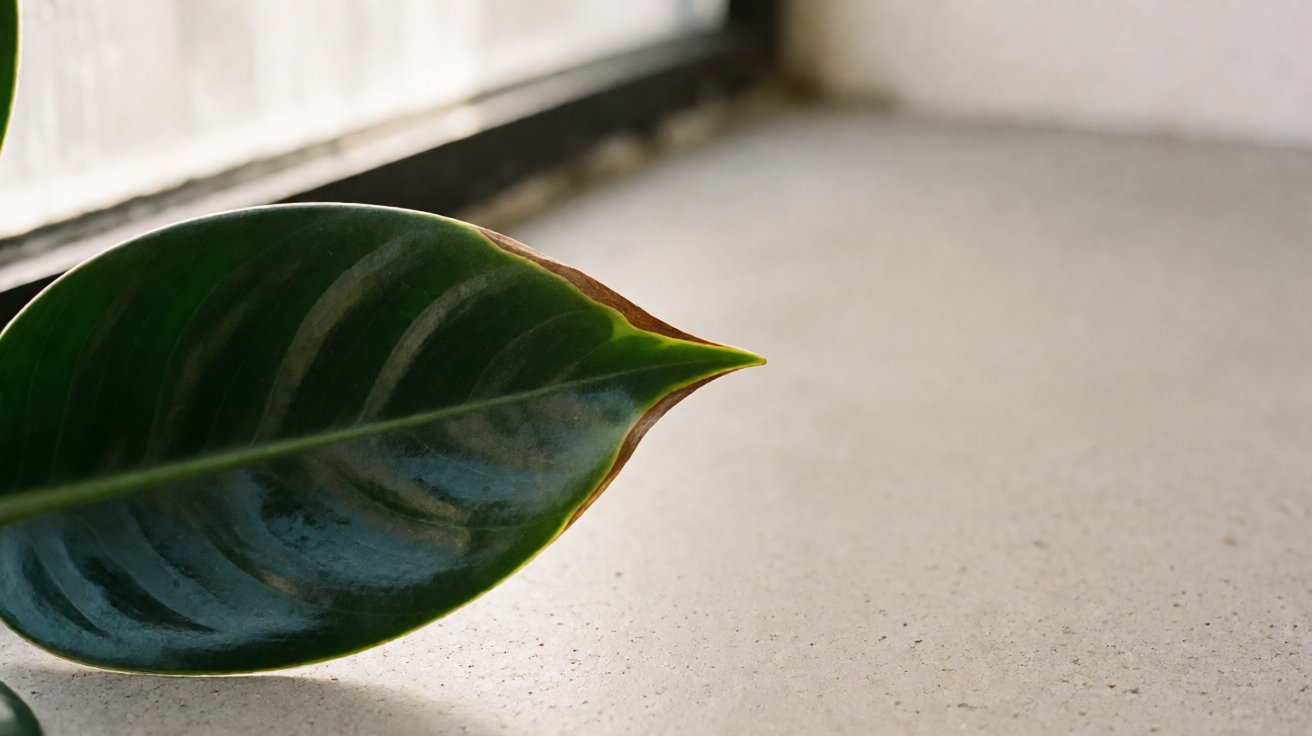

Brown leaf tips on a houseplant are not a watering problem. They are a transport problem, and the tip is simply the last tissue to arrive. Water moves through xylem from root to leaf under tension, and the margin and point of each leaf sit at the end of that column. When the column can no longer deliver, the tip dries out long before the leaf near the petiole does. That is why a plant can look perfectly green from across the room and be dying one millimeter at a time at the edge. One honest limit up front: brown tips that already exist will never turn green again. Everything below is about stopping the next one.
The frustrating part is that at least four different failures produce brown tips, and they look almost identical from the doorway. Too dry roots. Too wet roots. Salt build-up in the pot. Air that is drier than the plant evolved for. Each one kills the same tissue, at the same end of the same leaf, for completely different reasons, and the fix for one will make the other three worse.
So this article does not tell you which plant you own. It tells you which failure you are looking at. The four causes separate cleanly once you know to look at three things: whether the soil is wet or dry at two inches, whether a white crust has appeared on the surface or rim, and whether the newest growth is affected as hard as the oldest. Those three observations take about forty seconds and they split the four causes apart. Get them wrong and you will feed a plant that is drowning.
We will start with the reason the margin dies first, because that single fact explains the shape of the damage in every case below. Then four causes, then the test, then what each fix actually changes.
Why the tip is always the first thing to die
A leaf is not a uniform sheet of tissue fed from one opening. Each veinlet is its own irrigation line, and the water inside it is under negative pressure. That tension is what pulls mineral-laden water up from the roots against gravity, and it is the same physics that makes water move to the top of a straw. The tradeoff is that the further a cell sits from the plant’s hydraulic source, the thinner its share of the flow becomes.
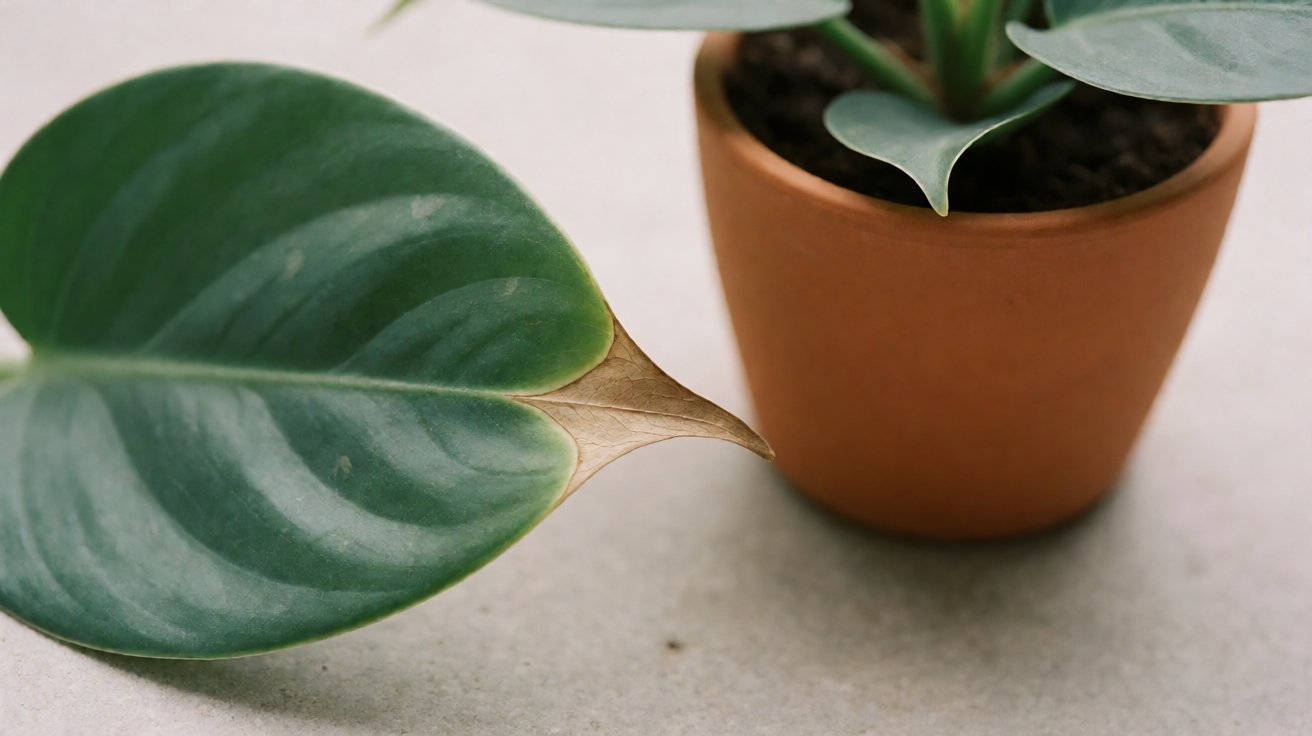
At the margin and especially at the point, that share approaches zero. These cells also have the least structural tissue behind them, and almost no capacity to shut down and protect themselves. When transpiration pulls more water out of the leaf than the xylem can replace, the deficit shows up there first. The tissue desiccates, cell membranes rupture, and the cells turn necrotic and brown. That is a tip burn. It is a hydraulic endpoint failure, not a disease.
Three things follow from that, and they are the whole diagnostic. First, tip burn is a symptom with four causes, never one. Second, the newest growth tells you the most, because new leaves are built with the thinnest margins and have no stored reserves to buffer a bad week. Third, a plant in dry air burns its tips faster than a plant in humid air, because dry air raises the vapor pressure deficit and accelerates the very loss the xylem has to repay. A Epipremnum aureum sold as a low-light plant is sold as a low-humidity plant too, which is not the same claim at all.
The four causes, and how they look different
Underwatering and overwatering both kill the margin. The distinction is not visible in the leaf. It is in the soil, thirty seconds after you pick up the pot. Salt build-up from fertilizer or tap water looks different in a way you can see without touching anything, because the salt does not stay in the soil, it migrates to the surface and the pot rim as the water evaporates. Low humidity produces damage that is gradual and symmetrical across every leaf at once, which no root problem does.
Here is the discrimination table. Read the soil and the crust columns before the leaf column, because the leaf is the least reliable evidence you have.
| Cause | Soil at 2 inches | Salt signs | Which leaves show it |
|---|---|---|---|
| Underwatering | Dry, light, pot feels light | None | Oldest leaves first, crisp and dry |
| Overwatering / root rot | Wet, heavy, may smell sour | White bloom on surface, rare | Oldest leaves first, soft and dark |
| Salt build-up | Normal to slightly dry | White crust on soil or rim | All leaves, tips and margins, hard brown |
| Low humidity | Normal | None | Newest growth worst, all leaves equal |
The row that catches people is the first two. Brown tips on old leaves with dry soil is a watering-volume problem. Brown tips on old leaves with wet soil is a root-rot problem, and feeding that plant more water finishes the job. Spathiphyllum is the species most often taught this lesson twice: it droops when it is dry, so people water a plant that was already drowning.
One thing no table can show you: the two potassium and calcium deficiencies also arrive at the margin, and they are not on this list because a container plant on a standard potting mix hits salt build-up first. The symptom looks the same until the crust appears. If your plant has never been repotted in two years, treat salt as your default hypothesis, because that is what two years of fertilizer and hard water produces.
The forty-second soil test
Push a finger to the second knuckle, about two inches in. This is the single most useful thing you can do for a houseplant and it costs nothing. Wet and cool means the roots have water, and a brown tip on wet soil is telling you about drainage, not thirst. Dry and warm means the plant has been relying on nothing but air for days, and the tip burned before you noticed.
Then look for the crust. White powder on the soil surface or on the inner rim of a terracotta pot is not mold and not a fertilizer deposit left by mistake. It is dissolved mineral coming up through the soil as the water evaporates from the top, leaving its heaviest components behind. Every watering moves more salt upward, and the salt never leaves the pot. A plant that has never been flushed in a year has been accumulating this the entire time.
Finally, compare the newest leaf to the oldest. If the newest leaf is the worst one, humidity or root rot. If the newest leaf is perfect and the oldest is burnt, your care was fine and something changed: a move, a cold snap, a missed watering, a shelf that got closer to a heat vent. Most tip burns have a date, and the damage shows up one to three weeks after whatever caused it. That lag is why people hunt for a cause the week it started and find the wrong one.
If you want the parallel read on the other common symptom, our yellow leaves diagnostic runs the same four-cause split from the leaf color side. Yellowing tells you about nitrogen and light. Browning at the tip tells you about the water column. They are separate failures and they often arrive together.
What each fix actually changes
Water the plant thoroughly and let it drain completely. Not a splash. Enough water to run out of the drainage hole, which is the only way the salt in the soil gets carried to the edge of the pot and out. Then empty the saucer. A plant sitting in a full saucer reabsorbs the salt you just flushed out, and the whole exercise does nothing.
Flush the pot on a schedule if you use tap water. Most apartment water is somewhere in the middle of the hardness range, and the fluoride and chloride in it accumulate in a pot that never drains to a storm drain. Our watering schedule by species covers the interval per species, but the flush is a separate job from the schedule and it does not care how often you water. Once every two months is enough to keep the root-zone EC from drifting. A Dracaena massangeana in a pot that has never been repotted will show the crust within a year.
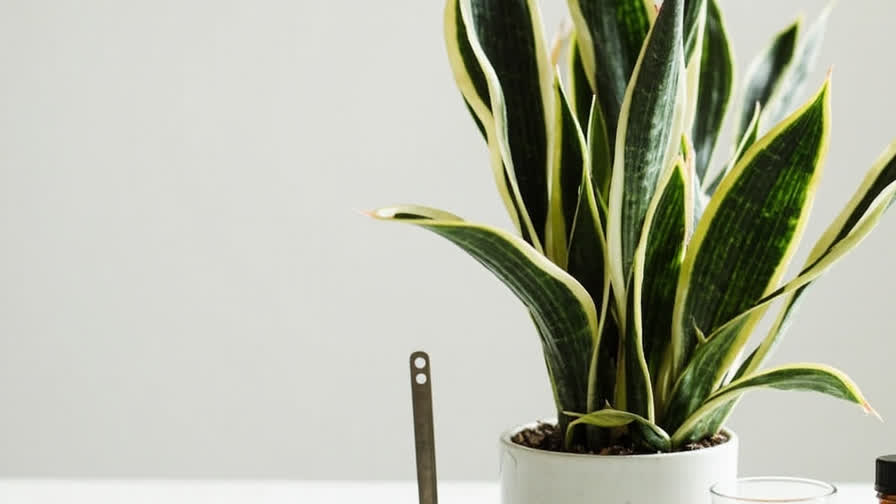
Humidity is a physical fix, not a misting fix. Misting raises humidity for eleven minutes and wets the leaves, which the plant cannot use and the fungus can. A pebble tray works because the water evaporates around the plant rather than on it. Dracaena trifasciata tolerates a dry shelf so well that people stop watering it, while Chlorophytum comosum burns its tips in the same room, and neither failure is a watering bug. A shelf in a bathroom works because the room is already humid. If you want to understand why the margin burns faster in dry air, read the indoor plant light requirements guide for the companion variable, because light drives the transpiration rate that sets how hard the xylem is working.
Trim the dead tips back to live tissue with clean shears, cutting just above a node where new growth can emerge. A brown tip is dead tissue, and it stays there. Leaving it does not hurt the plant, but removing it tells you where the damage stops, which is how you measure whether your fix worked over the next two weeks.
And if the pattern is a fertilizer crash rather than a water-column problem, that is a different failure with a different recovery. Our fertilizer burn recovery guide covers flushing the root zone and the four-week hold on feeding.
Why your plant’s tips died in a specific week
Tip burn always lags its cause. The damage you are looking at today was priced one to three weeks ago, which is why the hunt for the cause usually fails. The move to a new window, the week you were away, the cold night with the AC on, the shelf that got closer to the radiator. By the time the margin goes brown the event is over and the plant is telling you about last month.
Which is the useful part. You cannot undo that event, but you can name it, and you can check whether it will happen again. The plant that burned during a cold snap will recover on its own once the new leaves come in clean. The plant that burns on every new leaf is still in the condition causing the burn, and the new growth will tell you that within three weeks of your fix.
So count from the newest leaf, not from today. Mark the first clean new leaf with a piece of tape when it unfurls. That is your new baseline, and every future diagnosis starts from it. If your plant has never had a clean leaf since you brought it home, the problem is not a bad week. It is a standing condition, and the four causes above are where you look first.
Your plant is not dying from the tips. It is telling you the water stopped arriving, and the tip is just the tissue that ran out first. Find which of the four it was, and the next leaf comes in clean.
If you are still deciding where a plant goes in the first place rather than rescuing one that is already struggling, our indoor plant care guide covers the four variables that decide whether a tip ever browns.
Turn PDF Bank Statements Into Workable Spreadsheets
Your bank statement is a mess of numbers, but your books shouldn't be. Use our converter to get Excel, CSV, or QBO files — ready for QuickBooks.
Try It Free Now