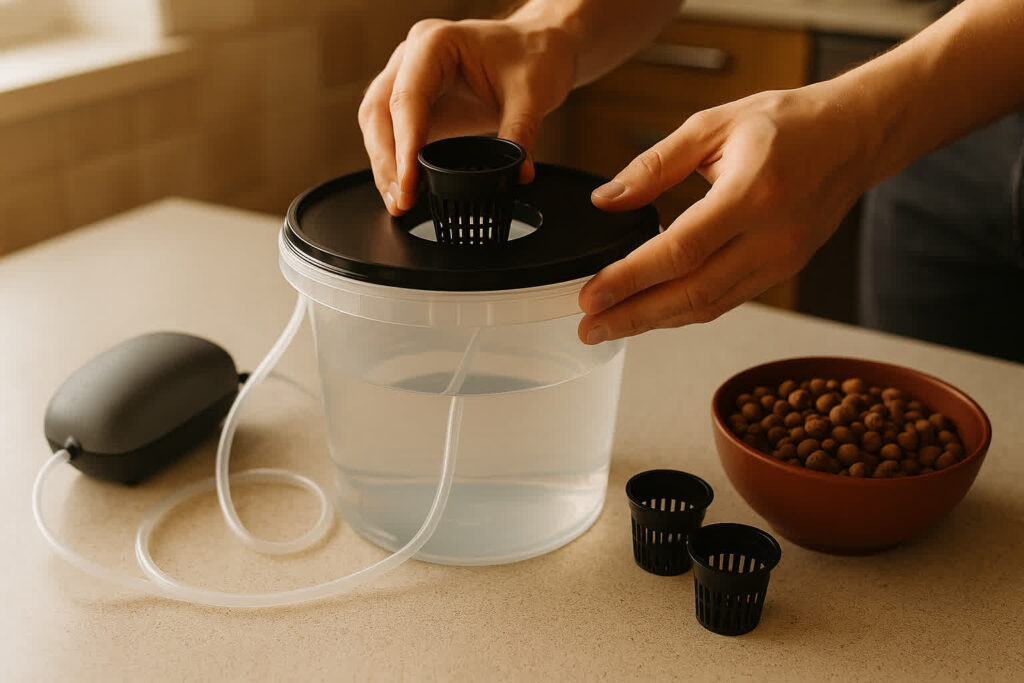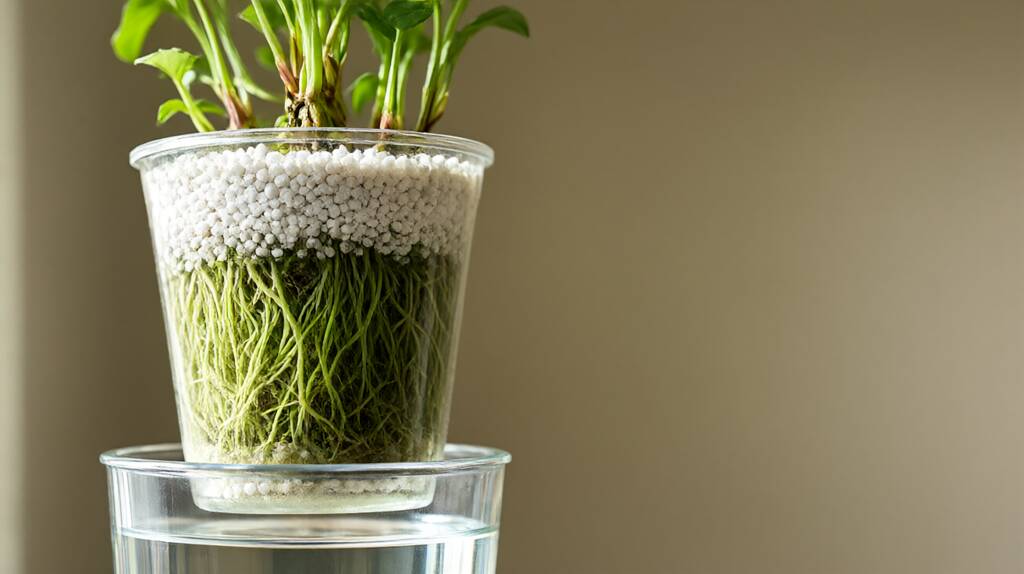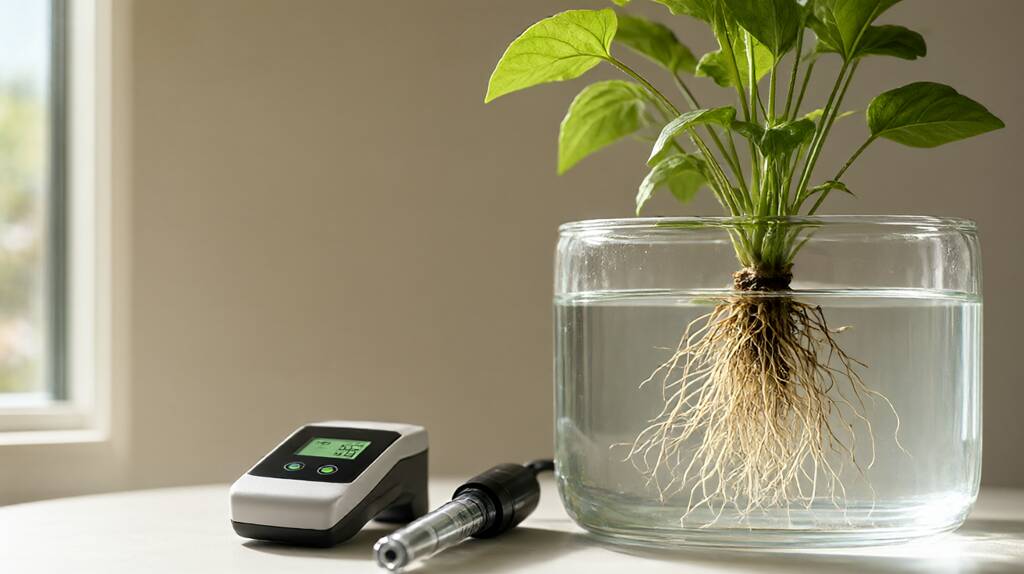

A hydroponic nutrient solution is three things at once: a solvent, a salt solution, and a pH buffer. Get the concentration wrong and the plant starves or burns. Get the pH wrong and the plant starves even when the concentration is perfect, because the ions lock up in forms the roots cannot absorb. The recipes below are the starting points that keep all three in range for a beginner reservoir.
Two failure modes follow. The first is concentration drift: as plants drink water faster than they drink nutrients, the solution gets saltier and the EC climbs, sometimes past the point where roots can take up water at all. The second is pH creep: nutrient uptake is not chemically neutral, and a reservoir that starts at pH 6.0 can slide to 7.5 within a week, locking out iron and manganese. Both are invisible until the plant shows symptoms, and by then the damage is done.
Most beginners get one thing wrong: they buy a complete nutrient and assume the label dose is correct for their water. It is not. Tap water carries calcium, magnesium, and sometimes sodium that the label assumes are absent, and the real dose is lower than the bag says. Start at two-thirds of the label rate and measure.
The Three Numbers You Manage
Every reservoir is governed by EC (electrical conductivity, a proxy for total dissolved salts), pH (acidity, which controls ion availability), and temperature (which controls dissolved oxygen and root metabolism). For most leafy greens and herbs:
- EC: 1.0 to 1.6 mS/cm for herbs and lettuce; 1.8 to 2.4 for fruiting crops.
- pH: 5.5 to 6.0 for most crops; 5.8 to 6.3 is acceptable.
- Temperature: 18 to 22 C (64 to 72 F) in the reservoir.
EC and pH move independently, and you adjust them independently. Raise EC by adding nutrient concentrate; lower it by adding water. Raise pH with potassium hydroxide (pH Up); lower it with phosphoric or citric acid (pH Down). Adjust pH after the nutrient is mixed, because the nutrient itself shifts pH.
Recipe 1: Two-Part Complete Nutrient (the Standard)
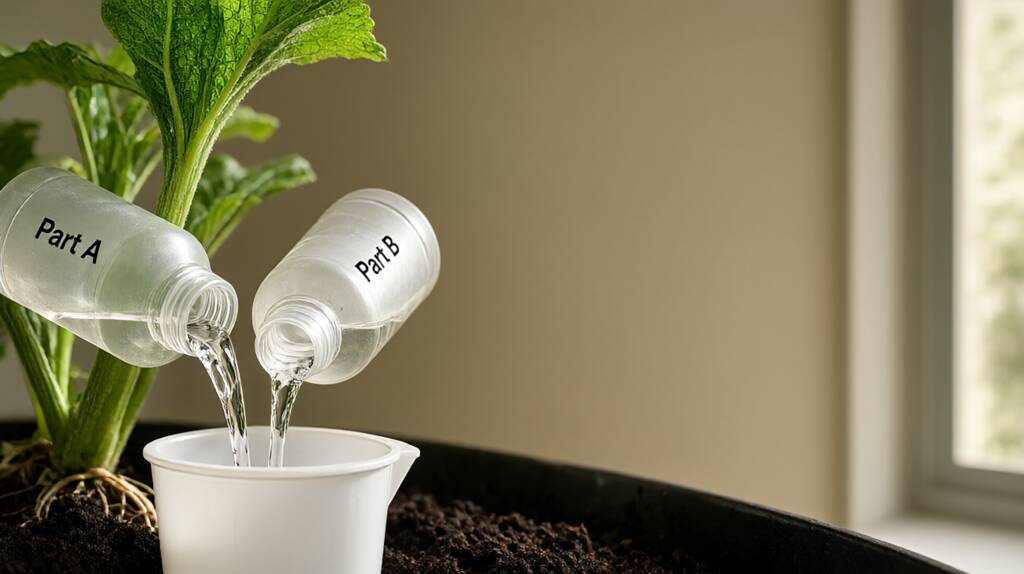
The most reliable beginner recipe uses a commercial two-part hydroponic nutrient (Part A and Part B) mixed into water. Two-part formulas exist because calcium and sulfate precipitate if mixed in the same concentrate; keeping them separate until the reservoir prevents that.
Method: fill the reservoir with water, measure and record the starting EC and pH, add Part A at half the label rate, stir for thirty seconds, add Part B at half the label rate, stir again, then adjust pH to 5.5 to 6.0. Wait fifteen minutes and recheck, because nutrients continue to react after mixing.
Start at half the label rate for the first reservoir. If the plants show pale new growth after a week, raise to two-thirds. If the leaf tips burn or the EC climbs above 2.0 mS/cm within three days, dilute with water. The right dose is the one that holds EC stable for a week with healthy growth, and that number is specific to your water and your crop.
Recipe 2: Dry-Salt Mix (Cheaper, More Control)
For growers who want to mix from dry salts, the standard recipe per 100 liters of water is:
- Calcium nitrate: 60 to 80 g
- Potassium nitrate: 30 to 40 g
- Magnesium sulfate (Epsom salt): 25 to 35 g
- Monopotassium phosphate: 15 to 25 g
- Trace element mix (chelated micronutrients): 1 to 2 g
Dissolve the calcium nitrate and the monopotassium phosphate in separate containers of water first, then add to the reservoir in order: calcium nitrate, magnesium sulfate, potassium nitrate, monopotassium phosphate, trace mix. Adding calcium nitrate and phosphate together in concentrate form causes precipitation. Stir between each addition and check EC after the full mix; target 1.2 to 1.6 mS/cm for leafy greens.
These ratios are a starting point, not a prescription. The exact balance depends on your water chemistry, and a water test for calcium, magnesium, and sodium before you mix your first batch saves a season of guessing.
Recipe 3: Organic Inputs (Slower, for Soilless Media)
Organic hydroponic nutrients (fish emulsion, seaweed extract, worm casting tea) feed the microbes in the medium rather than the plant directly. They work in media-based systems (coco coir, perlite, rockwool) where biology has a surface to colonize, and they fail in pure water culture because the breakdown products clog emitters and crash oxygen levels.
If you use organic inputs, dose at one-quarter to one-half the rate of synthetic nutrients and monitor EC daily for the first two weeks. Organic solutions swing in concentration as microbes digest the input, and an EC that reads 1.2 mS/cm today can read 2.5 mS/cm tomorrow. Start low, measure often, and dilute aggressively.
Managing pH Drift
Nutrient uptake is electrochemically active. When roots absorb a nitrate ion, they release a hydroxide ion in exchange, which raises pH. When they absorb ammonium, they release a hydrogen ion, which lowers pH. Most hydroponic nutrients are nitrate-based, so pH rises over time.
Check pH daily for the first week, then every two to three days once the pattern is stable. Adjust in small steps: 0.2 pH units at a time, wait an hour, recheck. Large adjustments overshoot and stress the roots. If pH refuses to hold, the reservoir may be undersized for the plant load, or the water may have high alkalinity (bicarbonate) that buffers against change. A water test for alkalinity tells you which.
Managing EC Drift and Top-Up
Plants drink water and nutrients at different rates. In the first week of a new crop, water uptake dominates and EC falls. In mid-cycle, nutrient uptake catches up and EC rises. Top up with plain water when EC climbs above target, and with diluted nutrient when EC falls below. Never top up with full-strength nutrient without measuring, or you will salt-burn the roots.
Replace the entire reservoir every two to three weeks, or sooner if the solution turns cloudy, smells sour, or the EC will not stabilize. A full change resets the chemistry and clears accumulated salts and byproducts.
Common Mistakes
Mixing the full label dose into hard tap water
Hard tap water already carries 100 to 300 mg/L of calcium and magnesium. Adding a full dose of nutrient on top pushes EC past 2.5 mS/cm and burns roots within days. Test your water first, and reduce the nutrient dose to compensate.
Adjusting pH before mixing the nutrient
The nutrient shifts pH by 0.5 to 1.0 units on its own. Adjusting first means adjusting twice. Mix the nutrient, wait fifteen minutes, then set pH.
Using pH Down daily without fixing the cause
If pH rises every day, the reservoir is too small or the plant load is too high. Adding acid daily treats the symptom and lets the underlying problem grow. Increase reservoir volume or reduce plant count.

Ignoring temperature
A reservoir at 26 C (79 F) holds roughly 20% less dissolved oxygen than one at 20 C (68 F). Roots suffocate in warm water even when every nutrient is correct. Keep the reservoir in shade, insulate it, or use a chiller in summer.
What to Expect in the First Week
A new reservoir with a correct mix and pH in range should hold stable for three to five days before the first adjustment is needed. If EC or pH moves significantly within twenty-four hours, the mix or the water source is the problem, not the plant. Recheck the measurements, retest the water, and adjust the recipe before changing anything else.
The solution is the plant’s entire environment. Treat it like the plant, not like water.
Sources and further reading: Oklahoma State University Extension, hydroponic nutrient management publications; University of Arizona Controlled Environment Agriculture Center, nutrient solution guidelines; University of Florida IFAS Extension, hydroponic crop production; Penn State Extension, hydroponic systems and nutrient management.
Last reviewed on 2026-11-21