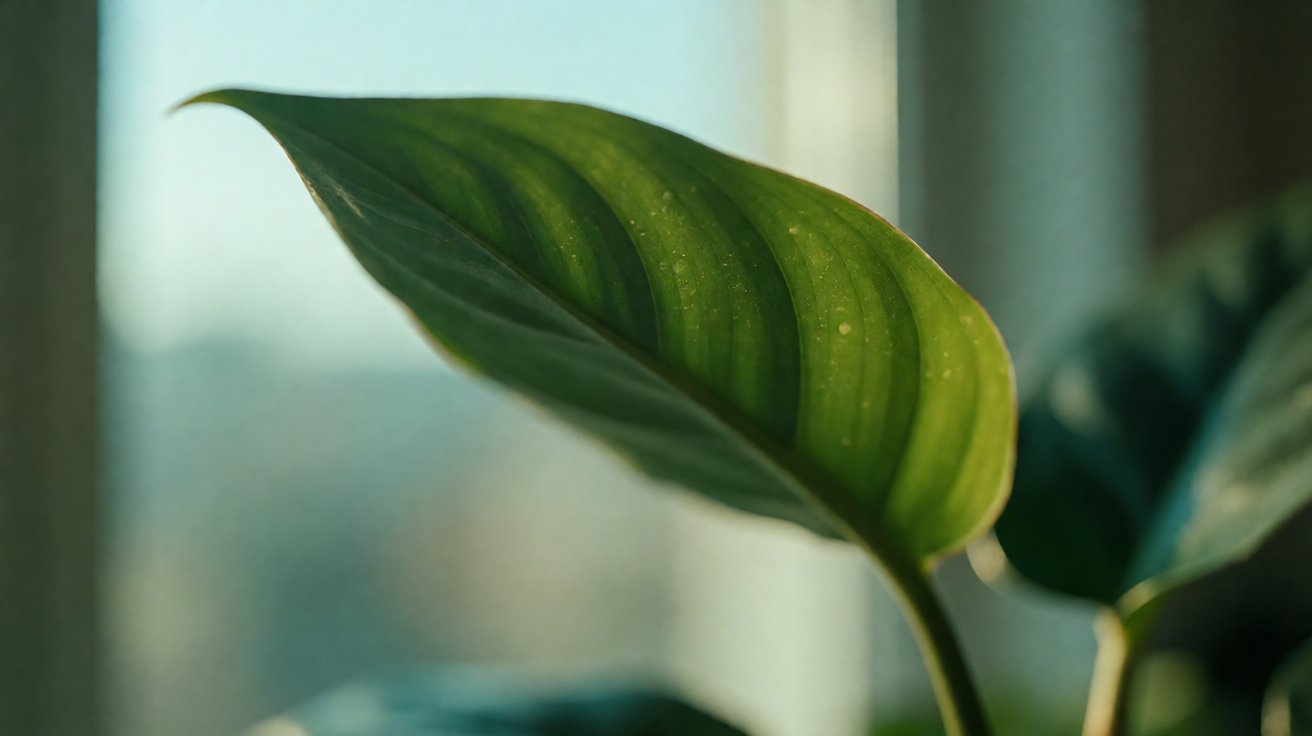

A sticky patch on a houseplant leaf is almost never the plant’s fault. It is the leftover meal of an insect that ate above where you are looking. The leaf you can feel is the floor of someone else’s kitchen. The kitchen itself sits somewhere along the stem or the underside of a leaf higher up, and it has usually been open for weeks.
The substance on your finger is honeydew: a sugar-rich, sticky excretion produced by sap-sucking insects as they feed. Phloem sap (the sugary transport fluid inside a plant) is loaded with sucrose, typically 250 to 800 millimolar in species like Epipremnum aureum, and only loosely loaded with amino acids, often 1 to 5 millimolar. The insect gut is hungry for nitrogen, not sugar. The sugar passes through and comes out the back end as honeydew, then drips downward onto whatever leaf or shelf sits below. That is the entire chain. Once you can name the chain, sticky stops being a mystery and starts being a search problem.
Three failure modes follow. The first is treating the wrong thing: people wipe the sticky leaf, throw away the sooty mold, spray for fungus, and miss the insect still feeding above. The second is panicking over a plant that is doing exactly what healthy plants do: pushing water out through leaf-tip pores overnight as guttation, which can leave a faint, slightly tacky residue at the leaf edge in the morning. The third is under-treating: the colony is small enough to look like nothing, but honeydew keeps appearing on the same shelf a week later.
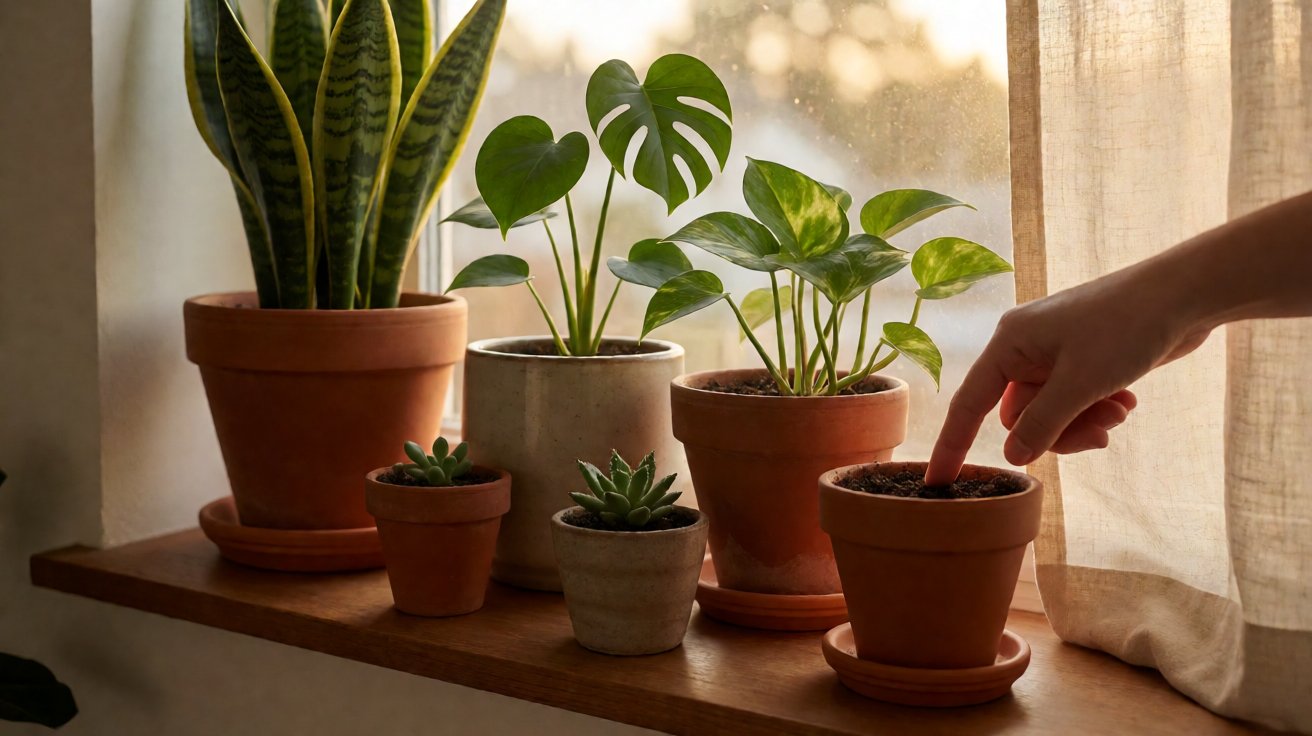
This page is the diagnostic hub. It owns the sorting stage for sticky leaves, the same way the yellow-leaves, droop, leaf-drop, and curl hubs own theirs. Pest-by-pest identification, neem-oil recipes, species-specific care all live on the linked pages. Here, the only job is to ask the leaf where it got sticky and what was sitting above it. Done in 60 seconds with a flashlight and a fingertip.
Sticky Is Honeydew Until the Leaf Proves Otherwise
The default assumption is a sap-feeding insect. This is not a guess, it is a frequency. The University of Minnesota Extension lists honeydew as the diagnostic clue for aphid, scale, and mealybug infestations specifically because it is what those insects leave behind. Whiteflies do the same. Four insect groups account for the vast majority of sticky-residue reports on indoor plants. So when you find a sticky leaf, the question is not “is this a pest” but “which pest, and where is it feeding.”
Two pieces of evidence settle the question fast. First, location: where on the plant is the stickiness concentrated? Honeydew drips downward, so a sticky patch on the floor of the pot or on a lower shelf while the upper leaves are clean is a near-certain pest signal. Honeydew on a leaf itself, with no insects visible, means the insect is sitting above or under that leaf on the stem. Second, presence of bumps, cottony tufts, or tiny flies: anything visible on the stem or underside of a leaf within 30 centimeters of the sticky patch is the insect producing the honeydew.
If neither piece of evidence is present, you are looking at one of the three false alarms. But default to pest first, and check the plant again in 48 hours. Honeydew keeps appearing. Guttation does not.
The Three Pest Profiles: Bumps, Cotton, and Flyers
Each of the four honeydew-producing pests leaves a different signature. The signature is identifiable by eye, even without a magnifier, on a healthy indoor plant.
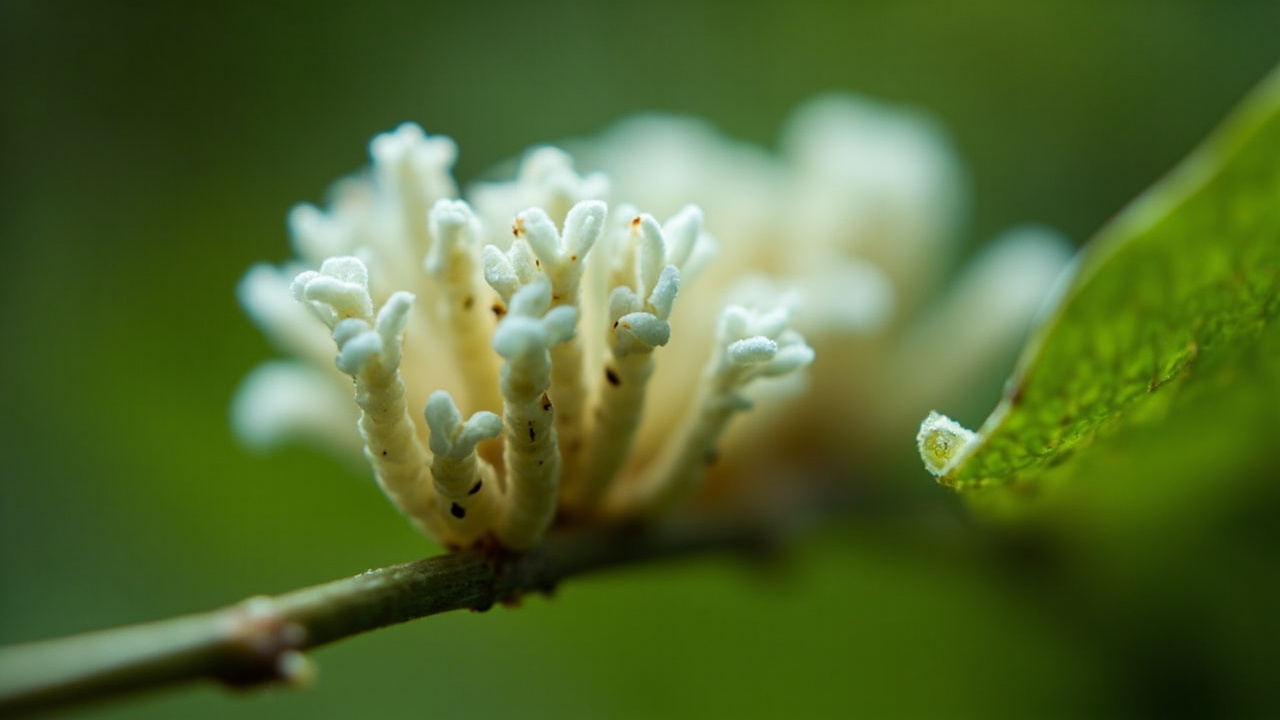
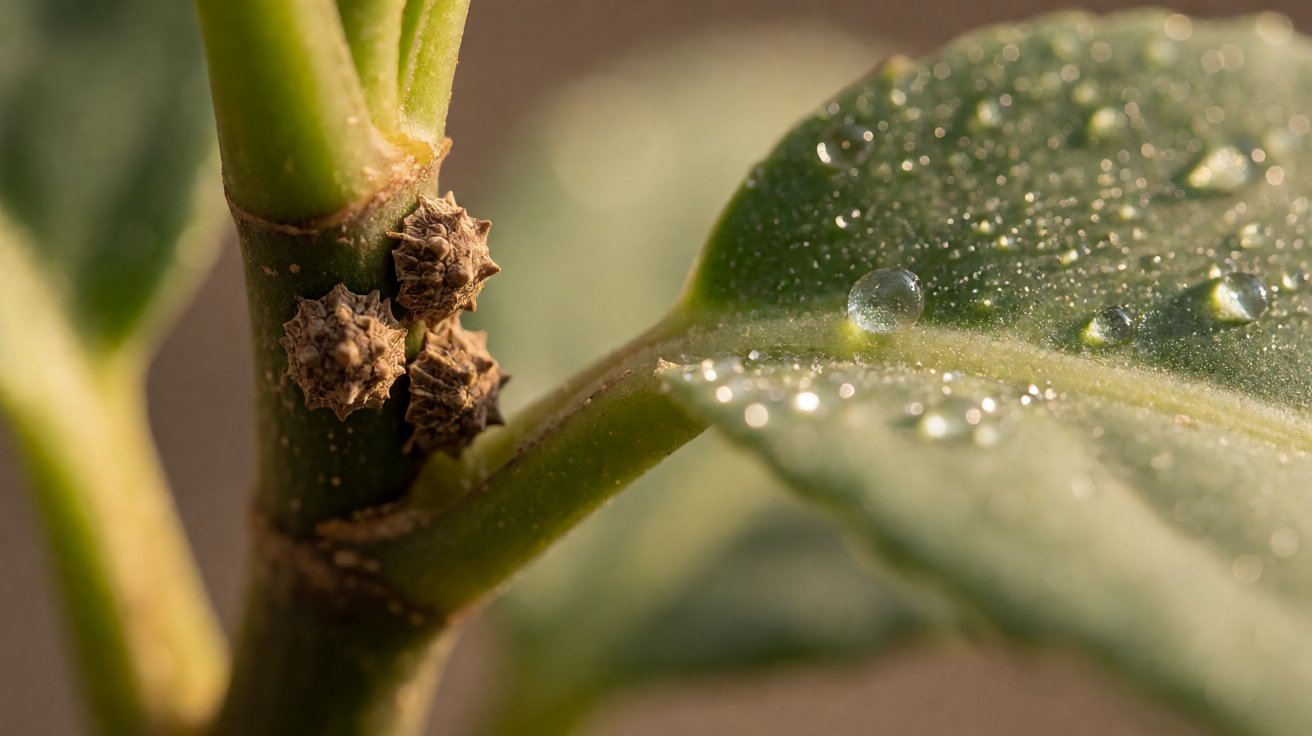
Scale insects are the most common cause of sticky leaves with no obvious bugs. Soft brown scale (Coccus hesperidum) looks like small tan or brown bumps, 2 to 5 millimeters long, along stems and leaf veins. They do not move. They sit flush against the plant surface and are easy to mistake for a woody ridge or a small scar. The discriminator is mechanical: scratch one with a fingernail. If it lifts off clean, with a soft shell underneath, it is scale. If the bump does not move, it is part of the plant.
Mealybugs (family Pseudococcidae) look like tufts of white cotton in leaf axils and along undersides, often with a sticky sheen nearby or on the leaves below. They are slow-moving, oval, and 3 to 5 millimeters long. The cotton is the giveaway. They tend to colonize where the leaf meets the stem first, which is also where honeydew accumulates before dripping. A mealybug colony can be wiped out with a cotton swab dipped in 70 percent isopropyl alcohol, but only at small scale; a heavy infestation needs the pest treatment page.
Aphids are soft, pear-shaped insects 1 to 3 millimeters long, green or black or pink, clustered on new growth, buds, and stem tips. They reproduce without mating in summer and a small colony becomes a large colony in two weeks. The shed white skins they leave nearby are an additional clue. The cluster sits visibly on the soft new tissue; the sticky residue appears on the leaves below the cluster where the honeydew is dripping onto.
Whiteflies (Trialeurodes vaporariorum) are tiny white moth-like insects that fly up in a cloud when you brush the plant, with flat, scale-like nymphs feeding underneath the leaves. A still plant can look clean and clear; a touched plant erupts in a small white snow flurry. Whiteflies are also honeydew producers, so the sticky residue below their feeding sites confirms the cause even if you only manage to glimpse them on first disturbance.
The False Alarms: Guttation, Nectar, and Shine Spray
Three things produce stickiness on a houseplant leaf that is not a pest, and the difference between these and honeydew is mostly in location and timing.
Guttation is a plant pushing excess water out through specialized pores called hydathodes at the leaf tips and edges, usually overnight. The droplets are clear, sit at the leaf margin in a regular pattern, and dry to a faint, slightly sticky or crusty residue by late morning. There are no insects anywhere on the plant. Guttation is common on Epipremnum aureum, Monstera deliciosa, Alocasia, and ornamental grasses. The discriminator is timing: if the residue is there at 7 a.m. and gone by noon, with no dripping from anywhere else on the plant, it is guttation.
Nectar is the second false alarm. Some plants secrete sweet droplets from extrafloral nectaries (small glands on the leaf or stalk outside the flower) as a normal part of growth. Hoya carnosa blooms drip nectar heavily onto the leaves below; passionflower, some ferns, and certain orchids produce small sugary drops on stems and buds. This is normal and harmless. The giveaway is context: droplets appear only on flower buds, stalks, or specific leaf bases, never on leaves themselves, and there is no insect on the plant.
Leaf-shine spray or fertilizer residue from foliar feeding leaves a tacky film on the top of the leaf. The discriminator is location: pesticide or foliar residue sits on the upper surface where it was sprayed, while honeydew appears scattered on the upper surface of leaves below a colony. Same chemistry (sugars and oils), different geometry.
When in doubt, the leaf tells you in 48 hours. Honeydew keeps returning to the same spot because the source is still feeding. Guttation stops when watering decreases. Nectar stops when the flower finishes. Shine spray stops the next time you skip the spray.
The Black Dust on the Lower Leaves Is Not a Disease
If you have had a sticky plant long enough, the leaves below the sticky patch, sometimes the stems, sometimes the floor, will start to grow a black, soot-like film. This is sooty mold, a complex of fungi in the genus Capnodium and related genera. Sooty mold does not parasitize the plant. It does not penetrate the cuticle or steal nutrients. It feeds on honeydew, plain and simple. Honeydew lands on the leaf, the fungus colonizes the sugar, and a black mat grows in two to four weeks.
The implication is direct: sooty mold is a symptom, not a pathogen. Treating the mold alone does nothing. The fungus will regrow as long as honeydew is dripping onto the leaf. The treatment sequence is: identify the pest above (which this page is helping you do), reduce the pest population to the point that honeydew production slows, then the mold weathers away on its own over the following weeks as both it and its food source dry out.
Wiping sooty mold off a leaf with a damp cloth is fine for cosmetic reasons and improves light capture on the leaf, which matters in low-light indoor settings. The University of Maryland Extension confirms: removing the mold does not harm the plant, the plant is not infected, and new growth will eventually conceal the damaged older leaves.
This is also why a sticky plant is rarely a one-step problem. Honeydew invites sooty mold. Sooty mold signals ongoing pest feeding. Treating the leaf instead of the insect above is the single most common reason a sticky plant stays sticky for months.
What to Do Once You Have Named the Cause
If you named scale, mealybugs, aphids, or whiteflies, the diagnosis is done. The treatment plan is on the pest-treatment pages. A short version, in priority order:
- Isolate the plant from other houseplants. Honeydew pests spread by the winged adults flying or by physical contact when leaves touch. A single infested plant can become a six-plant infestation in three weeks.
- Rinse the plant under a showerhead at lukewarm temperature, supporting the stem with your fingers so the root ball does not fall out. This physically removes a large fraction of aphids and whitefly adults and dislodges scale nymphs.
- For scale and mealybugs, dab each visible insect with a cotton swab dipped in 70 percent isopropyl alcohol. This kills them on contact. Tedious but cheap.
- Apply insecticidal soap or neem oil to leaf undersides and stem joints, where the insects actually feed. Coverage matters more than concentration. Multiple weekly applications are typical.
- Recheck at 7 and 14 days. Honeydew is the test: if it stops appearing, the population is below the threshold. If it returns, repeat from step 2.
If you named guttation, the diagnosis is also done. The plant is fine. Reduce watering frequency slightly if the guttation is heavy, but do not change light or humidity.
If you named nectar, do nothing. The plant is doing what Hoya carnosa does, and it does not need rescuing. Wipe the leaves for cosmetic reasons if you prefer.
The honeydew test at 7 days is the readable marker. If a sticky leaf stopped being sticky, the cause was named. If the same sticky leaf is sticky again, you named the wrong pest or you treated leaves instead of insects.
When to Bring in Another Page
This hub is built to sort. Three handoffs cover most of what you will need next. If honeydew is confirmed and you need a step-by-step treatment recipe plus the spray-vs-soap-vs-oil decision, the pest treatment page is the next stop. If the sticky leaves are on a specific plant you want to keep alive for years (a Ficus elastica, a Schefflera arboricola, a citrus tree), the species care page handles the broader pattern of where that particular plant tends to attract pests. If the sticky leaves are paired with yellowing, dropping, or curling and you are not sure which symptom to start with, the diagnostic hub for that symptom is the page to read next.
What this page is not: it is not a pest encyclopedia. It is not a recipe for neem or insecticidal soap ratios. It is not a species index. It is one question with one decision tree: where is the sticky, and what is sitting above it. Run the test, name the cause, hand off to the right page.
The sticky leaf is the message. The leaves above it are the answer. Read upward, not downward, when you wipe.
Where to read next: the common indoor plant pest identification and treatment page walks through the spray-and-soap recipes once the pest is named; the yellow-leaves diagnostic, the brown-tips diagnostic, the drooping diagnostic, the leaf-drop diagnostic, and the curling diagnostic each take a different symptom through the same cause-sorted process, and the bird of paradise toxicity page walks through the species-specific questions that arise when sticky shows up on a Strelitzia. The hydroponic farming at home guide and the first-30-days bucket guide show how the same honeydew-vs-guttation test plays out in a soilless setup, since sap-sucking insects follow the plant regardless of the root medium.
From Bank Statement to QuickBooks-Ready File
That manual cleanup you just read about? This tool skips it. Turn your PDF into QBO for QuickBooks without storing your data anywhere.
Start Converting