Spotting damage on your blueberry bush and wondering what’s actually eating it? Most blueberry pest problems get misidentified early — and the wrong treatment either does nothing or makes the infestation worse.
This guide covers the seven pests most likely to show up in a home garden, the specific damage pattern each one leaves behind, and exactly what to do about each one.
Blueberry bushes attract fewer serious pests than stone fruit trees, but when something does move in, it tends to be mistaken for a nutritional deficiency or fungal disease.
The difference matters: a nitrogen-deficient bush needs feeding. A vine weevil infestation needs targeted insecticide. Treating the wrong cause compounds the real problem.
For the companion plant strategies that reduce pest pressure naturally, see our best blueberry varieties for home gardens.
The Seven Pests Most Likely to Infest Blueberry Bushes
The most common blueberry pests fall into three groups: sap-feeders that weaken the plant slowly, fruit-feeders that damage the harvest, and stem-borers that can kill individual canes outright. Knowing which group you’re dealing with narrows the solution fast.
Sap-Feeding Pests
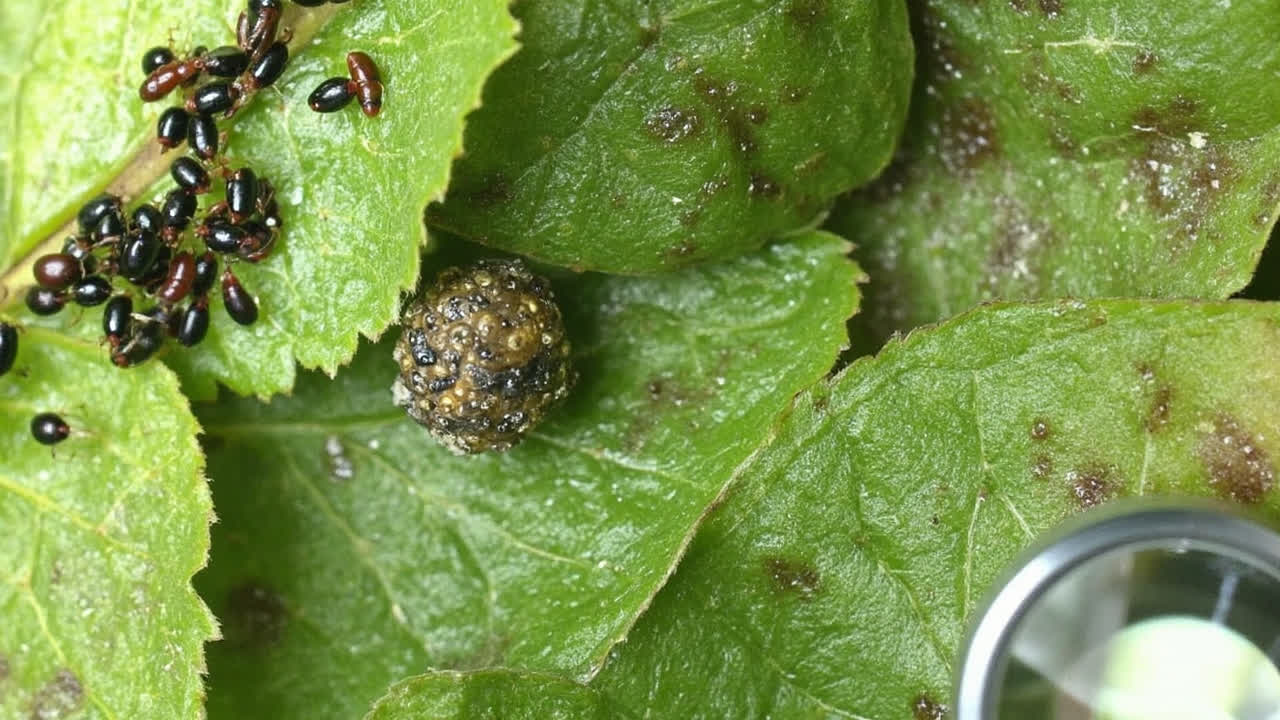
Blueberry aphids are the most frequent sap-feeders on blueberry bushes. They’re small, soft-bodied, and cluster on the undersides of young leaves and on new growth. The first sign is usually curled or distorted leaves — the aphid feeds by sucking phloem, and as the population grows, the leaves cup upward to protect the insects underneath.
Aphids also deposit honeydew: a sticky, shiny residue on leaves below the infestation. If you notice a sticky film on blueberry leaves with black sooty mold growing on it, aphids are almost certainly the cause. The mold itself doesn’t harm the plant directly — it blocks light the same way any debris on a leaf would — but it’s a reliable indicator that the real problem is aphids higher up. Soil pH around 4.5–5.5 keeps blueberry bushes vigorous enough to sustain minor aphid pressure without significant damage.
Scale insects appear on older blueberry canes as small, raised brown or gray bumps that don’t scrape off with a fingernail. Unlike aphids, scale insects are immobile for most of their lives — they attach to the bark and feed through a piercing mouthpart. Heavy scale infestations cause cane dieback and reduce the following year’s fruit production. Because they’re immobile, they’re often mistaken for natural bark lenticels. Run a thumbnail over a suspicious bump: if it doesn’t flex or come off, it’s likely scale.
Fruit-Feeding Pests
Cranberry fruitworms are the primary fruit-feeding pest in blueberry plantings. The adult is a small moth that lays eggs in the calyx end of developing berries. The larvae burrow in and feed inside the fruit, usually without obvious external damage until the berry begins to turn blue prematurely — then collapses and drops. An infested berry cut open will reveal a small greenish caterpillar and frass (insect waste) packed inside.
Spotted wing drosophila (SWD) is an invasive fruit fly that has become a significant blueberry pest across most of North America. Unlike common fruit flies that only infest overripe or damaged fruit, SWD females cut through the skin of intact, ripening blueberries to lay eggs. The larvae then feed inside, causing the fruit to become soft, leaky, and unmarketable within days of infestation.
What makes SWD particularly damaging is that it attacks sound fruit during the peak harvest window. Most home gardeners don’t notice the infestation until they bring picked berries inside and find larvae in the fruit. Traps monitoring from veraison (the color-change stage of ripening) through final harvest is the most reliable detection method. The harvest timing in our guide covers when berries are most vulnerable to SWD attack and how to monitor for it.
Stem and Cane Borers
The blueberry stem borer is a beetle whose larvae tunnel inside blueberry canes, weakening them from the inside out. The first sign is usually wilting or dieback of a single cane in otherwise healthy bush. On close inspection, the cane will show small emergence holes near the base or at nodes, and cutting the cane open lengthwise reveals a hollowed pith packed with fine sawdust-like frass.
Because the borer lives inside the cane, surface sprays are ineffective. The only reliable treatment is cutting the infested cane below the level of the borer tunnel and disposing of it by burning or sealing in a bag — not composting, which allows the larvae to complete their life cycle. If you need help diagnosing whether dieback is from borers or from blueberry root rot, our diagnostic guide covers the difference.
Spider Mites
Spider mites are not insects — they’re arachnids — but they’re grouped here because they behave like sap-feeders and show up in the same conditions. Spider mite damage appears as stippling: tiny pale dots scattered across the upper leaf surface, caused by the mites feeding at the cellular level. In heavy infestations, fine silk webbing appears between leaves and along stems.
Mites thrive in hot, dry conditions. Blueberry bushes grown against a south-facing wall or in containers that radiate reflected heat are particularly susceptible. Drought-stressed plants are also more vulnerable. The mites reproduce rapidly in heat, so what starts as a minor infestation can become serious within two weeks in midsummer.
How to Inspect Your Blueberry Bush for Pests
A pest inspection takes five minutes and should be part of every weekly garden walk during the growing season. The best time to inspect is morning, when insects are relatively sluggish.
Start with the new growth — young leaves and shoot tips are where aphids and spider mites first establish. Turn over ten leaves selected randomly from different parts of the bush and check the undersides. A magnifying glass helps but isn’t essential.
Then examine the fruit. Pick a sample of ten berries from different parts of the bush and cut each one open. You’re looking for larvae, frass, or the hollowed-out chambers that fruit-feeders create. If you find one infested berry in ten, the infestation is significant enough to warrant treatment.
Finally, inspect the canes. Feel along three or four main canes with your thumb — you’re looking for raised bumps (scale), small holes (borer), or areas of soft, sunken tissue. Cane lesions can also indicate Phytophthora root rot or Botryosphaeria canker, both fungal, which is why confirming insect damage with physical evidence matters before treating.
What to Do About Each Pest
Aphids
For light aphid infestations, a strong stream of water from a hose dislodges the majority of the colony. Repeat every two to three days for a week. For persistent infestations, insecticidal soap applied to the undersides of affected leaves on a cloudy morning (so it doesn’t burn the foliage in direct sun) is effective. Neem oil is a broader-spectrum option. Both require thorough coverage of the leaf undersides, where the aphids shelter.
After treating, watch the new growth — if it’s still emerging clean after two weeks, the infestation is controlled. Aphids rarely kill a blueberry bush, but heavy infestations reduce fruit quality and can spread viral diseases between plants.
Scale
Scale insects are difficult to control because the immobile adult form is protected by a waxy coating. The most effective treatment for home gardeners is horticultural oil applied during the dormant season (winter), which smothers the overwintering stages. During the growing season, the only effective option is a systemic insecticide containing imidacloprid, applied as a soil drench after harvest (not during harvest, as it can affect pollinators).
If the infestation is limited to a few canes, pruning those canes out entirely is often the faster and simpler solution.
Cranberry Fruitworm
Bacillus thuringiensis (Bt) applied weekly from petal fall through fruit set targets the hatching larvae before they bore into the fruit. Timing matters: once the larvae are inside the berries, Bt cannot reach them. For home gardeners without spray equipment, hand-picking infested berries as soon as they’re visible and destroying them reduces the population for the following year.
Sanitation is critical — remove all fallen and infected fruit from beneath the plant at harvest, as pupating larvae overwinter in the debris.
Spotted Wing Drosophila
SWD management requires an integrated approach. Traps baited with a fermenting sugar solution (one part sugar to one part water, with a few pieces of overripe fruit) should be monitored from veraison onward. If SWD adults are caught, begin weekly applications of spinosad-based insecticide, following label instructions for the pre-harvest interval.
After harvest, remove all fruit from the plant and surrounding ground — both sound and infested. SWD can complete a generation in under two weeks in warm conditions, so sanitation breaks the cycle more effectively than any single treatment.
Stem Borers
Prune out infested canes well below the visible damage — if you cut only where the damage is visible, you often leave the larvae behind. Burn the pruned material or seal it in a bag for disposal. Do not compost borer-infested cane material.
There are no effective soil-applied treatments for stem borers in home garden settings. Prevention through good cultural care — watering during drought, maintaining soil acidity, avoiding mechanical injury to canes — is the primary defense, as borers preferentially attack stressed plants.
Many blueberry pests have close relatives that attack other berry crops — raspberry growers face similar SWD and aphid pressure, and the prevention strategies overlap significantly.
Spider Mites
Predatory mites (Phytoseiulus persimilis or Neoseiulus californicus) are the most effective long-term solution for spider mite problems in blueberry. They are available from biological control suppliers and establish naturally in gardens that avoid broad-spectrum insecticide use. One release in early summer can provide season-long control if the conditions are right.
For direct treatment, a strong horticultural oil or insecticidal soap applied in the early morning provides knockdown. Repeat after three days. Increasing humidity around the plant — deep watering, mulching — reduces the hot, dry conditions that spider mites favor.
Prevention Is More Reliable Than Treatment
The pests most likely to establish in blueberry plantings are carried in on new plants, on contaminated soil, or in fruit waste from infested neighboring plots. Quarantining new plants for two weeks before introducing them to the garden, using clean potting media for container blueberries, and removing all fallen fruit from beneath the bushes all reduce the conditions that allow pest populations to establish.
Healthy blueberry plants are less susceptible to most of the pests described here. This means consistent watering during dry spells, maintaining soil pH between 4.5 and 5.2 (which keeps the plant vigorous and better able to sustain minor pest pressure), and annual pruning to keep the canopy open and airflow moving — conditions that spider mites, fungal diseases, and borer larvae all dislike. The complete blueberry growing guide covers the full cultural-care framework.
If you do find an infestation, act early. Most blueberry pests reproduce quickly enough that a minor problem becomes a serious one within two to three weeks in summer conditions. A five-minute inspection each week during the growing season is the most reliable defense. For recovering a pest-damaged or stressed blueberry plant, see our guide to how to save a dying blueberry plant.
From PDF to Excel in one click
Forget retyping line by line. Upload any bank statement, get a spreadsheet you can actually use. Your files are never stored, and you can test the converter with 3 free conversions.
Try it free