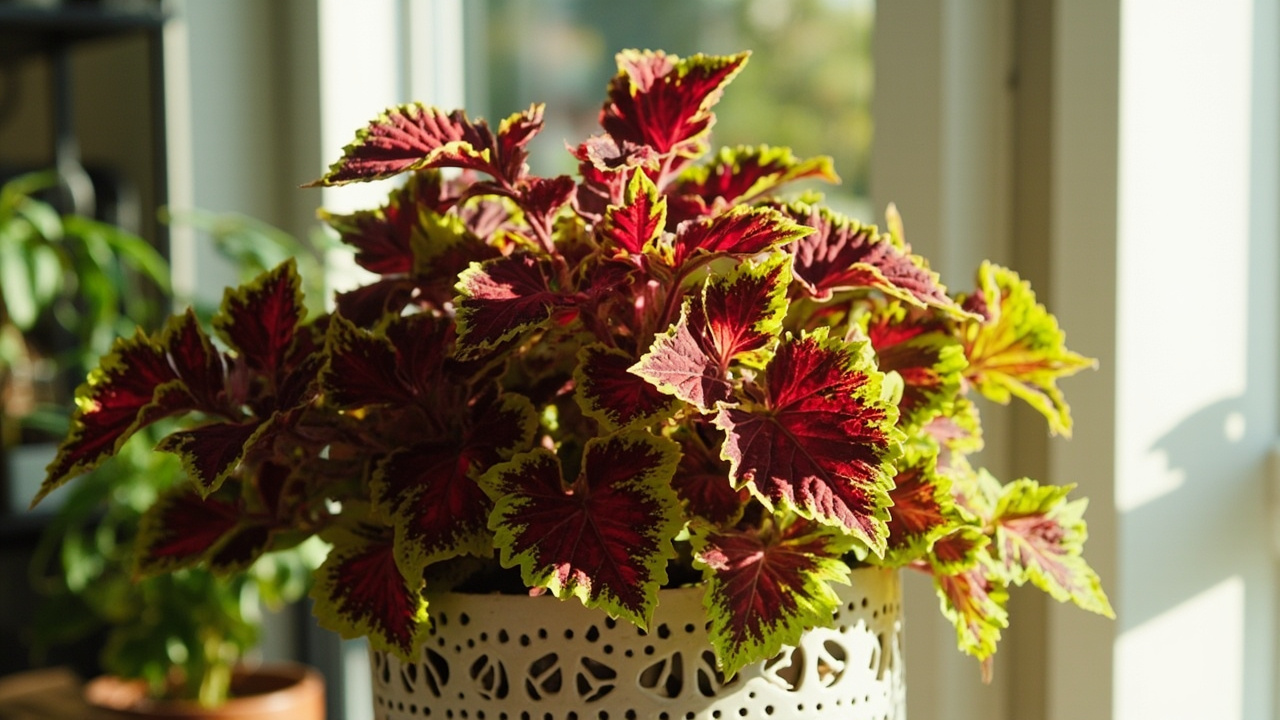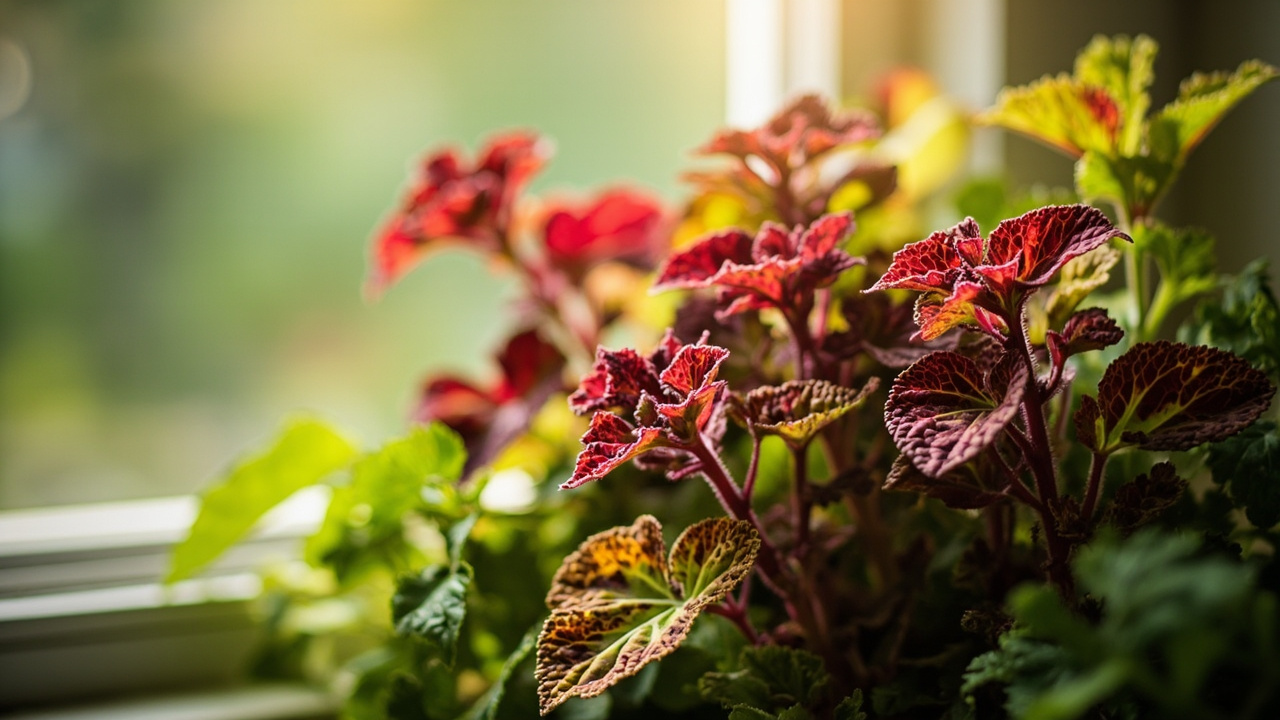

Coleus (Plectranthus scutellarioides) is grown for one reason above all else: its foliage. The brilliant reds, electric pinks, sunset oranges, and deep burgundies that make it a garden and windowsill staple are entirely dependent on one variable, light. Get the light level right, and the colours saturate. Get it wrong, and the plant fades to green or scorches at the margins.
This guide explains exactly how much light coleus needs, what “bright indirect” means in practice, how different windows change the outcome, and when you should supplement with artificial light. For the full care overview including soil, temperature, and feeding, see the coleus care guide.
Why Light Determines Coleus Foliage Colour
Coleus belongs to the mint family, Lamiaceae, and is classified today as Plectranthus scutellarioides. The genus name Solenostemon still appears on nursery tags, but the science has moved on. Regardless of which name you encounter, the physiology that produces those dazzling leaf colours is the same, and it is driven almost entirely by light.
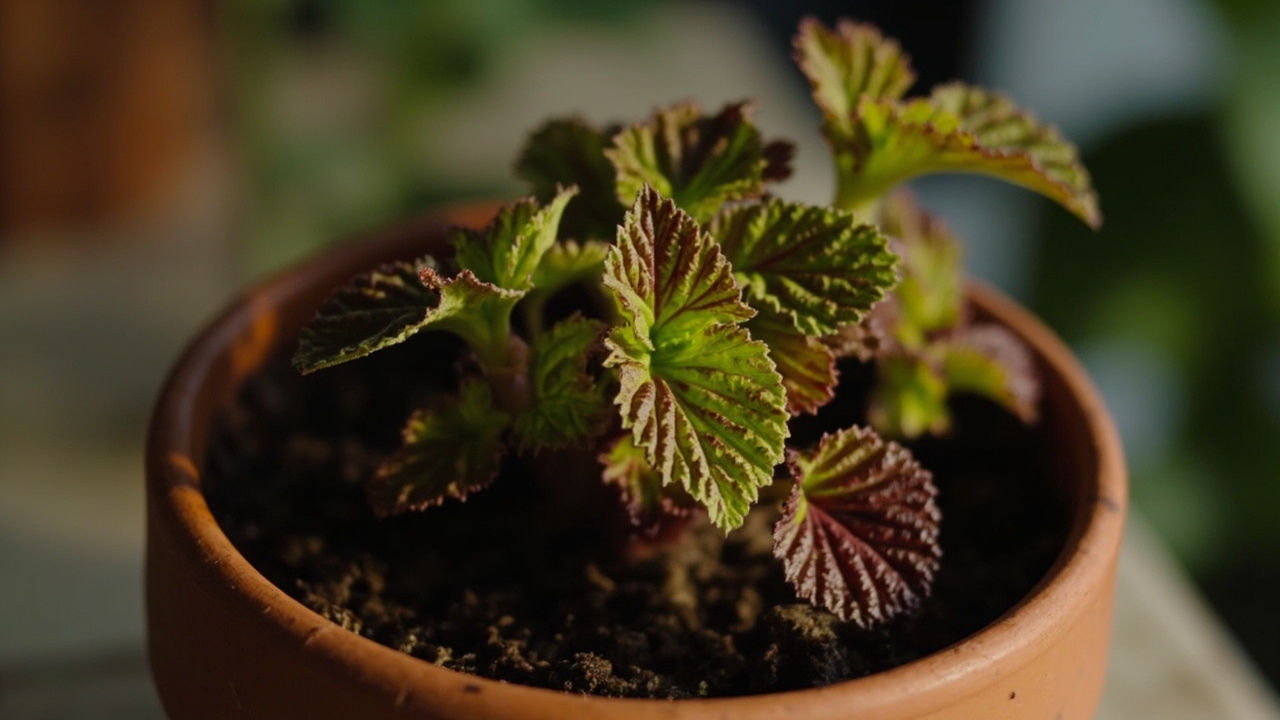
Inside every coleus leaf cell live two organelles responsible for colour: chloroplasts and chromoplasts. Chloroplasts contain chlorophyll, the green pigment that captures light energy for photosynthesis. Chromoplasts contain carotenoids and anthocyanins, the pigments that produce red, purple, orange, and pink hues. When light intensity is low, the plant invests heavily in chlorophyll to maximise photosynthetic capture. The leaf turns green because chlorophyll overwhelms the weaker coloured pigments. When light intensity rises to the optimal range, anthocyanin production ramps up. The result is a leaf that looks like it was painted rather than grown.
This is not a gentle gradient. Move a vividly coloured coleus from a bright window to a dim corner and the colour fade begins within two weeks. The chlorophyll concentration rises while anthocyanin production drops. The plant is making a rational survival decision. In low light, green leaves are more efficient at capturing whatever photons are available than brightly coloured ones. The trade-off is beauty for survival.
The reverse is equally dramatic. Move a pale green coleus from a dark bathroom to a bright south-facing window over three days and the new leaves emerge darker, richer, and more saturated. The plant recognises the light increase and reallocates resources from chlorophyll production to anthocyanin synthesis. This plasticity is why coleus is such a responsive foliage plant. It shows you exactly where it stands, every few days.
The Sweet Spot: Bright Indirect Light Explained
“Bright indirect light” is the phrase every coleus care guide repeats, but it means different things to different readers. For a collector who moved from a windowsill with sheer curtains to a south-facing glass door with nothing between them, the difference is catastrophic. The plant on the glass door develops brown edge burn within days. The plant behind the curtain intensifies in colour over the same period.
Bright indirect light means the plant receives the full intensity of daylight filtered through a barrier. That barrier can be a sheer curtain, a metre of depth inside a room, or a north-facing window that never receives direct sun. The key metric is photon flux, not visual brightness. A room that looks dark to your eyes may still deliver sufficient photosynthetically active radiation to a coleus positioned one metre from the glass. A room that looks bright may deliver far less if the glass is tinted or the angle of incidence is wrong.
The practical threshold is approximately 10,000 to 20,000 lux at the leaf surface for most modern coleus cultivars. Below 5,000 lux, colour fade becomes noticeable within two weeks. Below 2,000 lux, etiolation sets in: the plant stretches toward the light source, internodes lengthen, and the rosette opens into a sparse, leggy growth pattern. The plant is sacrificing compact form for reach. Apical dominance shifts from maintaining a bushy shape to racing toward any available photons.
Above 40,000 lux of direct sun, most cultivars show some degree of leaf scorch, especially during the two hours around midday in summer. The pigment that makes coleus beautiful is also what makes it vulnerable. Anthocyanins absorb excess light energy that the leaf cannot process. When that absorption capacity is exceeded, the tissue breaks down and browns at the margins. This is photoinhibition, and it is the most common cause of coleus leaf damage in summer gardens.
How Different Windows Change the Outcome
Window orientation is the single strongest predictor of coleus performance indoors. East-facing windows receive morning sun that is bright but never intense. The light angle is low in winter and rises through the day in summer, creating a natural intensity curve that matches coleus preferences almost perfectly. An east-facing window one metre from the glass delivers approximately 15,000 lux in spring, 20,000 lux in early summer, and drops to 5,000 lux by late autumn. This is the gold standard for indoor coleus placement.
West-facing windows receive afternoon sun, which is hotter and more intense than morning sun at the same irradiance level. A west-facing window two metres from the glass often delivers sufficient light without scorch, but the risk increases rapidly during July and August. The safest approach is to position the plant on a shelf that receives the light but is shielded by a wall or furniture from direct rays. The ambient brightness remains high even when the direct beam misses the leaves.
South-facing windows deliver the highest light intensity of any orientation in the northern hemisphere. During spring and autumn, a south-facing window one metre from the glass is ideal. By midsummer, that same position may deliver 60,000 lux or more at noon, which exceeds the scorch threshold for most cultivars. The solution is to move the plant back two metres, place it behind a sheer curtain, or rotate it so the leaves face the window rather than the glass. None of these changes reduce the total daily light integral significantly, but they eliminate the peak intensity that causes damage.
North-facing windows are the hardest environment for coleus. They never receive direct sun, which means the photosynthetic photon flux density rarely exceeds 5,000 lux even at midday. Colour fade is inevitable. The plant survives, but the vivid variegation that makes coleus desirable fades toward a uniform green. If you have only a north-facing window, consider placing the coleus on a white stand or near a light-coloured wall that reflects ambient light. This small adjustment can add 1,000 to 2,000 lux at the leaf surface, which may be the difference between a fading plant and one that holds colour through winter.
When to Supplement With Grow Lights
Grow lights are not a compromise. They are a precision tool that delivers more photosynthetically active radiation than any indoor window can provide during the darkest months. The question is not whether you need one, but whether the light your location provides falls below the 10,000 lux threshold for more than 90 days per year.
For readers in temperate zones between latitudes 40 and 55 degrees, December through February consistently delivers below-threshold light at most indoor positions. A full-spectrum LED grow light positioned 30 centimetres above the coleus canopy delivers approximately 30,000 to 50,000 lux at the leaf surface, which is well within the optimal range. The light should run for 12 to 14 hours per day, mimicking the natural photoperiod of the plant’s Southeast Asian origin. A simple timer eliminates the guesswork.
Fluorescent T5 fixtures are adequate but less efficient than LEDs. They deliver approximately 15,000 lux at 30 centimetres, which sits at the lower edge of the optimal range. Position them directly above the plant rather than to the side, and keep the distance no greater than 25 centimetres. Anything further and the intensity drops below the threshold for colour maintenance.
The cost of a basic LED grow light ranges from 15 to 40 USD, and the electricity draw is negligible. The alternative is watching a collection of expensive cultivars fade to green over three months and hoping for spring. If your coleus already sits in a bright west or east window and the colour holds through autumn, you do not need a grow light yet. Test the position first. Measure with a phone lux meter app if you have one. The data is more reliable than memory.
Signs Your Coleus Is Getting Too Much or Too Little Light
The coleus plant communicates its light status through three clear visual signals: leaf colour intensity, leaf texture at the margins, and stem elongation pattern. Reading these signals correctly allows you to adjust placement before permanent damage occurs.
Too little light produces three symptoms in sequence. First, the coloured portions of the leaf begin to fade toward green. This happens within two weeks and is reversible if the plant is moved promptly. Second, the internodes between leaf pairs lengthen noticeably. The plant stretches toward the light source, creating gaps that break the compact rosette form. Third, new leaves emerge smaller and paler than the previous generation. At this stage, the plant is diverting energy from leaf production to stem elongation in a desperate search for photons. Chlorophyll concentration is at its maximum because the plant is prioritising photosynthetic efficiency over colour display.
Too much light produces different symptoms. The leaf margins develop brown or tan necrotic patches that start at the tips and edges. The coloured portions may appear bleached or washed out, which is the opposite of the chlorophyll dominance seen in low light. The leaf texture becomes leathery and thickened as the plant produces additional protective pigments. In extreme cases, the entire leaf surface develops a crispy, papery texture that cannot be reversed. The damage is permanent once the tissue dies.
The most important diagnostic habit is to check the leaves that face the light source first. These are the most exposed and will show symptoms before the underside leaves. If the front-facing leaves look healthy but the shaded leaves are fading, the light level is borderline adequate. Move the plant closer to the window or add supplemental lighting. If the front-facing leaves show scorch marks, move the plant away immediately. The plant can recover from mild scorch if the damaged leaves are removed and the position is corrected, but new growth will be the true indicator of whether the adjustment was sufficient.
Seasonal Adjustments: What Changes From Spring to Winter
The light environment your coleus experiences changes continuously throughout the year, even if you never move it from the same windowsill. The sun arc shifts, the days shorten, and the intensity of direct sunlight varies by as much as 40 percent between June and December at mid-latitudes. A position that is perfect in April becomes dangerous in July and inadequate by January.
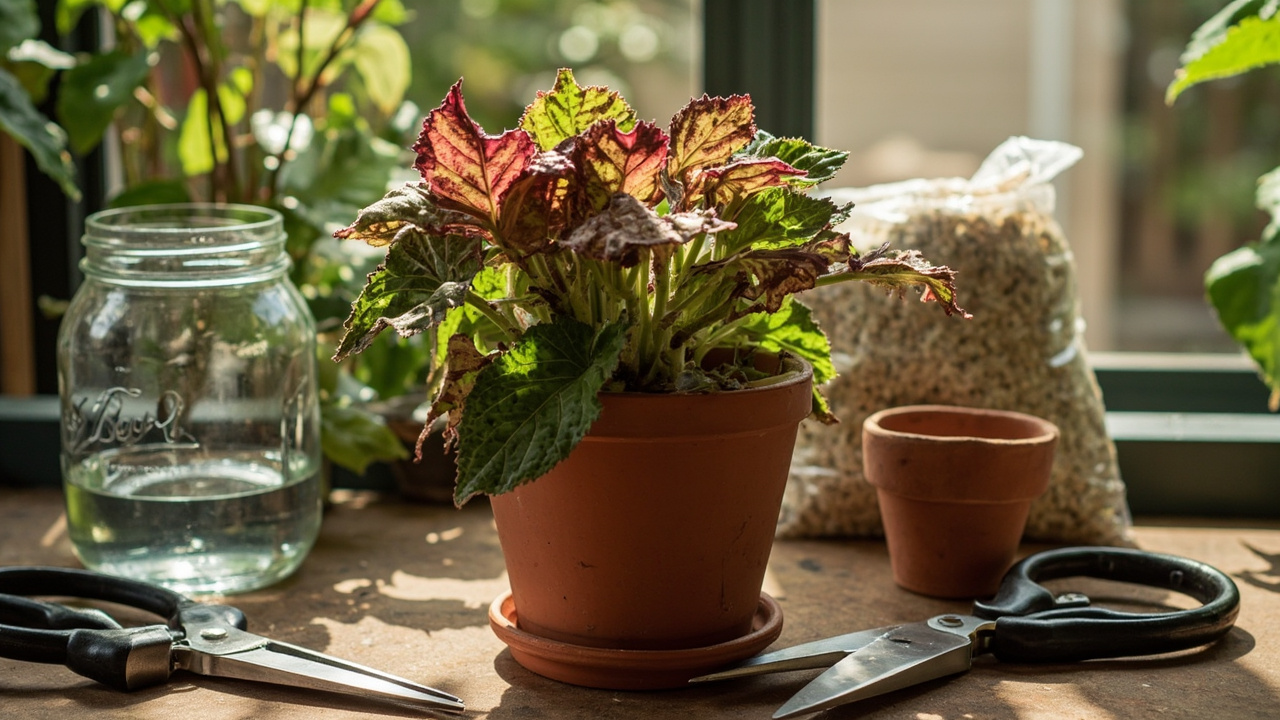
Spring is the season of increasing light and rising temperatures. A coleus that was sitting in a moderate position through winter should be monitored closely as March turns to April. The plant may accelerate its growth rate noticeably, and new leaves will emerge larger and more colourful. This is the best time to take stem cuttings because propagating coleus from stem cuttings is fastest when the parent plant has abundant energy reserves and the growing conditions are favourable. the parent plant has abundant energy reserves and the growing conditions are favourable. If the plant begins to show any sign of leggy growth, move it closer to the light source now rather than waiting for the problem to worsen.
Summer demands the most attention. The combination of high light intensity and high temperature creates the conditions for rapid leaf scorch. Even plants that thrive in spring positions may need to be shifted back or shaded during the two hottest months. If your coleus is outdoors, move it into dappled shade beneath a tree canopy or under a 40 percent shade cloth. Indoors, close the curtain during the afternoon hours if the window receives direct sun. The plant will not suffer from reduced light during these hours because the intensity during the rest of the day compensates.
Autumn is a season of declining light and the risk of premature dormancy. As daylight hours shorten past the autumn equinox, the coleus may begin to slow its growth naturally. This is not a sign of distress unless the colour has already faded significantly. If the leaves are holding their colour through October, the plant is adapting well to the changing light. If colour fade begins in September, consider moving the plant to the brightest available position or starting supplemental grow light duty before winter arrives.
Winter is the season where light management determines whether your coleus survives as a vibrant specimen or fades into an ugly green stretch. The shortest days deliver the lowest light levels, and most indoor positions fall below the 10,000 lux threshold during December and January. This is when grow lights become essential for collectors who want to maintain colour through the dark months. Without supplementation, expect the plant to enter a state of low-level dormancy characterized by slow growth, pale colour, and minimal new leaf production. The plant is not dying. It is conserving energy until the light returns.
The practical rule for seasonal adjustment is simple: move the coleus toward the light in spring as intensity rises, move it away from direct sun in summer, move it to the brightest possible position in autumn, and supplement with artificial light in winter. Each adjustment takes two minutes. The payoff is a plant that stays colourful and compact all year instead of cycling through seasons of vigour and decline.
Turn PDF Bank Statements Into Workable Spreadsheets
Your bank statement is a mess of numbers, but your books shouldn't be. Use our converter to get Excel, CSV, or QBO files — ready for QuickBooks.