Snake plants are slow-growing and relatively compact, and they do not require pruning the way fast-growing tropical climbers do.
However, there are situations where pruning a snake plant is useful — to remove damaged leaves, to control the size and shape, or to propagate from leaf cuttings.
Here is when and how to prune a snake plant without harming the plant.
When Snake Plant Pruning Is Needed
Removing damaged leaves. The most common reason. Leaves that have turned yellow, developed brown tips, been broken, or show fungal damage can be removed at the base with a clean cut. Removing damaged leaves improves the plant’s appearance and prevents potential spread of fungal issues to other leaves.
Controlling size and shape. Snake plants that have become very tall or have produced many offsets can be trimmed back. Cutting the tallest leaves at the base keeps the plant at a more manageable height and encourages new growth from the base.
Propagation. Leaf cutting propagation requires cutting healthy leaves into sections for rooting. This is covered in the Snake Plant Propagation guide.
What You Need
Clean, sharp scissors or a sharp serrated knife. Cleanliness matters — wiping the blade with rubbing alcohol before cutting prevents transmitting any fungal or bacterial issues to the cut surfaces. A clean cut heals faster than a crush cut, and snake plant leaves are thick enough that a dull blade will crush rather than cut cleanly.
How to Remove a Damaged Leaf
Step 1 — Identify the leaf. Find the leaf you want to remove at the base where it meets the soil or the rhizome. The cut must be at the base — do not cut halfway up the leaf, as the remaining stub will yellow and die and can become an entry point for rot.
Step 2 — Cut at the base. Place the blade as close to the rhizome as possible — flush with the soil surface or the main stem. Cut in one clean motion. A diagonal cut is fine but not necessary.
Step 3 — Discard the leaf. Remove it from the area — do not leave cut leaves sitting in the pot as they can attract pests or begin to rot.
How to Reduce the Height of the Plant
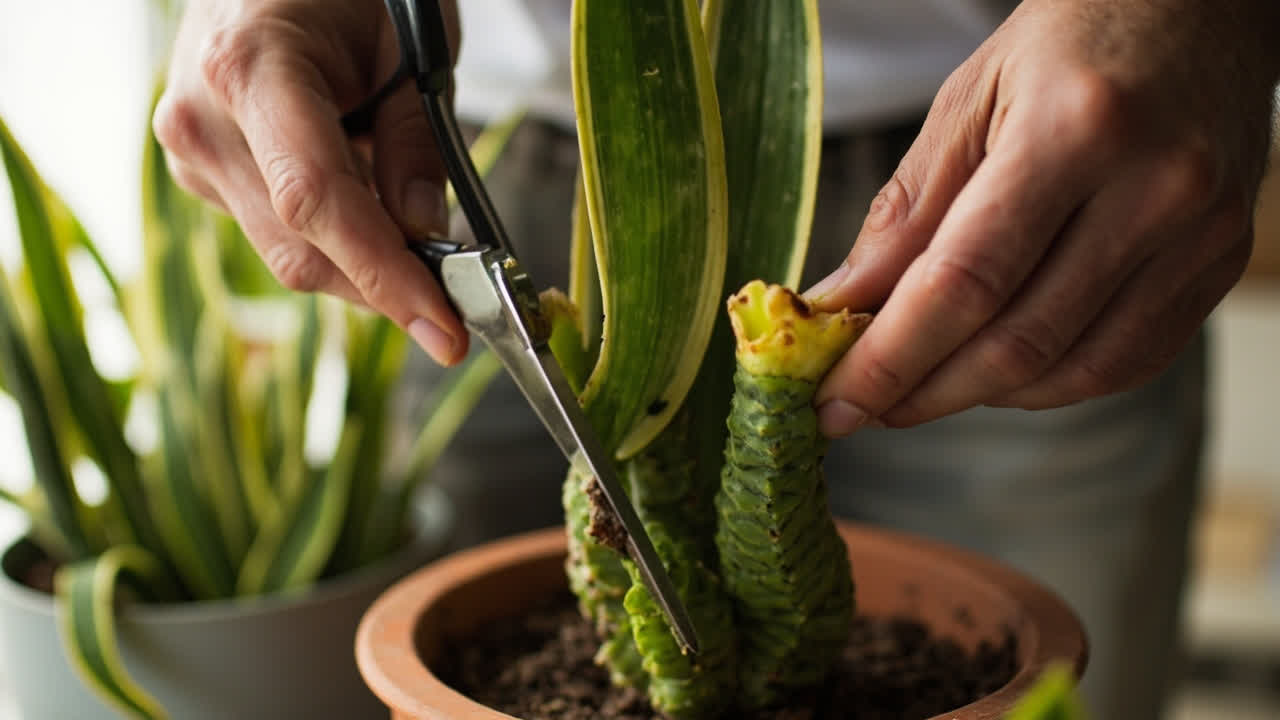
If your snake plant has grown very tall and you want to reduce its overall height, you can cut individual tall leaves at the base. This will not trigger new growth from the cut point — snake plants do not branch from cut leaves the way some plants do. Instead, new leaves will emerge from the rhizome as fresh pups, gradually replacing the removed height over time.
Removing too many leaves at once stresses the plant. Remove no more than a quarter to a third of the total leaf mass at one time. If you need to reduce height significantly, work in stages over several months.
What Not to Do
Do not cut leaves in the middle and leave a stub. The stub will yellow, die, and potentially rot back into the plant. Always cut at the base.
Do not prune a snake plant that is already struggling — with root rot, severe pest damage, or disease. Fix the underlying problem first, then prune cosmetic damage once the plant has recovered.
For the propagation guide, see Snake Plant Propagation. For general care, see Snake Plant Care guide.
From PDF to Excel in one click
Forget retyping line by line. Upload any bank statement, get a spreadsheet you can actually use. Your files are never stored, and you can test the converter with 3 free conversions.
Try it free