Brown tips on a snake plant are usually old leaf damage, not an emergency.
The first decision is whether the tip is only cosmetic. A dry brown point on one firm leaf is usually old damage from a watering swing, mineral buildup, sun, cold, or physical handling. Brown tips that keep expanding, appear on several leaves, or come with yellowing and softness need a closer diagnosis before you trim anything.
The pattern matters more than the tip itself. If the brown edge is dry, narrow, and stable for several weeks, it is usually old damage. If it is widening, moving down the leaf, or appearing on new leaves, the stress is still active.
This page walks through the six common causes, the three signals that tell them apart, three worked scenarios, and the four cases where the rule of thumb fails.
What Brown Tips Mean On A Snake Plant
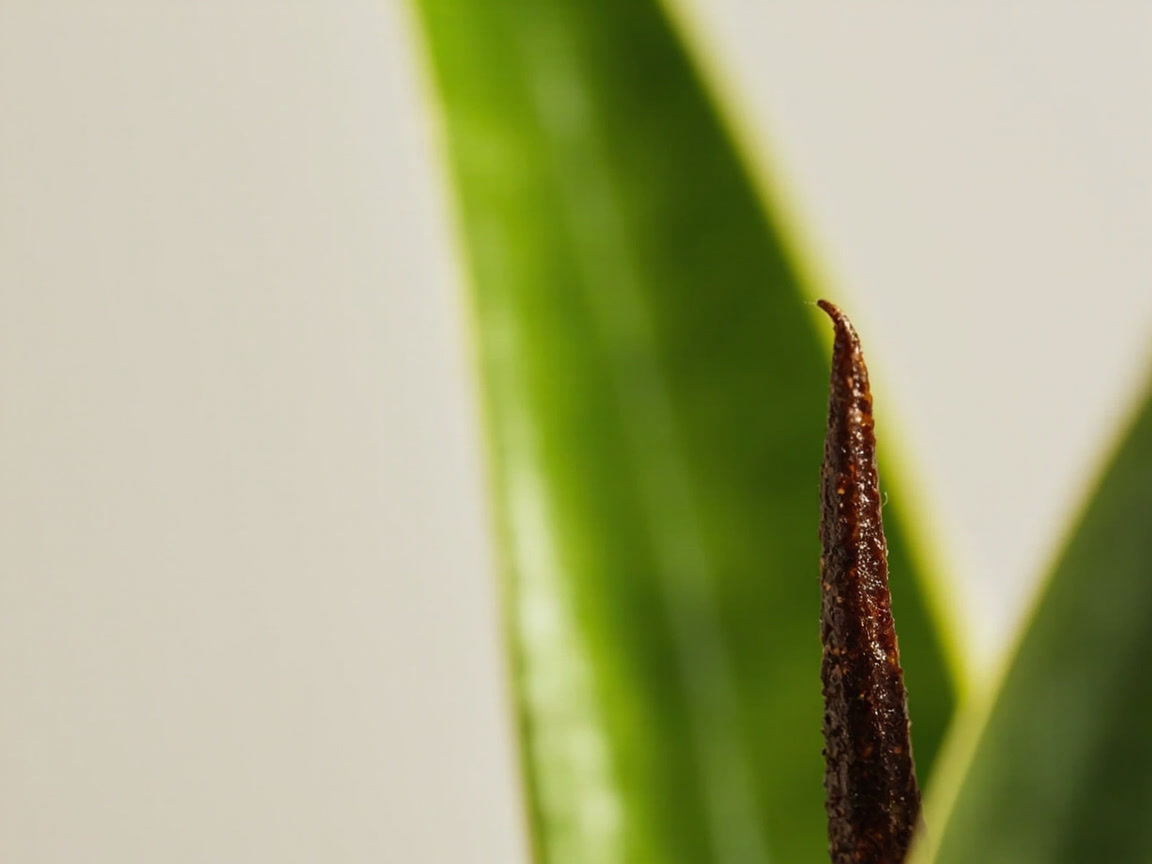
A brown tip is the end of the leaf drying beyond recovery. Snake plant leaves do not repair dead tissue, so the question is not how to make the tip green again.
The honest trade-off is that brown tips are often more visible than they are serious. A snake plant can live for years with a few dry leaf ends. What matters is the tissue around the tip.
Firm green tissue below the brown area points to a contained problem. Yellow, soft, translucent, or wrinkled tissue below the brown area points to a larger root, water, light, or temperature issue.
Causes Of Brown Tips: The Six Variables
Six variables drive most snake plant brown tips. Each one produces a slightly different pattern. The same plant can show two variables at once, which is why the case-study sections below read the variables as a layered set rather than a single cause.
The six variables are fluoride in tap water, low humidity, salt buildup in soil, inconsistent watering, sunburn, and mechanical damage.
Fluoride in tap water shows as a thin, even brown rim on multiple leaves. Snake plants are moderately sensitive to fluoride. Municipal tap water in many regions contains 0.7 to 1.2 ppm fluoride, which accumulates in the leaf tip over months.
If you see this pattern on several leaves at once, switch to filtered or rainwater. Expect clean new growth within 4 to 6 weeks.
Low humidity shows as dry tip damage on exposed leaves. Indoor relative humidity often sits between 20 and 35 percent in heated homes during winter. Snake plants tolerate low humidity, but leaf tips transpire faster than roots can replace moisture below 30 percent RH.
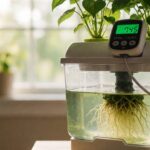
Use a hygrometer to confirm. If RH reads below 30 percent for weeks, expect tip damage on the leaves that sit closest to the heating vent or the cold window.
Salt buildup in soil shows as brown tips plus a pale crust on the soil surface or the pot rim. Hard water, frequent light watering, and excess fertilizer leave soluble salts in the potting mix. The University of Florida IFAS Extension notes that fluoride and chloride accumulation in the leaf tips of Dracaena is one of the most common indoor foliage disorders, and Sansevieria shares the same sensitivity.
Flush the soil with distilled water every 3 to 4 months as a preventative if your tap water is hard.
Inconsistent watering shows as small dry brown points that appear after long dry stretches. The plant rehydrates unevenly, the weakest end tissue dries first, and a small brown point remains even after the plant stabilizes.
Sunburn shows as crisp brown patches on the upper third of south-facing leaves. The rest of the plant may still look firm, which makes the damage feel mysterious until you look at where the affected leaf sits.
Mechanical damage shows as a single brown point on a leaf that catches on a curtain or gets nudged during a move. This is the most benign cause because the surrounding tissue stays firm and the brown point does not expand once the cut heals over.
Diagnosis Decision: Three Signals That Tell The Causes Apart
Three signals narrow the cause down quickly. Check each one in order.
Distribution tells you which variable to investigate. Tip-only damage on one leaf points to mechanical damage or a one-off stress event. Tip-only damage on several leaves at once points to water quality. Margin-wide browning across the whole plant points to low humidity or heat. Patchy damage on one side of the plant points to sun or cold draft from a window.
Texture tells you whether the problem is still active. Dry and papery brown tissue means the leaf dried out at the end, so the cause is in the past. Soft, mushy, or translucent brown tissue means the leaf is rotting, so the cause is active root or crown stress.
Recent watering history tells you whether rhythm or water quality is the trigger. If you water on a strict calendar and the soil has been dry for 3 or more weeks before each watering, the rhythm is the cause. If you water only when the soil feels dry and the tips still brown, water quality is more likely.
Use this rule of thumb: check distribution first, then texture, then watering history. If all three agree, you have the cause. If two agree and one disagrees, the disagreeing signal usually points to a secondary variable layered on top.
Three Snake Plant Scenarios
The same brown tip can come from different causes. Three worked examples show how the decision tree plays out.
For example, take a snake plant on a bathroom shelf 2 meters from the shower. The owner waters every 2 to 3 weeks and uses municipal tap water. After 6 months, brown tips appear on the older outer leaves but never on new growth.
Distribution is tip-only on older leaves. Texture is dry and papery. Watering history is steady. The likely cause is fluoride accumulation plus low humidity, both layered on the same plant.
Switch to filtered water. The next flush of new leaves should come in clean. The brown tips on the older leaves will not recover, but the plant stops producing new damaged tips within 4 to 6 weeks.
For instance, take a snake plant in a north-facing office with fluorescent lights and municipal water from a building with a water softener. After 4 months, every leaf has a thin, even brown rim at the tip.
Distribution is margin-wide on all leaves. Texture is dry and stable. The likely cause is fluoride plus softened-water salt.
Office buildings often add fluoride and the softener adds sodium, both of which concentrate in the leaf tips. Move the plant to a spot with filtered water and expect clean new growth in 6 to 10 weeks.
For a final case study, take a snake plant that lived indoors for 2 years, then was moved to a south-facing patio for the summer. Within 2 weeks, the south-facing leaves develop crisp brown patches on the upper third. The shaded leaves stay clean.
Distribution is patchy on one side. Texture is dry and crispy. The likely cause is sunburn.
Snake plants cannot handle direct afternoon sun, even after gradual acclimation. Move the plant back to bright indirect light and trim the damaged patches once they are fully dry. The Royal Horticultural Society recommends bright filtered light for Sansevieria trifasciata, with direct sun reserved for short morning exposure only.
When The Brown Tip Rule Does Not Apply
The diagnose-by-pattern approach works for most snake plant brown tips. However, four cases need adjustment.
Natural leaf-tip dieback on old leaves. The oldest outer leaves on a mature snake plant often develop small dry brown tips even under ideal care. This is part of normal aging.
If the rest of the leaf is firm and the brown tip has not expanded in 8 to 12 weeks, the cause is leaf age, not stress. The limitation of the rule is that not every brown tip has a hidden cause.
Variegated types. Cultivars such as Sansevieria trifasciata ‘Laurentii’ and ‘Moonshine’ carry thinner leaf tissue and yellow or silver variegation, which dries at the tip more easily than the solid green forms.
A constant light brown tip on the older leaves is expected. The drawback of treating variegated types the same as solid green is that you will overwater trying to fix a normal feature.
Freshly divided plants. A snake plant that has just been divided or repotted often shows brown tips on several leaves for 2 to 4 weeks as the roots re-establish. This is transplant stress, not the six variables listed above.
The caveat here is that the watering rhythm after division is different: keep the soil lightly moist for the first 3 weeks, then transition back to deep soak and dry-down.
Cold-damaged plants that will not recover. If the brown tip is paired with a soft, water-soaked base and a sour smell, the crown has rotted and the leaf cannot be saved.
The rule fails in this case because trimming the tip does not address the active crown rot. Cut the leaf at the soil line and inspect the rhizome before deciding whether the plant survives.
These four cases share one trait: they all break the diagnostic pattern. When you see one of them, do not chase the cause through the six variables. Use the case-specific guidance instead.
Pattern Table: Brown Tip Causes
Use the full leaf pattern rather than the tip alone. The same brown point can come from different causes depending on what is happening below it.
| Tip pattern | Leaf condition | Likely cause | What it means |
|---|---|---|---|
| Small dry point | Firm green leaf | Old watering swing or handling damage | Usually cosmetic if stable |
| Brown tip with white crust on soil | Firm but dull growth | Mineral or fertilizer salt buildup | Check water quality and feeding history |
| Crisp brown edge on sun-facing leaf | Firm tissue, one side affected | Heat or direct sun scorch | Placement stress, not root failure |
| Brown tip plus yellow or soft base | Soft, leaning, or collapsing leaf | Root or crown stress | Needs broader diagnosis |
| Thin even brown rim on all leaves | Firm tissue, recent 4-6 months | Fluoride or salt in tap water | Switch to filtered water; expect clean growth in 6-10 weeks |
| Tip browning after repotting or division | Firm leaves, recent 2-4 weeks | Transplant stress | Keep soil lightly moist for first 3 weeks |
If brown tips appear with yellowing, softness, or collapse, diagnose them inside broader snake plant problems. Brown tissue at the end of a firm leaf is one category. Brown tissue on a leaf that is soft at the base is a different problem.
Should You Cut Brown Tips Off?
You can cut brown tips off if the damage is dry, stable, and only cosmetic. It will not help the plant heal, but it can make the leaf look cleaner.
The important part is not to cut into healthy tissue more than necessary. A fresh cut creates a new dry edge and can make the leaf look more damaged than before.
If you decide the damage is cosmetic, use snake plant pruning guidance before shaping the leaf. Wait until the cause has stopped first.
Trimming while the tip is still expanding only hides the signal and makes it harder to know whether the stress is continuing.
What To Watch Next
After you identify the likely cause, watch the plant for 2 to 4 weeks before making more changes.
- If the brown edge does not expand, the damage is old.
- If new tips brown, look again at watering swings, minerals, or heat near the window.
- If yellowing or softness appears with the brown tip, move from cosmetic diagnosis to root or crown diagnosis.
- If only one old leaf is affected and the rest of the plant is firm, do nothing beyond normal care.
- If you have switched to filtered water and the new leaves still brown within 6 to 10 weeks, return to the six variables and recheck distribution and texture.
For rhythm guidance after you confirm the cause is watering-related, compare your interval against snake plant watering. For light placement issues, see snake plant light.
Read also: why snake plant leaves develop brown tips, the margin-death mechanism behind it, and the soil test that tells dry roots from salt build-up before you water again.
Turn PDF Bank Statements Into Workable Spreadsheets
Your bank statement is a mess of numbers, but your books shouldn't be. Use our converter to get Excel, CSV, or QBO files — ready for QuickBooks.
Try It Free Now