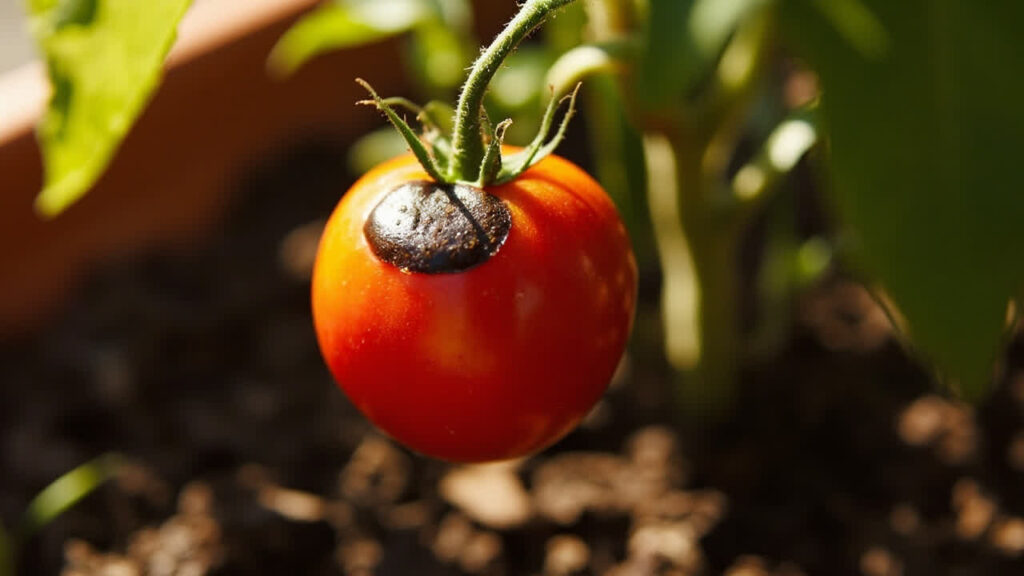

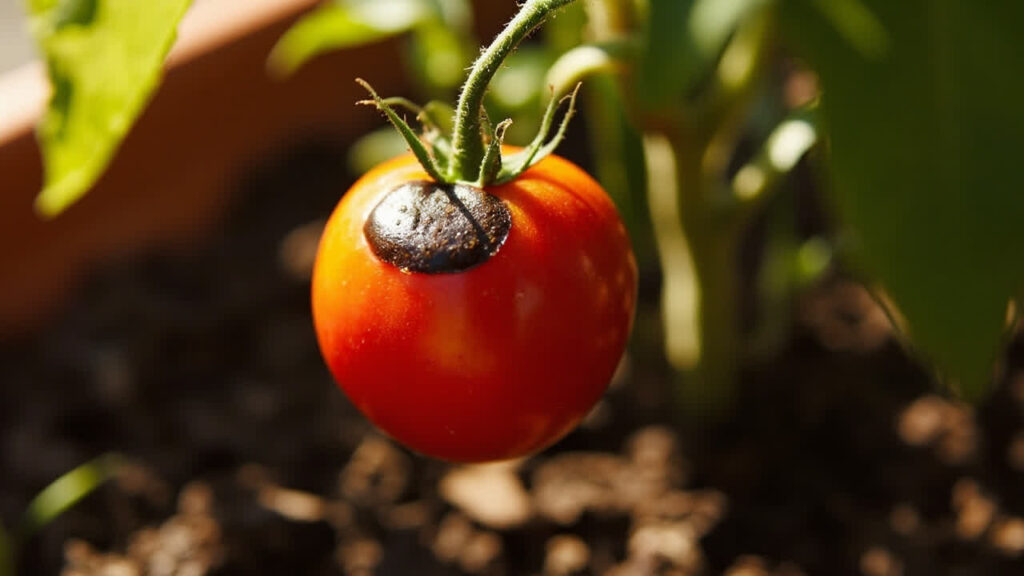
You’ve seen it before — that dark, leathery sunken patch on the bottom of your tomato fruit, the one that renders the whole thing inedible.
That condition has a specific name: blossom end rot in tomatoes. It’s one of the most common complaints among tomato growers, and it shows up just as often in container gardens as in backyard beds.
The frustrating part is that it looks like a disease. It isn’t one!
Blossom end rot is a physiological disorder — a direct signal that something is disrupting the way your plant moves calcium to its developing fruit.
Understanding that distinction matters more than most growers realize. Spraying fungicides won’t stop it. Removing affected fruit and hoping for the best won’t stop it either.
What stops blossom end rot is understanding the actual chain of events inside the plant, and then managing the conditions that break that chain. That’s what this article is for.
What Blossom End Rot Actually Is
Blossom end rot appears as a water-soaked lesion on the blossom (calyx) end of the fruit — the opposite end from where the fruit attaches to the stem. Early-stage spots are small, darkened, and slightly depressed. As the condition develops, the tissue becomes sunken, leathery, and turns dark brown or black. The lesion can expand to cover half the fruit’s base in severe cases.
The root cause is a localized calcium deficiency in the developing fruit tissue. Calcium plays a critical structural role in plant cell walls — without adequate calcium, cell membranes break down and the affected tissue collapses. This isn’t a general calcium shortage in the whole plant. It’s a failure to deliver calcium to the fruit fast enough while the fruit is still expanding. The leaves may show normal calcium levels while the fruit is starving for it.
That distinction — general shortage versus delivery failure — is the key to understanding why blossom end rot is almost never solved by simply adding more calcium to the soil. In most cases, calcium is present. The plant simply isn’t transporting it where it needs to go.
The Calcium-Uptake Mechanism: Why It Matters
Calcium moves through the tomato plant via the transpiration stream. Water is drawn up from the roots, carrying dissolved calcium through the xylem vessels, and exits through the leaves as water vapor. This flow is entirely dependent on the plant’s rate of transpiration — essentially, how quickly the leaves are losing water.
Here’s what this means in practice: calcium is not actively directed to fruit. It goes wherever water is flowing, and water flows fastest to the leaves. As a fruit develops, its surface area is relatively small and it transpires far less than the foliage. So the developing fruit is always the last stop on the calcium-delivery route — and if something interrupts the flow, the fruit pays the price first.
The transpiration stream requires one critical input: consistent water. Without it, the flow slows or stops, calcium delivery stalls, and the rapidly expanding cells in the fruit base don’t get the calcium they need to maintain membrane integrity. The result is that characteristic dark, leathery collapse at the blossom end.
This is precisely why irregular watering is the most common trigger for blossom end rot, and why it appears so frequently during hot, dry spells — even when the soil technically has adequate calcium.
Why Containers Make the Problem Worse
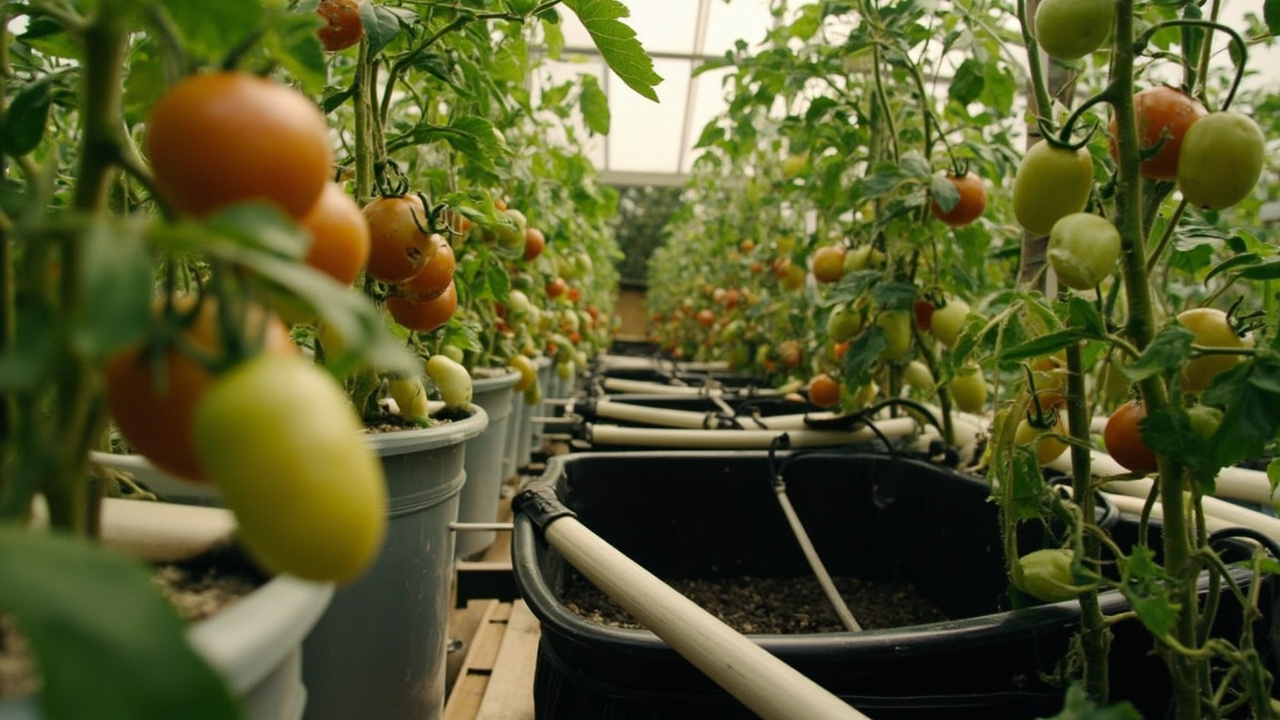
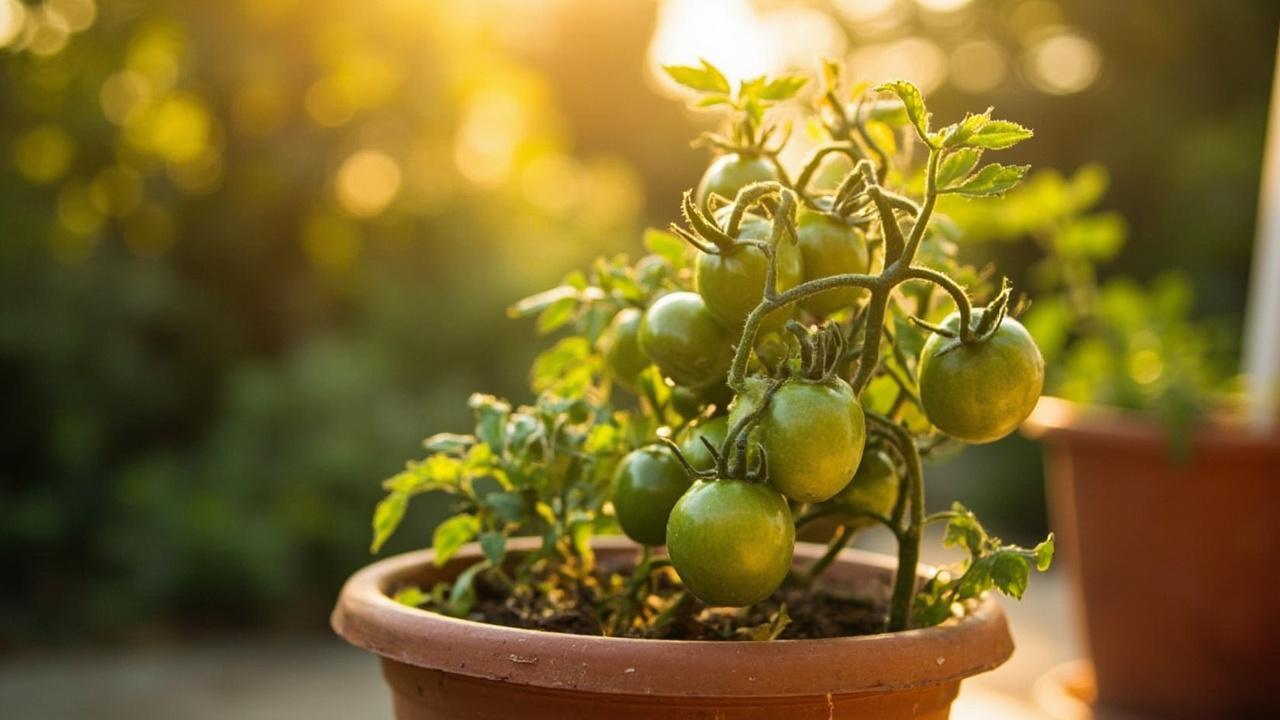
If you’re practicing container vegetable gardening, your tomatoes are more vulnerable to blossom end rot than garden-bed tomatoes in most conditions. Containers have a limited soil volume, which means root systems are constrained and potting mix dries out much faster than an in-ground bed. A container in full sun during a summer heat wave can go from moist to bone-dry in less than a day, and that fluctuation is enough to disrupt the transpiration stream.
The confined root zone also means there’s less buffer against inconsistent watering. In a garden bed, roots can explore a larger soil volume to find moisture. In a container, the plant depends entirely on you to maintain that moisture balance. When the root zone dries out and is then flooded again, the rapid change in water movement through the plant actually makes calcium uptake less efficient, not more — which is why overwatering after drought doesn’t “rescue” the fruit.
Root health compounds the problem. If roots are damaged — from compacted soil, root rot from overwatering, or physical injury during transplanting — their ability to absorb water and calcium is reduced even when soil moisture is adequate. Damaged roots can’t keep up with the fruit’s calcium demand during rapid expansion phases. This is why root damage is a significant secondary cause of blossom end rot, separate from any calcium or watering issue.
Overwatering and the Nitrogen Trap
It’s tempting to think that watering more frequently is the answer to blossom end rot. It’s not — and in some ways, overwatering makes things worse. When container soil stays perpetually saturated, oxygen is pushed out of the pore spaces, and roots need oxygen to function. Without adequate oxygen, root cells can’t maintain their energy-dependent uptake processes. Calcium absorption requires root cell activity, and oxygen-deprived roots absorb less of it.
There’s another mechanism at play with heavy nitrogen fertilization. When nitrogen levels are too high, the plant diverts enormous energy into rapid top growth — big leaves, long stems, new shoot development. This surge in foliage increases the plant’s overall transpiration demand dramatically, pulling calcium toward the leaves faster and leaving the developing fruit under-supplied. The fruit becomes a lower-priority destination in the transpiration stream when the plant is in aggressive vegetative growth mode.
A tomato plant with luxurious, dark green foliage and very little fruit set is often a sign of excessive nitrogen. When that plant does set fruit, blossom end rot frequently follows — not because calcium is missing from the soil, but because the plant’s internal transport priorities have shifted entirely toward the canopy.
How to Fix Blossom End Rot: The Calcium Spray
If you already have fruit showing blossom end rot, removing the affected tomatoes immediately is necessary — the lesions won’t reverse, and the plant will redirect energy toward the remaining healthy fruit once the damaged ones are gone. But you can also take a direct approach to boost calcium supply at the fruit level with a foliar calcium spray.
A calcium chloride spray is one of the most effective direct treatments. Dissolve 4 tablespoons of calcium chloride (available at most garden centers as a de-icing agent — make sure it’s pure calcium chloride without added anti-caking agents) in 1 gallon of water. Spray the developing fruit and surrounding foliage thoroughly, covering all surfaces. Apply in the early morning or late afternoon to avoid leaf burn in strong sun. Repeat every 7 to 10 days during active fruit development.
If calcium chloride isn’t available, a home alternative using crushed eggshells can provide a milder calcium boost. Finely grind 10 to 12 eggshells and steep them in 1 gallon of boiling water for 24 hours. Strain the solution and spray it directly onto the fruit and lower foliage. The effect is less immediate than calcium chloride, but it contributes supplemental calcium at the fruit surface while the plant’s internal transport systems catch up.
Neither spray replaces the need to fix the underlying watering or nutrition problem. Think of the calcium spray as a short-term rescue while you correct the conditions that caused the disorder in the first place.
Prevention: Building the Right Conditions
The most reliable prevention for blossom end rot starts with watering consistency. Tomato roots need a reliably moist root zone — not wet, not waterlogged, but consistently moist from the surface down to the root depth. In containers, this typically means checking the potting mix every day during warm weather and watering when the top inch feels dry. Applying a thick layer of mulch on top of the container soil slows evaporation and buffers the root zone against temperature swings and moisture fluctuation.
Calcium availability in the soil is straightforward to maintain. A soil pH between 6.0 and 6.8 ensures calcium is in a form the roots can absorb. If you’re growing tomatoes in containers, use a quality potting mix rather than garden soil, and consider incorporating worm castings into the top few inches of container mix before planting — worm castings provide slow-release calcium along with beneficial microorganisms that support overall root health and nutrient uptake efficiency.
Once your plants are growing, manage nitrogen carefully. A balanced fertilizer or one slightly lower in nitrogen than phosphorus and potassium produces healthier fruit-to-foliage ratios. If you’re using compost, understand that rich compost can supply very high nitrogen — test your soil or container mix before planting if you’ve amended heavily with compost. The goal is vigorous but not excessive top growth.
Finally, choose tomato varieties with some resistance to blossom end rot if you’re growing in containers or in areas with a history of the problem. Most modern cherry and small-fruited varieties are reasonably tolerant, and the trait is worth noting when selecting what to grow in container vegetable gardening setups where environmental control is more challenging.
Diagnosing Blossom End Rot vs. Other Tomato Fruit Problems
Before treating for blossom end rot, confirm that’s actually what you’re looking at. Two conditions that sometimes get confused with it are late blight and anthracnose, both of which are actual diseases rather than physiological disorders.
Late blight produces water-soaked, grayish lesions on fruit, but these lesions tend to appear on the upper half of the fruit and are often accompanied by white fungal growth and foliar symptoms — the characteristic potato-like odor and leaf blighting. The problem starts on the foliage and moves to the fruit.
Anthracnose causes sunken, circular lesions that are often concentric-ringed. The spores produce pinkish-orange masses at the lesion centers under humid conditions. The fruit lesions are generally smaller and more defined than the large, flat blotches of classic blossom end rot.
Blossom end rot is distinguished by its consistent location at the exact blossom end, its flat and leathery texture, and its clear association with watering inconsistency or root stress. If your plant has no foliage symptoms and the fruit lesions are exclusively on the base of the fruit, blossom end rot is almost certainly the diagnosis.
Blossom End Rot in Tomatoes
Blossom end rot in tomatoes is a signal, not a disease. It’s your plant telling you that something is interrupting the delivery of calcium to the developing fruit — most commonly inconsistent moisture, root stress, or an imbalance in nitrogen nutrition that tips the scales toward foliage at the fruit’s expense.
The good news is that it’s entirely preventable once you understand the mechanics. Growing tomatoes in containers demands a little more attention to watering consistency than garden planting, but the reward is a contained, manageable root environment where you have direct control over moisture, nutrition, and soil quality.
Building that environment with good potting mix, consistent watering, balanced nutrition, and healthy roots from the start means your plants have everything they need to deliver calcium where it matters most — to the fruit.
Start with worm castings mixed into your container soil, water on a regular schedule that keeps the root zone consistently moist, and watch your nitrogen.
If blossom end rot does appear, remove the affected fruit, apply a calcium foliar spray as a stopgap, and immediately review your watering routine.
Your next flush of fruit will be cleaner if you’ve corrected the conditions that caused the first outbreak.
If your pepper plants are showing the same sunken patch, the cause and fix are identical — see our guide to blossom end rot in tomatoes and peppers for the cross-crop breakdown.
Turn That PDF Into a Spreadsheet in Minutes
You've seen how to do it manually — now let the tool handle the heavy lifting. Upload your bank statement and get Excel, CSV, or QBO in a few clicks.
Try It Free