Not every hydroponic system needs an air pump. The only one that does is Deep Water Culture — and the reason comes down to how DWC handles root-zone oxygen differently than every other method.
An air pump in hydroponics is a small device that forces ambient air into your nutrient reservoir through an air stone, breaking the air into fine bubbles that dissolve oxygen directly into the water. Without that oxygen, plant roots in a DWC setup drown within days. Every other hydroponic method — NFT, Kratky, Aeroponics, EBB and Flow — delivers oxygen to roots through alternative pathways that make a separate air pump redundant.
Here’s what that means in practice: if you are running DWC, an air pump is not optional — it is structural. If you are running any other system, buying one is a waste of budget and counterproductively clutters your setup with equipment that sits idle.
Why DWC Roots Need Constant Oxygen
In a Deep Water Culture system, plant roots hang continuously submerged in a reservoir of nutrient solution. That stillness is the problem — still water holds very little dissolved oxygen, and roots consume it fast. Within 48–72 hours of a pump failure in a DWC system, root tissue begins to die from hypoxia. The first signs are wilting despite moist medium, followed by translucent or brown slimy roots — often misdiagnosed as nutrient lockout or pH drift.
The air pump solves this by pushing air through an air stone submerged in the reservoir. The stone fragments the air stream into bubbles typically 1–3mm in diameter, massively increasing the water–air surface area. Dissolved oxygen concentrations in a well-aerated DWC reservoir typically reach 6–8 mg/L, compared to under 2 mg/L in stagnant water at the same temperature. This difference alone explains the growth rate gap between aerated and non-aerated DWC.
What nobody tells you: The oxygen demand of DWC roots scales with water temperature. Warmer reservoirs (above 72°F / 22°C) hold less dissolved gas and roots consume oxygen faster. This is why many beginners lose DWC plants in summer even with a running air pump — the pump is working, but warm water has already dropped below the oxygen threshold the roots need. Managing reservoir temperature is therefore inseparable from air pump sizing in DWC.
What Each System Does Instead of an Air Pump
Every hydroponic method besides DWC has its own built-in oxygen-delivery mechanism. Understanding which one your system uses is the fastest way to know whether an air pump belongs in your setup.
NFT : Oxygen Through the Thin Film
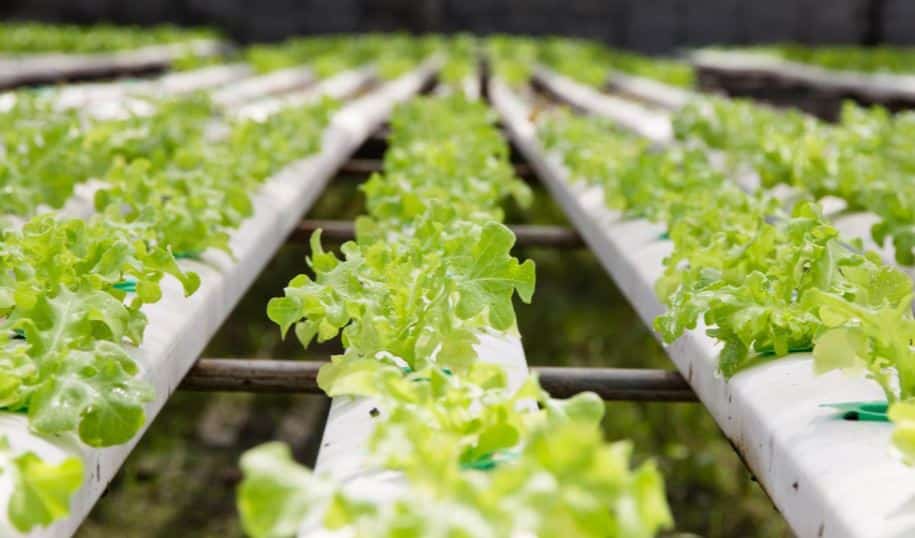
Nutrient Film Technique runs a shallow stream — usually under 3mm deep — continuously across the tips of plant roots suspended in a sloped channel. The exposed root surface above the film is in constant contact with air-oxygen. The film itself is so thin that the entire volume of solution is well-aerated as it flows. This dual exposure (air above, flowing solution below) is why NFT can operate at high density without supplemental aeration. For a full comparison of systems, see the NFT hydroponics article.
The practical implication: if your NFT pump fails, you lose the nutrient stream first, not the oxygen. Plants will wilt from dehydration before they suffer from hypoxia. That symptom ordering is diagnostic — it tells you which part of your system failed.
Kratky : The Stagnant Reservoir That Still Works
The Kratky method suspends plants so their roots reach down into a static, sealed nutrient reservoir with an air gap between the solution surface and the lid. As plants consume the nutrient solution, a small pocket of air forms and expands at the top of the reservoir. That air pocket is the oxygen source — it dissolves slowly into the water as the solution level drops, and the root zone above the water line absorbs oxygen directly from the air gap. If you are just starting out, see the full Kratky method guide for a complete setup walkthrough.
Because the nutrient solution in Kratky is not recirculated and not actively aerated, it goes stagnant and pH/EC drift happens faster than in active systems. This is the method’s main trade-off. It is ideal for passive, low-maintenance growing — but it requires careful attention to nutrient solution chemistry, and the grower who ignores reservoir condition will see slow decline that looks like a nutrient deficiency.
Aeroponics : Mist Instead of Water
Aeroponic systems keep roots suspended in air and mist them with nutrient solution at short intervals — typically every 30 seconds to 3 minutes. Because the roots are never submerged, they have maximum exposure to atmospheric oxygen between misting cycles. The oxygen availability in aeroponics at peak misting can exceed any other hydroponic method.
The trade-off: aeroponic misters clog easily with mineral deposits from hard water or concentrated nutrient solutions. A single clogged nozzle can starve one section of roots within a few mist cycles. The system that looks simplest is actually the most maintenance-intensive in real use.
Ebb and Flow : Tidal Oxygenation
Ebb and Flow (also called Flood and Drain) periodically floods the grow tray with nutrient solution from a reservoir, then drains it back. During the flood phase, roots are submerged and solution oxygen levels depend on the pump. During the drain phase, roots hang in air and absorb atmospheric oxygen directly.
This tidal pattern means oxygen arrives in two ways: dissolved in the solution during flood, and atmospheric during drain. A separate air pump in EBB is helpful for reservoir aeration but not structurally required — the drain cycle refreshes root-zone oxygen mechanically without it.
How to Size an Air Pump for DWC
If you have a DWC system, your air pump needs to deliver enough airflow to keep dissolved oxygen above 6 mg/L across your full reservoir volume. The standard rule is 1 litre of air per minute (LPM) for every 15–20 litres of reservoir capacity. For a typical 30-litre home DWC reservoir, that means a pump rated at 1.5–2 LPM.
What matters more than raw LPM rating is the air stone. A cheap air stone with large pores produces large, fast-rising bubbles that have minimal contact time with water — they burst at the surface before dissolving. A fine-pore air stone (ceramic or sintered polyethylene, pore size 5–10 microns) produces bubbles 1–2mm in diameter that stay suspended longer and dissolve oxygen far more efficiently. Budget $8–15 for a quality 4-inch ceramic air stone rather than running an undersized pump with a cheap stone.
After you set up the pump, run it for at least 15 minutes, then test the reservoir with a dissolved oxygen meter. You are looking for 6–8 mg/L at 68–72°F (20–22°C). Below 5 mg/L consistently, increase airflow or improve your air stone. Above 8 mg/L with a fine stone, you are aerating well.
The One Thing That Makes Or Breaks DWC Aeration
Every variable in DWC aeration is secondary to this: distance between the air stone and the root zone. If your air stone sits at the bottom of the reservoir but your net pots hang 8 inches above the reservoir water line, the bubbles dissolve before they reach the roots. Place your air stone directly beneath the net pots, or use a dual-air-stone setup in larger reservoirs to ensure the oxygen cloud rises through the root zone.
For most home DWC setups — 5-gallon buckets, 3-foot wide grow trays — a single fine-pore air stone positioned centrally beneath the root zone is sufficient when paired with a pump rated at 1.5+ LPM. The difference between a perfectly aerated and a barely functioning DWC is almost always stone position and pore size, not pump power.
From PDF to Excel in one click
Forget retyping line by line. Upload any bank statement, get a spreadsheet you can actually use. Your files are never stored, and you can test the converter with 3 free conversions.
Try it free