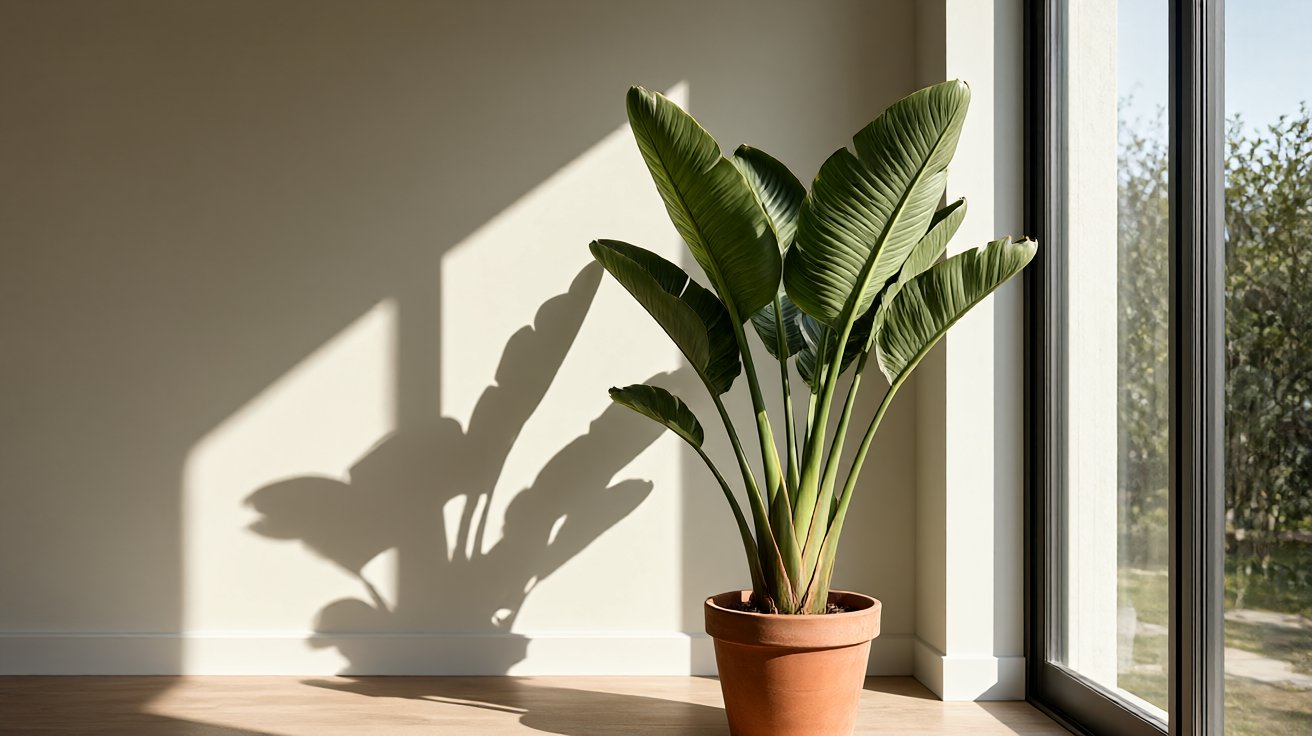

A bird of paradise in a dim corner does not stretch so much as it stalls. The plant converts light into leaf area first, and without roughly 6 hours of direct sun on a south or west window, it spends its reserves on survival rather than on the leaf blades and flowers that make the species worth growing. Light is the first variable to set, and every other one you adjust later, water, feed, humidity, sits downstream of it.
The numbers are less forgiving than the usual houseplant guidance. Extension guidance for Strelitzia reginae puts it in the full sun category, meaning 6 hours or more of direct light, not the 250 to 1,000 foot-candle band that covers a medium light plant.
A plant that receives enough light to live happily can still refuse to flower, because flowering in this species needs both maturity and near full sun. Here is how to find out which of those two problems you actually have, and how much light you need to solve it.
How Much Light a Bird of Paradise Actually Needs
Three numbers define the target, and they come from three different directions. The first is duration: a bird of paradise wants a minimum of 6 hours of direct sun on a south, south-west, or west window, and it does better with 8 hours.
The second is intensity: extension services place it in the high light band, which works out to 250 to 450 micromoles per square meter per second, or roughly 1,000 foot-candles or more as a floor for good growth and flowering. The third is the daily total. Indoor plant lighting guidance targets 4 to 6 moles per square meter per day for houseplants generally, and 14 to 20 moles for full sun plants that need to flower.
The practical target is a plant standing in direct sun for at least 6 hours a day, receiving at least 1,000 foot-candles at leaf height, for 12 to 14 hours of light. A south-facing window with the pot 1 to 3 feet back from the glass is the classic answer. A west window works if it gets the afternoon light. An east window with 2 to 6 hours of morning sun keeps the plant alive and leafy, but it will not push a flower.
Bright indirect light is a survival floor, not a target
The phrase bright indirect light appears constantly in houseplant care, and for Strelitzia nicolai, the giant white form, it is genuinely the preferred indoor condition. For the orange flowering bird of paradise, Strelitzia reginae, it is the minimum.
The distinction matters because a plant kept in bright indirect light grows steadily, produces healthy new leaves, and still refuses to bloom, and the grower usually concludes that the plant is broken rather than underlit.
If your light is genuinely bright and indirect, you can hold a bird of paradise for years as a foliage plant. The leaves get large, the plant gets tall, and the flower never comes. Our complete indoor guide covers the rest of the setup, from watering intervals to repotting, for anyone who wants the plant to survive the wait as well as possible, and for the plant-wide picture see our complete bird of paradise care guide.
Which Window, and How Far Back
Direction picks the daily total. Distance picks the intensity, and the two interact. In the northern hemisphere the sun sits lower in the sky in winter, so light reaches further into the room, and a south window delivers its best light in December and January.
In summer the same window becomes intense at the glass, and the direct beam no longer reaches the spot where the plant stood in February. This is why an indoor bird of paradise is often moved a foot or two back from the glass in high summer, then returned to the sill in autumn.
Wisconsin Horticulture makes the practical point about moving plants outdoors for the summer, which applies in reverse to the winter windowsill: the species requires nearly full sun in the summer and as much light as possible in winter to bloom, and moving it into stronger light without a gradual step will scorch it.
That is a transition, not a switch. If your plant spends summer outside, the seasonal handling in our bird of paradise outdoor care guide covers the rest of the move in both directions.
Set the plant where it gets its 6 hours, then move it seasonally by 1 to 2 feet rather than between rooms. A plant that stays in the same spot but changes distance by a foot through the year keeps a more stable light budget than a plant that gets shuffled between windows.
Rotation helps less than growers expect
Turning the pot a quarter turn every week is standard advice for houseplants, and it does help a plant avoid one-sided growth. It does not fix a light deficit. A quarter turn redistributes the light the plant already receives, and rotating a plant that receives 2 hours of sun does not create 4 more. Rotate for shape, not for energy.
Measuring the Light You Already Have
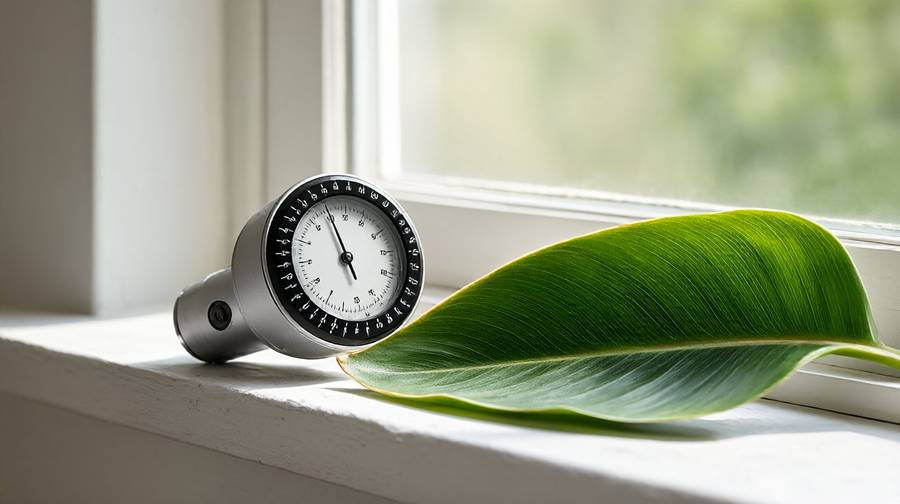
You do not need a professional meter to find out whether your window qualifies. You need a phone light meter app, a cheap light meter, or a willingness to use the published foot-candle bands for window position. Indoor light falls off fast, which is why position inside the room matters more than the compass direction of the window.
Extension services publish a consistent set of bands. Low light runs 50 to 250 foot-candles. Medium light runs 250 to 1,000, with best growth above 750. High light starts at 1,000. Direct light at a south window in front of the glass reaches 1,500. Missouri Extension publishes the falloff explicitly: under standard fluorescent fixtures, the same lamp delivers 500 to 900 foot-candles at 6 inches, 260 to 600 at 1 foot, 110 to 330 at 2 feet, and 40 to 100 at 4 feet.
Measure at leaf height, at midday, on a clear day, and in the season you care about. If you are measuring in January you have measured your worst case. If you are measuring in July, you have measured your best case, and the plant will be stressed for the other 10 months.
For a plant in a less obvious spot, our guide to the best plants for east facing windows is a useful check on what that window can actually carry.
| Position | Approximate light | For a bird of paradise |
|---|---|---|
| South window, pot touching the glass | Direct, 1,500 foot-candles | Excellent in winter, scorch risk in summer |
| South window, 2 to 3 feet back | 700 to 1,000 foot-candles | The standard indoor target |
| West window, directly in front | High, 1,000 foot-candles or more | Strong afternoon option |
| East window, 3 to 10 feet back | Medium, 250 to 500 foot-candles | Survival level, no flowers |
| North window, a few feet away | Low, under 250 foot-candles | Too dark for this species |
| Room corner, over 8 feet from glass | Under 100 foot-candles | Move the plant out |
Two adjustments change the answer more than most people expect. Sheer curtains can cut light by 40 to 50 percent, and a net curtain costs more still. A window that looks bright to the eye is often medium light by the meter, because the eye adapts. Trust the number over the impression.
Reading the Plant for Its Light Problem
Leaves report the light situation accurately, and the two failure modes look nothing alike. Underlighting produces a plant that is leggy, thin, and reaching. The newest leaves come in noticeably smaller than the last set, the stems stretch, and the plant leans hard toward the window.
Leaf colour shifts pale and washed out, and the plant may drop its oldest leaf as it cannot support it. If the plant has been in that light for years and has never flowered, light is the leading suspect before maturity or feeding.
Overlighting, usually called leaf scorch, produces damage on the surface facing the light. Bleached patches, papery tan areas that appear in the middle of a blade rather than at the edge, crisping along the sun-facing half, and browning that appears within days of a move are all scorch. A sunburnt bird of paradise does not recover on those leaves. The tissue is dead, and the next leaves are the diagnostic.
Small new leaves plus a lean means you need more light. Bleached patches on sun-facing tissue means you gave it too much, too fast. Both can be true at once if the plant sits at a hot west window in July and in a dim corner in January.
The counterintuitive part: more light means less water
This is where the light question feeds back into everything else. A plant in full sun drives higher transpiration through its stomata and burns more carbon through photosynthesis, so it uses more water and dries faster. The same pot of soil that was moist for 12 days in a dim corner will dry in 6 days in a south window in July.
Move a plant into stronger light and the instinct to water more is correct, but so is the instinct to keep the soil constantly wet, and the second one kills the plant. Water when the top layer is dry, and expect the interval to shorten. The soil-first rule in our watering guide covers how the pot size and the mix change that number.
When a Grow Light Earns Its Place
A supplemental light setup makes sense in one specific situation: a window that delivers 4 or 5 hours of direct light, which is enough to keep the plant healthy but not enough to flower it, and no way to move the plant closer to better light. It also makes sense for a grower who wants a bird of paradise to bloom in a room with north-facing glass and nothing else.
The specifications are not complicated. Extension guidance for supplemental lighting is consistent: use a full spectrum LED fixture, run it 14 hours a day on a timer, and hang it 12 to 24 inches above the foliage for a foliage plant, adjusting as the plant grows so the distance stays roughly constant. A standard 4 foot full spectrum LED shop fixture providing at least 3,000 lumens, placed 18 inches from the foliage, is the commonly published baseline.
Keep it above 8 hours and below 16 hours a day, and keep the dark period genuinely dark, because street light and television light leaking into the night can suppress flowering. Our guide to grow lights for low light plants covers the cheaper setup if you are starting from nothing, and the distance rules there are the same ones that apply here at a higher output.
One 14 hour LED fixture at 12 to 24 inches will move a plant from medium light to a flowering-capable position, if the window is doing nothing. The failure mode is not the fixture, it is the distance, and then the timer.
| Symptom under supplemental light | What it means | Correction |
|---|---|---|
| Spindly growth, small leaves, no flowers | Intensity too low | Move fixture closer, 12 to 18 inches |
| Leaf scorch, bleached patches | Intensity too high | Raise fixture to 18 to 24 inches |
| Flowers absent despite healthy growth | Day length too short, or dark period polluted | Set timer to 14 hours, block stray light |
| Growth slow in winter only | Seasonal light decline, not a fixture fault | Increase hours to 16, or accept slower winter growth |
Moving a Plant Between Indoors and Outdoors
The transition between indoor light and full outdoor sun is where most bird of paradise scorch happens, and it is a process with a timeline rather than a decision. Outdoor sun delivers 10,000 to 12,000 foot-candles. Indoor light near a window delivers a fraction of that. A plant moved directly from a windowsill into full June sun receives roughly ten times the light it has been acclimated to, and the leaves facing the sun burn within days.
Acclimate over 7 to 14 days. Start in bright shade under a tree or on a covered patio for 2 to 3 days, then increase exposure in steps of about 30 to 60 minutes of direct sun each day, moving the plant to a less exposed spot if the leaves show any bleaching. The plant that survives this ramp is the one that goes back indoors cleanly in autumn, when the same sequence runs in reverse over another 7 to 14 days before the first frost.
Ten days of gradual exposure costs nothing and prevents permanent leaf loss that no amount of watering will reverse. The tissue that scorches in June is gone for good, and a bird of paradise that loses half its leaves in one afternoon has lost half its photosynthetic capacity for the season.
Cold damage has its own thresholds, and our temperature tolerance guide covers the other end of the range.
Light, Maturity and the Question of Flowering
Light is the answer to most questions about a bird of paradise that will not bloom, but it is not the only answer, and it is not the first answer. A plant grown from seed needs 4 to 7 years before it flowers, and divisions taken from a blooming mother plant need roughly 2 to 3 years. A plant that is 2 years old, in excellent light, may simply be too young.
The check is simple: if the plant is pushing new leaves of full size and colour in good light and has not flowered, and it is old enough to flower, then light or feeding is the cause. If the new leaves are small and the plant leans, the plant has not reached the light level that flowering requires.
Two more factors sit alongside light. Flowering plants in this species are described as blooming more profusely when pot-bound, so an oversized pot can suppress flowering in a well-lit plant. And excess nitrogen, which is what most indoor feeders deliver, pushes leaf growth at the expense of flowers.
Both are covered in detail in our guide to why a bird of paradise will not bloom, which works through the seven reasons in order of how often they turn out to be the cause.
If you fix one variable first, fix the light, because it is the one that changes how the plant uses water and how fast the soil dries. Everything else you tune afterwards is calibrated to that number.
Sources and further reading
The light thresholds and propagation timings in this guide come from extension services rather than from houseplant blogs. Here is where the specifics come from:
Strelitzia reginae (Bird of Paradise) plant profile, plants.ces.ncsu.edu, NC State Extension Gardener Plant Toolbox.
Bird of Paradise, Strelitzia reginae, hort.extension.wisc.edu, University of Wisconsin Madison Extension.
Bird of Paradise, hgic.clemson.edu, Clemson Cooperative Extension Home and Garden Information Center.
Lighting for indoor plants and starting seeds, extension.umn.edu, University of Minnesota Extension.
Lighting Indoor Houseplants, publication G6515, extension.missouri.edu, University of Missouri Extension.
How to Set Up Supplemental Lights for Indoor Plants, yardandgarden.extension.iastate.edu, Iowa State University Extension.
Lighting, extension.illinois.edu, University of Illinois Extension, and lighting for houseplants, extension.msstate.edu, Mississippi State University Extension.
Last reviewed on 24 November 2026. Updated as new evidence and extension guidance are checked.