
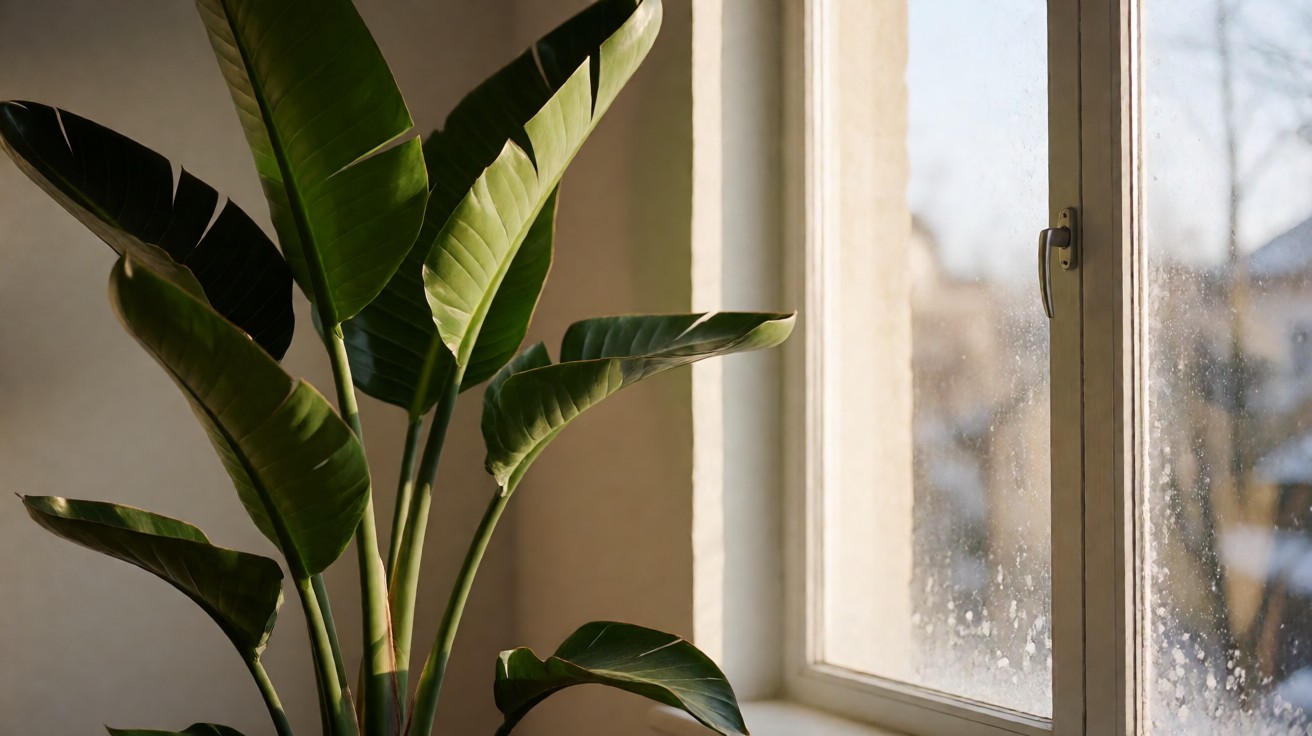

Bird of paradise is a tropical plant, but it is not a tropical rainforest plant, and that distinction is the entire reason temperature management indoors is more nuanced than a simple “keep it warm” rule. Strelitzia reginae and Strelitzia nicolai evolved in the coastal and sub-coastal regions of South Africa, where summer temperatures routinely exceed 95°F and winter nights can drop into the high 30s°F in the plant’s native range. The plants are not cold-hardy in the sense that a temperate shrub is, but they are also not the equatorial tropicals that a glance at their lush leaves might suggest. They tolerate a real range of temperatures, and that range has hard edges that show up as visible damage within hours of being crossed.
Two failure modes follow from misunderstanding that range. The first is the cold-shock plant: a bird of paradise left near a drafty window in a winter cold snap, or moved outside too early in spring, develops blackened leaf margins and a collapsed petiole within 24 hours of exposure to temperatures below 50°F. The damage is fast and dramatic, and the visible collapse looks worse than the plant’s actual condition. The second is the heat-stress plant: a bird of paradise in a south-facing window behind glass in a summer heat wave, with leaf temperatures climbing above 100°F and the plant unable to transpire fast enough to cool itself, develops leaf curl, brown patches on the blade, and a generally wilted appearance that often gets misdiagnosed as underwatering. Both patterns are temperature, not water. Both belong to the Strelitziaceae family of monocot perennials native to southern Africa.
What most indoor growers miss is that the leaves of a houseplant are not at room temperature. A leaf in direct sun behind glass can be 15°F to 30°F warmer than the surrounding air, and a leaf next to a single-pane window in winter can be 5°F to 15°F colder than the room. The plant responds to its actual leaf temperature, not the thermostat reading on the wall. That gap is where most indoor temperature damage comes from.
The Tropical Origin and Its Indoor Problem
Strelitzia reginae is native to the Eastern Cape and KwaZulu-Natal provinces of South Africa, in habitats ranging from coastal scrub to grassland edges. The plant is classified as suitable for USDA hardiness zones 9b through 11, meaning it can survive winter lows down to about 25°F to 30°F for brief periods when grown in the ground, but the foliage will be damaged at temperatures below 32°F and the plant will die back to the rhizome below about 25°F. Strelitzia nicolai is similar in cold tolerance, classified for zones 9b through 11 as well, though in practice it is more sensitive to frost than S. reginae because of its larger leaf surface area and more exposed growth habit. Neither species is a houseplant that wants to be cold.
Outdoors in those hardiness zones, the plants are landscape specimens. They are planted in the ground, their roots are buffered by the soil mass, and the leaves experience temperature swings more slowly than they would in a container. The foliage can be damaged by a hard frost and still recover from the rhizome, particularly in S. reginae, which has a substantial underground rhizome that resprouts in spring. Indoors, the plant is in a container with a much smaller soil mass, the roots are exposed to air temperature on all sides, and the leaves are subject to the same temperature swings as the room, sometimes more extreme.
The indoor practical range is narrower than the outdoor hardiness range. Most indoor Strelitzia thrive between 65°F and 85°F (18°C to 29°C) and tolerate brief excursions to 60°F on the low end and 90°F on the high end without significant stress. Outside that range, the plant shows visible damage.
For the broader picture of how temperature fits into the indoor care rhythm, the indoor bird of paradise guide covers light, humidity, watering, and feeding alongside the temperature picture. The four variables move together, and managing them as a system is what produces a healthy plant rather than a constantly-recovering one.
The Mechanism: Cold Damage, Heat Stress, and Leaf Temperature
Cold damage in Strelitzia is fundamentally a membrane failure. Plant cell membranes are made of lipids that maintain a fluid, flexible structure at warm temperatures. Below about 50°F, the lipids in Strelitzia leaf cells begin to undergo a phase transition from fluid to semi-rigid, and the membrane loses its ability to control what moves in and out of the cell..
Heat stress operates by a different mechanism. At high temperatures, the rate of water loss through transpiration can exceed the rate at which the roots can replace it, even in moist soil. The plant responds by closing the stomata on its leaves to slow water loss, but closing the stomata also stops the evaporative cooling that normally keeps leaf temperature below air temperature..
The indoor-specific danger is the gap between air temperature and leaf temperature. A leaf in direct sun behind glass can be 20°F to 30°F warmer than the surrounding air, which means a 75°F room can produce leaves at 100°F or higher during a sunny afternoon. A leaf next to a single-pane window in winter can be 10°F to 15°F colder than the room, which means a 65°F room can produce leaves at 50°F or lower on a cold night. Both extremes are common in indoor environments, and both produce visible damage that does not match the thermostat reading.
USDA zones 9b through 11 for both Strelitzia reginae and Strelitzia nicolai are well established in horticultural references, and the 50°F damage threshold is the practical indoor limit, not the hardiness limit. The plant can survive colder temperatures for brief periods, but the damage accumulates with each exposure, and a plant that has been repeatedly chilled will show the cumulative effect in stunted new growth and chronic leaf margin damage even after it has been moved to a better location.
What Actually Works: Indoor Placement for Temperature Stability
Five placement decisions reliably keep an indoor bird of paradise in its safe temperature range. They are ranked by how much each one actually moves the needle on the plant’s leaf temperature.
- Move the plant 2 to 3 feet away from single-pane exterior windows in winter. The cold downdraft from a single-pane window in a cold climate can chill the nearby leaves by 10°F to 15°F below the room temperature. Double-pane windows reduce the effect significantly but do not eliminate it. The simple fix is to pull the plant away from the glass by 2 to 3 feet, which puts the leaves into the room air mass rather than the cold microclimate immediately adjacent to the glass.
- Keep the plant out of the direct path of heating and cooling vents. A forced-air heating vent pointing at the plant creates rapid temperature swings as the system cycles, and a cold air conditioning vent creates localized chilling in summer. Both produce temperature stress that shows up as brown leaf tips and stunted new growth on the side of the plant facing the vent. Aim the vents away from the plant, or relocate the plant to a spot that is not in the direct airflow path.
- Provide afternoon shade in summer for plants near south or west-facing glass. A sheer curtain, a partially closed blind, or a position 3 to 4 feet back from the glass rather than right next to it can drop the leaf temperature by 15°F to 25°F during peak sun. The light reduction is minimal, but the heat reduction is substantial. This is the single most effective summer intervention for a plant that is showing heat stress symptoms.
- Do not move the plant outside until night temperatures are consistently above 55°F. The instinct to put the plant out for the summer is good, but moving it out too early in spring, when night temperatures are still dropping into the 40s, exposes it to cold damage that does not show up until a day or two later. Wait until the overnight low is reliably above 55°F, and bring the plant back in before nights drop below 55°F in autumn. That window is typically late May to late September in most temperate climates.
- Use a small fan to keep air moving across the foliage in summer. Stagnant hot air holds heat against the leaves. A small fan running on low 3 to 4 feet from the plant, oscillating gently, keeps the boundary layer of hot air from settling against the leaf surface and allows the leaves to transpire and cool themselves more effectively. This is the same principle as a ceiling fan, applied locally.
A simple thermometer placed at leaf height near the plant, ideally a min-max thermometer that records the overnight low and the daytime high, will tell you more about what the plant is actually experiencing than any thermostat reading on the wall. The numbers from the leaf-height thermometer over a week will reveal the hot and cold spots in your home and tell you which placement decisions actually matter.
For a deeper look at how light and temperature interact in indoor placement, the east-facing window plant guide covers the bright-but-not-direct positions that work well for Strelitzia in climates where south-facing summer sun is too intense.
For the cluster context, see the full bird of paradise indoor care guide and related articles: complete Strelitzia care guide indoor Bird of Paradise care Bird of Paradise indoors versus outdoors.
How to Help a Cold-Damaged or Heat-Stressed Plant Recover
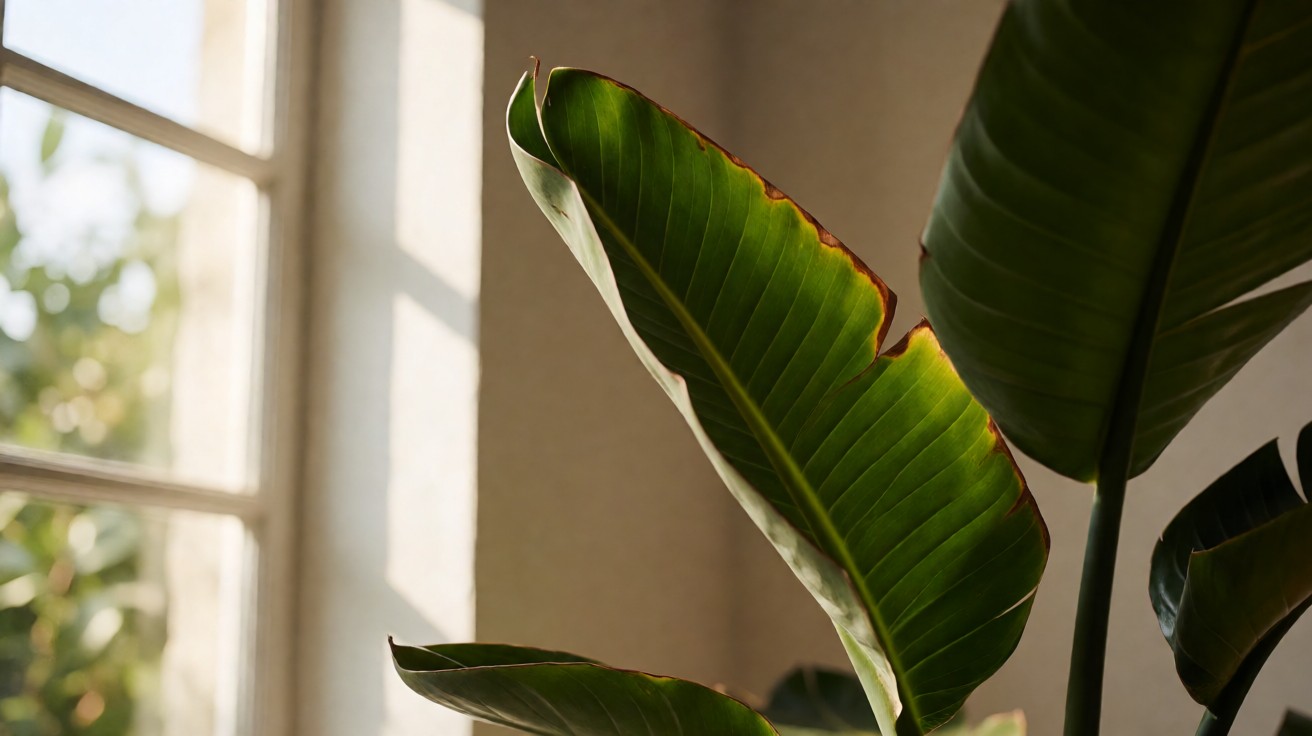
Cold damage is irreversible in the affected tissue. The blackened leaves and collapsed petioles will not recover, and the plant’s energy is better spent producing new growth than trying to maintain damaged leaves. The right response is to move the plant to a stable, warm location with bright indirect light, hold off on fertilizing until new growth emerges, and water only when the top 2 inches of soil are dry. The rhizome of Strelitzia reginae is hardy and will usually resprout from the base within 4 to 8 weeks even after a hard cold event that has killed all the foliage. S. nicolai resprouts from the base as well, but more slowly. Do not give up on either species until the rhizome is soft and mushy, which indicates actual rhizome death rather than just foliar damage.
Heat stress is more reversible. If the plant is showing leaf curl and wilting but the soil is moist, the diagnosis is heat stress, not underwatering. Move the plant out of direct sun, provide afternoon shade, set up a fan for air movement, and mist the leaves briefly to provide immediate evaporative cooling.
The save a dying bird of paradise guide covers the full diagnostic tree for a plant that has been through a serious stress event, including temperature damage combined with the watering and root problems that often follow. The general rule is to stabilize the temperature first, then address water and light, then resume feeding only after new growth appears.
What to Expect When You Stabilize the Temperature
Once you have moved the plant out of the cold draft and away from the heating vent, or shaded it from the afternoon sun behind the south-facing window, the visible recovery follows a predictable sequence. In the first week, the plant stops producing new damage. The leaves that are already showing tip burn or blackening will not heal, but no additional damage appears..
The cumulative effect of repeated temperature stress is more serious than any single event. A plant that has been chilled half a dozen times in a winter shows it the following spring in stunted new growth, smaller leaves than the previous year, and a general reluctance to push out new foliage even when conditions are good..