
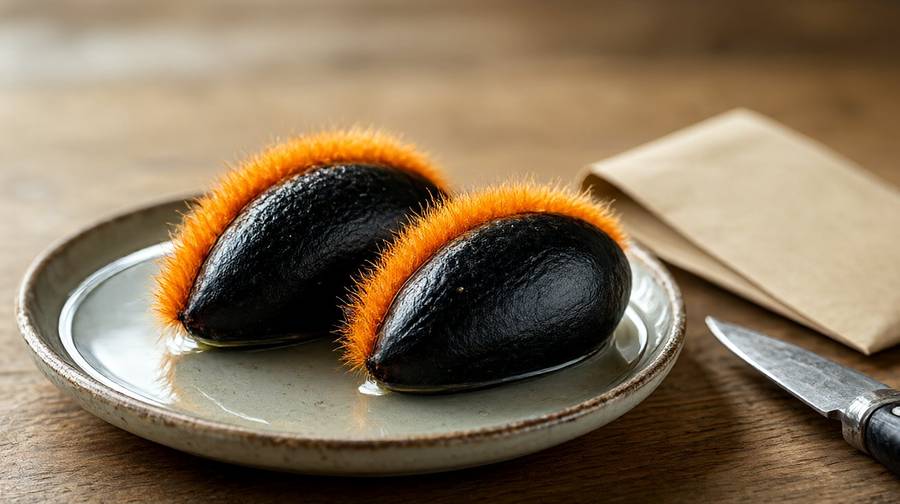
Starting a bird of paradise from seed is the slowest way to get a plant you can hold in one hand, and the only way to get one that is genuinely your own. The seeds are large, black, and hard-coated, with a bright orange tuft of hairs attached to one end.
Under the right conditions they will sprout in 6 to 12 weeks. Under the wrong conditions they will sit in the soil for months and rot. The difference is temperature, moisture control, and patience, and every step of the process is documented in extension guidance rather than guessed.
What makes this worth doing is the arithmetic. A division from a blooming mother plant gives you a plant 2 to 3 years from flowers. A seed gives you a plant 4 to 7 years from flowers, with the added possibility that the offspring will not match the parent.
University of Florida IFAS Extension is direct about the tradeoff: a bird of paradise grown from seed will take 3 to 5 years to bloom, and because seed comes from a hybrid, the offspring may have variable characteristics. Here is how to sow, germinate, and raise one properly, and what you are actually trading away.
Why Grow From Seed When Division Is Faster
The case for division is strong and our propagation guide covers it in detail: it is faster, it clones the parent exactly, and a plant that has been blooming for a few years can be split with offsets that root quickly.
So the honest answer to why sow a seed is that division has a limit. You can only divide a plant you already own, or one a friend will give you, and you cannot divide a seed. Sowing also produces the only plant with a documented genetic identity that is entirely yours from day one, which matters if you are building a collection rather than filling a pot.
There is a third reason that is more practical than philosophical. Division carries a 5 week recovery protocol, the risk of losing the mother plant if you cut wrong, and the reality that a divided plant may skip flowering for a few years while it re-establishes. A seed does none of that.
It asks for 3 months of attention and then 4 to 7 years of patience, but it asks for patience, which is available in a way that a scalpel is not. Meanwhile our complete bird of paradise care guide covers the setup it will grow into.
For the indoor setup the seedling will grow into, see our complete indoor guide.
Seed is the right choice when you want a plant you cannot get any other way, and the wrong choice when you want flowers next spring. Those are the only two honest positions, and most growers are choosing based on which of those two they actually care about.
Getting Viable Seed in the First Place
Fresh seed or no seed
Seed viability is the variable people get wrong, and it is fixable before you plant anything. The fruit is a woody capsule that ripens in fall and winter, and inside it the seeds are large and black with an orange aril, the small tuft of hairs that native African birds and monkeys eat. The aril is not a protective coat. It is food attached to the seed, and the hard black shell beneath it is the coat that has to be broken.
University of Wisconsin Extension is specific: for best results, sow fresh seed in the spring. Seed that has been stored loses viability over time, and a seed that has been dried in a warm room for a year may never sprout.
If you are buying, buy from a supplier who will tell you the harvest year, and keep the seed in a sealed envelope in a cool place until you are ready to sow. If you are harvesting from your own plant, take the capsules when they turn brown and split open on the plant, not from a cut stem.
Freshness decides more than technique does. A well-sown old seed and a badly-sown fresh seed both fail, but a badly-sown fresh seed is still recoverable, and a well-sown old seed is not. This is the one step where you cannot fix a mistake later, so buy or collect fresh seed and sow it in spring.
Breaking the Seed Coat Before You Sow
The black shell on a Strelitzia seed is genuinely hard, and it is the reason a surprising number of sown seeds never emerge. Two treatments are published, and they work together rather than instead of each other.
The first is soaking. University of Wisconsin Extension advises soaking the hard seeds for 24 hours and removing the bright orange tuft of hairs attached to the seed before planting. The second is a nick in the coat, which is what breaks the water barrier and lets the seed take up moisture.
The cleanest way to combine them is to nick the coat at a single point, deep enough to see a hint of the pale kernel beneath but not so deep that you injure it, then soak the seed in room-temperature water for 24 hours. Change the water once if you are starting in a warm room.
After soaking, the seed should feel slightly heavier and look less glossy. That is the whole test. There is no benefit to soaking for 3 days, and a seed that starts to smell or turn slimy has been left too long and should be discarded rather than sown.
One nick plus 24 hours of soaking is the entire preparation, and it is the step most growers skip. Skip it and you spend 3 months waiting for nothing.
Sowing: Depth, Medium and Temperature
Three variables decide whether a treated seed emerges: how deep it goes, what it sits in, and how warm it stays. University of Wisconsin Extension gives the specifics, and they are worth following exactly rather than approximately.
Plant the seed 1 inch deep in moist potting mix and keep it warm at 85 F. Clemson Cooperative Extension adds the mechanism that explains the number: bottom heat of 75 to 90 F speeds germination, and seedlings should emerge in 6 to 12 weeks.
Extension guidance on starting seeds indoors also places seedlings, not mature plants, in the medium and high light bands of 150 to 250 and 250 to 450 micromoles per square meter per second, so a warm but dim spot will produce a thin, pale seedling rather than a failure.
1 inch deep, moist but not soaked, and a steady 85 F is the published recipe. Bottom heat means the warmth comes from below the tray, not from a lamp above it, and it is the difference between emergence in 6 weeks and emergence in 4 months.
| Step | Setting | Why it matters |
|---|---|---|
| Seed preparation | One nick in the coat, 24 hour soak | Breaks the water barrier the hard shell creates |
| Sowing depth | 1 inch deep in moist potting mix | Deep enough for the shoot, shallow enough to prevent rot |
| Temperature | 85 F, with bottom heat of 75 to 90 F | Bottom heat speeds germination over ambient room heat |
| Emergence | 6 to 12 weeks | Longer than most houseplant seeds, and normal |
| First transplant | At 2 to 3 leaves | Roots need room before they are allowed to set |
| First flower | 4 to 7 years from sowing | Seed-grown plants bloom later than divisions |
Germination Is a Monitoring Job
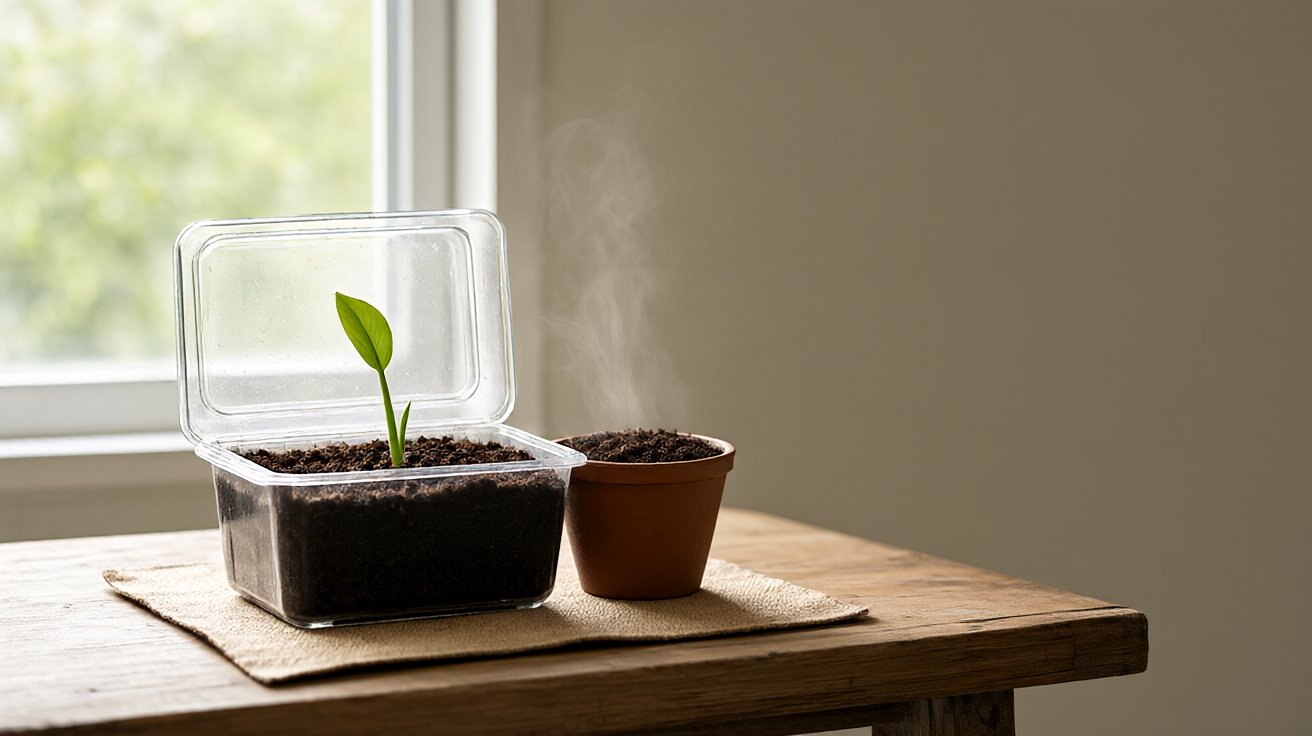
For the first 6 to 12 weeks the pot tells you what it needs, and the failure modes are simple: too dry and the seed dies, too wet and it rots, too cold and it sits dormant. A sealed propagation tray or a bag over the pot holds moisture and heat in one move, which is what makes a 24 hour soak worth doing in the first place. Check weekly, not daily, and let the surface of the mix tell you when to water rather than keeping it permanently wet.
The signal to watch for is the shoot, not the seed. A seed that has split or shows a white nub is working. A seed that has darkened, softened, or smells sour has failed, and pulling it out protects the seeds around it. Seedlings themselves are vulnerable to damping off, a fungal collapse at the soil line, and the standard counter is gentle bottom watering and airflow rather than a fungicide sprayed over everything.
If nothing has emerged by week 12, dig one seed up and check it. A firm seed is dormant and worth waiting on. A soft, split, brown seed is dead, and the remaining ones in that pot are likely in the same condition. Our guide to starting plants from cuttings covers the airflow and moisture discipline that keeps damping off out of the pot, because the same failure kills both.
Raising the Seedling Without Ruining It
Two pieces of published guidance cover the months after emergence. University of Wisconsin Extension advises transplanting when the seedlings have 2 to 3 leaves, growing them in lower light than mature plants, and not restricting root growth, because restriction slows overall development of the plant.
That last point is easy to get wrong. A seedling squeezed into a small pot to look tidy develops a root system that never fills the space, and a stunted root system becomes a stunted plant that never flowers.
University of Florida IFAS Extension adds the other side of the same point: seed-grown bird of paradise takes 3 to 5 years to bloom, and seed from a hybrid gives variable offspring, so a seedling may not resemble the parent at all. Accept that before you sow. If you need a plant that matches a specific parent, division is the only method that guarantees it.
Let the seedling set roots without restriction, keep it in lower light than the adult plant, and give it the same soil you would use for a mature one. Our soil and repotting guide has the mix ratio and the pot sizing rules, and using them from the start saves you from a plant that needs repotting twice in its first year.
The Years Between Sprout and Flower
Here is the part nobody can rush. University of Wisconsin Extension puts seed-propagated plants of this genus at 4 to 7 years before they begin blooming.
Clemson notes that flowering plants in this species are described as blooming more profusely when pot-bound, which means the seed-grown plant wants to stay in its pot longer than instinct suggests. Every spring, replace the top soil rather than repotting a plant that is doing well, exactly as you would with a mature specimen.
The gap between seedling and flower is where most seed growers give up, and it is also where the plant is quietly building the reserves it needs to bloom. Extension guidance on this genus is consistent that light drives flowering, with the species requiring nearly full sun in summer and as much light as possible in winter.
A seedling in low light spends those 4 years growing slowly and arrives at maturity without the reserves to flower. Our guide to why a bird of paradise will not bloom works through the reasons in order of how often each turns out to be the cause, and light sits at the top of that list.
Give a 2 year old seedling the best light you have and do not expect a flower, because the plant is doing exactly what it should be doing. The bloom you are waiting for is budgeted from light, and the budget is set years before the flower opens.
Sources and further reading
The germination timings and temperatures in this guide come from extension services rather than from seed-selling websites. Here is where the specifics come from:
Bird of Paradise, Strelitzia reginae, hort.extension.wisc.edu, University of Wisconsin Madison Extension.
Bird of Paradise, hgic.clemson.edu, Clemson Cooperative Extension Home and Garden Information Center.
ENH79 bird-of-paradise, publication mg106, ask.ifas.ufl.edu, University of Florida IFAS Extension.
Strelitzia nicolai (Giant Bird of Paradise) plant profile and Strelitzia reginae plant profile, plants.ces.ncsu.edu, NC State Extension Gardener Plant Toolbox.
Lighting for indoor plants and starting seeds, extension.umn.edu, University of Minnesota Extension.
Last reviewed on 24 November 2026. Updated as new evidence and extension guidance are checked.