
Bird of paradise is a common name, and it covers at least three different plants. The one sold as white bird of paradise or giant bird of paradise is Strelitzia nicolai, a tree-forming species from coastal Botswana, KwaZulu-Natal, Mozambique, and Zimbabwe that grows to 20 to 30 feet in the wild with leaves up to 78 inches long on a woody stem.
It is not a bigger version of the orange bird of paradise. It is a different plant with different water needs, different light preferences, and a much longer wait before it flowers.
The confusion matters because the orange Strelitzia reginae is what most people picture, and most care instructions on the internet are written for it. Applied to Strelitzia nicolai, those instructions produce a plant that grows large, holds its leaves, and never flowers. Here is what the giant species actually needs, and where it genuinely differs from the one you may already own.
What the White Bird of Paradise Actually Is
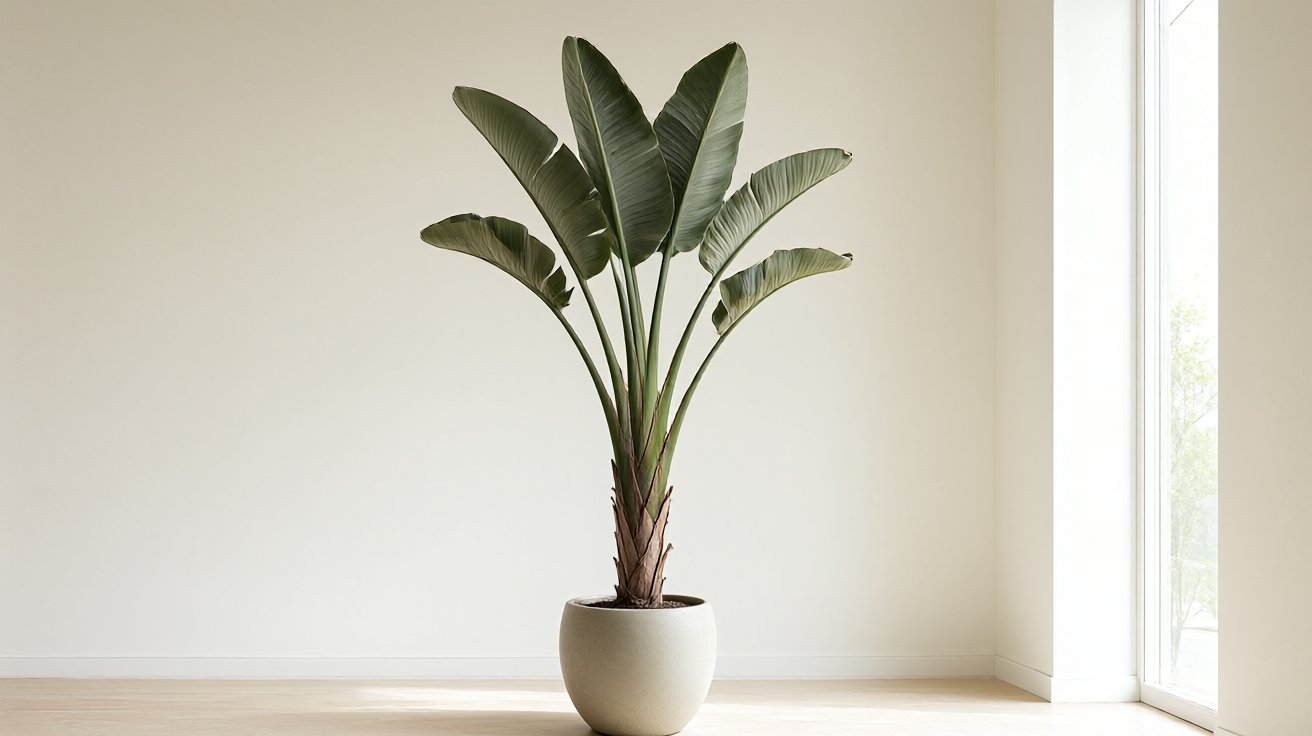
Two species share the white and giant common names in the trade, and they are frequently confused with each other. Strelitzia nicolai, the giant bird of paradise, develops a genuine woody trunk that can reach 1.5 feet across, with large paddle-like leaves arranged in a spiral fan around the top of that trunk.
Strelitzia alba, the white bird of paradise, is the smaller of the two, reaching about 18 feet with leaves of the same shape but a more clumping, trunkless habit. When the two look nearly identical in the trade, the blue petals are the tell, because Strelitzia nicolai usually carries them and Strelitzia alba does not.
Both species are native to southern Africa, both are in the same genus as the orange flowering bird of paradise, and both produce the same large seeds with a bright orange aril that native birds and monkeys eat. The name confusion between the two is documented in University of Wisconsin Extension guidance, which notes the common names white and giant are often used interchangeably even though the plants are visibly distinct.
Check the trunk before anything else, because it decides whether you have a tree-forming Strelitzia nicolai or a clumping Strelitzia alba. A single thick woody stem with leaves fanned around its top is Strelitzia nicolai. A tight clump of leaf stalks with no trunk is Strelitzia alba. If you cannot tell, treat the plant as the more drought tolerant of the two, because overwatering is the mistake that kills both.
Light and Placement for a Tree-Sized Plant
The giant species is more forgiving about light than the orange one, and the difference is real rather than folklore. NC State Extension describes Strelitzia nicolai as preferring bright, indirect light, and lists its cultural light requirement as partial shade with 2 to 6 hours of direct sun.
The orange Strelitzia reginae is listed as full sun, meaning 6 hours or more of direct light. Put both under the same window and you are running the orange species short of what it needs to flower while the white one is comfortable.
Position still decides the outcome. For a plant that will eventually carry 6 foot wide leaves on 5 foot stalks, the floor space matters as much as the light. NC State lists the available space to plant this species as 6 to 12 feet, and Wisconsin Extension notes that the leaves of the white and giant forms are 18 to 24 inches wide and 3 to 4 feet long, arranged attractively enough to work as an interior foliage specimen on their own.
Bright indirect light will keep Strelitzia nicolai alive and growing for years. Flowering is a different problem, and it is a maturity problem first. A plant that has never bloomed and is pushing 3 foot leaves is probably doing exactly what the species does indoors. For the general indoor setup, our complete indoor guide covers the light, watering and repotting setup this species shares with the orange species.
Our side-by-side comparison of Strelitzia reginae and Strelitzia nicolai lays out which one to choose if the goal is flowers rather than a floor-to-ceiling tropical statement.
| Feature | Strelitzia nicolai | Strelitzia reginae |
|---|---|---|
| Growth form | Single woody trunk, crown of leaves at top | Clumping, no trunk |
| Native range | Botswana, KwaZulu-Natal, Mozambique, Zimbabwe | Eastern Cape of South Africa |
| Preferred indoor light | Bright indirect, 2 to 6 hours direct sun | Full sun, 6 hours or more |
| Temperature range | 65 to 85 F, not below 50 F | 65 to 70 F by day, 50 to 55 F at night |
| Leaf length | Up to 78 inches | 12 to 18 inches |
| Time to first flower | 5 to 6 years from seed | 4 to 7 years from seed |
Soil, Potting and the Aggressive Root System
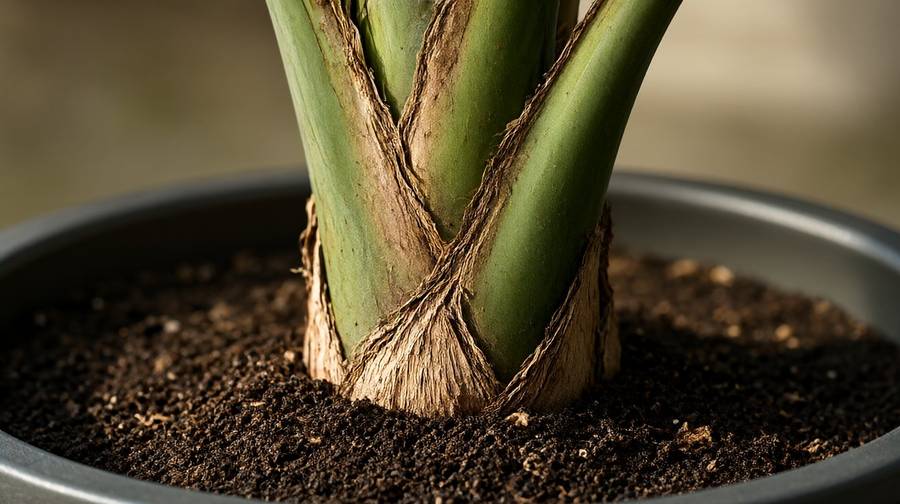
Soil for Strelitzia nicolai is not unusual, but the roots are. NC State Extension specifically warns against planting this species near buildings or sidewalks because its root system is very aggressive, and notes that it needs good drainage with soil textures of clay, loam, or sand and an acidic to neutral pH. In a container that means a free draining mix, and a pot with enough room that the roots are not circling the wall and pushing it over.
Two details are specific to this plant. First, it prefers moist soil but with occasional dryness, so a mix that holds water for weeks is wrong even if it is rich. Second, the root ball of an established specimen is heavy and woody, and it can push a light plastic pot sideways.
A heavier pot or a heavier base is not decoration, it is what keeps a 6 foot plant upright. Our soil and repotting guide covers the 60/40 mix and the pot sizing rules that keep this species stable.
Give it a heavy pot and a mix that drains within a week, and repot only when the roots have visibly cracked the container. Extension guidance on this genus is consistent about one thing: flowering plants bloom more profusely when pot-bound, so an oversized pot is not progress.
Watering: More Forgiving Than the Orange Species, Not Carefree
The water rule for this species is narrower than the internet suggests. NC State Extension advises watering the plant when the top layer of soil feels dry, and adds the detail that matters: once established, the plant becomes more drought tolerant.
In practice that means a mature Strelitzia nicolai in a room with reasonable air movement will forgive a missed watering, while the same plant sitting in wet soil for days will show the damage in the form of root rot and leaf yellowing.
The trap is the opposite error. A 20 foot species in a large pot holds a lot of water, and a grower who keeps to a fixed schedule rather than checking the soil will keep it saturated long after the plant has drawn down what it needed.
The soil-first rule in our watering guide explains how to read the pot rather than the calendar, and it applies to this species with one adjustment: a bigger pot dries more slowly than a small one, so the top layer test has to be checked deeper.
Test the top 2 inches of soil, and if it is still damp, wait. For a plant in a 12 to 18 inch pot, that test means pushing a finger past the surface layer rather than just touching it. The counterintuitive part is that a plant in more light needs more water, not less, and the giant species is no exception once it is in a bright window.
Humidity and air movement
NC State lists high humidity among the preferred conditions for this species, and also warns against cold drafts and sudden temperature changes, both of which cost the plant leaves. Humidification and airflow are not opposites here: a humidifier running in a closed room keeps moisture on the leaf surface long enough to invite fungal leaf spot.
The vapor pressure deficit approach in our humidity guide explains the threshold, and it applies to this species as much as to the orange one.
Feeding, and the Long Road to Flowers
Feeding is straightforward. NC State advises that during spring and summer, a balanced liquid fertilizer may be used once a month for this species, and Wisconsin Extension recommends fertilizing every 2 weeks through the summer and monthly in winter for the genus. The two differ because the climates differ, and the monthly spring and summer rate is the right indoor default for a plant that will spend most of its life under a roof.
Then there is the wait. NC State states plainly that a mature plant produces flowers and may take up 5 to 6 years before flowering, and Wisconsin Extension puts seed-grown plants of the genus at 4 to 7 years before they bloom. That number is the single most important thing to understand before buying a Strelitzia nicolai for its flowers. There is no fertilizer, no light fixture, and no feeding schedule that shortens it. The species flowers on its own clock.
Treat this as a foliage plant with a possible bonus, and the bonus becomes real when the plant is 5 to 6 years old, not before. If you want flowers on a schedule you control, the orange Strelitzia reginae is the species to grow, and our guide to why a bird of paradise will not bloom covers the reasons a mature plant still holds its flowers back.
What the leaves do year to year
Leaves on Strelitzia nicolai are large enough to tear along their veins in wind, and NC State notes this explicitly, along with the advice to remove ripped or torn leaves. In a container, wind damage comes from a fan, a door, or a window left open in a draught, not from weather. Trim the torn blades back to clean tissue so the plant does not carry open wounds through the winter, and expect the plant to replace them from the crown once growing conditions are right.
Pests and the Problems That Follow Them
Pest pressure on this species is moderate and manageable. NC State lists scale, spider mites, aphids, and mealybugs as the things to monitor for, with no significant known diseases.
The large leaf surface makes two of those easy to spot early: spider mites show as fine pale stippling across the blade, and scale insects appear as small fixed bumps along the veins and leaf midrib. Mealybugs collect in the leaf axles where the stalk meets the crown, which is the part of a Strelitzia that is hardest to see and easiest to skip.
Because the leaves are enormous, a soft cloth is the practical tool. University of Wisconsin Extension notes that it is easy to wipe the large leaves off with a soft cloth, and advises against leafshine products because they damage the natural matte finish. Do the same for the giant species, and check the undersides of the leaves and the base of each petiole at least monthly during the growing season.
A monthly wipe-down with a damp cloth is both pest prevention and leaf care, and it takes two minutes on a plant this size. Our bird of paradise problems guide covers the diagnostic sequence for spotting mites versus scale versus a plain watering mistake before you treat anything.

Is the Giant Species the Right Choice for Your Room?
Choose Strelitzia nicolai if you have a room with a high ceiling, a bright but not sunniest window, and a plant that will be admired for its foliage for at least 5 years before you expect a flower. Choose it for the tropical look, because that is what it delivers reliably and early, and it delivers it with far more grace than any other large-leaved indoor plant.
Choose Strelitzia reginae if you want orange and blue flowers, if your window is genuinely sunny, and if you are willing to accept a slower, more demanding watering schedule. Choose it if the plant will live in a spot you check daily, because that species punishes neglect with root rot faster.
The white bird of paradise is the forgiving, oversized, long-lived option, and it is the wrong plant for anyone hoping for a bloom in the first three years. Our indoor versus outdoor guide covers the other decision you will face with a plant this size, since a Strelitzia nicolai is the one species in this genus that genuinely benefits from a summer outside.
Sources and further reading
The species facts in this guide come from botanical and extension sources rather than from houseplant blogs. Here is where the specifics come from:
Strelitzia nicolai (Giant Bird of Paradise) plant profile, plants.ces.ncsu.edu, NC State Extension Gardener Plant Toolbox.
Strelitzia reginae (Bird of Paradise) plant profile, plants.ces.ncsu.edu, NC State Extension Gardener Plant Toolbox.
Bird of Paradise, Strelitzia reginae, hort.extension.wisc.edu, University of Wisconsin Madison Extension.
Bird of Paradise, hgic.clemson.edu, Clemson Cooperative Extension Home and Garden Information Center.
ENH79 bird-of-paradise, publication mg106, ask.ifas.ufl.edu, University of Florida IFAS Extension.
Last reviewed on 24 November 2026. Updated as new evidence and extension guidance are checked.