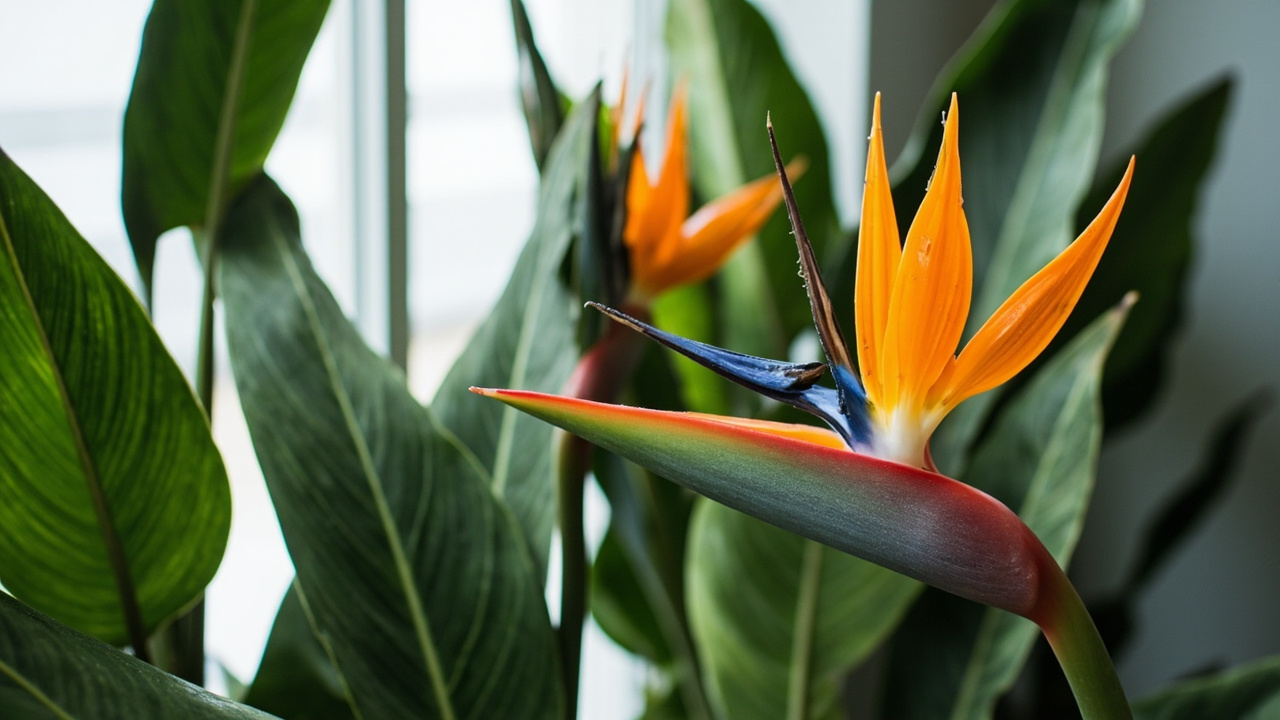
Few houseplants make a statement the way a Bird of Paradise does. With its bold, architectural leaves — and, given enough light, those unmistakable crane-like flowers in orange and electric blue — Strelitzia is the tropical showpiece that turns any room into something closer to a glasshouse. But it is also the plant that frustrates owners most: the leaves split, the plant refuses to bloom, brown edges appear for no obvious reason. Most of that frustration comes down to a handful of specific care needs that are easy to get right once you understand them.
Bird of Paradise refers to the genus Strelitzia, a group of five species native to South Africa. The name comes from the flower shape — each bloom looks like a bird in flight, with a blue hood and orange crest. In nature, these plants grow in warm, sunny, semi-humid conditions along riverbanks and forest margins. Replicating those conditions at home is what the whole care system is built around. This guide covers every core dimension — light, water, soil, temperature, and the common problems you are most likely to encounter.
The short version: Bird of Paradise wants bright light, a well-draining growing mix, consistent moisture during the growing season, and warm temperatures. Miss any one of those and the plant will tell you — through split leaves, brown edges, stalled growth, or a complete refusal to flower. Get them right and a healthy Strelitzia will reward you with new leaves every month or two during the active growing season and, eventually, those spectacular blooms.
This article is the foundation of our Bird of Paradise cluster. Follow it with our guides to grow lights for indoor plants and increasing humidity for indoor plants for deeper dives into the two care dimensions that cause the most reader complaints.
Understanding Bird of Paradise (Strelitzia): Species and What Makes Them Tick
Strelitzia is a genus of five species, but only three are commonly grown as houseplants — and they are quite different from each other in size, habit, and care requirements.
Strelitzia reginae is the iconic one: compact, 3 to 6 feet tall indoors, with deep green leaves and the famous orange-and-blue flowers that appear on a long stalk in mature, well-lit plants. It is the species most people picture when they hear “Bird of Paradise.” Strelitzia nicolai, the Giant White Bird of Paradise, is a different proposition entirely. It reaches 20 to 30 feet in the wild and can push 8 to 10 feet indoors with large, paddle-shaped leaves that split naturally as they mature. Then there is Strelitzia juncea, the Rush Strelitzia — slender, upright reed-like stems instead of broad leaves, more compact, and surprisingly drought-tolerant for a tropical plant.
The split leaf is not a disease or a deficiency — it is a built-in feature. In their native habitat, Strelitzia reginae and nicolai evolved in windy conditions where large, undivided leaf surfaces tore easily. Leaf splitting is the plant’s structural solution: the blade separates along natural fracture lines, reducing wind resistance. Indoors, you will see the same splitting when humidity is low or when a large leaf has grown quickly. It does not mean the plant is sick. Well-grown specimens in consistently humid environments tend to show less splitting, but some is entirely normal and cosmetic.
The practical takeaway for sizing up a Bird of Paradise at purchase time: if you have a bright south-facing window with several feet of clearance, S. nicolai makes a dramatic statement. If your space is more modest or you want the iconic flowers, S. reginae is the practical choice. S. juncea suits anyone who wants the Strelitzia look in a narrower footprint.
Light Requirements: Bright Indirect to Full Sun
Light is the non-negotiable for Bird of Paradise, and it is the reason most indoor specimens disappoint. Strelitzia evolved in open, sunny habitats and needs a lot of photons to maintain its large leaf surface and, eventually, to bloom.
Indoors, that means the brightest spot you can offer — ideally several hours of direct sun, most commonly a south-facing or west-facing window. An east-facing window can work for compact S. reginae if the plant is close enough to the glass. North-facing windows are almost never adequate; the plant will survive but will not thrive or bloom. As a rough benchmark, aim for 6 or more hours of bright indirect light or at least 4 hours of direct sun daily.
The specific consequence of insufficient light is predictable: growth slows or stops, new leaves emerge smaller than the ones below them, existing leaves lose their deep green colour and look washed out, and the plant will not bloom — no matter how perfectly you water it. There is no workaround for low light that does not involve adding more light. If your window situation is limited, a quality full-spectrum grow light is not optional — it is the entire solution. Position the light 12 to 24 inches above the foliage and run it for 10 to 12 hours a day to replicate the photon density a south window would provide.
The trade-off at the other extreme is sunburn: if you move an indoor Bird of Paradise outside for the summer, introduce it to direct sun gradually over two weeks or the leaves will scorch. A plant that has been grown in lower light and suddenly receives full afternoon sun will bleach and burn. Transition carefully.
Watering Schedule and Humidity Needs
Watering is where most Bird of Paradise problems originate — and the fix is usually either too much water or inconsistent watering, not too little.
The practical rule: water when the top 2 inches of the growing mix feel dry to the touch. In a heated home during the active growing season (spring and summer), that typically means every 7 to 10 days. In winter, when growth slows or stops, stretch that to every 10 to 14 days or even longer. The single biggest mistake is watering on a fixed weekly schedule regardless of season or moisture level — Strelitzia in a large nursery pot in summer can need water twice a week; the same plant in a compact pot in winter may go three weeks between waterings. Always check the soil first.
Use room-temperature water. Cold water shocks the roots and can cause temporary leaf damage, especially in a plant that has been allowed to dry out slightly. Let tap water sit overnight so chlorine dissipates, or use filtered water if your tap water is heavily chlorinated or fluoridated — Strelitzia can be sensitive to fluoride, which shows as leaf tip burn on the older leaves first.
Humidity is the second half of the watering conversation, and it is the primary driver of the leaf-splitting that owners find most alarming. Indoor humidity in most heated or air-conditioned homes sits between 30% and 45% relative humidity — well below the 50% to 65% that Strelitzia prefers. When the air is dry, leaf edges lose moisture faster than the rest of the blade, causing the tissue to tear along the natural fracture lines. The fix is straightforward: raise the humidity around the plant. A pebble tray — the plant pot sitting on a saucer of gravel and water, with the pot base above the water line — provides a modest but meaningful localised humidity boost. A room humidifier run consistently near the plant is more effective. Grouping plants together also creates a slightly more humid microclimate.
The honest limitation: if your home air is very dry year-round, some leaf splitting on your Bird of Paradise is inevitable. It is cosmetic, not fatal. New leaves produced in higher humidity will split less or not at all. You are managing the condition, not curing it.
Soil Mix, Feeding, and Fertilizing
Bird of Paradise needs a growing medium that drains freely but retains enough moisture to support active growth. The starting point is a quality all-purpose potting mix — something peat-based or coco-coir based — amended with roughly 25% to 30% perlite by volume to improve drainage. A standard 5-1-2 or balanced 10-10-10 NPK ratio liquid fertilizer, diluted to half the label strength, applied once a month during the growing season (roughly April through September in the northern hemisphere) covers the nutritional needs of most indoor specimens.
The substrate recipe in practice: for a standard 8-inch pot, roughly three parts potting mix to one part perlite. If you are growing S. nicolai, which has a more vigorous root system and larger leaf mass, add a small amount of compost or slow-release granules to the mix to sustain the longer nutrient draw of a big plant.
Feeding should stop or reduce significantly in autumn and winter when growth naturally slows. Pushing fertilizer on a plant that has gone semi-dormant in low light leads to salt build-up in the root zone, which shows as brown leaf tips and stunted new growth — symptoms that look like underwatering but are the opposite problem. If you fertilize year-round, use a weaker dilution (one-quarter strength) in winter.
The one feeding mistake that causes the most visible damage is applying fertilizer to dry soil. Always water first, then apply diluted fertilizer — watering a dry root ball with a concentrated nutrient solution burns the fine root hairs and can set a plant back by months.
Temperature, Repotting, and Maintenance
Strelitzia is tropical and has no frost tolerance. Temperatures below 50°F (10°C) for extended periods cause visible damage — leaves turn dark and mushy at the edges, growth halts, and the plant can be severely set back. Sustained temperatures below 40°F (4°C) are often fatal to container-grown specimens. If you move your Bird of Paradise outside for summer, bring it back in when night temperatures start dropping toward 55°F (13°C) in autumn.
The comfortable indoor range is 65°F to 85°F (18°C to 29°C) — standard home temperatures in most climates. The plant will tolerate the low end of that range but grows more vigorously in the upper half. Avoid placing it near cold drafts from exterior doors or air-conditioning vents.
Repotting is necessary every 2 to 3 years, or when you see one or more of these signals: roots circling the inside of the pot and emerging from the drainage hole, water running straight through the pot without being absorbed (the root ball has become solid), the plant becoming top-heavy and tipping, or new leaves emerging smaller and paler than previous ones. When repotting, go up one pot size — roughly 2 inches larger in diameter. Burying the stem is the most common and most damaging repotting mistake: keep the top of the root ball at or slightly above the soil line to prevent the stem from rotting, which can kill the whole plant.
Basic maintenance is straightforward: remove dead or fully yellowed leaves at the base with a clean, sharp blade. Wipe the large leaves with a damp cloth every few weeks to remove dust — a clean leaf photosynthesises more efficiently, and inspecting the leaf surface is also how you catch early pest signs. Flower stalks can be cut back to the base after the bloom finishes.
Common Problems and How to Fix Them
Most Bird of Paradise complaints follow a predictable pattern. Here is a quick-reference diagnosis guide.
Leaf splitting: Low humidity is the primary cause. Increase ambient humidity with a pebble tray or humidifier. Some splitting on lower and older leaves is normal and cosmetic. If the splits appear on new, young leaves, the humidity problem is acute. Note that S. nicolai splits more dramatically than S. reginae simply due to its larger leaf surface — this is not a problem, it is a feature.
Brown leaf edges: Usually either inconsistent watering, low humidity, or fertiliser salt build-up. Check the soil: is it bone dry between waterings, or is it staying wet for weeks? Both cause the same symptom. Flush the pot thoroughly with room-temperature water if you suspect fertiliser salt accumulation. If the air is dry, address the humidity.
No blooms: The most common reason a Bird of Paradise fails to flower indoors is insufficient light — typically not enough direct sun hours. Mature plants (generally 4 to 5 years old or older) that receive at least 6 hours of direct sun or equivalent supplemental grow light are the ones that bloom. If your plant has never flowered and gets less than 4 hours of direct sun, light is almost certainly the limiting factor. Be patient: Strelitzia blooms when it is good and ready, not on a schedule.
Yellowing leaves: Older leaves yellow and die as a normal part of the plant’s lifecycle — one or two yellow leaves at a time, on the bottom of the plant, is nothing to worry about. If multiple leaves yellow simultaneously or the yellowing is widespread, the cause is usually overwatering, root rot, or a sudden cold exposure. Check the roots if you suspect rot: healthy roots are firm and pale; rotted roots are brown, mushy, and smell of decay.
Pests: Bird of Paradise is relatively pest-resistant but can host spider mites (most common), mealybugs, and scale. Spider mites show as tiny stippling dots on leaf surfaces and fine webbing between leaf and stem. Wipe the foliage with a damp cloth, then treat with neem oil or insecticidal soap, repeating every 5 to 7 days for three cycles to catch newly hatched individuals. Mealybugs appear as white, cottony clusters at leaf joints — dab them directly with a cotton swab dipped in rubbing alcohol, then follow with a neem oil spray.
Most problems that affect Bird of Paradise are correctable once the cause is identified. The plant is more resilient than its reputation suggests — it bounces back from setbacks faster than most tropicals, producing new growth when conditions improve, sometimes within weeks of a difficult period.
From Bank Statement to QuickBooks-Ready File
That manual cleanup you just read about? This tool skips it. Turn your PDF into QBO for QuickBooks without storing your data anywhere.
Start Converting