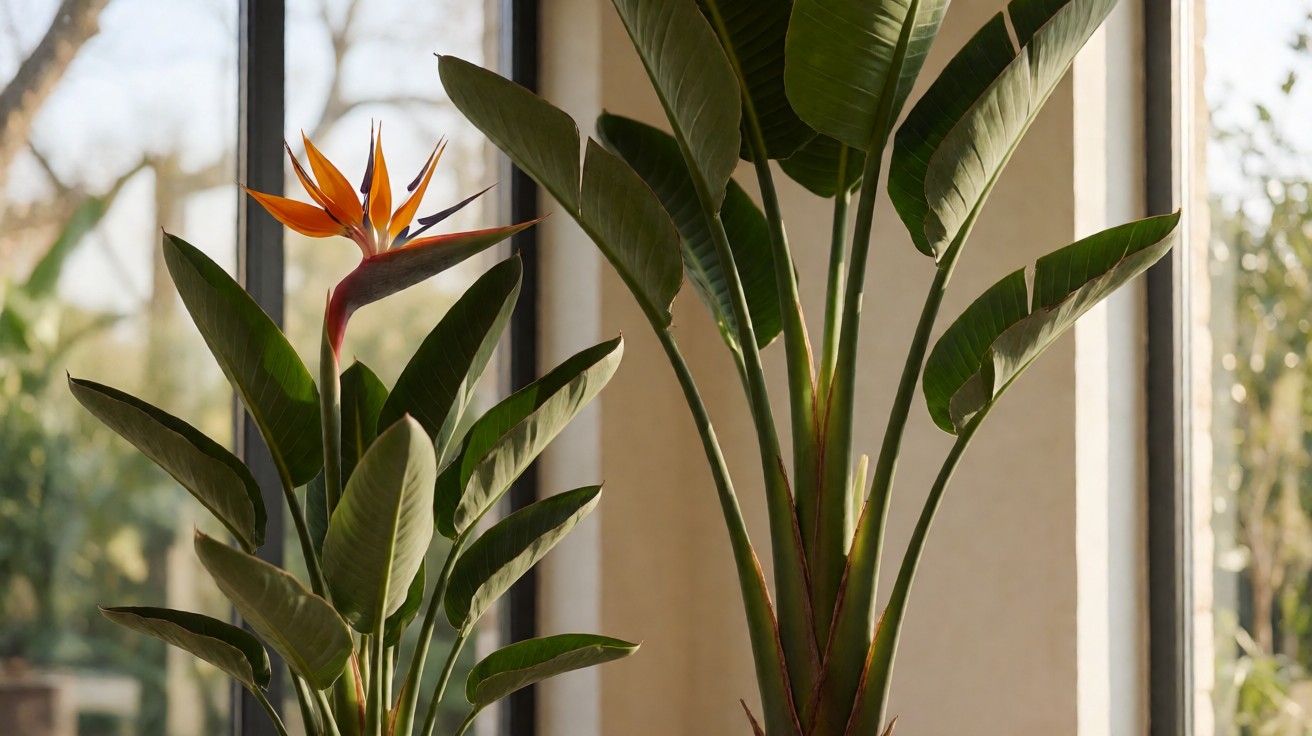

Two plants share the common name “bird of paradise” in the houseplant trade, and they are not the same plant. Strelitzia reginae and Strelitzia nicolai are sibling species in the family Strelitziaceae, both native to South Africa, both named for royal patrons of the 18th and 19th century botanical world, and both capable of growing indoors in a container. Beyond those shared facts, the plants diverge sharply. One stays compact, flowers in 4 to 5 years with the iconic orange and blue crane-like bloom, and tops out at 6 feet in a container. The other grows to 30 feet in the ground, pushes its leaves toward the ceiling, and produces a white and dark blue flower only on specimens that are 8 to 10 years old or older. Choosing between them is not a matter of preference. It is a matter of ceiling height, container space, patience, and what you actually want the plant to do in the room.
Two failure modes follow from getting the choice wrong. The first is the apartment dweller who bought a juvenile S. nicolai thinking it would stay tabletop-sized, and is now watching it hit the ceiling in three years. The second is the homeowner with a sunny conservatory who planted S. reginae in a 14-inch pot expecting a 6-foot architectural specimen, and is wondering why it has not done anything dramatic in five years. Both plants are doing exactly what their biology dictates. The mismatch is in the choice, not in the plant.
What most growers miss when choosing between the two is that they are not really choosing between plants. They are choosing between two different relationships with a plant. One is a long-lived flowering houseplant that behaves like a feature specimen. The other is a foliage sculpture that grows into a structural element of the room. The plant follows the relationship.
Two Indoor Birds, Not One
The bird of paradise genus Strelitzia contains five recognized species, of which two dominate the indoor plant trade. Strelitzia reginae, the smaller of the two, was the first to enter European cultivation in 1773, brought to the Royal Botanic Gardens at Kew by the botanist Francis Masson. Strelitzia nicolai followed in the 19th century and was named in honor of Tsar Nicholas I of Russia, who was the patron of the botanical garden where the species was first formally described. Both species are evergreen perennials native to coastal and sub-coastal regions of South Africa, and both belong to the family Strelitziaceae, a small family within the order Zingiberales that also includes the banana family.
The visible difference between juvenile specimens is small. Both species produce paddle-shaped leaves on long petioles emerging from a basal clump. Both have a similar root structure, a rhizomatous crown that expands slowly and produces new growth points over time. The plants look alike in a 6-inch nursery pot, and that is the source of most of the confusion in the trade. A juvenile S. nicolai and a juvenile S. reginae of similar size are difficult to tell apart at a glance. The differences emerge as the plants mature, and by the time the differences are obvious, the grower has already chosen the wrong plant for the space.
The way to tell them apart in the nursery is to look at two features. First, the leaf base: S. nicolai develops a distinct leaf sheath that wraps tightly around the stem at the petiole base, forming a visible fan-like structure as the plant matures. S. reginae lacks this sheath structure and the leaves emerge more individually from the crown. Second, the leaf color: S. nicolai leaves are a slightly grayer green with a more matte surface, while S. reginae leaves are a deeper, glossier green. The differences are subtle on a juvenile plant but reliable on a mature one. If you can, ask the nursery which species it actually is. If they cannot tell you, assume the largest specimens are likely S. nicolai and the smaller, more compact specimens are likely S. reginae.
For a quick reference, the general indoor bird of paradise guide covers the care fundamentals that apply to both species, with specific notes where the two diverge. The two species are close enough that most care practices apply to both, but the differences in mature size and flowering behavior mean that the choice of species is the first decision, and the care follows from that.
The Mechanism: Growth Habit, Leaf Shape, and Flowering Biology
The growth habit of Strelitzia reginae is a tight, clumping perennial that produces leaves in a fan-like arrangement from a central crown. The rhizome expands slowly outward, and new growth points emerge from the edges of the expanding clump. In a container, the rhizome is constrained by the pot wall, which limits the eventual size of the clump. A mature S. reginae in a 14 to 18 inch container reaches 3 to 6 feet in height with a 3 to 4 foot spread, and the leaves are typically 12 to 18 inches long and 4 to 6 inches wide. The petioles are slender, often 18 to 24 inches long, and the overall effect is a graceful, fountain-like clump rather than a single-stemmed tree.
Strelitzia nicolai is a different architecture. The plant produces a thick, woody stem from a basal crown, and the leaves emerge in a fan arrangement along the upper portion of the stem. As the plant matures, the lower leaves drop off, leaving the characteristic bare trunk with a tuft of leaves at the top, very much resembling a small banana plant. In the ground in a frost-free climate, the trunk can reach 30 feet. In a container, the trunk is constrained and the plant typically reaches 8 to 15 feet at maturity, with leaves 3 to 5 feet long and 12 to 18 inches wide. The petioles are thick and channeled, and the leaf blade is more elongated and paddle-shaped than S. reginae‘s more compact blade.
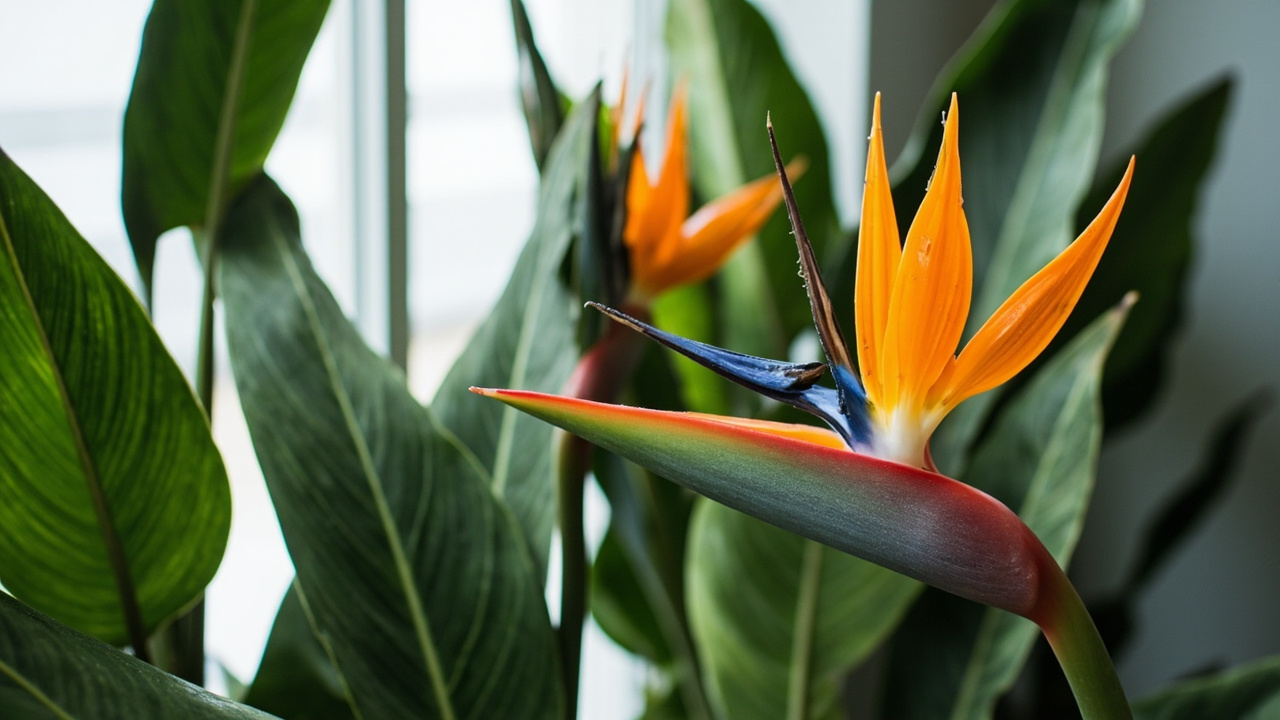
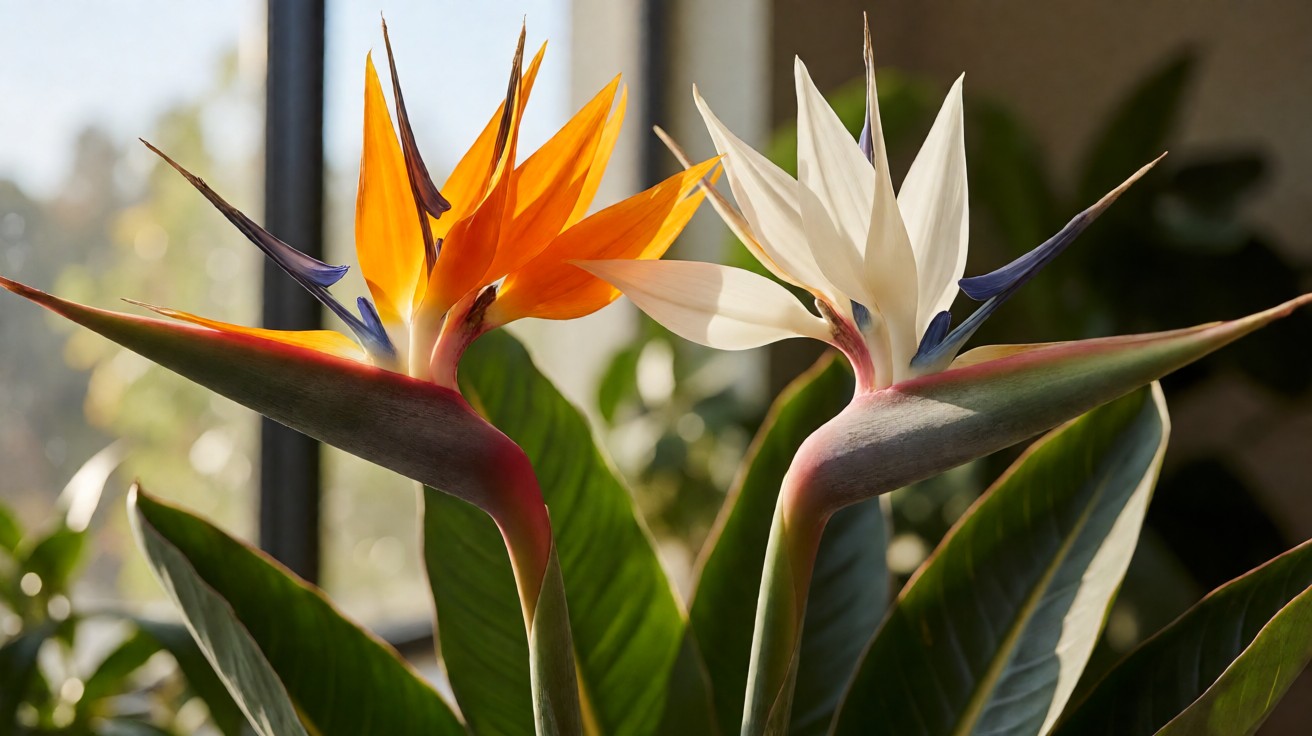
The flowering biology of the two species reflects their different evolutionary pressures. S. reginae is pollinated in the wild by sunbirds, which perch on the beak-like bract and access the nectar. The bloom is a horizontal orange and blue structure that emerges from a green and pink bract at the leaf base, and a mature, well-grown plant can flower multiple times per year once it reaches flowering age, typically 4 to 5 years from seed. S. nicolai is also pollinated by sunbirds, but its larger white and dark blue flowers emerge from a purple-grey bract on a shorter stalk and stand more upright. Critically, S. nicolai in a container almost never flowers indoors, and when it does, the plant is typically 8 to 10 years old or older, and the conditions are unusually good. Plan on S. nicolai being a foliage plant indoors, not a flowering one.
The native ranges of the two species overlap but are not identical. Strelitzia reginae is native primarily to the Eastern Cape and KwaZulu-Natal provinces of South Africa, in coastal scrub and along forest margins, and is adapted to drier conditions and more direct sun. Strelitzia nicolai is native to a broader coastal belt from the Eastern Cape through KwaZulu-Natal into Mozambique, often in more sheltered positions along riverbanks and at forest edges, and tolerates more shade than S. reginae. The two species can hybridize, and named hybrids exist in the trade, though most commercially sold plants are true species.
Side-by-Side Comparison
The practical differences between the two species, when you are choosing one for a specific indoor space, come down to a handful of measurable variables. The table below summarizes them. Note that mature size and flowering age assume typical indoor container culture with reasonable care. Plants grown in the ground in a frost-free climate reach substantially larger sizes.
| Feature | Strelitzia reginae | Strelitzia nicolai |
|---|---|---|
| Mature indoor height | 3 to 6 feet | 8 to 15 feet |
| Mature leaf size | 12 to 18 in long, 4 to 6 in wide | 3 to 5 ft long, 12 to 18 in wide |
| Growth form | Clumping perennial, no trunk | Single trunk with crown of leaves at top |
| Flowering age (from seed) | 4 to 5 years | 8 to 10 years |
| Bloom color | Orange and blue | White and dark blue |
| Indoor flowering likelihood | Moderate, with good light and maturity | Low, even with good care |
| Light requirement | High; tolerates direct sun | High; tolerates bright indirect better than direct sun |
| Container size at maturity | 14 to 18 in diameter | 18 to 24 in diameter |
| Native range | Eastern Cape, KwaZulu-Natal, South Africa | Eastern Cape through coastal Mozambique |
| Best indoor use | Feature specimen, flowering houseplant | Foliage sculpture, architectural anchor |
The two columns tell different stories. S. reginae is the species for a flowering houseplant, with a reasonable mature size, a real chance of blooms on a mature plant, and the iconic orange and blue flower that gave the genus its common name. S. nicolai is the species for a foliage statement, with architectural presence but a flowering payoff that almost never materializes indoors. Both are legitimate choices. They are not interchangeable.
What Actually Works for Each Species
For Strelitzia reginae indoors: the goal is a flowering plant at maturity, and that requires a south-facing window with at least 6 hours of direct sun or a strong full-spectrum grow light on a 12-hour timer. Water when the top 2 inches of soil are dry, and let the plant experience a slight dry-back between waterings. Fertilize at half-strength with a balanced 3-1-2 ratio every other watering during the active growing season, and stop feeding through the winter. A pot-bound root system actually favors flowering in S. reginae, so resist the urge to up-pot until the roots are clearly pressing hard against the pot wall, typically every 2 to 3 years. The bird of paradise not flowering guide covers the most common reasons a mature S. reginae fails to bloom indoors, which is almost always a light issue rather than a feeding or watering issue.
For Strelitzia nicolai indoors: the goal is a healthy foliage plant, and the care is similar but with a stronger emphasis on humidity and a more relaxed attitude toward flowering. The bigger leaves transpire more water, so the plant will drink more, but the same rule applies: water when the top 2 inches of soil are dry. The bigger container dries out more slowly, so be careful not to overwater. Light requirements are slightly lower than S. reginae on a direct-sun basis but the plant still needs a very bright position, ideally within 2 to 3 feet of a south or east-facing window. Fertilize at half-strength during the growing season, but do not push the feeding in hopes of triggering a bloom, because S. nicolai indoors is essentially a foliage plant. The leaves are the point.
For both species, the soil and repotting guide covers the substrate and container choices that work for Strelitzia in general, and the houseplant types guide places bird of paradise in the broader context of large foliage houseplants if you are still deciding whether either species is the right plant for your space.
Which One to Choose If You Only Have Room for One
If you are choosing between the two species for a single indoor plant, the decision is straightforward. Choose Strelitzia reginae if you have a south-facing window with at least 6 hours of direct sun, a container space of about 18 inches in diameter, and you want the iconic orange and blue bloom. With adequate light and a mature plant, the flowers will come. Choose Strelitzia nicolai if you have a bright position that is not directly in front of a south-facing window, ceiling height of at least 10 feet, and you want a foliage anchor that grows into the room rather than a flowering feature. The bloom is unlikely but the architecture is worth it.
Choose neither if your indoor light is genuinely low. A north-facing room with no supplemental lighting will not sustain either species long-term, and you are better off with a plant that evolved in the understory of a forest, like Aspidistra elatior or Aglaonema species, rather than a sun-adapted South African coastal plant. For an overview of which large foliage plants tolerate lower indoor light, the east-facing window plant guide covers the options for bright-but-not-direct indoor positions.
Whichever species you bring home, the first year is the settling-in year. The plant is establishing its root system in your specific microclimate, and growth above ground is often slow while the roots develop below. By year two, you should see noticeably faster leaf production, and by year three, the plant will tell you whether the species is the right one for your space. The leaves are the answer. Watch them, and trust what they show you.
Turn That PDF Into a Spreadsheet in Minutes
You've seen how to do it manually — now let the tool handle the heavy lifting. Upload your bank statement and get Excel, CSV, or QBO in a few clicks.
Try It Free