
Most people walk into a nursery, see a wall of green, and grab the plant with the prettiest leaf. Two weeks later it is yellowing. Three weeks later it is dead.
The plant was not the problem. The decision before the plant was the problem.
Picking a houseplant without knowing which type of houseplant matches your light, your room, and your houseplant care routine is the single biggest reason indoor plants fail at home.
There are thousands of indoor plant species. You will never memorize them. You do not need to.
Every houseplant you will ever consider falls into one of eight categories, and those categories are decided by six facts about the space you actually live in: sunlight, room humidity, pet access, watering habit, soil drainage, and care demand.
Once you can name your category, the plant choice gets obvious.
That is the whole job of this houseplant types guide: turn the wall of green into a short list of plants that can survive your specific window, your pets, and your habit of forgetting to water.
This is indoor plant care at the category level, not the species level.
Why Category-First Beats Plant-First
Plant-first shopping treats every indoor plant like a separate decision. It is not.
A pothos and a heart-leaf philodendron are the same plant in different branding, because both are trailing tropical foliage vines that want bright indirect light and a drink when the top inch of soil dries out.
A snake plant and a ZZ plant are the same plant in different environment, because both are rhizome-rooted succulents that store water in their leaves and tolerate weeks of neglect.
They share the same watering tolerance, the same drainage need, the same humidity tolerance, the same light range.
Category-first shopping asks the room first. What direction does the window face. How many hours of direct sun actually hit the leaves. Is there a cat that chews. How often do you realistically water.
Once those facts are answered, the right category usually names itself. The plant becomes a footnote. Diagnosis gets faster too, because yellow leaves, brown tips, leaf drop, and root rot all point back to a category mismatch long before they point to a species problem.
This is also why our indoor houseplants guide opens with a diagnostic framework instead of a plant list.
Same reason. The category decides whether a species will live or die in your room, not the other way around. The category also tells you when you have a watering schedule mismatch, when humidity is too low for the species, and when your soil moisture is sitting too wet for too long.
Diagnose the category once, and most plant care problems stop before they start.
Light-Driven Categories
Light is the first gate. Get this wrong and nothing else saves the plant.
Indoor light is measured in hours of usable sun on the leaves, not in how bright the window looks from the couch. A north-facing window in a basement apartment gives you low light. An unobstructed south-facing window in a high-rise gives you bright direct sun. The two rooms house different categories.
Low light houseplants are species that evolved under rainforest canopy, where sun reaches leaves only as dappled flecks. Pothos, snake plant, ZZ plant, philodendron heart-leaf, and cast iron plant dominate this category.
They photosynthesize at one tenth the rate of a tomato. They also live longest of any houseplant because they are not stressed by dim rooms.
In low light the soil moisture stays high for weeks, so overwatering becomes the dominant risk and a drainage hole at the bottom of the pot is the cheapest insurance you can buy.
See our full low light houseplant roundup for the species list, and pair it with our diagnostic guide to spot the drainage and overwatering problems that hit this band most often.
Medium light houseplants handle east-facing windows and rooms with one or two hours of direct morning sun. Pothos climbs here, peace lily flowers here, and most foliage tropicals are happier here than people realize. Humidity tends to sit in a friendly mid-range in medium light rooms, which is why beginners do best with this band.
Bright indirect houseplants are the divas. They want a south or west window with a sheer curtain, or a spot four to six feet from a sunny window. Monsteras, fiddle leaf figs, rubber plants, calatheas, and prayer plants live in this category. Direct sun burns their leaves in an afternoon. Humidity below forty percent turns leaf edges brown within a week, which is why most brown tips on a calathea start at the edges and not the center.
Direct sun houseplants are desert and savanna species. Cacti, succulents, jade, and most herbs need four or more hours of direct sun on the leaves. A north window kills them in a month. A south window with no curtain keeps them alive for decades. Their soil needs to dry out fast, which is why a well-draining soil with perlite, vermiculite, and coarse sand matters more than the species label.
For specifics on species that survive dim apartments, our low light houseplant list ranks the top fifteen by survival rate and drainage tolerance.
If your apartment has zero direct sun, a grow light on a six-hour timer bridges the gap.
Pet-Safe Categories
If a dog or cat shares the room, the second gate opens. Many popular houseplants are toxic to pets. Pothos, philodendron, dieffenbachia, and most true lilies cause oral burning, vomiting, or kidney failure in cats and dogs.
The ASPCA maintains a public database of toxic and non-toxic species. Treat it as the source of truth, not the plant label at the nursery.
Pet-safe houseplants that survive dim rooms are a smaller list than most people think.
The reliable ones are spider plant, Boston fern, parlor palm, calathea, prayer plant, peperomia, and African violet. All confirmed non-toxic to dogs and cats by the ASPCA. None of them are indestructible or low-maintenance under low light, so a drainage hole and a sensible watering schedule matter more in this band because there is no margin for error.
Spider mite and mealybug outbreaks hit this category first because dry indoor air and a low transpiration rate make the leaves an easy target.
Pet-safe houseplants for sunny rooms add succulents like echeveria and haworthia, plus herbs such as basil and rosemary.
Pet-safe is a hard filter, not a soft preference. A cat will chew the leaves regardless of species, and a dog will dig in low-drainage soil and tip the pot.
Pick species from the ASPCA non-toxic list, then apply the rest of this care guide to keep them alive. If a pest outbreak hits, neem oil and insecticidal soap are the two safest pet-safe treatments for scale and whitefly.
The full breakdown lives in our pet-safe low light houseplant guide, which cross-references the ASPCA database by species and growth habit.
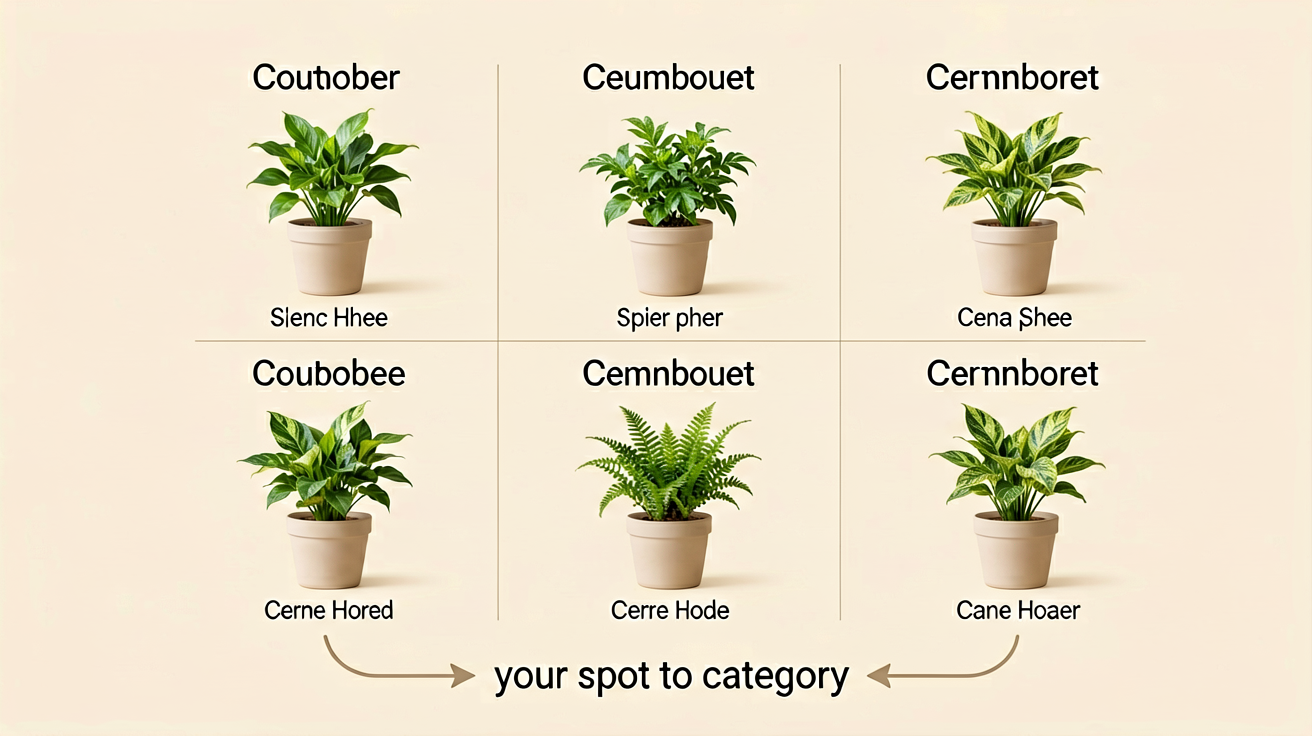
Care-Demand Categories
Care demand is the third gate, and it is the gate most people lie to themselves at.
The honest question is not how often do you intend to water. It is how often do you actually water when life is busy, when you travel, when the season turns. Pick the category that matches the real version of you.
Beginner houseplants survive a two-week vacation and a forgetful owner. Snake plant, ZZ plant, pothos, cast iron plant, and succulent jade are the headline five. They tolerate dry soil, low humidity, and irregular light. A beginner houseplant is not a lesser plant.
It is a plant with a wider survival margin for missed waterings, for soil that stays too wet, for low humidity in winter, and for the occasional fungus gnat outbreak.
Easy houseplants want weekly attention but forgive a missed week. Spider plant, philodendron heart-leaf, rubber plant, dracaena, and peace lily fit here. They show brown tips fast when humidity drops or when mineral buildup in the soil stops nutrient uptake, but a trim and a flush of the soil resets them in a month. A nitrogen deficiency shows as pale new growth first, so a monthly NPK feed keeps the canopy green without forcing a re-pot.
Intermediate houseplants need consistent watering, filtered water, and a steady spot. Calathea, fiddle leaf fig, and most ferns live in this band. They punish inconsistency with brown leaf edges within days.
They also show yellow leaves the moment nitrogen or potassium runs short, which is why a monthly feed with a balanced NPK fertilizer keeps them out of nutrient deficiency. A phosphorus deficit shows as stretching and leggy growth as the plant reaches for sunlight, and chlorosis on the leaf edges tells you iron is short.
Advanced houseplants are the orchids, bonsai, carnivorous plants, and variegated monstera albos. They need humidity trays, scheduled fertilizing, and tight watering windows.
They are worth growing once the easy category is boring. They are not worth growing first.
Our beginner houseplant list ranks the top ten by how forgiving each one is when life gets in the way.
Pair it with the broader framework in our indoor plant humidity guide to set a routine that holds even when travel interrupts the rhythm.
Room-Type Categories
Room type is the fourth gate, and it is the one most guides skip. A bathroom is a different climate than a living room. A bedroom tolerates different plants than a kitchen. Match the category to the room before you match the plant to the category.
Bedroom houseplants want low light, low pollen, and low scent. Snake plant and pothos clean air quietly and release oxygen at night according to the NASA clean air study, though the practical oxygen claim is small. Peace lily adds white flowers without heavy pollen. Bedroom air tends to sit dry in winter, so humidity-loving species show leaf curl and brown leaf edges within weeks.
Pair the humidity-tolerant species with a routine that holds steady. Our indoor plant watering schedule covers how to keep soil moisture in range without daily checks.
Bathroom houseplants love the humidity from showers. Ferns, calathea, prayer plant, and pothos thrive here. A bathroom with no window still keeps these alive because the humidity does the work that misting tries to fake. Drainage still matters even in high humidity, because transpiration slows and the soil moisture lingers.
Office houseplants survive fluorescent light, dry air from a heater vent, and weekends without care. ZZ plant, snake plant, and cast iron plant own this category. They tolerate dry indoor air, irregular watering, and a forgotten office desk. If your cubicle measures under one hundred foot-candles, even the easy species show etiolation within a month. Pick a snake plant and place it two feet from a fluorescent panel.
Kitchen houseplants need to handle cooking steam, grease, and bright spots by the sink. Herbs such as basil, rosemary, thyme, and mint are the practical pick. Decorative picks are pothos on a high shelf and spider plant in a hanging basket. A drainage hole and a saucer are non-negotiable here because kitchen soil dries unevenly.
Living room houseplants are the show plants. Fiddle leaf fig, monstera deliciosa, rubber plant, and bird of paradise. They want bright indirect light and room to grow. They reward a routine.
The full light breakdown sits in our indoor plant light guide, which pairs living room window direction with the species that thrive in it across the four indoor light bands.
Growth-Habit Categories
Growth habit decides how the plant sits in the room. A trailing pothos wants a shelf or a hanging basket. A tree-form fiddle leaf fig wants floor space. A fern wants a pedestal. Match the habit to the spot before you fall in love with the leaf.
Foliage houseplants are grown for leaves, not flowers. They live longest indoors because flowers take energy. Philodendron, pothos, monstera, calathea, and rubber plant dominate this category. Foliage plants spend less energy on blooms, which means they have a wider margin for missed watering and lower humidity, and they show nutrient deficiency slower than flowering types.
Flowering houseplants are grown for blooms. African violet, peace lily, anthurium, orchid, and kalanchoe flower indoors with the right light. They need more feeding and slightly tighter watering than foliage types. Phosphorus drives the bloom cycle, so a higher phosphorus NPK during the bloom window keeps flowers coming back. Without enough sunlight, the plant stretches toward the window, the internode stretches, and the lateral branch count drops, which is why bloom volume collapses.
Our schedule covers how flowering versus foliage types differ week by week across the four care-demand bands.
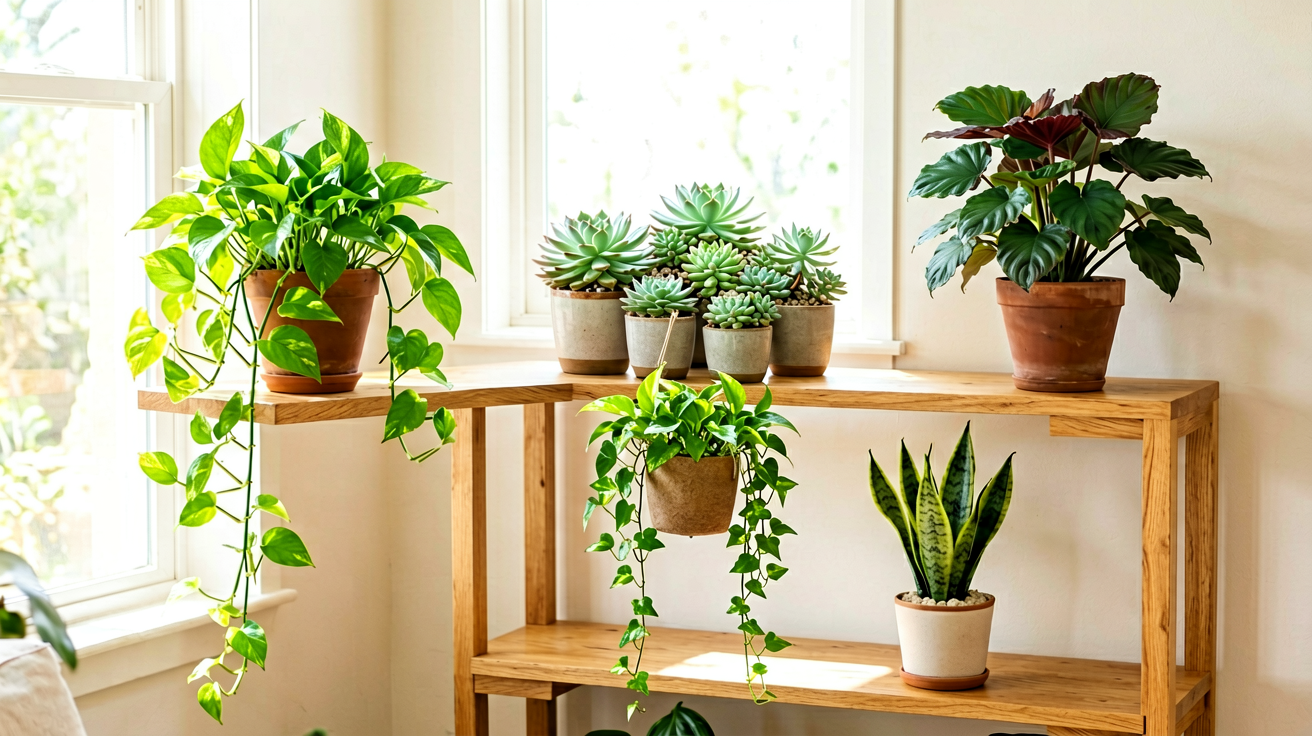
Trailing and hanging houseplants are vining species that drape. Pothos, philodendron heart-leaf, string of pearls, string of hearts, and ivy live here. They want a tall pot, a hanging basket, or a shelf edge. Their stems root at the node when they touch soil, which is why propagation by stem cutting is the fastest way to multiply them. Peat-heavy indoor potting mix holds enough moisture for node rooting without rotting the stem.
Tree-form houseplants are the floor plants. Fiddle leaf fig, rubber plant, dracaena, schefflera, and money tree grow a single trunk with a canopy above. They want floor space and bright indirect light. They drop lower leaves the moment humidity drops or nitrogen runs short, which is why a monthly nitrogen feed keeps the canopy full. Pinching the apical bud in spring forces a lateral branch to take over and thickens the canopy, which is how nursery trees get their full shape.
Succulent and cactus houseplants are the dry-climate specialists. They want gritty soil, terracotta pots, and direct sun. The full light and water breakdown sits in our light guide, which pairs growth habit with light window across the four indoor light bands. Terracotta is the default pot for this band because it pulls moisture out of the soil through the wall, which is exactly what succulents need.
Fern houseplants are the humidity specialists. Boston fern, maidenhair fern, and bird’s nest fern want a humid room and consistently moist soil. They fail fast in dry apartments without a humidity tray. Their root systems are shallow and root-bound fast, so repot every two years in fresh peat-based indoor potting mix.
Climate-Tolerance Categories
Climate tolerance is the sixth gate. It separates plants that handle drafts, dry winter air, and summer AC from plants that drop leaves the moment the heating turns on. This is the gate that decides whether a plant survives its first winter in your home.
Humidity-loving houseplants need a steamy room or a humidity tray. Ferns, calathea, prayer plant, and most tropical foliage plants live here. They brown at the edges when humidity drops below forty percent, which is most US homes in winter. A cheap humidifier and a weekly pebble tray keep relative humidity above the threshold without overwatering the soil.
Drought-tolerant houseplants store water in their leaves, stems, or roots. Cacti, succulents, snake plant, ZZ plant, and ponytail palm live here. They survive a missed watering for two to four weeks.
The full symptom-to-cause map sits in our indoor plant yellow leaves guide, which also explains when yellow leaves mean too much water, not too little.
Overwatering kills these species faster than underwatering, so a drainage hole and a fast-draining indoor potting mix are the safety net. Root rot is the common cause of death, not underwatering, and it shows up first as soft yellow leaves near the soil line.
Cold-sensitive houseplants want a steady room temperature above sixty degrees Fahrenheit with no draft. Most tropicals including pothos, philodendron, calathea, and peace lily fall here. A window in winter is the common killer, not the cold room itself. Pull them two feet back from the glass in January and the leaf drop stops.
Draft-tolerant houseplants handle the air currents from open windows, AC vents, and doorways. Snake plant, ZZ plant, jade, and most succulents shrug off drafts. They are the species for the spot by the front door or under the AC vent. Their tolerance for dry air also makes them the species to keep on a sunny office desk where humidity sits below thirty percent year-round.
How to Use This Houseplants Map
The eight categories above are not a checklist to fill out in order. They are a decision tree.
The first question is the room. The second is the light. The third is the pet. The fourth is the care habit.
By the time you have answered those four honestly, the right category has narrowed itself to one or two of the eight. The plant choice is now a five-minute task instead of a two-hour nursery walk.
The single most useful question to ask before buying any houseplant is this: which of the eight categories above does my room actually fit. Not the category I wish it fit. Not the category the nursery sells.
The real one.
A plant bought for the wrong category will struggle with humidity, watering, soil moisture, drainage, light, or pet safety before you ever see new growth.
A plant bought for the right category will quietly thrive for years. The category is the decision. The plant is the decoration.
One last important check: if your spot combines two or more of the categories above (for example, a north-facing bedroom with a cat, or a low-light office desk with no weekend attention), read the deep guide for the harder category first.
A pet-safe pick that also tolerates low light is rarer than a low-light pick alone, so start there. The pet-safe guides cross-link the light, humidity, watering schedule, and fertilizer guides so you only need one bookmark.
For problems after the plant is home (yellow leaves, brown tips, leaf curl, root rot, leggy stretching, leaf drop, or pest sightings like mealybug, spider mite, or fungus gnat), the troubleshooting guides in the indoor houseplants guide map symptom to cause to fix.
Most problems trace back to one of three things: wrong light range, wrong watering rhythm, or wrong soil drainage.
The category system you just read gives you the first two; the indoor plant watering schedule guide gives you the third.
Turn PDF Bank Statements Into Workable Spreadsheets
Your bank statement is a mess of numbers, but your books shouldn't be. Use our converter to get Excel, CSV, or QBO files — ready for QuickBooks.
Try It Free Now